Asahikawa Science Museum with Kids: A Floor Built to Be Touched.

A science museum built for hands, from a pedal-powered windmill to a bubble you can stand inside, with one room that will not let a late child in.
From October 1, 2026; junior high and under free. With the planetarium, ¥770 and ¥500. Entry cannot be booked ahead.
Closed Mondays, one other weekday late in most months, and December 30 to January 4 (January 2 open).
Built around one planetarium program of 20, 35 or 40 minutes.
A 20-minute preschool planetarium program; Moon Jump and the Space Top need 110 cm.
Lockers and a separate baby corner beside the rest corner.
Some links on this page are affiliate links. LuNi may earn a commission at no extra cost to you.
Is the Asahikawa Science Museum worth it with kids?
The short version, before the costs, the timings and the case for each child.
Yes, and it is the easiest indoor visit in Asahikawa to get right. The exhibit floor is made to be handled: children pedal a bike to turn a windmill, step inside a giant bubble and play soccer with a laser, mirrors and prisms, and junior high students and younger get in free. It asks two things of a parent. Check the calendar, because the museum closes on Mondays and on one more weekday near the end of most months. And if the planetarium is on the plan, choose the program at home and let the rest of the visit follow it. Take the bus from the station rather than walking the whole way. With those two settled, the visit runs itself, and the rest corner is on the same floor for the pauses.
Planning Your Visit to the Asahikawa Science Museum with Kids.
Three decisions shape the visit, and none of them is hard. The first is the day: the museum keeps a monthly closing day that moves, so look at the month’s calendar before promising the visit to anyone. The second is the planetarium. Its programs run from twenty to forty minutes, one of them made for preschoolers, so choose the program first, with the youngest child’s attention in mind, and fit the exhibit floor around it. The third is the approach, where Japan’s buses and trains earn their keep: the walk from JR Asahikawa is long for small legs, and the city bus from the station front takes about five minutes, so the bus saves the legs for the exhibits, where they are needed far more.
Every LuNi attraction guide starts with a visit, with our own children
LuNi rates and writes about attractions only after visiting them with children. Luca and Nico were at the Asahikawa Science Museum, and what they did there is recorded further down this page, including how each child actually met it.
Children arrive with different tolerances: for noise, for lines, for standing still, for being on their feet all day. A guide written for the average of them helps almost nobody. So every place on this site is read four ways, and each verdict says which children it already suits and what makes it work for the rest. Whoever you are bringing, the answer here is built for your family rather than for a general reader.
Restricted-movement depletion stays low on a floor built to be handled, pedaled and stepped into, so let the child run the Earth corner first.
Sensory-input depletion stays manageable because the dark passage, the quake station and the illusion room are single stops, so choose them rather than meet them.
Unfamiliarity and unconfirmed structure ease when the calendar, the planetarium start and the height limits are checked ahead, so settle those three before leaving.
Sustained walking and standing stay low when the bus replaces the long walk and every exhibit corner sits on one floor, so take the bus.
Hotels we would book for this visit.
Three Asahikawa hotels, each a base for a stay of several days; the museum is five minutes by city bus from JR Asahikawa, so the bus matters more than the base.
| Property | The LuNi Reason |
|---|---|
| LUNI Pick OMO7 Asahikawa by Hoshino Resorts | OMO7 Asahikawa is for a family giving Asahikawa a few days with the museum on one of them. The museum bus leaves from stand 27 at the station front and takes about five minutes, so the morning is short work, and the day can go to the exhibit floor and one planetarium program. |
| ART HOTEL Asahikawa | ART HOTEL Asahikawa is for a family making Sci-Pal one stop in a week of Asahikawa days, since the museum bus, the zoo bus and the Ueno Farm bus all start near Asahikawa Station. One base for the week means the same walk to the buses every morning. |
| JR INN Asahikawa | JR INN Asahikawa stands at the station front, where the museum bus starts, which makes it the simplest base for a family of three: its large twin rooms take three, and one preschooler per adult may share a bed. A family of four books two rooms, and still begins each museum morning at the station. |
OMO7 Asahikawa by Hoshino Resorts
Nearby attractions, matched to your child.
Three Asahikawa-area visits that answer what an indoor floor cannot: a hillside of animals for a child who needs to move, a garden in open air for a child who needs quiet, and a flower park with one fixed ride.
| Pairing | Why This Solves the After-Visit | For Your |
|---|---|---|
| LUNI Pick Asahiyama Zoo Bus from JR Asahikawa, about 40 minutes | After a floor of stations, Asahiyama Zoo gives a Dynamo a mountainside of animal houses to move between, taken counterclockwise from any gate. Restricted movement is not the risk there. A Sprinter’s walking and standing are, so use the free shuttle from the East Gate. | Dynamo |
| Ueno Farm Nagayama: seasonal bus, late April to mid-October | In summer, Ueno Farm is a garden with a gnome path and a small hill behind it, open until October 18. Sensory-input depletion from a morning of bubbles, lasers and quake stations eases outdoors, with a view around the basin from the summit to aim for. | Sensor |
| Shikisai-no-oka Biei: Bibaushi Station, 25 minutes’ walk | At Shikisai-no-oka the tractor bus runs a fixed fifteen-minute circuit of the park and keeps running in rain. Unfamiliarity and unconfirmed structure ease when the whole ride can be told before boarding: what it costs, how long it lasts and where it goes. | Anchor |
Asahiyama Zoo
Bus from JR Asahikawa, about 40 minutes For YourDynamo
Ueno Farm
Nagayama: seasonal bus, late April to mid-October For YourSensor
Shikisai-no-oka
Biei: Bibaushi Station, 25 minutes’ walk For YourAnchor
How two children actually met this attraction.
Two opposite children spent the same visit in Sci-Pal, and the building held both of them, which says more about it than any exhibit list. One treated each station as an experiment, reading first and then running it again with one thing changed. The other treated the whole floor as equipment, pressing and spinning everything within reach and talking the entire time. A museum that holds both of those children is rare, and the reason it works is worth knowing before arriving: the exhibits reward a second try as much as a first, so the careful child and the fast one each find their own way through. Plan for the repeats, and plan the exit, because for the careful child leaving is the hard part here.
Luca treated Sci-Pal as the ideal building. He worked the hands-on physics and space exhibits methodically, one at a time, and read every explanatory panel in full before moving on, unwilling to leave a station until he understood why it did what it did. When a demonstration produced a result he had not predicted, he ran it again, adjusting one thing each time to see what changed. By the end he had to be pulled out rather than coaxed on.
This is the Anchor pattern, in a child who needs to know why before he can enjoy what. A child whose Reserve depletes through unfamiliarity and unconfirmed structure settles once a thing behaves the same way twice, and running a demonstration again is exactly that check. Families with a similar child should let one corner be finished properly rather than every corner sampled, and leave time for the repeats, because the second and third runs are where this child relaxes, not where he stalls.
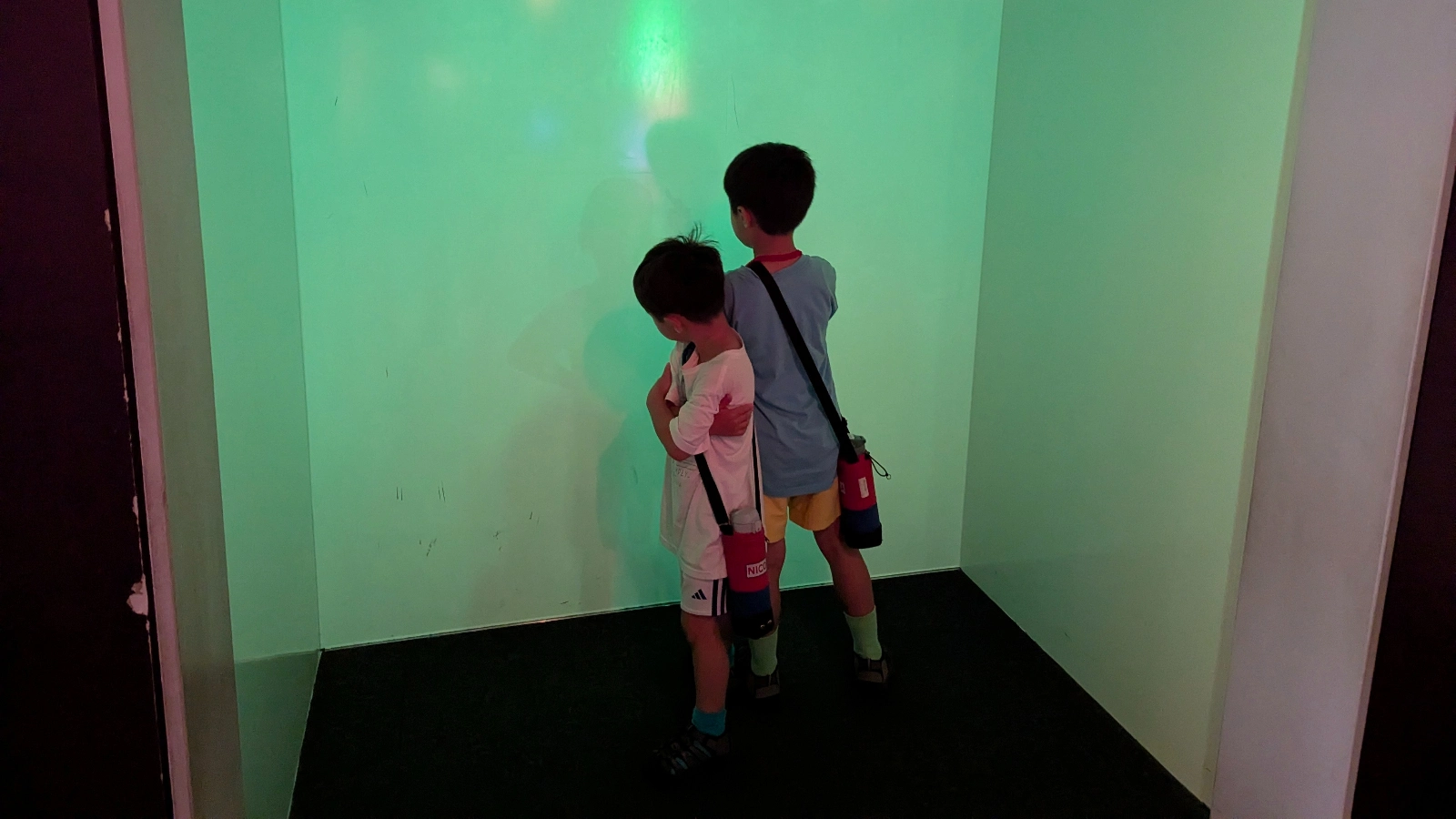
Nico ran the floor rather than read it. He pressed, pulled, and spun every interactive he could reach, moving on the instant a station had given up its trick, and at one point invented a use for an exhibit that its designers plainly never considered. He narrated the whole visit out loud as he went, and the stations that held him longest were the ones that let him do something with his body instead of watching a screen.
This is the Dynamo pattern. A child whose Reserve depletes through restricted movement was refilling, not spending, as he pressed and spun his way around the floor, and the stations that held him were the ones that used his body. Families with a similar child should start where the exhibits are physical, with the pedal windmill, the giant bubble and the laser soccer, and hold the planetarium until the handling has run its course, since the dome asks for stillness from the first minute.
A science museum that asks a child to pedal, push and stand inside a bubble turns abstract ideas into something felt. Children understand wind, light and motion best when their own bodies make them happen, and a hands-on floor lets them test, fail and try again with nobody keeping score. The planetarium’s darkness adds a different lesson: that some wonders ask for stillness. A day that moves between doing and quietly watching teaches a child that curiosity has more than one pace, and that both are worth learning.
The LUNI Rating for the Asahikawa Science Museum.
One fact runs under all four verdicts: this is a single floor of exhibits made to be used, with the planetarium as the part that runs to a clock. That is why every child does well here. The child who needs to move has stations that move them; the child sensitive to input can choose which intense stops to meet; the child who needs structure gets plain rules and stated height limits; and the child whose legs tire first has one floor and a five-minute bus, a combination rarer among Japan’s big attractions for children than it should be, and the reason this museum belongs early in a trip.
Start where the exhibits move. The Dynamo depletes through restricted movement, and the Sci-Pal exhibit floor is built for the opposite. In the Earth corner a child pedals a bike to turn a windmill, sends balls down a coaster, steps inside a giant bubble and plays soccer with a laser, mirrors and prisms. The Space Corner adds Moon Jump and the Space Top, a spinning astronaut-training rig, but both need a child of at least 110 centimeters and 20 kilograms, so a younger Dynamo will watch those two rather than ride them.
Order is everything for this child. Begin in the Earth corner, where the stations are physical, and let the child run it twice before anything else. Move to the Space Corner with an older child, or with a younger one who has been told in advance that two of the rigs are for bigger bodies. Keep the planetarium for after the handling, when sitting still in the dark feels like a rest rather than a demand, and the day ends on the calm note rather than the restless one.
What this means for your Dynamo: restricted movement has a floor to spend itself on. A younger Dynamo needs the pedals, the bubble and the laser soccer; an older one can add Moon Jump and the Space Top once measured.Choose the intense stops; do not stumble into them. The Sensor depletes through sensory input, and the stations that test the senses at Sci-Pal are ones a family chooses to step into: a dark passage walked by touch, an earthquake experience, a room built on the gap between what the eyes see and what the body feels, and three booths of sound illusions. The avalanche exhibit is a model shown on a monitor, not a ride. They are four stations a family can choose between, and that choice is what keeps the load manageable.
Preview first, then let the child pick. Tell the child what each of those stations does before arriving, let them decide which to try, and plan one pause in the rest corner, which has lockers, a separate baby corner and a hot-water room. The planetarium is dark and runs twenty to forty minutes with no way back in, so give a younger Sensor the twenty-minute preschool program and an older one a seat chosen well before the lights go down.
What this means for your Sensor: sensory input arrives in chosen doses. A younger Sensor needs each station named in advance and the short dome program; an older one can pick the illusion room and the quake station.Check the three things that move. The Anchor depletes through unfamiliarity and unconfirmed structure, and nearly everything about a Sci-Pal day can be confirmed before leaving the hotel. The hours are fixed, with last entry half an hour before closing. The prices change on October 1, 2026, and junior high students and younger stay free either side of that date. The planetarium rule is plain: no entry and no re-entry once a projection starts. Even the Space Corner states its limits in centimeters and kilograms.
What catches families out is the calendar. Mondays are closed, a holiday Monday moves the closure to the day after the last consecutive holiday, and one more weekday near the end of most months closes too, except in July and March, while summer vacation runs without closures. Look at the month together, pick the planetarium program together, and measure a younger child against the 110-centimeter line at home, so that no limit becomes a surprise at the door.
What this means for your Anchor: a day confirmed at home leaves unfamiliarity little to work on. A younger Anchor needs the dome’s no-return rule said twice; an older one can read the month’s calendar and choose the program.Let the bus do the walking. The Sprinter depletes through sustained travel-style walking and standing, and at Sci-Pal the cost sits outside the door rather than inside it. The walk from JR Asahikawa takes about twenty-five minutes, a real spend for small legs before the first exhibit. The city bus from the station front reaches the Kagakukan-mae stop in about five. Inside, every exhibit corner is on the first floor, with the rest corner on the same level, so the exhibits ask for no climbing at all.
Get the approach right, then plan the pauses. Ride the bus in and out, or drive, since parking at the museum is free. Inside, plan one sit-down in the rest corner, and let the planetarium double as a seated break: twenty to forty minutes in a chair is exactly what this child needs midway, as long as the family is seated before it starts. The rooftop observatories are a bonus for an older child with legs left, not the point of the day.
What this means for your Sprinter: walking and standing stay short when the bus covers the approach. A younger Sprinter needs the bus and a dome program midway; an older one can walk one direction if the other is by bus.The questions parents actually ask.
Sci-Pal is simple to plan once three things are known: what it costs after the October price change, how to reach it from the station, and which days it closes. The one that catches people out is the calendar, because the monthly closure is not a Monday and moves around the month. The planetarium asks for a program chosen in advance, since its doors close once a show begins. Everything else is simple enough that the museum slots into almost any Asahikawa day, and our itineraries for families show where an indoor day like this one fits a longer trip across Japan.
Is the Asahikawa Science Museum worth visiting with kids?
Yes. It is an indoor museum built around doing: children pedal a bike to turn a windmill, stand inside a giant bubble and play soccer with a laser. Junior high school students and younger enter free, and the rest corner has a baby corner. Check the monthly closing day and reach the planetarium before its program begins.
How much does the Asahikawa Science Museum cost?
From October 1, 2026, the exhibition costs 610 yen for adults and 400 yen for high school students, the planetarium 490 and 320 yen, and both together 770 and 500 yen. Junior high school students and younger are free. Until September 30 the exhibition costs 410 and 280 yen.
What are the opening hours and closing days?
Doors open 09:30 to 17:00, with last entry at 16:30. Mondays are closed, or, after a holiday Monday, the day after the last consecutive holiday, and on the last weekday of each month that is not a Monday, except in July and March. The year end closure runs December 30 to January 4, with January 2 open.
How do you get there from Asahikawa Station?
Take route 82 or 84 from stand 27 at the JR Asahikawa station front to the Kagakukan-mae stop, about five minutes for 220 yen. On foot it is about 25 minutes by way of Miyashita-dori, or about 15 from JR Asahikawa-Yojo Station. Drivers get free parking, with room for 81 cars.
Can you go into the planetarium late?
No. Nobody enters or re-enters once a projection starts, so take children to the bathroom first and sit down early. Programs run 20, 35 or 40 minutes, and the 20-minute Nakayoshi Time is made for preschoolers. Pick the program before arriving and build the rest of the visit around its start.
Are there height limits on any exhibits?
Yes, in the Space Corner. Moon Jump needs a child of at least 110 centimeters and 20 kilograms, the Space Top needs 110 to 200 centimeters and 20 to 100 kilograms, and the rotation device is for ages 6 and over. Measure a younger child at home before promising any of the three.
Does it work for toddlers and babies?
With a plan, yes. The rest corner on the first floor has lockers, a separate baby corner and a hot-water room, and the 20-minute preschool planetarium program is made for the youngest. Aim a small child at the pedal windmill, the ball coaster and the giant bubble, and leave the Space Corner rigs for later years.
What else is there besides the exhibit floor?
The first floor also holds a Science Theater with 54 seats and a 250-inch screen, and the rooftop holds observatories and a deck as well. The Illusions Corner holds 42 works, including three booths of sound illusions, and the Northern Country corner has a minus 30 degree lab that runs at set session times.
Where the Asahikawa Science Museum fits your Japan trip.
Official site and opening information: Asahikawa City Science Museum (Sci-Pal)