Ueno Farm with Kids: a gnome garden with a hill behind it.
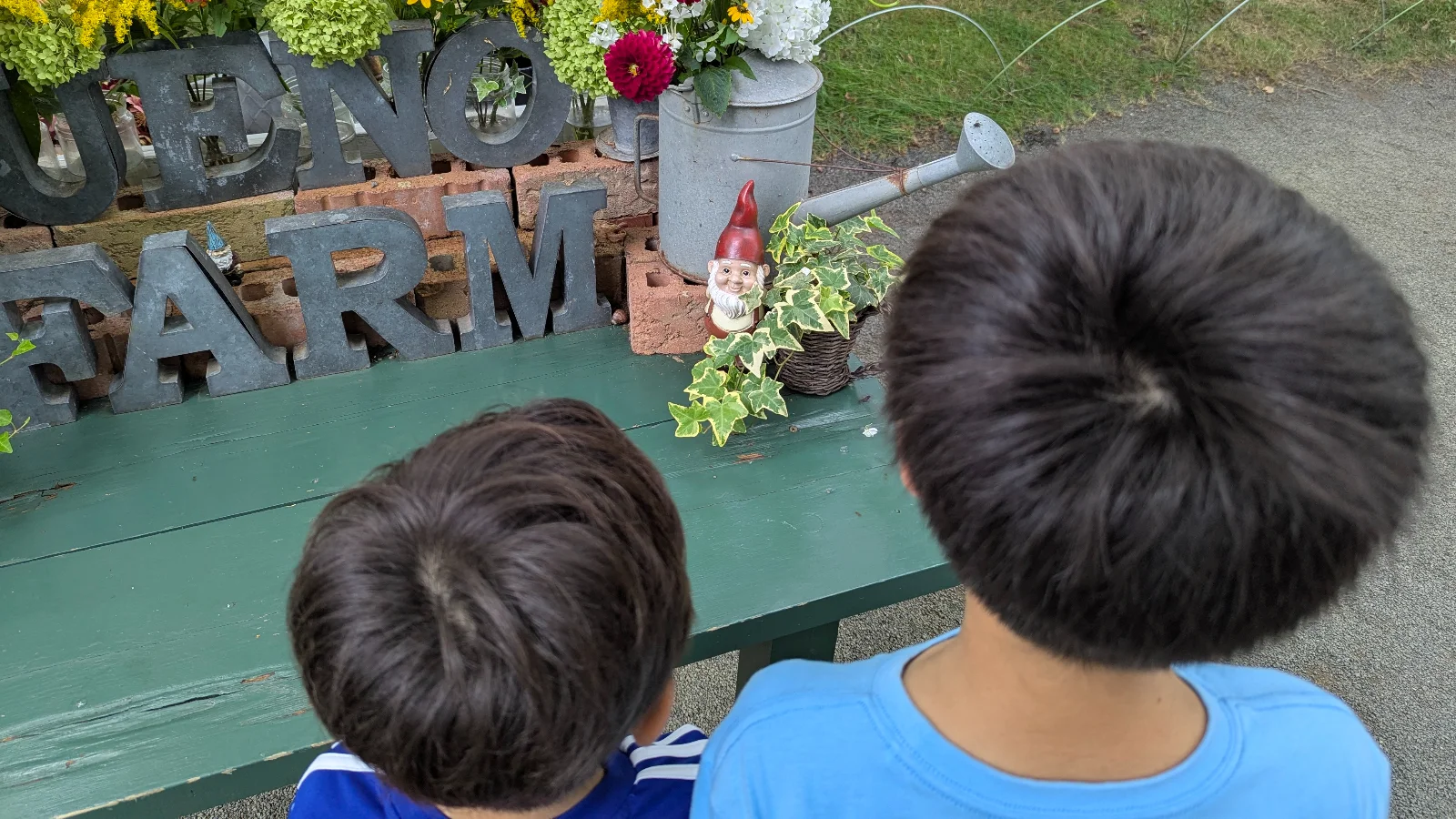
A garden where gnomes help with the gardening and a hill rises behind the gardens, open for six months and then shut for the whole winter.
Elementary and under free; high school pays the adult price. No booking needed; advance e-tickets are 10 percent off.
Open every day of the season; closed all winter.
The gardens, the Gnome Path and the hill are choices, not a fixed route.
Elementary and younger enter free; the climb to the summit is optional.
The farm sits at the foot of a small hill, Shatekiyama, whose path climbs to a view.
Some links on this page are affiliate links. LuNi may earn a commission at no extra cost to you.
Is Ueno Farm worth it with kids?
The short version, before the costs, the timings and the case for each child.
Yes, if the calendar allows it, and it is one of the gentler days in the area. Ueno Farm is a garden with a gnome garden, where the gnomes are said to help with the gardening, and a named path that runs from it to a small hill behind the farm, with a view around the basin from the top. Elementary students and younger enter free. The catch is the season: the 2026 garden opens April 17 and closes October 18, then shuts for the winter, so a family arriving after that date finds it closed. The other catch is the bus, which runs three times a day and only in the season, so most families will drive, or check the return bus before leaving.
Planning Your Visit to Ueno Farm with Kids.
Three decisions come before the garden, and the first is the date. The season is fixed and short, so check it early, against when to visit Japan with children before anything else, because the garden is open every day inside it and shut for the whole winter outside it. The second is the ride out. A car makes the day flexible; the bus makes it a schedule, with three departures a day from a stop near Asahikawa Station, and the way back matters more than the way there. The third is the hill. The path from the gnome garden climbs to a summit with a view, and whether a child walks all of it is a choice to make at the bottom, not halfway up.
Every LuNi attraction guide starts with a visit, with our own children
LuNi rates and writes about attractions only after visiting them with children. Luca and Nico were at Ueno Farm, and what they did there is recorded further down this page, including how each child actually met it.
Children arrive with different tolerances: for noise, for lines, for standing still, for being on their feet all day. A guide written for the average of them helps almost nobody. So every place on this site is read four ways, and each verdict says which children it already suits and what makes it work for the rest. Whoever you are bringing, the answer here is built for your family rather than for a general reader.
Restricted-movement depletion stays low in a garden with a gnome path to follow and a hill to climb, so let the child lead the way uphill.
Sensory-input depletion stays low in an open-air garden with a view around the basin from the hilltop, so give the child time among the gardens.
Unfamiliarity and unconfirmed structure ease with fixed daily hours, no closing day in season and a named path to a summit, so say the route first.
Sustained walking and standing build on the path up the hill behind the gardens, so make the summit optional and plan the return bus early.
Hotels we would book for this visit.
The farm’s seasonal bus leaves from the 1-jo 8-chome stop, the nearest to Asahikawa Station, three times a day, so the city is the base, and all three are Asahikawa hotels.
| Property | The LuNi Reason |
|---|---|
| LUNI Pick OMO7 Asahikawa by Hoshino Resorts | OMO7 Asahikawa is for a family that will ride the farm bus. The farm day starts at the stop in front of the Feeeal building, nearest to Asahikawa Station, so check the three departures the night before, and the last one back most of all. |
| ART HOTEL Asahikawa | ART HOTEL Asahikawa is for a family that will drive to the farm rather than ride. The bus runs only three times a day in season, so a car frees the family to leave when the child has had enough of the gardens rather than when the schedule says. |
| JR INN Asahikawa | JR INN Asahikawa stands at the station front, the part of the city the farm bus leaves from, which matters on a route with only three departures a day. Its large twin rooms take three and a preschooler may share a bed, so a family of four books two rooms for the farm day. |
OMO7 Asahikawa by Hoshino Resorts
Nearby attractions, matched to your child.
Three Asahikawa-area visits for what a garden day does not give: a mountainside of animals for a child still full of energy, a one-floor museum for tired legs, and a ride with a fixed shape.
| Pairing | Why This Solves the After-Visit | For Your |
|---|---|---|
| LUNI Pick Asahiyama Zoo Asahikawa: bus from JR Asahikawa, about 40 minutes | For a child the garden did not wear out, Asahiyama Zoo offers three to four hours of animal houses spread over a mountain slope. Restricted movement is spent well there, but a Sprinter’s walking and standing run long, so ride the free shuttle from the East Gate and plan the rest houses. | Dynamo |
| Asahikawa Science Museum Asahikawa: bus from JR Asahikawa, about 5 minutes | After a hill path, the Asahikawa Science Museum is kind to tired legs: every exhibit corner is on the first floor, the bus from JR Asahikawa takes about five minutes, and a planetarium program gives twenty to forty seated minutes. Walking and standing stay short for a Sprinter. | Sprinter |
| Shikisai-no-oka Biei: Bibaushi Station, 25 minutes’ walk | The tractor bus at Shikisai-no-oka circles the park in about fifteen minutes on a fixed route at a fixed price, in rain as well as sun, from late April to late October. Unfamiliarity and unconfirmed structure ease for an Anchor who can hear the whole ride before the first seat. | Anchor |
Asahiyama Zoo
Asahikawa: bus from JR Asahikawa, about 40 minutes For YourDynamo
Asahikawa Science Museum
Asahikawa: bus from JR Asahikawa, about 5 minutes For YourSprinter
Shikisai-no-oka
Biei: Bibaushi Station, 25 minutes’ walk For YourAnchor
How two children actually met this attraction.
The same garden gave two children two different games, and both came from the gnomes. One made it a set to complete and would not stop until every one was accounted for; the other made it a chase, where the looking mattered and the total did not. That split is worth knowing before the gate, because it decides how a family moves through the garden. A counting child needs time and no rush at the end, or the unfinished set becomes the story of the day. A chasing child needs room and new places to run to. Give each child the version they chose, keep the hill as the shared finish, and the same afternoon works for both of them without anyone having to give way.
Luca treated the gnome hunt as a set to be completed, not a game to be played loosely. He worked the paths methodically and kept a running count, and by the end he had found fifty-two gnomes and noted that five of them were golden. He was not wandering the garden; he was making sure he had accounted for every one, and he was satisfied only once he was confident he had the whole set.
This is the Anchor pattern, in a child who likes a finished set. A child whose Reserve depletes through unfamiliarity and unconfirmed structure settles when a place offers something that can be completed and checked, and Luca turned a garden into exactly that. Families with a similar child should let the counting run without hurrying it, leave time at the end for the last few, and treat the finished total as the moment the visit lands, because an unfinished set follows this child home.
Nico’s version of the hunt was all motion. He cared far less about the final count than about the searching itself, darting from one flower bed to the next and calling out each gnome as he spotted it, with the golden ones setting off his biggest reactions. The looking, not the tally, was the fun, and the constant movement between hiding spots kept him going in a way that standing to admire any single flower bed never would have.
This is the Dynamo pattern. A child whose Reserve depletes through restricted movement stays regulated while searching and running, and a garden with things to find kept Nico moving from place to place. Families with a similar child should make the search the engine of the visit, follow the Gnome Path out toward the hill while the energy is still high, and keep the standing still at any one spot short, because for this child the moving is the whole point of the garden.
A garden where gnomes hide among the plants turns a walk into a quest, and that small invention matters. Children engage with nature far more readily when there is something to look for, and hunting for a gnome slows them down enough to notice the flowers around it. Gardens can feel like adult places until a child is given a reason to belong in them. A day that lets a child discover a garden on their own terms plants a curiosity about growing things that can take root long after the trip.
The LUNI Rating for Ueno Farm.
One fact sits under all four verdicts: Ueno Farm is an open garden with a path out to a small hill, open every day of its season and closed all winter. That is why three children do well: room to move, an outdoor garden for the senses, and a day that can be fixed in advance. The Sprinter needs a plan because the hill is part of the pull, and the bus back runs only three times a day, so a tired child cannot always leave when ready. Families comparing it with Japan’s attractions for children should weigh the season first, since the farm closes for half the year.
Follow the gnome path out to the hill. The Dynamo depletes through restricted movement, and Ueno Farm gives this child somewhere to go. The Gnome Garden is a naturalistic planting where gnomes are said to help with the gardening, and a named path, the Gnome Path, runs from it to Shatekiyama, the small hill behind the farm. Climb to the top and the view opens around the mountains that ring the basin. A garden visit that ends on a summit is a garden visit with a destination, which is what this child wants.
Give the walk a goal. Start in the gnome garden, let the child look for the gnomes as the reason to keep moving, then follow the path out to the hill while the energy is still there. Keep the standing at any one spot short, and let the summit be the finish line. Plants stay where they are, so a child who likes to pick things needs that rule before the first garden, not after it.
What this means for your Dynamo: restricted movement has a path and a hill to spend itself on. A younger Dynamo needs the gnome garden and a short way along the path; an older one can take the summit.Let the garden be the reset. The Sensor depletes through sensory input, and a garden is one of the gentler places a family can spend a day in Japan. Ueno Farm is open air, with its gardens, a naturalistic gnome garden and a path out to a hill with a wide view. The NAYA cafe keeps the same hours as the garden, which gives a family a sit-down indoors when one is needed. For a child who arrives already carrying a busy trip, this is the day that gives some of it back.
Pace is what this child needs to own. Let the child set how long each part takes, and resist the urge to cover every garden; the summit view is a reward, not an obligation. Photography is free for visitors, so a camera can be the child’s job rather than the parent’s, though drones are not allowed. Plan the cafe as the midpoint, so the day has a quiet seated half, and end before the child is tired rather than after, which a garden makes easy to do.
What this means for your Sensor: sensory input stays low in an open garden. A younger Sensor needs the cafe as a midpoint; an older one can take the camera and set the route.Fix the date, the bus and the path. The Anchor depletes through unfamiliarity and unconfirmed structure, and Ueno Farm is easy to confirm in advance. The garden opens at 10:00 and closes at 17:00 every day of its season, with no closing day in between, and the 2026 season runs from April 17 to October 18. The route has a name and an end: the Gnome Path runs from the gnome garden to the summit of Shatekiyama. Even the price is simple, with elementary students and younger free.
The bus is the one part that cannot bend, so build the day around it. Route 69 runs three times a day in season from the 1-jo 8-chome stop in front of the Feeeal building, the nearest stop to Asahikawa Station, so tell the child which bus goes out and which comes back, and keep the return time visible all day. A family with a car removes that pressure entirely. Say the route aloud too: gnome garden, path, hill, back.
What this means for your Anchor: a day with fixed hours and a named path leaves unfamiliarity little to work on. A younger Anchor needs the return bus named early; an older one can hold the times.Make the summit optional. The Sprinter depletes through sustained travel-style walking and standing, and Ueno Farm puts its best view at the top of a hill. The path from the gnome garden climbs to the summit of Shatekiyama, and that climb is the part of the visit that asks the most of small legs. Let the child, not the plan, decide on the hill. And the bus back runs only three times a day, so a tired child may have to wait for it rather than leave when ready.
Make the climb a choice, not the plan. Walk the gardens first, then decide at the start of the path whether the child has the legs for the summit. A younger child can turn back at any point and still have had the visit; an older one can go up while a parent waits in the cafe with a younger sibling. Drive if possible, so the day ends when the legs end rather than when the bus leaves.
What this means for your Sprinter: walking and standing build on the hill path. A younger Sprinter needs the gardens and a turnaround point; an older one can take the summit if the return is by car.The questions parents actually ask.
Ueno Farm is simple once when and how are settled: when the season opens and closes, what it costs by school level, and how to get there without a car. The season and the bus are the two that catch families out, since the garden shuts after October 18 and the bus runs only three times a day while it is open. Once those two are settled, and the return bus is noted, the rest is a relaxed day, and a family hotel guide for Japan can place the base for the whole Hokkaido leg of the trip, from the first night on.
Is Ueno Farm worth visiting with kids?
Yes, in season. It has a gnome garden, a path to a small hill with a view from the summit, and a cafe keeping the garden’s hours, and elementary school students and younger enter free. The 2026 season ends on October 18, so check the date first, and plan the bus back if not driving.
How much does Ueno Farm cost?
Adults pay 1,200 yen, junior high school students 500 yen, and elementary students and younger enter free; high school students pay the adult price. Groups of ten or more pay 1,000 yen per adult, a season passport costs 1,500 yen, and advance e-tickets, not sold on the day, are 10 percent off.
When is Ueno Farm open?
The 2026 garden season runs from April 17 to October 18, open every day from 10:00 to 17:00 with no closing day, and the NAYA cafe keeps the same hours. After the season the garden closes for the whole winter, so check the 2027 season dates before booking a visit next year.
How do you get to Ueno Farm without a car?
Dohoku Bus route 69 runs to the farm three times a day, and only in the garden season, from late April to mid-October. It leaves from the 1-jo 8-chome stop, in front of the Feeeal building, the nearest stop to Asahikawa Station. Check the return times before leaving, because departures are few.
Where exactly is Ueno Farm?
At Nagayama-cho 16-chome in Asahikawa, at the foot of Shatekiyama, a small hill. The path from the gnome garden leads up it, and from the top the view reaches around the mountains that ring the basin. Plan on the seasonal bus or a car to reach it from the city.
Are there really gnomes at Ueno Farm?
Yes. The Gnome Garden is a naturalistic garden where gnomes are said to help with the gardening, and the Gnome Path joins it to the hill behind the farm. Treat looking for them as the reason to walk the path, and give a child who likes to count time at the end.
Can you take photos at Ueno Farm?
Yes, photography in the garden is free. Drones are not allowed, photographs of the farm may not be sold on stock sites for personal profit, and shoots in wedding costume are charged even for individuals. Pets are not allowed, apart from assistance dogs, and nothing may be taken from the plants.
Is Ueno Farm good for toddlers?
It works for them in the gardens, where the gnome garden gives a small child something to look for, with elementary students and younger free and the cafe for a break. The hill path is the harder part, so plan it for a child who can walk it or be carried, and keep that part short.
Where Ueno Farm fits your Japan trip.
Official site and opening information: Ueno Farm