Hotel Pools in Japan:
what families need to know before booking.
The photograph is the least reliable signal in the search. The families who get caught are the ones who booked the image, not the rules behind it.
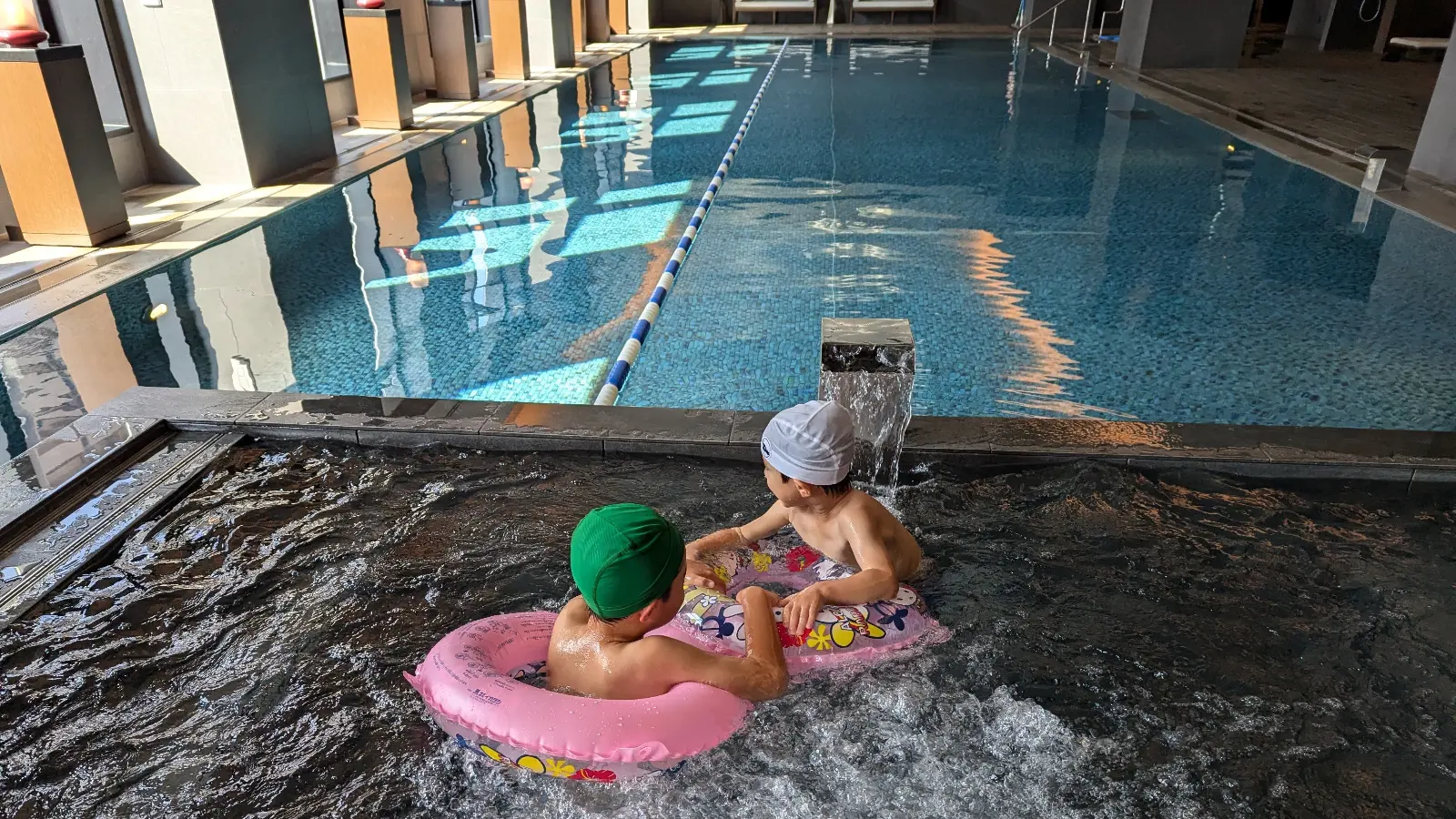
Most run as fitness facilities.
Swim diapers rarely accepted.
Closed most of the year.
Tokyo and Osaka lead.
Some links on this page are affiliate links. LuNi may earn a commission at no extra cost to you.
Why the photograph lies.
A pool photograph sells a promise the booking page does not keep. In Japan, the gap between the image and the rules is where the family mistake happens.
Most hotel pools in Japan are licensed and regulated as fitness or wellness facilities, not recreational amenities, and that single classification decides everything that follows. A fitness-category pool is built for lap swimmers and spa guests, not for families with young children, and its rules reflect that design intent. So a pool featured prominently in a hotel’s marketing can carry a minimum age of 12, a mandatory swim cap rule, a ban on floaties and toys, and a per-person daily fee the listing never mentions.
The photographs show a pool. The classification determines who may use it and under what conditions. For families arriving from countries where hotel pools are casual, all-access amenities, the distance between those two things is the booking mistake waiting to happen, and it is almost never disclosed on the platforms most families book through.
The two rules that turn families away.
Most restrictions will not derail a well-researched visit. Two of them will, and they are worth understanding in full before the rest.
Age limits, and the swim diaper trap.
Many hotel pools in Japan exclude children under 12 outright. This is a posted rule enforced at the entrance, not a guideline. For younger children the harder restriction is toilet training: most pools bar any guest who is not fully trained, and they explicitly do not accept swim diapers as an equivalent. A family arriving with a toddler in a swim diaper, and a family arriving with a ten-year-old who simply misses the age cutoff, are turned away by the same desk for different reasons. The applicable minimum is rarely stated on the booking page; it lives in the hotel’s own pool rules, often only in Japanese, so direct verification before confirming is the only reliable way to know whether your children qualify.
Swim caps are not optional.
Swim caps are mandatory at most hotel pools in Japan, regardless of hair length, age, or nationality, and the rule is enforced at the entrance with no negotiation on the day. Some hotels sell or rent caps at the pool desk, but availability is not guaranteed. The families who get turned away are almost always the ones who did not know the rule existed until they were standing at the entrance. The fix is small and total: a 100-yen shop or convenience store sells inexpensive caps, bought on arrival day before you reach the hotel.
The restrictions that vary by property.
Beyond age and caps sits a cluster of further rules. Pool toys, floaties, and energetic water play are prohibited at most facilities, which are built for quiet use; families whose children need a physical water outlet rather than a calm swim will find most hotel pools structurally unsuited to that purpose. Per-person daily usage fees apply at many properties, luxury ones included, sometimes restricted to premium room categories. Outdoor pools run mid-July to late August only, closed the rest of the year regardless of temperature, while year-round indoor pools sit mainly in larger urban hotels under stricter rules. Visible tattoos are barred at many pools, consistent with onsen culture, and some properties require pool reservations that fill before check-in day.
| Restriction | What Applies | Where It Bites | Verify Before Booking |
|---|---|---|---|
| Minimum age | Often 12+ at fitness pools | Older children below the cutoff | Yes |
| Toilet training | Required; swim diapers excluded | Toddlers and pre-trained children | Yes |
| Swim caps | Mandatory, enforced at entry | Every guest, every age | No, buy ahead |
| Pool fee | ¥¥¥ Per person, per day, set by each hotel | On top of the room rate | Yes |
| Outdoor season | Mid-July to late August only | Spring, autumn, early-summer trips | Yes |
| Toys and floaties | Prohibited at most pools | Active water play with young kids | If it matters to you |
| Visible tattoos | Barred at many facilities | Parents with visible tattoos | Yes |
| Reservation-only | Applies at some properties | Peak-season slots fill early | Yes |
Minimum age
Toilet training
Swim caps
Pool fee
Outdoor season
Toys and floaties
Visible tattoos
Reservation-only
A child who has spent weeks picturing a swim arrives carrying that anticipation as something real, and being turned away at the entrance does not just disappoint them. It teaches them, in a small way, that the things they are promised may not hold. The opposite lesson is the one worth protecting: when the day delivers what a child was told to expect, they learn to trust the shape of a trip, and a child who trusts the plan travels lighter through everything else in it.
An unconfirmed pool fails two profiles in opposite ways. The Dynamo depletes through restricted movement, and a rest-day pool is often the one outlet to discharge it, the outlet that vanishes if access was never verified. The Anchor depletes through unfamiliarity and unconfirmed structure: a pool promised and then denied at the entrance reads as the day turning unpredictable. For both, the consequence is the same, so confirm pool access in writing before booking, so the outlet is real and the structure holds.
When a pool is worth booking around.
For most families visiting Japan, the honest answer is: only under specific conditions. Identifying which side of that line you fall on before booking prevents the costliest version of the mistake.
Where pool access earns its place.
A pool is worth booking around when your family meets most of four conditions: you are traveling in July or August, the only reliable window for outdoor pools; you are staying three or more consecutive nights, so the pool is a repeated feature rather than a single-day gamble; your children clear the hotel’s own pool age rule; and the hotel explicitly markets family pool programming rather than a stock amenity photo. Resort-category properties that genuinely serve families operate pools designed for family use, and they are meaningfully different from a pool that merely happens to sit on the premises. Where families search by city, Tokyo and Osaka hold the most year-round indoor options, while Kobe and Fukuoka are thinner and reward verifying before you commit.
When the pool should not decide the booking.
Pool access is not worth booking around outside the July to August window, when most outdoor pools are closed regardless of the listing. It is not worth it on a fast-paced itinerary of one or two nights per property, where the pool never gets used enough to justify its influence. And it is not worth it when your children are under six, not fully toilet trained, or when a parent has visible tattoos with no plan for the entry rule. The most damaging version of this mistake is not the restricted pool. It is choosing a hotel for its pool, finding the pool inaccessible, and discovering the hotel itself was a poor fit for the family’s actual needs.
What to ask, and what serves families better.
Booking platforms rarely disclose the full restriction set, so direct verification is the only reliable path. Contact the hotel before confirming, and ask the questions that decide whether the pool is real for your family.
The questions that settle it.
Ask whether the pool is open during your exact dates or seasonal; what the minimum age is; whether swim diapers are accepted or full toilet training is required; whether swim caps are mandatory and available onsite; whether a fee applies and to your room category; whether toys and floaties are permitted; whether advance reservation is required; and whether visible tattoos are allowed in the pool area. A hotel that cannot answer these clearly at the inquiry stage is a hotel whose rules you will be discovering at check-in.
Water that actually works for young children.
For families who conclude a hotel pool is the wrong fit, the alternatives are genuinely strong. Private family onsen baths, the kazoku buro or kashi-kiri buro bookable by the hour at many onsen properties and ryokan, let children of any age soak with parents in a fully private setting, with no conduct rules, no age limit, and no swim cap. Indoor water parks and public facilities with family zones run year-round in the major cities without the hotel-pool restrictions, and summer splash parks and riverside play areas give younger children a water outlet with no entry barrier. For a toddler, the private onsen bath is often the better experience outright; for an older child who wants to actually swim, the indoor water park clears the age and conduct rules a hotel pool would not.