Gion With Kids:which stop is for which child.
- Book Ahead
- Gion Corner is the one ticket to book
- Room to Move
- Maruyama Park and a walk down Hanamikoji
- Getting There
- Gion-Shijo on the Keihan Line, 5 minutes
- Best Time
- Late afternoon, or at first light
- With a Toddler
- The Shirakawa Canal and two calm halls
Things to do in Kyoto’s old district with children, from the lantern-lit lanes to the shrines at its edges.
Some links on this page are affiliate links. LuNi may earn a commission at no extra cost to you.
Gion works with kids when the timing is right: late afternoon for the lanterns at dusk, or first light for the temple slope. Gion-Shijo on the Keihan Line is five minutes on foot, and with children the train beats the bus. Maruyama Park and a walk down Hanamikoji give a moving child room; the Shirakawa Canal and two calm indoor halls nearby suit a child who tires on noise; Yasaka Shrine, the Kiyomizu-dera slope and Chion-in give structure to a child who likes a plan. Gion Corner is the one ticket to book; every other stop here is walk-up.
Which stop is for which child.
These stops are not ordered best to worst. They are grouped by which child each one is for. The reason is simple: Gion looks gentle, but a slow stroll past silent teahouses asks very different things of very different children, and the lane that enchants one of yours is the lane that empties another. So instead of a single list, you get four short ones, organized by how each child runs out of steam. The Dynamo runs short when they cannot move. The Sensor runs short on noise and crowds. The Anchor runs short when nothing is predictable. The Sprinter runs short on walking and standing. Find your child below, and start there.
For the Dynamo
Stops that relieve restricted-movement depletion.
For a child who depletes through restricted movement, the strongest stops are Maruyama Park and a walk down Hanamikoji.
Directly behind Yasaka Shrine, Maruyama Park is the open green release valve of the whole district. For a movement-driven child it does what no teahouse lane can: it gives unbroken running room, ponds and paths to circuit, and no rope line holding anyone still. It returns Reserve rather than spending it, which is why it works best as the start or the recovery point of a Gion visit, not the end. A younger Dynamo gets the flat central lawns; an older one can take the longer wooded loop without a single queue.
Who it costs.The Sprinter, mildly. The size that frees the Dynamo is real walking distance for a low-stamina child, and seating clusters near the central pond rather than spreading through the park.
How to make it work.Open the day here so the Dynamo discharges before the slow lanes, then move into Gion proper while the rest of the family still has the park’s calm behind them.
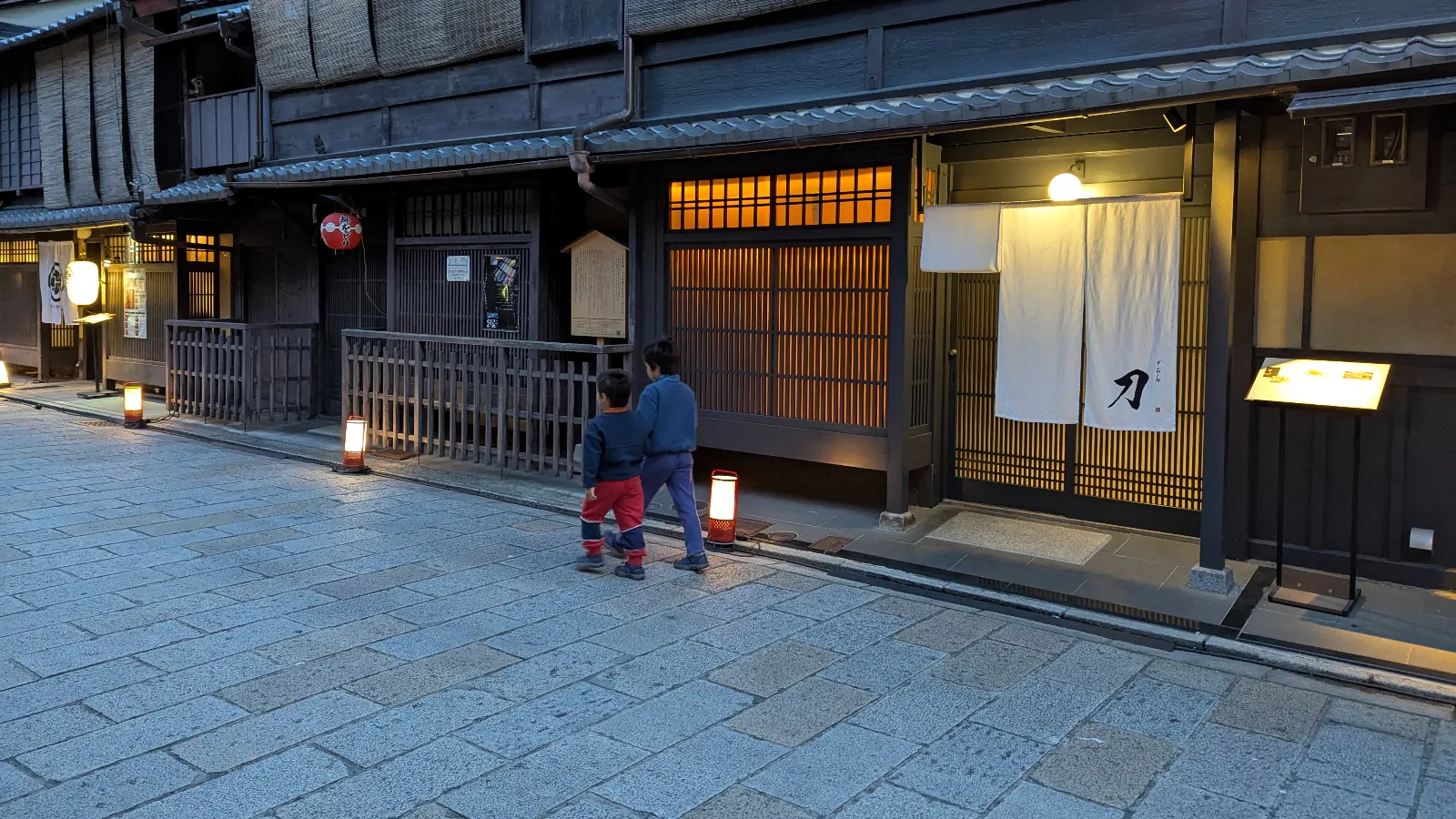
If this isn’t your child: still a green breathing space between shrine and street, useful to any family even without the movement need.Hanamikoji is the cultural spine of Gion, a flat, walkable lane of wooden teahouses that a moving child can actually cover at their own pace rather than stand and stare at. For the Dynamo the value is the walking itself: forward motion through a living set, with the geiko-spotting game giving the stroll a purpose that keeps legs going. A younger Dynamo turns it into a lantern-and-rooftop hunt; an older one walks the full lane to the Shirakawa end and back.
Who it costs.The Sensor and the Anchor at the evening peak, when the lane narrows with photographers and tour groups and there is no contained interior to step into. The unpredictability of who is around the next corner is exactly what unsettles an Anchor.
How to make it work.Walk it in the late afternoon before the dinner crowds, not at the evening crush, and keep to the side of the lane so a sudden geiko sighting never turns into a blocked path.
If this isn’t your child: the postcard image of Gion, worth one slow pass even if you do not linger.For the Sensor
Stops that let a sensory-loaded child recover.
For a child who depletes through sensory input, the strongest stops are the Shirakawa Canal and two calm indoor halls nearby.
A few steps off the main lane, the Shirakawa Canal is the quiet version of Gion: a low willow-lined waterway with the same wooden frontages and far less foot traffic. For a Sensor child it is where the dial turns down without leaving the district, soft light, dispersed sound, and water to watch instead of crowds to navigate. A younger Sensor settles by the little Tatsumi bridge; an older one walks the canal’s length at a slow, low-input pace.
Who it costs.The Dynamo, mildly. It is short and slow, with little to discharge against, so it pairs better with the park than it stands alone.
How to make it work.Use it as the planned reset between two busier stops, so the Sensor refills before the next demand rather than absorbing the lane’s peak with no relief.
If this isn’t your child: the most photogenic corner of Gion, calmer and prettier than Hanamikoji at most hours.A short walk toward central Kyoto, the Museum of Kyoto is a quiet, climate-controlled exhibit hall where input drops and a spent sensory threshold can recover indoors. The display-and-read format is predictable and acoustically soft, the opposite of a crowded lane. A younger Sensor rests over the recreated historical street on the lower floor; an older one moves through the history galleries at their own pace.
Who it costs.The Dynamo. The browse-and-read format offers almost no discharge, so it should follow a movement stop, not precede one.
How to make it work.Treat it as the indoor reset on a hot or overstimulating afternoon, and pair it with the park rather than stacking it against another still, quiet stop.
If this isn’t your child: a calm, low-cost indoor hour and a genuine look at the city’s history, useful on a wet day for any family.Steps from Yasaka Shrine, the Japan Kanji Museum is a small, hands-on indoor hall built around playing with characters rather than reading about them. For a Sensor child the appeal is a contained, low-noise space with interactive stations they control, input they choose rather than input that arrives. A younger Sensor stamps and traces simple characters; an older one works the larger interactive wall and the giant character of the year.
Who it costs.The Sprinter very little, which is a bonus, but a child with no interest in language may tire of it quickly, so it suits some families far more than others.
How to make it work.Keep it short and let the child lead between stations, using it as a cool, quiet break right beside the shrine rather than a long sit-down visit.
If this isn’t your child: a niche, playful indoor stop, best for word-loving kids and easy to skip for the rest.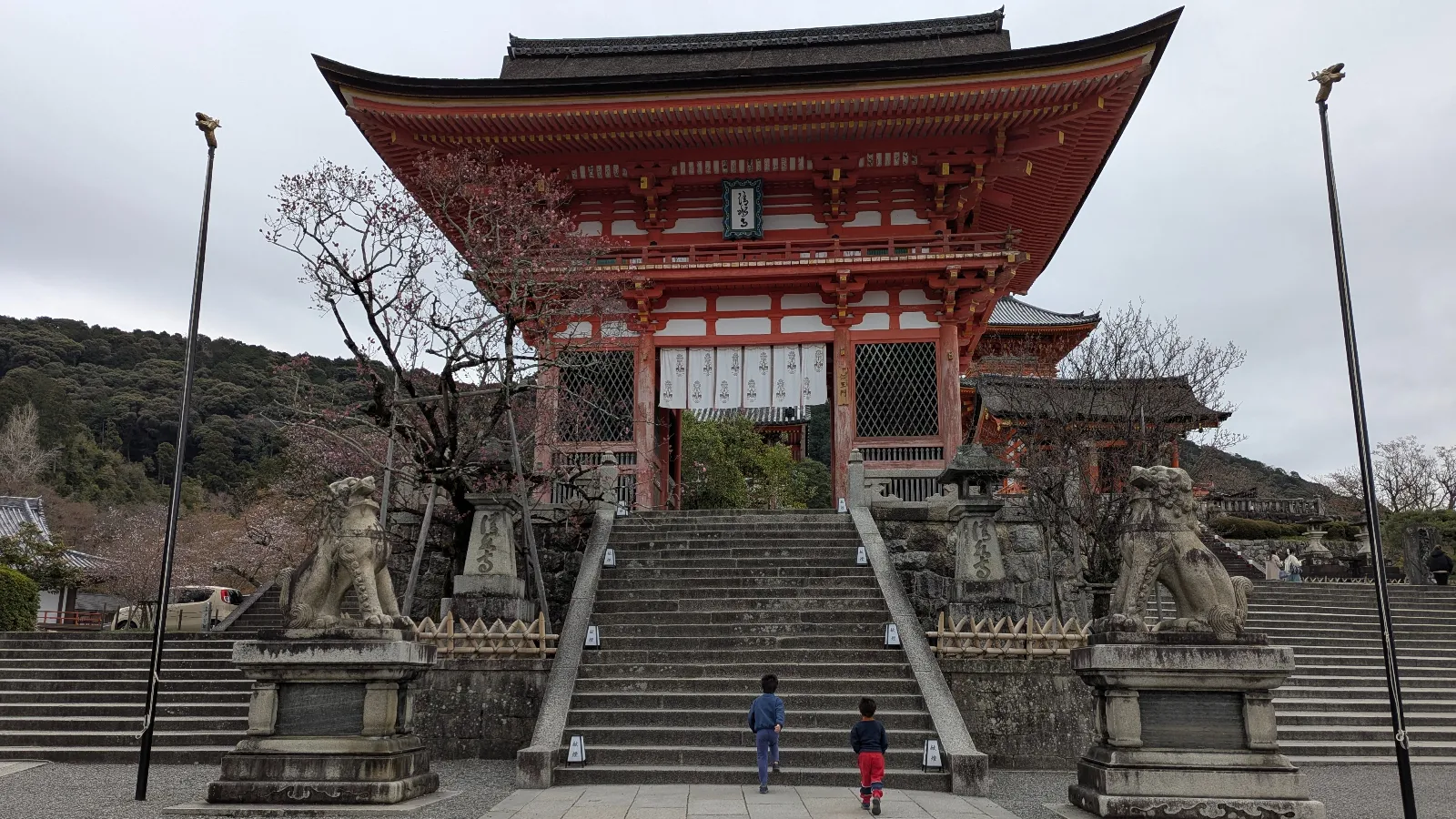
For the Anchor
Stops with confirmed, predictable structure.
For a child who depletes through unfamiliarity and unconfirmed structure, the strongest stops are Yasaka Shrine, the Kiyomizu-dera slope, and Chion-in.
Yasaka Shrine sits at the head of Gion as its fixed front gate, a bright, open, single-circuit shrine with a clear way in and out. For an Anchor that legibility is the point: the format is the universal shrine format, the path is obvious, and nothing about it improvises. A younger Anchor is reassured by the big vermilion gate as an unmistakable landmark to return to; an older one can follow the offering and washing rituals as a predictable sequence.
Who it costs.The Sensor whenever the grounds fill and the crowd noise rises, though there is open space to step back into.
How to make it work.Use the shrine as the day’s anchor point and meeting spot, since its gate is the one feature of Gion every child can find again, and visit outside peak evening hours to keep the Sensor cost low.
If this isn’t your child: the natural gateway to Gion and Maruyama Park, and a free, central orientation point for any route.Above Gion, the preserved lanes of Ninenzaka and Sannenzaka climb past the Yasaka Pagoda to Kiyomizu-dera, the temple whose wooden stage defines Kyoto. For an Anchor the temple itself is deeply predictable: an internationally recognized landmark with a clear single-path circuit, exactly the confirmed structure they rely on. A younger Anchor recognizes the famous stage on sight; an older one follows the set route from gate to stage to spring.
Who it costs.The Sprinter, at high risk. The stone slope is a sustained stepped climb with little seating, and on record Kiyomizu-dera reads best in the morning only, before the approach fills.
How to make it work.Go at opening, climb the slope while legs and Reserve are fresh, and treat the descent through the shop lanes as the reward, not a second climb. With a Sprinter, build in seated breaks and keep the day’s other walking light.
If this isn’t your child: the single most iconic thing to do above Gion, and worth the climb on its own.Just north of Maruyama Park, Chion-in is a large, working Buddhist temple built on a grand, legible scale, an enormous gate, a clear approach, a defined main hall. For an Anchor the sheer structural clarity is reassuring: the sequence reads from the entrance, and the format is the familiar temple format at impressive size. A younger Anchor is anchored by the giant gate as a fixed marker; an older one takes in the great bell and the main hall as a confirmed circuit.
Who it costs.The Sprinter. The main hall sits at the top of a steep flight of steps, and the grounds are large enough to add real distance to a tired day.
How to make it work.Pair it with Maruyama Park next door so the climb is bracketed by flat green space, and skip the upper steps with a low-stamina child rather than forcing the full grounds.
If this isn’t your child: a calm, spacious counterpoint to the busy lanes, and rarely crowded compared with Kiyomizu-dera.For the Sprinter
Short, low-stamina stops with little walking.
For a child who depletes through sustained walking and standing, the strongest stops are Gion Corner, the Samurai Ninja Museum, and a short evening pass down Pontocho.
Gion Corner is the one stop in the district where a child sits down and the culture comes to them: a booked, seated theater program of dance, music, and a tea ceremony in a single defined hall. For the Sprinter that is the whole value, a real Gion experience that costs no stamina, with a fixed start time and a seat from the first minute. For the Anchor it doubles as the most predictable thing in Gion, a confirmed sequence in a confirmed room. A younger Sprinter manages the short, varied program; an older one follows the individual arts.
Who it costs.The Dynamo, mildly. It is a seated, quiet program with no discharge, so a movement-driven child needs a release stop on either side of it.
How to make it work.Book a specific performance in advance so the Sprinter gets a guaranteed seat and the Anchor gets a confirmed plan, then chain it to a free walk-up stop so the Dynamo is not left sitting twice in a row.
If this isn’t your child: the reliable way to show children the geiko tradition without depending on a chance street sighting.A short walk from Gion toward the center, the Samurai Ninja Museum runs as a guided, costumed, hands-on experience rather than a walk-through of cases. For the Sprinter the format is kind: it is largely indoors, broken into short stations, and led at a set pace, so there is little sustained standing and no long circuit to cover. The guided structure also suits an Anchor, who always knows what comes next. A younger child throws stars under supervision; an older one takes the sword session seriously.
Who it costs.The Sensor at busy slots, when the small rooms and demonstrations concentrate noise and movement, though sessions are capped and contained.
How to make it work.Book an earlier session when the rooms are quieter, and let the guide set the pace so the Sprinter never has to stand and wait between stations.
If this isn’t your child: a high-energy, hands-on hour that lands well with school-age kids and works rain or shine.Pontocho is a single narrow lantern-lit lane along the river, and its shortness is exactly why it suits a low-stamina child: the whole atmospheric stretch is one brief, flat pass, not a circuit. For the Sprinter it delivers a lot of evening character for very little walking, a quick lane of lanterns and river glimpses with the station close at either end. A younger Sprinter manages the short walk easily; an older one takes in the dining-alley mood on the way to an early table.
Who it costs.The Sensor and the Anchor at the dinner peak. The lane is genuinely narrow, fills with diners and photographers, and offers no room to step aside, so its unpredictability and density climb fast after dark.
How to make it work.Take it as a single early-evening pass before the dinner rush, walking straight through rather than lingering, so the Sprinter spends no standing time and the Sensor never meets the lane at its fullest.
If this isn’t your child: a short, scenic riverside lane and a good route to an early dinner, easy to fold into any evening.Tucked at the end of the covered shopping arcade, Nishiki Tenmangu is a tiny, bright shrine that asks almost nothing of a child’s legs: a fixed, low-walk landmark you reach under cover and leave in minutes. For the Sprinter it is a cheap anchor point in the central shopping zone, a quick, sit-nearby stop with lanterns, a water basin children love, and no climb. A younger Sprinter spins the prayer wheels at the entrance; an older one reads the wishes tied along the rails.
Who it costs.The Sensor, on the approach. The shrine itself is calm, but it sits at the mouth of a dense, echoing covered arcade that is high-stimulation at peak shopping hours.
How to make it work.Reach it along the quieter end of the arcade rather than pushing through the busiest stretch, and use it as a short, covered rest stop on a rainy afternoon when the open-air stops are off the table.
If this isn’t your child: a charming two-minute landmark and an easy covered stop when the weather turns.Open with the child who runs short first.
The order of a Gion day is set by Reserve, not by the map. Each route opens with the stop that protects the named child, then chains to the nearest compatible one.
Settle these first. Gion Corner is a fixed-time, ticketed performance: book the slot in advance, because a booking-gated stop controls the day’s shape more than the route does. The Kiyomizu-dera slope is at its calmest at opening, so claim the morning for the climb. Everything else is free walk-up, arranged around those two.
How to arrive, when to go, and what costs nothing.
Gion is a five-minute walk from Gion-Shijo Station on the Keihan Line, or about eight minutes from Kawaramachi Station on the Hankyu Line. City buses stop here too, with Yasaka Shrine as the landmark, but the train is easier with children than the bus at busy hours. On timing, the district has two best windows for two different jobs: late afternoon into early evening for the lanterns and the highest chance of a geiko sighting, and first thing in the morning for the Higashiyama temple slope, before the approach fills and while a low-stamina child still has Reserve for the climb. The free stops carry real weight here. Walking Hanamikoji, the Shirakawa Canal, Maruyama Park, and the Yasaka Shrine grounds all cost nothing and keep no opening hours, and they are also the stops that protect a child’s Reserve best, so the free route and the calm route are largely the same route.
Three bases that fit a family’s Reserve.
A shortlist chosen for location logic, not price tier. The full set is in the complete Kyoto hotel guide.
| Property | The LuNi Reason | Budget |
|---|---|---|
| LUNI Pick Hotel The Celestine Kyoto Gion Steps from Hanamikoji | A modern-comfort base inside Gion proper, a short flat walk from the calm-route stops. Starting and ending the day in the same predictable place inside the district holds an Anchor’s routine through a busy itinerary. | ¥¥¥ |
| OMO5 Kyoto Gion by Hoshino Resorts Heart of Gion | Family-pitched design in the center of the district, a lower-stimulation base than a station hotel that protects a Sensor’s evening reserve once the lantern hours are over. | ¥¥ |
| Hotel Alza Kyoto Direct Gion access | A practical walk-to-everything base at a mid-range price, close enough to the core lanes that a Sprinter’s daily walking distance stays short. | ¥ |
Hotel The Celestine Kyoto Gion
Budget: ¥¥¥
OMO5 Kyoto Gion by Hoshino Resorts
Budget: ¥¥
Budget: ¥
For every family-friendly option in the city, see the full Kyoto family hotel guide.