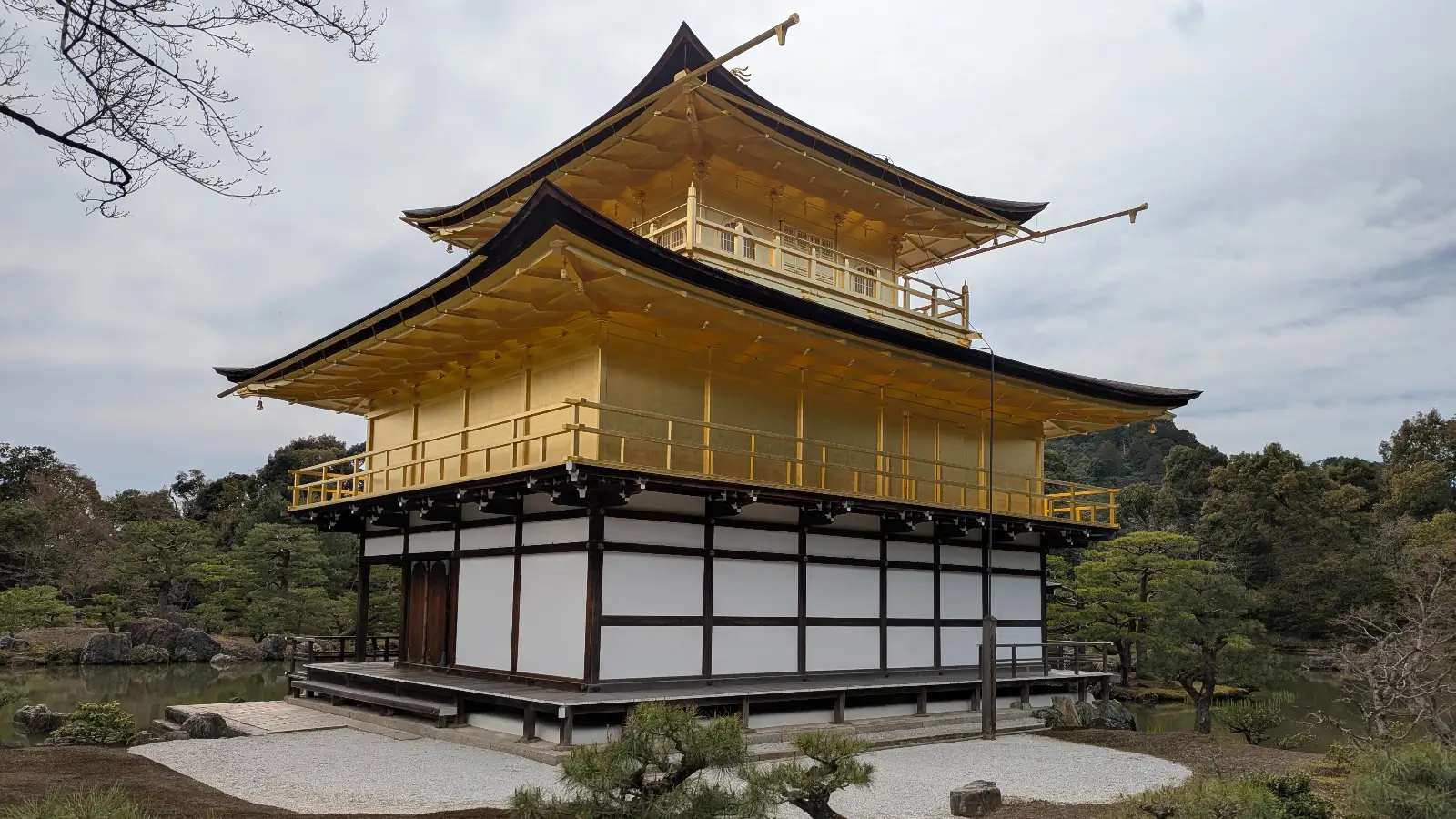
The concern most parents arrive with is not whether the Golden Pavilion is impressive enough for children. It is whether Kinkaku-ji’s strictly roped, single-direction circuit, which offers no mid-route exit once families are inside the crowd flow, will work for a child who cannot tolerate enforced, slow-moving pedestrian queues. The gold-lacquered pavilion reflecting on Kyoko-chi pond is one of the only historic Japanese sites that lands immediately for any age group, requiring no cultural framing whatsoever, and that visual payoff is what keeps Kinkaku-ji on almost every family shortlist.
Whether the visit earns its place in your Kyoto schedule depends entirely on your child’s specific travel profile, and the Family Fit™ framework is the tool that makes that distinction predictable. For the full Kyoto pacing picture and how this stop fits within a multi-day routing plan, start with our Kyoto Family-Friendly Hub.
Is Kinkaku-ji Worth Visiting with Kids? (Quick Answer)
Kinkaku-ji is conditionally worth visiting with kids for families whose child can sustain a structured, crowd-dense outdoor circuit for under an hour without needing space to decompress mid-route. The prescribed loop around Kyoko-chi pond, with its defined start point and natural endpoint at the souvenir area, rewards children who thrive in predictable, contained environments, while the inescapable lateral crowd pressure on the narrowing sections of the circuit makes this a poor fit for sensory-sensitive children, for whom no quiet retreat zone exists once the route is underway. The profile breakdown below details exactly how the physical and sensory mechanics of Kinkaku-ji’s grounds interact with each child type, so your routing decision rests on evidence rather than guesswork.
Pros of Visiting Kinkaku-ji with Kids
- The gold-lacquered pavilion and its water reflection register in seconds, without any cultural explanation. The Kyoko-chi reflection is visible from the first viewing area immediately after entry, delivering a visual payoff that children grasp instinctively. This is the attraction’s single greatest asset for family visits: the reward arrives before a child’s patience is tested.
- The complete circuit takes under an hour for most families, making it one of Kyoto’s most time-efficient major landmarks. The forty-five-minute loop delivers its full visual reward within a window that leaves the afternoon itinerary intact, and the visit closes at a natural endpoint rather than requiring a family decision about when to leave. For families managing a multi-site Kyoto day, this is a meaningful structural advantage over larger temple compounds where the time cost is harder to predict.
- The layout is entirely enclosed and the route structure is unambiguous. There are no navigation decisions, no dead ends, and no ambiguity about when the visit ends. The route closes at a clearly marked exit and souvenir area, giving Anchors a rare Kyoto experience with a predictable open-and-close structure that can be briefed in full before the family passes through the gate.
- The initial photography angles at the main viewing area are accessible immediately and without effort. Older children and teenagers who want to document the site can capture the pavilion’s full reflection from ground level within the first five minutes of the circuit, with no elevation gain or secondary hiking required.
- The Kyoko-chi viewing area is the widest point on the route and provides the most crowd relief on the entire circuit. For families with Dynamos, this is the one section of the loop where the forced pedestrian pace opens up enough to allow brief forward movement without compressing into a tour group bottleneck.
Cons of Visiting Kinkaku-ji with Kids (Important for Parents)
- Once families pass the first viewing area, the path narrows and the crowd compresses into a single-direction column with no practical exit option until the circuit completes. This is the defining structural reality of Kinkaku-ji for family planners: a child who needs to leave mid-visit cannot leave quickly or quietly. Parents should treat the entry decision as a commitment to the full loop, not a flexible exploration.
- The pathway is roped off and directionally enforced, which eliminates any possibility of self-pacing for high-energy children. Dynamos have no space to accelerate, no side paths to explore, and no physical output to channel energy into. The experience is paced by the crowd in front, not by the child.
- Peak-hour crowd density generates constant lateral physical contact on the narrowest sections of the loop. This is not a busy street that a family can step out of. It is a funneled outdoor corridor where stopping causes a bottleneck and exiting mid-circuit is not a realistic option. For Sensors, this environment operates at the far end of the sensory load spectrum.
- The attraction itself operates in a look-don’t-touch format throughout, with the pavilion accessible only from a fixed viewing distance and all structures strictly off-limits. Families expecting interactive engagement or physical exploration will not find it here. The entire visit is observational.
- Kinkaku-ji sits in northern Kyoto, removed from the eastern temple districts where most families base their itinerary. Routing a stop here requires a deliberate transit decision, and returning from a difficult visit with a dysregulated child involves a longer journey back to familiar ground than most northern Kyoto alternatives. The location does not disqualify the stop, but it raises the cost of a visit that does not go as expected.
Why Worth It Depends on Your Child
Two families can complete the identical loop on the same morning and leave with opposing verdicts, and both can be accurate. The difference is never the pavilion. It is the child’s relationship to crowd density, structured movement, and the absence of any escape option mid-circuit. The Family Fit™ framework converts that variability into a predictable assessment before you purchase a single ticket.
The Dynamo – Caution. The roped, one-directional pathway enforces a pace set by the crowd rather than the child, and the loop contains no point between the entry gate and the exit where physical energy can be released. The visit works best when it is positioned between two stops that give this child room to move, treating it as a contained interval within a day rather than a standalone destination.
The Sensor – High Risk. At peak hours, the narrowing sections of the Kinkaku-ji loop generate inescapable lateral crowd pressure and unpredictable stopping, and there is no mid-circuit exit route that avoids the densest sections. Families whose Sensor child cannot guarantee a 9:00 AM opening arrival should treat this as a skip, not a caution, because the timing window that makes this environment manageable is narrow and non-recoverable once missed.
The Anchor – Go. The prescribed loop, the clearly defined duration, and the souvenir area that marks a concrete endpoint give Anchors a fully predictable structure from entry to exit. Briefing the child on the format before entering, including the estimated time, the direction of travel, and where the visit ends, removes the primary anxiety source this profile carries into unfamiliar environments.
The Sprinter – Caution. The Kinkaku-ji loop is flat, short, and physically manageable within The Sprinter’s endurance range under normal conditions. The caution applies to sequencing rather than to the attraction itself: positioning Kinkaku-ji immediately after a walking-heavy site risks arriving with a physical deficit that the circuit, while brief, is not forgiving enough to absorb.
If you have not yet identified your child’s profile, the Family Fit™ Quiz is the most direct way to get a specific answer before your Kyoto itinerary is set.
Who Will Enjoy Kinkaku-ji with Kids (By Age Group)
Toddlers (under 3)
Toddlers have not yet developed the behavioral capacity to sustain a slow-moving, roped pedestrian queue surrounded by adult strangers without actively wanting to exit the crowd. At Kinkaku-ji specifically, that impulse cannot be honored mid-circuit, which makes the visit a high-friction experience for this age band regardless of how impressed the child might be by the gold exterior. Kinkaku-ji is not worth it for toddlers.
Preschoolers (3-5)
A preschooler has enough attention span to be genuinely impressed by the shimmering pavilion at the first viewing area, and the Kyoko-chi reflection is visually arresting at eye level for small children. The visit is conditionally worth it for this age band if the family keeps expectations focused entirely on the initial viewing area and is prepared to carry the child through the compressed sections of the loop once interest fades.
School-Age Kids (6-10)
School-age children possess the cognitive capacity to appreciate the visual drama of a gold-covered building and the behavioral regulation to navigate a structured, directional route without requiring an escape route. The forty-five-minute loop sits comfortably within their physical and attentional range, and the pavilion delivers the kind of immediately striking landmark that this age group tends to retain long after the trip. Kinkaku-ji is worth it for school-age kids without condition.
Older Kids and Teens (11+)
Teenagers are motivated by high-visual, documentable experiences and by sites they can contextualize within something larger, and Kinkaku-ji delivers on both: the pavilion is among the most architecturally striking subjects in Japan and carries genuine historical weight for any child old enough to receive a brief explanation. The structured nature of the loop, which can feel constraining for younger children, rarely registers as a limitation for teens who are accustomed to managing their own pace within structured environments. Kinkaku-ji is worth it for older kids and teens.
Family Fit™ Travel Method
Most families skip this.
It's why Day 3 falls apart.
The Family Fit™ Quiz identifies the specific planning adjustments your child needs. Two minutes now saves the whole trip.
Best Alternatives to Kinkaku-ji for Families with Kids
If Kinkaku-ji’s roped, no-exit circuit is the wrong fit for your child, these four alternatives address the specific gap it creates.
- Nijo Castle. Kinkaku-ji gives children no opportunity for self-directed movement once the circuit begins. Nijo Castle’s grounds are navigated across wide, open paths at whatever pace the family sets, and the nightingale floors inside the Ninomaru Palace convert a historic site into something a child actively participates in rather than passively observes. Nijo Castle Guide
- Arashiyama Bamboo Grove. The bamboo corridor is equally high-visual and comparable in duration, but families can reverse direction, step aside, or accelerate freely at any point. For children whose difficulty at Kinkaku-ji would be the loss of personal space and pacing control, the grove delivers the same category of dramatic visual experience without the crowd-funnel mechanics.
- Kiyomizu-dera. The main wooden veranda provides a single structural focal point that gives children who need clear visit boundaries something to orient around, while the surrounding viewing decks and rest areas allow families to pace the visit naturally rather than complete a prescribed loop. The site is more physically demanding than Kinkaku-ji but offers routing flexibility the Golden Pavilion circuit does not. Kiyomizu-dera Guide
- Fushimi Inari Taisha. There is no enforced pace, no roped path, and no committed circuit. Families can move forward, slow down, and turn around at any point on the trail, which means the visit scales to the child rather than the crowd. For older children and teenagers, the progressive elevation creates a discovery-driven experience with a genuinely different quality from a viewing route that ends where it began. Fushimi Inari Guide
For the full routing picture across Kyoto’s family-relevant sites, our Kyoto family-friendly travel hub covers neighborhood sequencing and pacing strategy across multi-day itineraries.
Final Recommendation: Is Kinkaku-ji Worth It with Kids?
Kinkaku-ji earns its place in a Kyoto itinerary for families visiting specifically for a brief, high-impact visual landmark and whose child can sustain a structured, crowd-dense outdoor circuit without a mid-route exit option. Children who need predictability and a defined endpoint will find the visit straightforward; children who are sensory-sensitive face a genuinely difficult environment at any hour where an early opening arrival cannot be guaranteed, and high-energy children require deliberate energy management before and after the loop to make the visit work. For families whose child sits somewhere in between, the single variable that determines success is the ability to arrive at opening time, which compresses the crowd column enough that the circuit operates closer to a structured walk than a forced shuffle. Arriving after 10:00 AM changes the visit materially for most children.
The Kinkaku-ji Briefing: Essential Intel
Families deciding whether Kinkaku-ji belongs in their Kyoto schedule ask these questions most consistently, from whether the roped loop will work for an active child to how the crowd density compares to Kyoto’s other major sites.
A: Yes, conditionally, for families whose child can manage a structured outdoor circuit of under an hour with no mid-route exit option. The gold pavilion and Kyoko-chi reflection deliver a visual reward that registers immediately for children of almost any age, but the enforced crowd flow on the loop path makes the visit unsuitable for children who need space to move or decompress mid-visit.
A: School-age children represent the age band that gets the most consistent value from Kinkaku-ji. Their behavioral regulation is sufficient to navigate a directional crowd circuit, their attention span comfortably covers a forty-five-minute loop, and the pavilion’s gold facade is striking enough to hold genuine interest without any historical preparation.
A: No. The roped, one-directional circuit creates a museum-style movement restriction in an outdoor setting, and the crowd density at peak hours eliminates any possibility of forward acceleration or side exploration. Families with high-energy children should treat this as the clearest planning signal the site offers: the loop works on the crowd’s terms, not the child’s.
A: Visiting with toddlers at Kinkaku-ji is a high-friction decision because the mid-circuit crowd density creates a situation where a child who wants to exit cannot exit quickly or quietly. If a toddler reaches the point of refusal inside the narrowest sections of the loop, the family’s only option is to push through to the end, which is a significant risk when the environment has no quiet retreat zone.
A: At peak hours, yes. The loop at Kinkaku-ji generates the kind of sustained lateral crowd pressure and unpredictable stopping that is particularly difficult for sensory-sensitive children to regulate, and there is no section of the circuit that functions as a sensory reset zone. The question is not whether the pavilion is worth seeing, but whether the crowd environment required to see it is manageable for this specific child.
A: For the right profiles, it is among Kyoto’s most time-efficient major landmarks. The visit completes within forty-five minutes, the visual payoff arrives in the first few minutes, and the structured loop means there is no time lost to navigation decisions. For families with Anchors or older children, the return on time investment is high. For families with Sensors or a toddler, the same forty-five minutes carries a meaningfully different risk profile.
