Miraikan with Kids: free for children every Saturday.
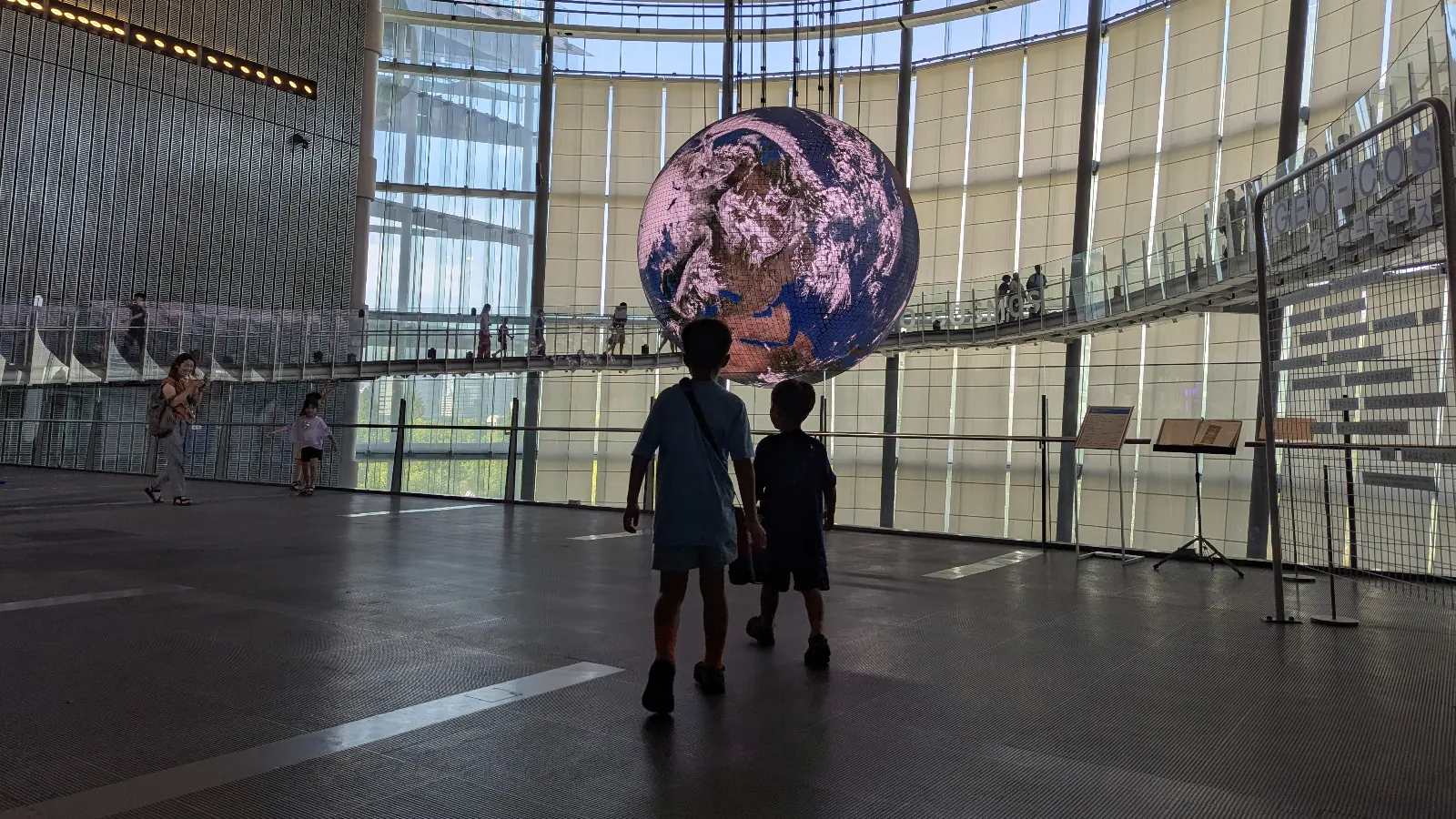
A science museum sounds like a day for older children, but Miraikan keeps a free play space for the youngest and explains itself in two languages to everyone else.
Free for children every Saturday, and preschool children are always free. Booking ahead is offered, not required.
Closed on Tuesdays (open if a holiday) and from December 28 to January 1.
Time for a Dome Theater show sits inside it.
Children under 6 need a suitable companion.
Ask staff for one of the museum’s strollers; elevators run inside the building.
Some links on this page are affiliate links. LuNi may earn a commission at no extra cost to you.
Is Miraikan worth it with kids?
The short version, before the costs, the timings and the case for each child.
Yes, and it suits a wider range of children than most museums in the city. A child who wants to understand how things work finds a building that explains itself, in Japanese and English, at whatever pace they read. A younger child who needs to move finds a free play space inside the same walls. The one condition is the Dome Theater. Shows run at set times and nobody is admitted late, so choose the show before you arrive and let it fix the middle of the day, rather than chasing it from the galleries. Outside food is allowed in the eating spaces, so a packed lunch gives a tired child a seated break without leaving the building. Plan the Dome first, let the play space carry the youngest, and let an older child read.
Planning Your Visit to Miraikan with Kids.
Three decisions shape a visit, and the first is the day. A Saturday costs children nothing, but it is also the day the play space hands out numbered tickets, so go early or go on a weekday, when families walk straight in. The second is the Dome Theater: pick a show time before you arrive, since nobody is admitted once it starts, and let it fix the middle of the day. The third is lunch, and a packed lunch works well here, eaten in the designated spaces, so a tired child can sit down without leaving the building. Check the closing day against your dates before planning the rest of the week. A child who has done a full day here rarely has room for a second big stop, however close Odaiba’s other family stops are.
Every LuNi attraction guide starts with a visit, with our own children
LuNi rates and writes about attractions only after visiting them with children. Luca and Nico were at Miraikan, and what they did there is recorded further down this page, including how each child actually met it.
Children arrive with different tolerances: for noise, for lines, for standing still, for being on their feet all day. A guide written for the average of them helps almost nobody. So every place on this site is read four ways, and each verdict says which children it already suits and what makes it work for the rest. Whoever you are bringing, the answer here is built for your family rather than for a general reader.
Restricted-movement depletion eases with a free play space in short rotations for younger children, so plan a session there between the long galleries.
Sensory-input depletion stays manageable with eating spaces for a pause and a weekday walk-in play space, so plan a quiet lunch at the midpoint.
Unfamiliarity eases around a Dome Theater on fixed show times with no late entry, so choose the show at home and plan around it.
Walking and standing stay easier with strollers and wheelchairs lent on request and eating spaces to rest in, so ask for a stroller on arrival.
- Cost
- ¥630 adult / ¥210 elementary to 18Free for children every Saturday, and preschool children are always free. Booking ahead is offered, not required.
- Booking
- Online ahead, or on the dayDome entry opens 10 minutes before a show, and no one enters after it starts.
Hotels we would book for this visit.
After hours of galleries and a Dome show, a child needs the ride home short, which is the whole case for staying on the water. Three of Odaiba’s family hotels, the pick first.
| Property | The LuNi Reason |
|---|---|
| LUNI Pick Hilton Tokyo Odaiba | Hilton Tokyo Odaiba, on the waterfront, is for a family making Miraikan the center of a day by the bay. A museum day ends with a child who has read, pressed and listened for hours, and a room on the same side of the city means the evening begins with a rest rather than a long ride across Tokyo. |
| Hotel Trusty Tokyo Bayside | Hotel Trusty Tokyo Bayside, also on the waterfront, is for a family that wants the museum one day and the bay the next. Staying on the water side of the city spares a tired child the cross-city trip at both ends of the day, and leaves the energy for the galleries rather than the trains. |
| Grand Nikko Tokyo Daiba | Grand Nikko Tokyo Daiba is for a family whose bay days run long. A child who has read, pressed and watched a Dome show needs dinner and bed without another journey, and a room on Odaiba itself keeps the evening that simple, with the next day’s first stop still close. |
Nearby attractions, matched to your child.
Three pairings for the parts of a museum day that go unmet: somewhere outdoors for a child who has stood still among exhibits, wide, quiet space for a child the building wore down, and rides for one with energy left.
| Pairing | Why This Solves the After-Visit | For Your |
|---|---|---|
| LUNI Pick Senso-ji Temple Asakusa; a free, open-air precinct | After a day of galleries, Senso-ji Temple in Asakusa gives a Dynamo a free, open-air precinct to cross, with the main hall open from early morning. Restricted movement has room to spend itself outdoors, which even the best museum cannot offer a child. | Dynamo |
| Shinjuku Gyoen National Garden Shinjuku; free for junior high and under | For a Sensor who has had a full day indoors, Shinjuku Gyoen National Garden offers lawns and wide paths where sensory input thins out, so a child still full of the Dome show can walk it off slowly before the evening. | Sensor |
| Tokyo Joypolis Decks Tokyo Beach, Odaiba; indoor rides | For a Dynamo who spent the day on careful looking, Tokyo Joypolis turns the next afternoon into rides and games, bought ride by ride or as a Passport, and a same-day ticket lets the family step out and back in. Restricted movement finally gets speed, and a family can step out whenever the noise builds. | Dynamo |
Senso-ji Temple
Asakusa; a free, open-air precinct For YourDynamo
Shinjuku Gyoen National Garden
Shinjuku; free for junior high and under For YourSensor
Tokyo Joypolis
Decks Tokyo Beach, Odaiba; indoor rides For YourDynamo
How two children actually met this attraction.
Two children spent the same day in the same museum, and one read it while the other played it. One worked through the explanations one by one and was only moved on by a fixed time he could plan around; the other went for whatever he could touch and ended the day imitating what he had seen. Both came away with something, and that is the promise of a good science museum with children. It has depth for the reader and enough to do for the mover. The skill is pacing. Give the reader a fixed point to aim for, such as a show time, and give the mover the first hours, when he is freshest, before the day turns more abstract and he starts to tire.
Luca planted himself at the robotics and space exhibits and read. He worked through the explanatory panels in full, tracing how each mechanism actually functioned before he would move on. The Geo-Cosmos globe held him for a long stretch while he tried to work out what the shifting data on its surface meant. Only the posted planetarium time finally moved him, because it was a fixed point he could plan around.
This is the Anchor pattern. A child whose Reserve depletes through unfamiliarity and unconfirmed structure holds steady when a place explains itself, and a museum that labels everything gives an analytical child a system to follow. For a similar child, choose the Dome Theater show before you arrive and tell them the time, so the day has a fixed point, and let them read as slowly as they like on the way there. A child reading at their own pace is not bored; they are settled.
Nico did not stand still. He pressed, pulled, and tried every interactive station within reach, talking the whole time, and made a beeline for the robot demonstration so he could watch the machines move. The moment it ended he was imitating it, stiff-legged and delighted, walking like a robot down the hall. His engagement ran highest early and started to fade by the later afternoon.
This is the Dynamo pattern. A child whose Reserve depletes through restricted movement meets a museum through his hands, and the more he can touch and do, the steadier he stays. For a similar child, put the museum first in the day, let him lead through whatever invites him in, and plan a break in the eating spaces before the energy drops. Give the younger ones a session in the play space, too, which suits exactly this kind of child.
A science museum is at its best when it sends a child home with a better question than the one they arrived with. Miraikan explains its ideas in two languages and keeps a play space for the youngest, so a whole family meets the same big subjects at different depths, the reader through the panels and the smallest child through their hands. What matters is not how much a child understands on the day, but whether they walk out still wondering. Curiosity lit on a trip often outlasts the facts that lit it.
The LUNI Rating for Miraikan.
All four children are served without conditions, which is rare, and the reason is that the museum gives each child something to hold on to. The Anchor gets fixed Dome show times, the Dynamo a free play space for younger children, the Sensor eating spaces for a quiet pause and a walk-in play space on weekdays, and the Sprinter strollers and wheelchairs lent on request. Two of those holds depend on choices made at home: the Sensor’s walk-in play space exists only on weekdays, and the Anchor’s show time helps only if it is picked before the family arrives. Make both, and the day holds for all four.
Put the museum first in the day, and plan the play space. The Dynamo depletes through restricted movement, and a museum is a place where movement is usually the thing being managed. Miraikan helps in one specific way: a free play space for children, running in rotations. For a younger child who needs to move, a session there between the galleries changes the whole day, and it costs nothing.
So plan it in. On a weekday, walk straight in; on a weekend or a busy day, pick up the numbered ticket first thing, since they are handed out on the day, first come, first served. Then let the child lead through the galleries at their own speed, and plan a break in the eating spaces before the energy drops. For an older child, the Dome show gives the middle of the day a clear shape.
What this means for your Dynamo: a free play space in short rotations gives restricted movement somewhere to go. A younger Dynamo needs a play space session between galleries; an older one needs the museum early, while energy is high.Plan the quiet lunch, and use the weekday. The Sensor depletes through sensory input, and a museum can add up over a long day. Miraikan gives this child several ways to pause. Outside food is allowed in the designated eating spaces, so a packed lunch becomes a real break away from the galleries. Exhibit text is in Japanese and English, so an English-speaking child can read rather than guess. And the Dome Theater keeps phones and cameras away during shows, since photography is not allowed inside.
The simplest lever is the day of the week. On weekdays, the play space is walk-in, with none of the numbered tickets of a weekend, which makes for a gentler start. Plan the lunch as the midpoint of the visit, not the end, and let the child choose where to go after it. A Sensor who has had a quiet hour in the middle of the day will enjoy the second half.
What this means for your Sensor: input stays manageable with eating spaces for a pause and a walk-in weekday play space. A younger Sensor needs lunch at the midpoint; an older one can choose the quieter parts and set the pace.Choose the Dome show at home, and build around it. The Anchor depletes through unfamiliarity and unconfirmed structure, and Miraikan offers a fixed point to build around. The Dome Theater runs at set times, entry opens 10 minutes before each show, and nobody is admitted after it starts. Strict as that rule is, it is a gift to this child: the day holds one moment that will happen exactly when the family said it would, and everything else can be arranged around it.
For a child who needs to know what happens next, the Dome show is the anchor of the day. Choose it before you arrive, tell the child the time, and plan the galleries around it: before the show, lunch, then the rest. Arrive at the doors in good time rather than cutting it close, because the no-late-entry rule is strict. A child who knows the shape of the day can enjoy the parts in between.
What this means for your Anchor: unfamiliarity eases around a Dome show on a fixed time with no late entry. A younger Anchor needs the show chosen and the time said at home; an older one can plan the day around it and keep the time.Ask for a stroller, and rest in the eating spaces. The Sprinter depletes through sustained travel-style walking and standing, and a long museum day asks for both. Miraikan lends strollers and wheelchairs on request, so a small child who usually rides can do so here, and a family arriving by train does not have to bring one. The designated eating spaces give the whole family somewhere to sit, eat and rest partway through.
So ask for a stroller on arrival, even for a child who thinks they are too big for it, and plan two sit-down breaks: one in the eating spaces at lunch, and one in the Dome Theater, where a show is a rest as well as a highlight. A Sprinter who has sat down twice will still be walking at the end of the day, which is the whole goal with this child.
What this means for your Sprinter: walking and standing ease with a lent stroller and eating spaces to rest in. A younger Sprinter needs a lent stroller from arrival; an older one needs two breaks planned, lunch and a Dome show.The questions parents actually ask.
Miraikan runs on two clocks, the Dome Theater’s show times and the play space’s rotations, and a good day fits between them. Children enter free every Saturday, and preschool children are always free. The Dome admits nobody after a show starts. The play space is walk-in on weekdays and runs on numbered tickets on weekends. And the museum closes on Tuesdays unless the day is a holiday, so check the calendar before you commit to a date. Miss the show you planned, and the next one sets the new middle of the day. Inside the museum, fix the Dome time first and build out from it.
Is Miraikan worth visiting with kids?
Yes, and on a Saturday it is one of the best-value museum days in Tokyo, because children from elementary school to 18 enter free every Saturday and preschool children are always free. Add the free play space for children of 3 and over and a Dome Theater with fixed show times, and a visit with a show takes two to three hours.
How much does Miraikan cost for children?
Admission to the permanent exhibitions is 630 yen for adults and 210 yen for children from elementary school to 18, who enter free every Saturday. Preschool children are free. The Dome Theater with the exhibitions is 940 yen for adults and 310 yen for elementary to 18, which falls to 100 yen on Saturdays, and 100 yen for preschoolers of 3 and over.
How does the Dome Theater at Miraikan work?
Shows run at set times, entry opens 10 minutes before each one, and nobody is admitted after a show has started. That makes the show a fixed point to plan the day around rather than something to catch on the way past. Photography is not allowed inside the Dome, so settle phones and cameras before the doors.
Does Miraikan have a play space for young children?
Yes, a free play space for children, always with a guardian and up to four children per adult. It runs in rotations. On weekdays, families simply walk in; on weekends, on holidays and on busy days, numbered tickets are handed out on the day, first come, first served, so arrive early on those days.
When is Miraikan open?
Miraikan is open from 10:00 to 17:00, with tickets and entry until 16:30, times that may change. It is closed on Tuesdays, unless a Tuesday is a public holiday, and from December 28 to January 1, and it can close briefly for maintenance. Some Tuesdays open during school vacations. Check the calendar for your dates before building a day around it.
Can you bring food into Miraikan?
Yes, outside food may be eaten in the designated eating spaces, though not in the exhibition areas, where only sealed bottles are allowed. There is also a restaurant on site. For a family, that means a packed lunch is a real option and a tired child can sit down to eat without leaving the building.
Can you borrow a stroller at Miraikan?
Yes. Strollers and wheelchairs are lent on request, so a family arriving without one can still give a small child a ride through a long day. Ask staff when you arrive. The nearest station is Telecom Center, and a stroller from the museum saves carrying one there on the train with the rest of the day’s bags.
Is Miraikan good for English-speaking families?
Yes. Exhibit text is in Japanese and English, apart from some exceptions, so an English-speaking child can read most of what is on the walls. Personal photography is allowed throughout, except inside the Dome Theater and at some exhibits, and media or commercial photography needs permission in advance.
Where Miraikan fits your Japan trip.
Official site and opening information: Miraikan