Odori Park Sapporo with Kids: Twelve blocks, chosen by the exits.
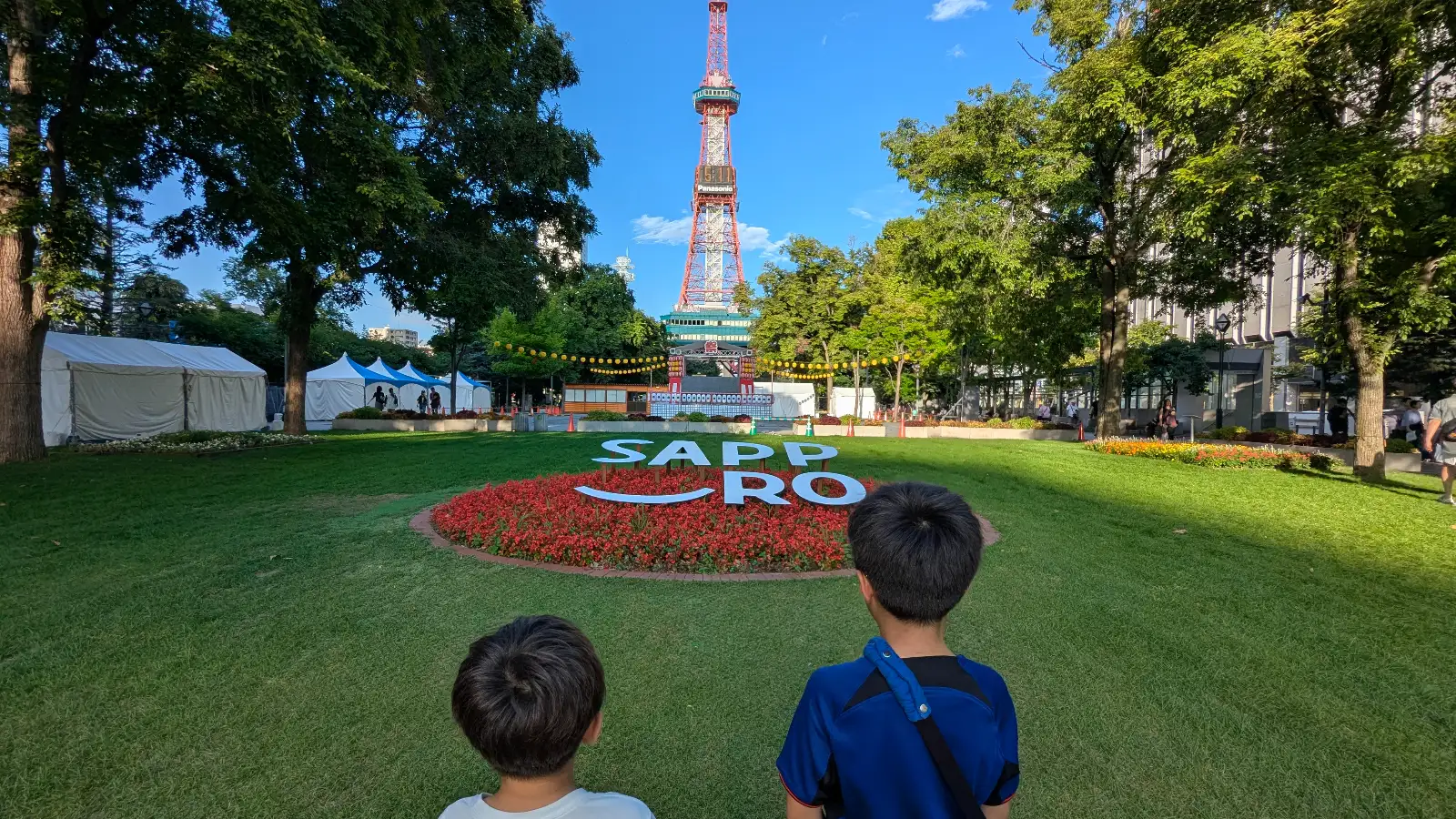
A free park twelve city blocks long gives a child who needs to move all the ground they want, and gives the parent a choice about where the walk ends.
Nothing to book; corn wagons trade on West 3 and West 4 from mid-April to mid-October.
The play equipment closes for winter; the Information Center at West 7 keeps its own hours.
About 1.5 km from West 1 to West 12; a family walks as much of it as it likes.
Play equipment, a play slope and the Black Slide Mantra in West 6 to 9, in season.
Odori Station Exit 8, at West 3, has an elevator; multipurpose restrooms at West 3, 5, 7, 9 and 11; wheelchairs on loan outside winter.
Some links on this page are affiliate links. LuNi may earn a commission at no extra cost to you.
Is Odori Park Sapporo worth it with kids?
The short version, before the costs, the timings and the case for each child.
Yes, and it may be the most useful hour in Sapporo, because it asks nothing. There is no ticket, no gate and no route. The park runs through the middle of the city for about 1.5 kilometers of blocks, and a family walks into it wherever it likes and leaves wherever it likes. The best part for children sits in the middle, where the play equipment, a play slope and a sculpture you can slide down gather in four blocks. The water that makes summer visits so good is seasonal, and so is the play equipment. So come for the play blocks between spring and late autumn, and plan the walk around where the subway exits are, because the play blocks have none of their own.
Planning Your Visit to Odori Park Sapporo with Kids.
A park with no gate still rewards a plan, and it is a short one. Decide which blocks you want, not which park. The numbered blocks run from West 1, where the TV Tower stands, to West 12, where the rose garden is, and each range of blocks has a job: fountains near the east end, play in the middle, history and roses to the west. Then decide how you arrive and leave, which matters more in a park this long than in most. Finally, check the season. Water play is a summer thing and the play equipment closes for winter, so a February family and a July family are visiting two different parks. For where the rest of the week goes, start from our Sapporo guide.
Every LuNi attraction guide starts with a visit, with our own children
LuNi rates and writes about attractions only after visiting them with children. Luca and Nico were at Odori Park Sapporo, and what they did there is recorded further down this page, including how each child actually met it.
Children arrive with different tolerances: for noise, for lines, for standing still, for being on their feet all day. A guide written for the average of them helps almost nobody. So every place on this site is read four ways, and each verdict says which children it already suits and what makes it work for the rest. Whoever you are bringing, the answer here is built for your family rather than for a general reader.
Restricted-movement depletion has nowhere to build in twelve open blocks with a play slope and play equipment, so head straight for the middle blocks.
Sensory-input depletion stays low in an open-air park with no gate to pass through, so check the event calendar and avoid festival days.
Unfamiliarity and unconfirmed structure ease in a park laid out in numbered blocks, one after another, so let the child read the numbers aloud.
Sustained walking and standing stay low when the family sets the length, so start and finish at a subway exit and skip the rest.
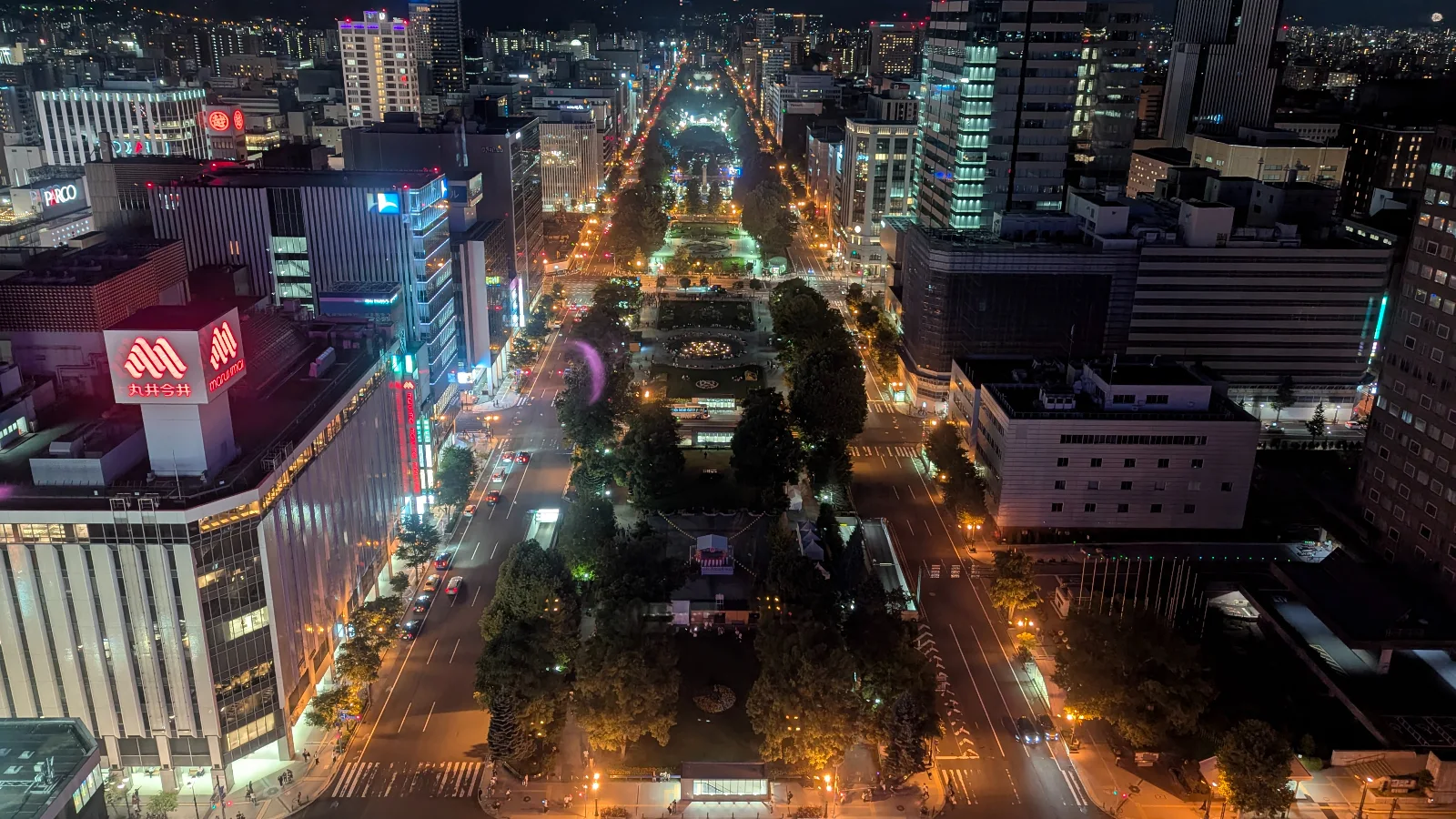
Hotels we would book for this visit.
Three hotels for a family that wants the park as part of every day rather than a single trip: one on the park’s own West 1 block, and two a few streets north of it in the city grid.
| Property | The LuNi Reason |
|---|---|
| LUNI Pick The Royal Park Canvas Sapporo Odori Park | The Royal Park Canvas stands on the park’s own first block, at the TV Tower end, which makes the park something a family uses rather than visits. A child who wakes early can be in the park before breakfast, and a tired one can be back in the room without a subway ride. |
| Sapporo Grand Hotel | A hotel a street north of the park’s fountain blocks, for a family that wants a larger hotel and the park as its daily walk. The West 3 to 5 blocks, with their fountains and four subway exits, are the natural first stretch from here, and the play blocks follow. |
| Hotel Monterey Edelhof Sapporo | The choice for a family with a young child, because children aged 6 and under stay free in existing bedding. It sits on the same West 1 line of blocks as the TV Tower end of the park, so the park and the tower are the easy first morning of the trip. |
The Royal Park Canvas Sapporo Odori Park
Hotel Monterey Edelhof Sapporo
Nearby attractions, matched to your child.
Three pairings for what an open park leaves unmet: a child who wants a fixed plan with an end, a child with energy still to spend indoors, and a child who wants somewhere even quieter.
| Pairing | Why This Solves the After-Visit | For Your |
|---|---|---|
| LUNI Pick Sapporo TV Tower At the park’s West 1 end | An open park has no beginning or end; the Sapporo TV Tower at its West 1 end has both: one ticket and one deck, with a clear end. Unfamiliarity and unconfirmed structure ease when the park walk finishes at a place with a fixed shape. | Anchor |
| Sapporo City Sewage Science Museum Namboku Line from Odori to Asabu | The Sapporo City Sewage Science Museum is free and indoors, with a kids’ space, which makes it the wet-day stand-in for the play blocks. Restricted-movement depletion stays manageable when leaving early costs nothing. Take it on the day the weather turns against the park. | Dynamo |
| Hill of the Buddha Namboku Line to Makomanai, then a bus | After a city park, the Hill of the Buddha is quieter still: a cemetery where every visitor walks and keeps their voice low, and a tunnel that opens onto a great Buddha. Sensory-input depletion eases where silence is the rule for everyone. | Sensor |
Sapporo TV Tower
At the park’s West 1 end For YourAnchor
Sapporo City Sewage Science Museum
Namboku Line from Odori to Asabu For YourDynamo
Hill of the Buddha
Namboku Line to Makomanai, then a bus For YourSensor
How two children actually met this attraction.
Two children walked the same park on a summer day and found different problems in it. One wanted to know the names of things and found that the park would not always tell him; then a crowd arrived in the middle of the work he had set himself, and he stopped. The other wanted room, found plenty of it, and treated the same crowd as something to walk around. Both of them liked the park a great deal, and neither needed it explained. Between them they show what an open space gives a child and what it can take away: freedom for one kind of child and an interrupted project for another. Choose the blocks with your own child in mind, and the park can work for both.
Luca went to the flower beds and stayed there. Many of the flowers were ones he did not know, and not knowing them was the problem he wanted to solve: he wanted names, and the beds did not always supply them. He worked along the planting slowly, comparing one bed to the next. Then the beer garden, busy with adults, pulled his attention off the flowers, and he simply stopped working on them.
This is the Anchor pattern. A child whose Reserve depletes through unfamiliarity and unconfirmed structure treats an unnamed thing as an open question, and open questions cost them. The crowd did not overwhelm Luca; it broke the structure he had built for himself. Families with a similar child should give the park a stated shape before entering, which blocks and in what order, and route around any event blocks rather than through them, keeping the plan intact.
Nico’s verdict on the park was that it was big, which from him is approval. The water fountain was the thing he actually rated: he called it cool and kept returning to it rather than moving on down the blocks. The beer garden he registered as an obstacle, not an event. There were too many people in the middle of the space he wanted to move through, so he went around them and kept going.
This is the Dynamo pattern. A child whose Reserve depletes through restricted movement reads a park as available space first and its contents second, which is why the size registered before anything else and why the fountain he could keep going back to won. Families with a similar child should treat the water and the play blocks as the destination, and cross any crowded block quickly on the way to them, without stopping to negotiate it.
A park that runs for twelve city blocks gives a child something rare in a city: a long, open line to walk, run and explore, with fountains and play areas along the way. Letting a child count the blocks down to the end turns distance into a game and gives them a sense of progress they can see. Parks like this teach children that a city can hold open space as well as buildings. A child who has walked a city’s green spine from end to end begins to feel at home there.
The LUNI Rating for Odori Park Sapporo.
One fact sits under all four verdicts: Odori Park is free, open and numbered. There is no gate, no ticket and no required route, and the blocks run in numbered order, each with its own purpose. That is why every child is well served. A child who needs to move gets space, a child who needs quiet can find it away from the events, and a child who needs structure gets a map written in numbers. For a child who tires on foot, the family decides the length. What changes the park is the calendar, the seasons and the festivals, not anything inside it.
Go straight to the middle. The Dynamo depletes through restricted movement, and a park that runs 1.5 kilometers through a city is about as unrestricted as travel gets. The part built for children is West 6 to 9: a play slope, play equipment, and the Black Slide Mantra, a sculpture children slide down. In summer a water-play channel adds water to it, and the fountains in the eastern blocks run from spring into October.
Everything depends on the season. From late spring to late autumn, the play blocks are the whole point, and a moving child can spend an hour there before walking anywhere else. In winter the play equipment and the slope close, so the park turns into a walk, and the Snow Festival replaces the playground. The two park rules that touch a moving child are no skateboards and no playing catch, so leave the ball at the hotel.
What this means for your Dynamo: restricted movement is rarely the issue here; the season is. A younger Dynamo needs the play equipment and the water in summer; an older one can take the whole length of the park.Check the calendar before you choose the day. The Sensor depletes through sensory input, and on an ordinary day an open-air park asks very little of it: open space, plantings and water in season, with a way out at either end. The park is also Sapporo’s main events ground, though. The Snow Festival, the White Illumination, the Lilac Festival, the YOSAKOI Soran festival, a summer beer garden and a Bon dance all happen here, and on those days the park is a different place.
Check the date before anything else. Look at what is on before going, and on a festival day, choose blocks away from it or choose another day. The event blocks and the play blocks overlap, since the play blocks hold the outdoor stage as well, so an event can land right where a child wants to be. For a walk away from the events, the sunken rose garden sits at the opposite end of the park from the TV Tower.
What this means for your Sensor: sensory input stays low outside event days. A younger Sensor needs a non-festival day and the rose garden; an older one can choose which festival to see, and for how long.Let the child read the numbers. The Anchor depletes through unfamiliarity and unconfirmed structure, and an open city park could feel shapeless. Odori Park is the opposite, because it is numbered. The blocks run in order from West 1 to West 12, and each range has a purpose: fountains in the east, play in the middle, history and culture, then the rose garden at the far west end. A child can know where they are, and what comes next, at every step.
The plan belongs in the child’s hands. Before leaving, agree on the start block and the end block, and what happens in between: fountains, then the play equipment, then the train home. Each subway exit is listed by its block, so the plan can include how you leave: Exit 2 at West 5, Exit 4 at West 10. A child who can count the blocks down to the end of the walk is rarely the one asking how much longer.
What this means for your Anchor: unfamiliarity has little to hold on a park laid out in numbers. A younger Anchor needs the first and last block named; an older one can plan the route and choose the exit.Walk from exit to exit. The Sprinter depletes through sustained travel-style walking and standing, and the visit here rests on one thing: the family sets the length. The park asks for only as much walking as the family chooses to do. The catch is that the subway exits are not evenly spread. Odori Station has exits at West 1, 3, 4 and 5, Nishi-11-chome has exits at West 10 and 11, and the four play blocks in between have none.
Think of the walk as a line from one exit to another. The fountain blocks have an exit on every block, so a short visit there can end whenever the child does. For the play blocks, enter at West 5 and leave at West 10, walking the distance once. Multipurpose restrooms stand at every other block, and the Information Center at West 7 lends wheelchairs free outside winter.
What this means for your Sprinter: walking and standing are what the family chooses. A younger Sprinter needs the fountain blocks, with an exit on each; an older one can walk the play blocks from one exit to the next.The questions parents actually ask.
Odori Park is mostly a matter of where: where children can play, where the exits are, where the restrooms are, and when the water is on. Because the park costs nothing, the planning is about timing rather than money. Summer brings the water and the full play blocks, and winter brings festivals and closes the playground. For a bigger outdoor day beyond the city center, the Historical Village of Hokkaido has fifty-two old buildings to explore, though a Sprinter’s walking and standing mount fast across its large site. Every choice starts from the same idea: the family decides how much of the park to use.
Is Odori Park Sapporo worth visiting with kids?
Yes, and it costs nothing. The park runs about 1.5 km through central Sapporo, from West 1 to West 12, with no ticket and no gate. The middle blocks hold the play equipment and a play slope, and in the warmer months there are fountains and a water-play channel. Families can use as much or as little of it as they like.
Where can children play in Odori Park?
The play blocks are West 6 to West 9: a play slope, play equipment and the Black Slide Mantra. They close for winter once the season turns; in 2025 they closed from November 20, and the 2026 date is posted in the autumn. Skateboards and playing catch are not allowed anywhere in the park.
When do the Odori Park fountains and water play run?
They are seasonal. In 2026 the West 9 water-play channel and the West 11 and 12 fountains started on June 1 and ran 10:00 to 16:00; the channel and the West 12 fountain ended on September 23. The fountains in West 2 to West 6 run into October. Check the park’s news page for the current year.
Which subway exits serve Odori Park?
Odori Station exits serve West 1 (Exit 27), West 3 (Exits 6 and 8, and Exit 8 has an elevator), West 4 (Exit 5) and West 5 (Exit 2). Nishi-11-chome Station serves West 10 (Exit 4) and West 11 (Exit 1). No exit is listed for West 6 to West 9, the play blocks.
Does Odori Park have restrooms and wheelchair access?
Multipurpose restrooms stand at West 3, 5, 7, 9 and 11, and every block has a drinking fountain at wheelchair height. The Information Center at West 7 lends wheelchairs free, with ID, except in winter; it opens 10:00 to 12:00 and 13:00 to 16:00, and closes December 29 to January 3.
How long is Odori Park?
About 1.5 km, from West 1 to West 12, not counting the TV Tower at its West 1 end. The blocks follow themes: international exchange at West 1 and 2, fountains at West 3 to 5, play and events at West 6 to 9, history and culture at West 10 and 11, and a sunken rose garden at West 12.
Is Odori Park worth visiting in winter?
Yes, for the Snow Festival and the White Illumination, which the park hosts in winter; check the dates for your year. Outside those events, winter changes the park for children: the play equipment and the play slope close for the season, and the wheelchair loan stops.
Is the Sapporo Ainu Culture Promotion Center near Odori Park?
No. The Sapporo Ainu Culture Promotion Center is in Minami Ward, about 60 minutes by bus from Sapporo Station, so it is a half-day of its own rather than a rainy-day stop near the park. The Jotetsu Bus from Sapporo Station is the simplest way there. Plan it on a separate morning.
Where Odori Park Sapporo fits your Japan trip.
Official site and opening information: Odori Park