teamLab Planets vs Borderless:which one fits your child.
- The Difference
- Planets is one guided path; Borderless has none
- Younger Kids
- Planets: barefoot, one sequence
- Older Kids and Teens
- Borderless: an open maze to roam
- Time Needed
- 60 to 90 min at Planets, 90 to 120 at Borderless
- Strollers
- Neither allows one; bring a carrier
Parents arrive at this comparison expecting a winner, and the two museums do not sort that way. At teamLab Planets the shoes come off and every visitor moves along one path, through shallow water pools, soft floors and mirrored rooms, in 60 to 90 minutes. Borderless has no path: rooms branch, the art drifts from wall to wall, and families spend 90 to 120 minutes there, often longer. Choose by the child, not the museum. A child steadied by knowing the next room belongs at Planets; a child who lights up when a room surprises them belongs at Borderless. Doing both? Planets first.
Why this is not a ranking.
That is the lens The LUNI Framework brings. Families already budget two currencies, money and time. The third is the child’s Reserve, their finite capacity to absorb what an environment asks of them. One of these museums will replenish a given child and the other will quietly drain them, and which does which flips entirely depending on who the child is. So the useful question is not which teamLab is better for kids, but which environment your child’s Reserve can sustain for the length of a visit. For most families the answer splits the same way: Planets for the child who needs the route decided for them, Borderless for the child who wants to decide it themselves.
What each museum asks of a child.
Before matching a museum to a child, name precisely what each space demands. The difference is structural, and everything else follows from it.
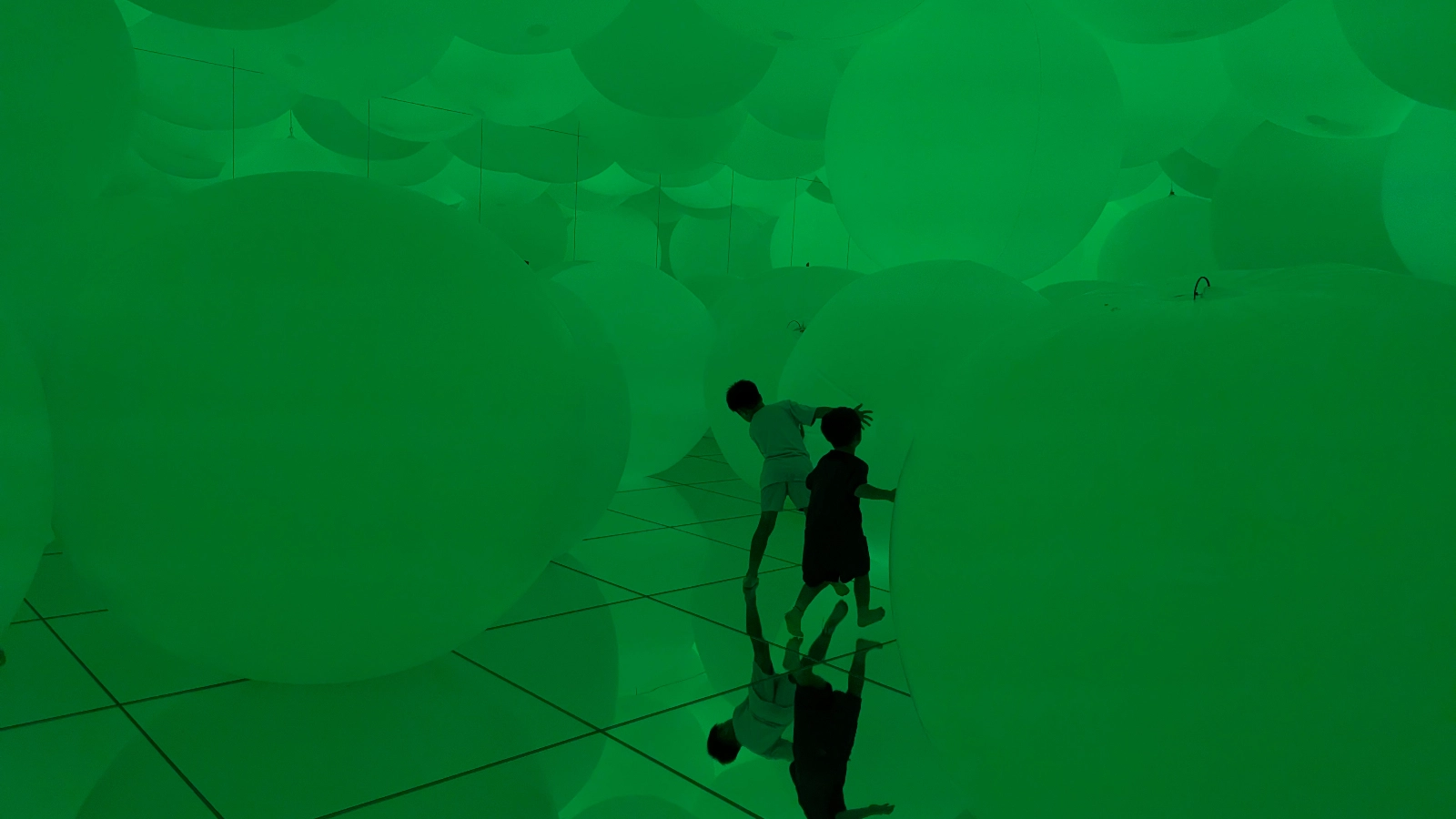
teamLab Planets is built to remove decisions. Visitors take off their shoes and move barefoot through a fixed sequence: shallow, temperature-controlled water pools, soft reflective floors, and rooms where projections respond to movement. Every installation is met in order, with no branching and no doubling back. That linear structure is the defining feature, because it removes the decision fatigue that quietly derails family visits and sets a shared pace, parents and children moving through the same rooms in the same sequence. The tactile load is high, the water and mirrors are genuinely immersive, but the navigational load is close to zero. Most families are through in 60 to 90 minutes.
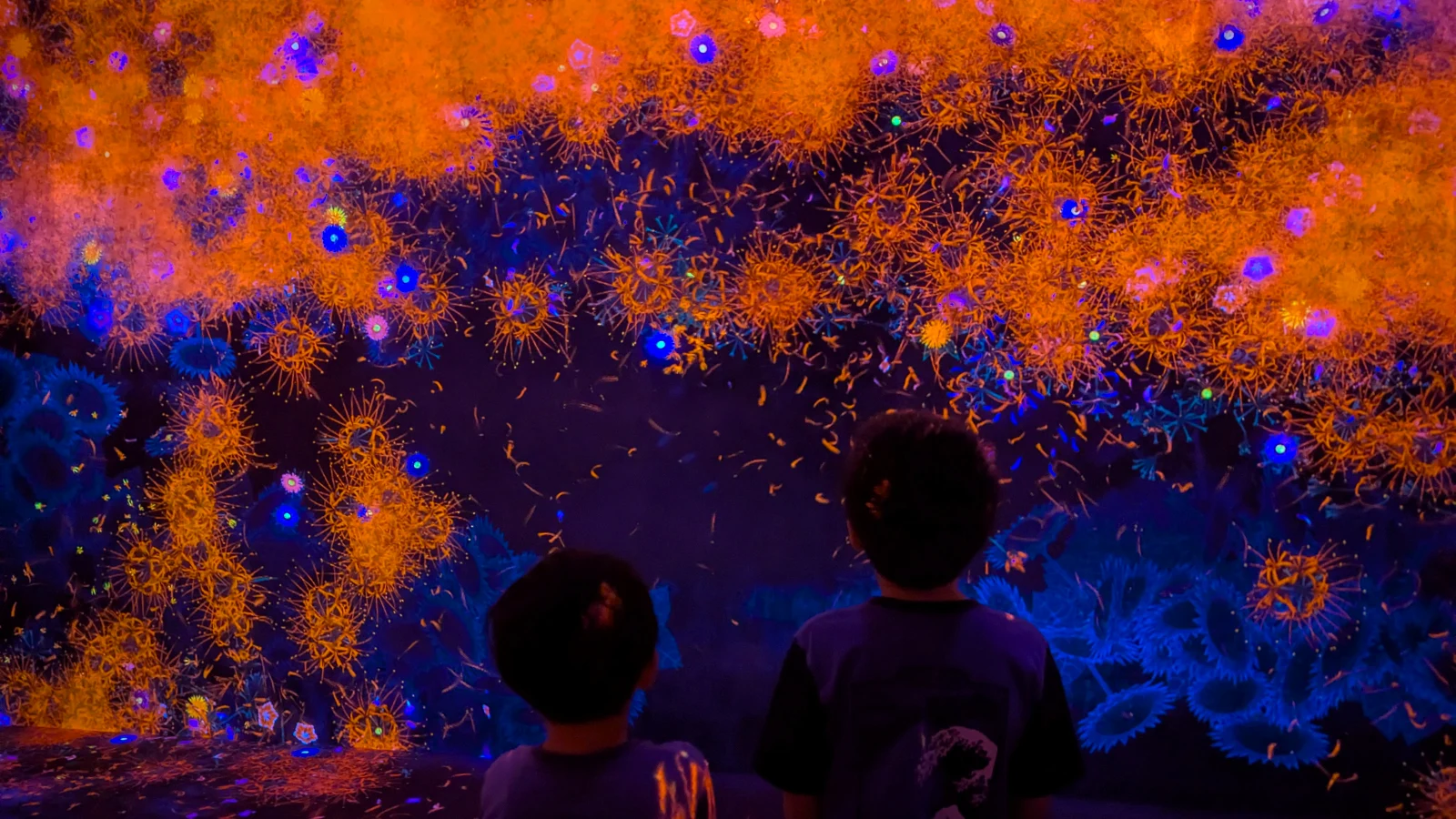
teamLab Borderless is built to reward exploration. There is no path. Rooms branch in several directions, artwork drifts from one space into the next, and the route is different every time a family moves through it. Children lead and parents follow. Projections fill entire rooms floor to ceiling, color transitions happen in real time, and the effect is less like looking at art than being inside it. Here the navigational load is the experience, and the visual intensity runs high throughout. Plan 90 to 120 minutes, and expect older kids to want longer.
Stated plainly: one museum removes the need to choose where to go, and the other makes choosing the entire point. That single structural difference, guided against free-roaming, is what determines which child each one fits. Pacing, energy, sensory intensity, and the honest age range all flow from it.
Which museum fits which child.
Four profiles describe how a child’s Reserve depletes. Read your child in them, and the museum that suits them stops being a guess.
The framework sorts the ways a child runs low into four profiles. Age is a starting point; profile is the better filter, which is why a calm eight-year-old and a bold five-year-old can want opposite museums.
The Dynamo depletes through restricted movement, and Planets’ single-file path is one long restriction. The barefoot sequence looks gentle, but a child who discharges energy by moving spends the whole visit unable to range. Borderless is the fit: the free-roam format hands a Dynamo the discharge channel directly, letting them race ahead, double back, and set their own pace. A younger Dynamo runs the maze as a game with a parent tracking from behind; an older one can be given a room to meet you in and turned loose. Book Borderless for the block of the day when the tank is fullest, never after a full sightseeing morning, and name the meeting room before you go in rather than after the first branch.
The Sensor depletes through sensory input, and this is where the obvious call gets interesting. Borderless stacks input continuously: floor-to-ceiling projection, real-time color shifts, dark corridors with no fixed edges. Planets is intense too, the water and the mirrors, but its load is predictable, and sensory cost falls when the environment is predictable. The guided path lets a Sensor meet one room at a time in a known order. Planets is the fit, timed early before the threshold drops, with a quieter stop held in reserve straight after. A younger Sensor may need that recovery sooner; an older one can often push further into the visit before it is needed.
The Anchor depletes through unfamiliarity and unconfirmed structure, and Planets’ fixed route is itself the anchor. The child always knows what comes next, because the museum decides it for them. Borderless does the opposite: with no path, every corridor is an open question, and the format that thrills a Dynamo reads to an Anchor as continuous low-grade vigilance. Planets is the fit. If the family is set on Borderless, preview it out loud first, name that the rooms change and that getting lost is the point, so the unpredictability arrives as a plan rather than a surprise. A younger Anchor leans hardest on the fixed sequence; an older one will accept the maze once told what to expect.
The Sprinter depletes through sustained walking and standing, and here the two museums diverge on physical load. Planets runs as one forward sequence that never doubles back on itself, so the distance a child walks is the distance the route is, which is why it lands at 60 to 90 minutes and why it cannot overrun. Borderless runs longer, 90 to 120 minutes and often more, on the feet the whole time, navigating dark space that invites covering the same ground twice. For a Sprinter, Planets is the lighter budget and the safer default. If the family chooses Borderless, cap it: pick the rooms that matter, skip the completionist loop, and treat the exit as planned rather than negotiated. A younger Sprinter hits the wall sooner; an older one can stretch the visit as long as the pace stays their own.
When the answer isn’t obvious.
Most children are not a single clean profile, and some families want both museums. Two rules resolve almost every case.
When age and personality disagree, personality wins. A calm, sensory-sensitive eight-year-old can find Borderless genuinely overwhelming, and a bold, high-energy five-year-old can thrive in it. The question that settles it is not how old your child is but how they handle environments they cannot predict. A child who needs to know what comes next belongs at Planets regardless of age; a child who lights up when a space surprises them belongs at Borderless.
If you want to do both, run Planets first. Its grounded, sensory-first pacing is a strong introduction to teamLab’s visual language, and after it, Borderless reads as a natural expansion rather than an abrupt jump in intensity. Doing both in one day is possible but demanding: the two venues sit in different parts of Tokyo, each asks real physical and sensory energy, and a younger child can reach their limit fast. Schedule Planets first, build in a genuine break with food and rest, and hold a clear exit plan in case the second venue is one room too far.
A few logistics apply to either choice. Neither venue allows strollers inside; the barefoot water rooms at Planets rule them out from the first installation, and Borderless’s dark, shifting corridors make them impractical, so a baby carrier is the workable option for non-walking children. And both reward arriving with the Reserve to spend, which means neither belongs at the tail end of a long sightseeing day for the child you are bringing.
What a child remembers from either museum is almost never the installation on the poster. It is the moment the room answered them back, when the water moved because they moved, or the light followed them and not the adult beside them. That is a rare thing to hand a child in a country where they spend most of the day being quiet and being led.
The questions families ask most.
What is the main difference between teamLab Planets and teamLab Borderless?
teamLab Planets follows a single linear path through tactile, water-based rooms. teamLab Borderless is a free-roaming digital maze with no fixed route, where artwork shifts and migrates between spaces. Planets is structured and sensory-focused; Borderless is open-ended and visually kinetic.
Which is better for toddlers, teamLab Planets or teamLab Borderless?
teamLab Planets is the stronger choice for toddlers. Its guided path, barefoot water rooms, and calm pacing suit young children. Borderless, with its maze-like layout and fast-moving projections, can be difficult to navigate and visually overwhelming for very young children.
Which teamLab is better for teens?
Teens typically prefer teamLab Borderless. The open layout, the freedom to explore independently, and the visually dramatic rooms make it feel less like a museum visit and more like a self-directed experience. Most teens find Planets meaningful but slower-paced than they prefer.
Is teamLab Planets or teamLab Borderless more sensory-friendly?
teamLab Planets is more sensory-friendly. Its slower pace, tactile focus, and predictable sequence make it easier for sensory-sensitive children to navigate. Borderless is visually intense, fast-changing, and unpredictable, which is exciting for many kids but harder for those with sensory sensitivities.
How long does each teamLab take with kids?
Most families spend 60 to 90 minutes at teamLab Planets and 90 to 120 minutes at teamLab Borderless. Borderless tends to run longer because the free-roaming format encourages revisiting rooms and following artwork in different directions.
Can you visit both teamLab Planets and teamLab Borderless on the same day?
It is possible but demanding. The two venues are in different parts of Tokyo, and each requires meaningful physical and sensory energy. If you plan to visit both, schedule Planets first, build in a proper break with food and rest before Borderless, and have a clear exit plan ready in case a younger child reaches their limit.