Best Museums in Tokyo With Kids:
which museum is for which child.
In Tokyo the museum a family ends up in is usually the one nearest the hotel. That is how a child’s best two hours go to the wrong building.
The Fire Museum and Tokyo Water Science need no ticket at all.
A fixed timed sale on the 10th, Lawson only. No lottery.
Rescue helicopters on two upper floors, climbed into in a coat.
45 minutes, booked a month ahead, inside a museum with no set route.
Some links on this page are affiliate links. LuNi may earn a commission at no extra cost to you.
Which museum is for which child.
Ten museums across Tokyo, plus one beyond it, grouped by the child each holds longest.
Family travel runs on three currencies, not two. Money and time are the pair every parent already counts; the third is the child’s Reserve, their finite capacity to absorb what travel asks of them. Tokyo is where that gets expensive: too many indoor options, no way to tell them apart, so the choice defaults to whatever is two stops away. These ten are grouped by what the building lets a child do with their body. The Dynamo runs short when they cannot move, the Sensor on noise, the Anchor when nothing is confirmed, the Sprinter on standing.
Miraikan, Odaiba.
Not because it is the best museum here for any single child, but because it is the only one on this map that holds all four profiles, and the architecture is why: the vertical move that exhausts a child in every other multi-floor museum is a 125 meter sloping corridor with a view.
Match your child to one of the four profiles, then read that entry.
| The Museum | What It Settles | Best For |
|---|---|---|
| The Railway MuseumSaitama, day trip | A 300 m outdoor circuit the child drives from elementary age. | Dynamo |
| Fire MuseumYotsuya-sanchome | Free, on a station exit, with boardable helicopters on 3F and 5F. | Dynamo |
| Science and Technology MuseumKitanomaru Park | A machine room worked with hands and feet; some devices need two people. | Dynamo |
| Postal Museum JapanSolamachi 9F | 330,000 stamp varieties, searched by a word the child chooses. | Sensor |
| Fukagawa Edo MuseumKoto City | A reconstructed Edo block you may step up into and handle. | Sensor |
| Ghibli MuseumMitaka | A building the child already knows from the films; tickets sold once a month. | Anchor |
| Nature and ScienceUeno | ComPaSS: a booked 45-minute session inside a museum with no set route. | Anchor |
| Tokyo Water Science MuseumAriake | Free, with a numbered ticket into the working water plant beneath it. | Anchor |
| MiraikanOdaiba | A 125 m sloping corridor instead of stairs between the exhibition floors. | Sprinter |
| Tokyo Toy MuseumShinjuku | A 1935 school where the exhibit is the floor, with 20,000 wooden balls. | Sprinter |
The Railway Museum
Dynamo
Fire Museum
Dynamo
Science and Technology Museum
Dynamo
Postal Museum Japan
Sensor
Fukagawa Edo Museum
Sensor
Ghibli Museum
Anchor
National Museum of Nature and Science
Anchor
Tokyo Water Science Museum
Anchor
Miraikan
Sprinter
Tokyo Toy Museum
Sprinter
For the Dynamo
Museums where the child works the exhibit rather than watches it.
For a child who empties out when they cannot move.
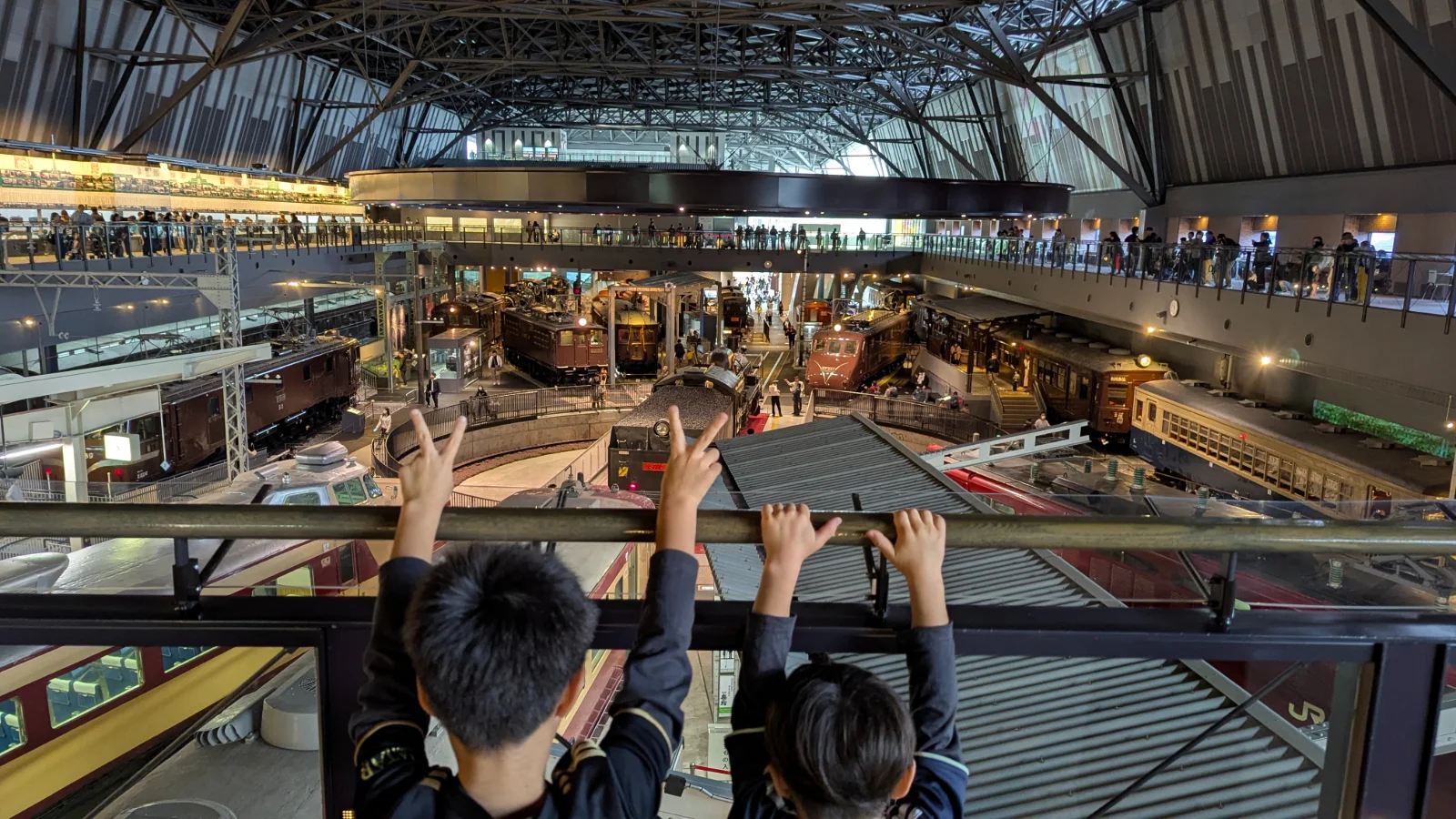
Here the child is at the controls, on a real line, outdoors. The Mini Unten Ressha is a 300 meter circuit of about six minutes, and driving it is restricted to elementary age and above because the driver reads the signals themselves. A movement-led child is not settled by a big room but by a job with consequences. A six-year-old rides in a vehicle a sibling drives; a thirteen-year-old takes the driving school.
Who it costs.The Sensor. Four simulators sit together on the second floor, first come and unlimited, so there is a permanent standing crowd around four screens with four soundtracks at once.
How to make it work.The hands-on experiences are not sold over a counter, they are drawn in the Teppaku Raffle App on the day, so install it before you travel and enter the moment you are through the gate. Treat the mini railway as the reason you came, not the thing you add at the end.
If this isn’t your child: the best railway museum in the country, but forty minutes out and the draw may not go your way.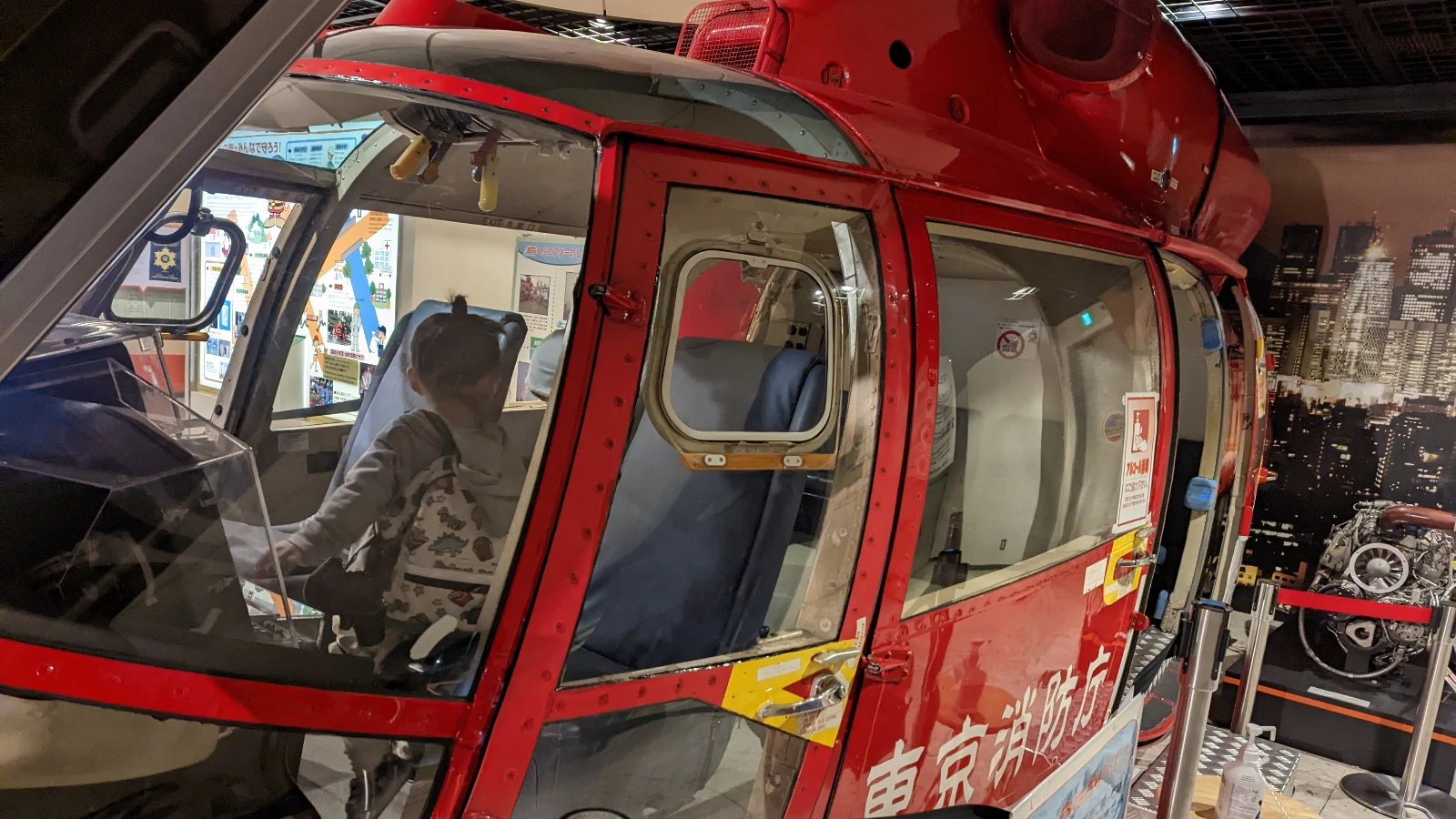
The only museum here where a child puts a uniform on and then gets into an aircraft, and the usual version is wrong: the boardable machines are the helicopters on the third and fifth floors, the basement engines are look-only, and the coats are on the third floor. Get dressed, then climb in: a movement-led child engages by occupying an exhibit, not standing in front of one. A four-year-old wears the coat and sits in the cockpit; a nine-year-old reads the floors for how the equipment changed.
Who it costs.The Sensor. The floors are compact, the exhibits are hard-surfaced vehicles in rooms that carry sound, and the only quiet room is the tenth-floor lounge.
How to make it work.Entry is free and it takes no bookings of any kind, which is the whole use of it: sitting on Exit 2 at Yotsuya-sanchome, it is the stop you insert when a plan collapses, with no ticket bought and nothing committed to lose. Send the child to the coats on the third floor before the helicopters, because that order is what makes it work.
If this isn’t your child: a free hour in central Tokyo you can walk out of at any point, but not an afternoon.This one has a room where several of the machines cannot be moved by one person. Mecha, on the fifth floor, is built from pulleys, levers and gears, and the museum’s instruction is to operate them with hands and feet and to work with the people around you. That makes physical effort the point of the room rather than the thing it suppresses, which is what a movement-led child came for. A five-year-old hangs off a lever; a twelve-year-old works out the gear ratio and fetches a sibling to push.
Who it costs.The Sensor, mildly, and the museum is honest about it: its guide publishes a sensory map naming ten rooms for sudden loud sound, six for flashing light and six as dark.
How to make it work.Several of the Mecha machines cannot be worked by one child, so this entry repays two children over one, and a parent willing to pull a lever. Read its sensory map before you go in and route around the rooms it names for sudden sound.
If this isn’t your child: four floors of hands-on physics in a park most families walk straight past on the way to the palace.For the Sensor
Museums where the child sets the rate anything arrives at.
For a child who empties out on noise, crowding and unfiltered input.
The Postal Museum holds about 330,000 varieties of stamps, the largest display in Japan, and Stamp Pond surfaces them when a child types a word of their own: flowers, people, cute. That inverts the usual contract, where the building decides what the child looks at next; here a sensory-led child sets both subject and pace. A six-year-old searches for animals; a thirteen-year-old finds a stamp from the year they were born.
Who it costs.The Dynamo. There is one physical exhibit, a Kinect delivery game finished in ten minutes, and then a room of glass cases nine floors above the street.
How to make it work.Stamp Pond is the reason to come, so put the child at the search box first and let the cases follow. This one keeps no fixed weekly pattern, so check its published dates before you build a Skytree afternoon around it.
If this isn’t your child: forty-five quiet minutes nine floors above the queue for the tower.Here the family is allowed to step up into the houses, and that permission is tied to the ticket: a visitor holding one may step up into the buildings and handle what is inside them. Inside is a full-scale reconstruction of a Fukagawa Sagacho block, and for a child short on input the load is unusually low and unusually interesting at once: no screens, no narration, no queue, dim by design. A four-year-old opens the cupboards in a row house; a ten-year-old works out from the shared well how the alley functioned.
Who it costs.The Dynamo. It is one hall, walked through in thirty to forty-five minutes on the museum’s own guidance, with no outdoor space.
How to make it work.The hall runs a full day-to-night lighting cycle across the block, so sit through one turn of it rather than walking the lane once and leaving. Tell the child on the way in that they may open the cupboards, because nothing in the room says so.
If this isn’t your child: the most convincing historical reconstruction in Tokyo, but it is one room.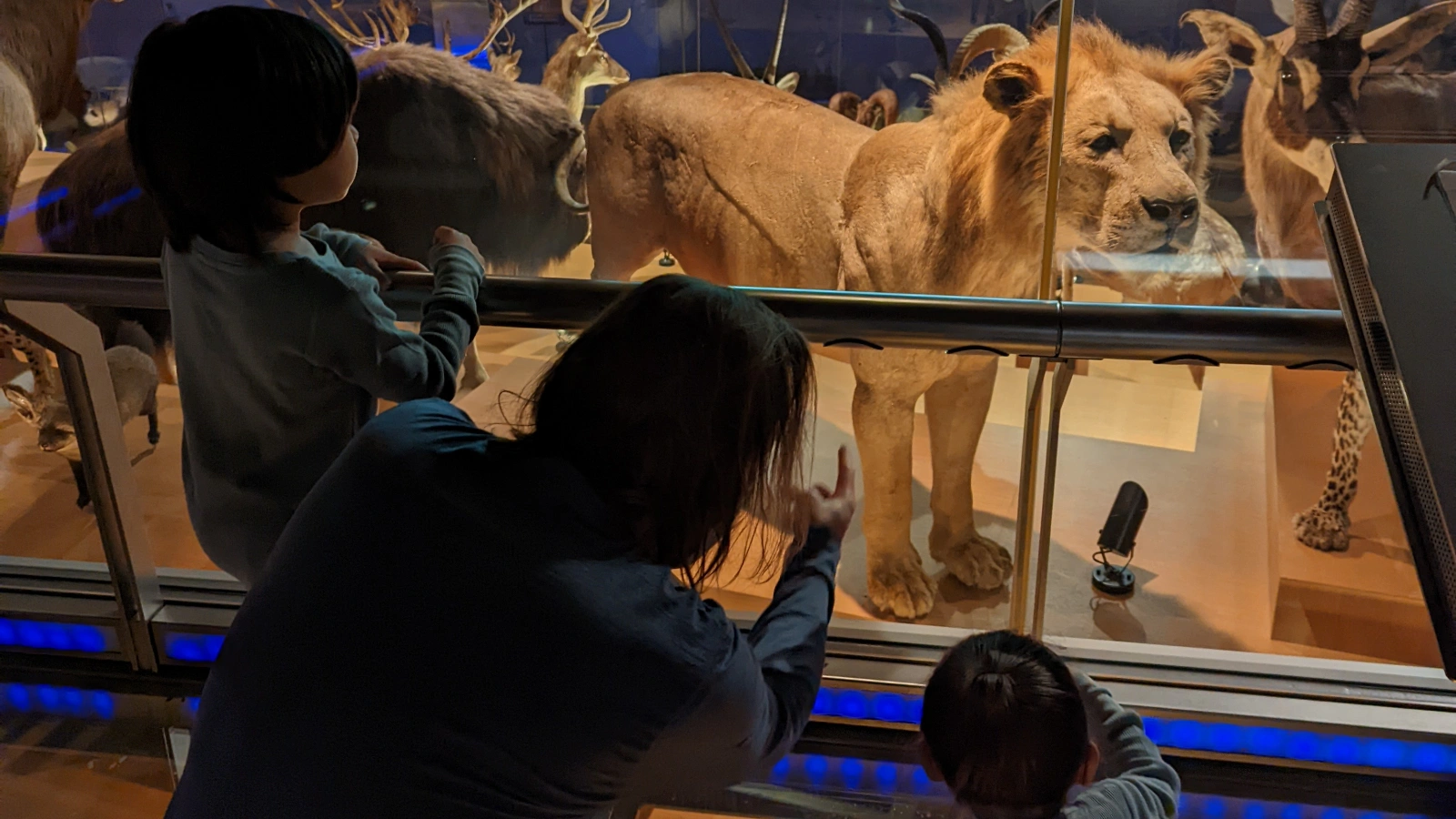
For the Anchor
Museums that hand a child a fixed point to hold on to.
For a child who empties out when nothing is confirmed and everything is new.
The one building in Tokyo a child can walk into already knowing what is in it. Almost every room quotes a film they have watched at home: the Catbus, real, climbable and capped at elementary age, the robot soldier on the roof. For a child who depletes on unfamiliarity the mechanism is prior knowledge, carried in from the sofa, not a schedule. The ceiling is absolute: a child who has not seen the films loses it entirely. A five-year-old goes for the Catbus; a fifteen-year-old spends the visit in the animation rooms.
Who it costs.The Dynamo. A small, deliberately maze-like building with no running and no photography, where the one climbable thing is capped at twelve, and a strobe-flash exhibit in the basement.
How to make it work.Get the ticket rule right, because the repeated version is wrong: this is not a lottery. Tickets are a fixed timed sale on the 10th of each month for the following month, Lawson Ticket online only, six to a buyer, and the museum’s own counter sells nothing. Be at the site the moment the sale opens, not later that day, and watch two of the films before you book.
If this isn’t your child: the most atmospheric small museum in Japan. If nobody has watched the films, watch two before you book.This museum refuses to give visitors a route, then sells one booked session with a start time, an end time and a door. ComPaSS is a room on the third floor, entered by booked session only, forty-five minutes long, from age two upward. The museum states its layout principle openly: two buildings, eleven levels, no prescribed circuit. A child who depletes on unconfirmed structure is not asked to hold the whole museum, only one fixed hour. A three-year-old does the session and one gallery; a twelve-year-old does Theater360, a six-minute film projected inside a 12.8 meter sphere.
Who it costs.The Sprinter. Four levels in one gallery, seven in the other, and no route joining them.
How to make it work.Book ComPaSS on the 1st of the preceding month, the day reservations open, because it is the only fixed point this building offers and it goes quickly. A child aged 0 to 1 still needs a booking of their own. General admission is the opposite case: the old timed-entry advice is wrong and walk-up is normal.
If this isn’t your child: the largest natural history collection in Japan, and eleven levels with no route joining them.Its best exhibit is the working plant underneath. The Aqua Tour goes down into the Ariake Water Supply Station, an operating waterworks below the building, and the allocation matters for a child who needs the day confirmed: numbered timed tickets handed out at the first-floor desk when you arrive, with no advance booking. The time is fixed within a minute of walking in. A five-year-old spends the wait in the water play pool; an eleven-year-old does the laboratory demonstrations.
Who it costs.The Sensor. A theater and a staffed demonstration hall fill the day, the play zone is a wet, echoing space built for noise, and the Aqua Town quiz ends in a sound and mist effect.
How to make it work.Everything here is free, the Aqua Tour included, so the only thing being allocated is time. Go to the first-floor desk before anything else and take the numbered tickets: the tour and the theater both run on them, in the order families arrive. Do that before the play pool, or the tour is whatever is left.
If this isn’t your child: a free two hours in Odaiba with a genuine industrial tour buried inside them.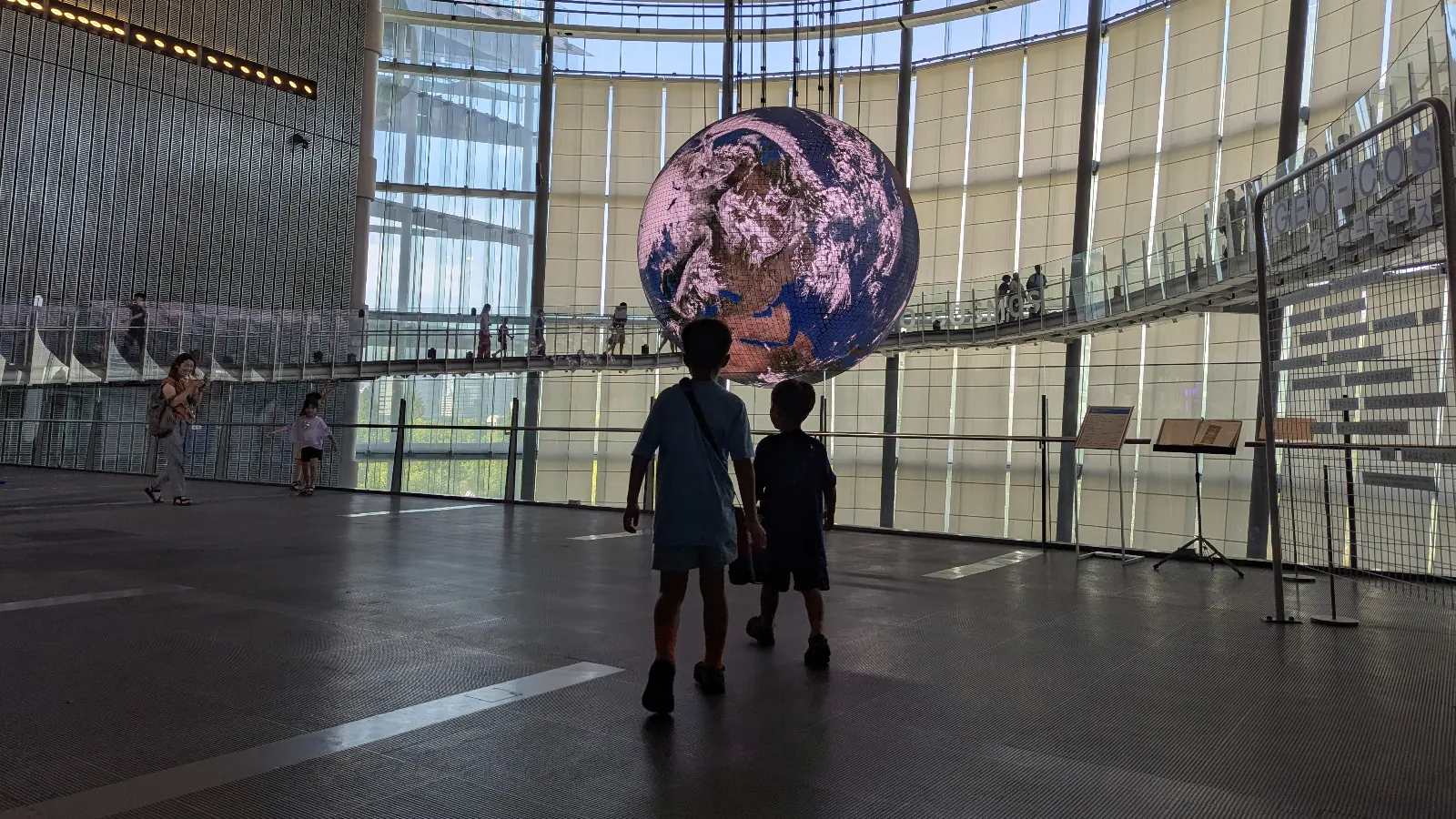
For the Sprinter
Museums that take the standing and the stairs out of the visit.
For a child who empties out on sustained walking and standing.
The only museum on this map where moving between floors is itself the exhibit. Its two exhibition floors are joined by the Oval Bridge, a 125 meter glass-walled corridor that slopes gently between them, with the Geo-Cosmos, a six meter globe, in view its whole length. Everywhere else the vertical move is paid for twice, in the stairs and in the lift queue, and it is the transition rather than the galleries that finishes a child who depletes on standing. Here it is downhill, with something to look at. A four-year-old stops halfway to watch the globe turn; a fourteen-year-old treats the corridor as a viewing gallery.
Who it costs.The Anchor, and mildly is the point: the exhibits have no prescribed order, and the Dome Theater admits nobody once a show starts.
How to make it work.The permanent exhibition has no timed entry at all, so it absorbs a late start. The Dome Theater is the exception: it books a week ahead and admits nobody once a show has begun, so take a slot and build the day around it.
If this isn’t your child: the safest single choice here, and the only one that forgives a slow morning.Here the exhibit is the floor. The museum occupies a wooden elementary school built in 1935, and its central room is a sandbox holding 20,000 Hokkaido hardwood balls, played shoes off, sitting down. That changes the arithmetic for a child who runs out of legs: everywhere else sitting down is the repair after the damage, and here it is the intended posture from the moment the shoes come off. A one-year-old is in the cedar-floored baby room; a nine-year-old is in the workshop making a toy, or booked into the scroll-saw room, open from grade four.
Who it costs.The Sensor, whatever its reputation as a gentle museum suggests: the rooms are old classrooms, small and hard-walled, they fill at weekends, and every sound is made by another child.
How to make it work.Book the date online, because door tickets stop once the day’s allocation has gone, and a baby under six months still needs a ticket of their own. Come on a weekday: the classrooms fill at the weekend, the sandbox first.
If this isn’t your child: the best toddler museum in Tokyo, but nothing for a child past about eleven.Open with the child who runs short first.
Only two pairs chain: Miraikan with Tokyo Water Science in the bay, and the Fire Museum with the Tokyo Toy Museum in Shinjuku.
Three things worth getting right.
Ghibli is not a lottery, and believing it is will cost you the tickets. Tickets go on sale at a set date and time, the 10th of each month for the following month, through Lawson Ticket and nowhere else. Be on the site when the sale opens.
The Railway Museum is not in Tokyo. It is in Saitama, about forty minutes out, so treat it as a day rather than a morning. It earns its place because nothing inside the city hands a child who empties out when they cannot move a circuit to drive.
The Science and Technology Museum has no pedal generators, and the Tokyo Toy Museum’s floors are cedar rather than hinoki. Both are worth knowing before you build a day around them.
How a museum earns a place here.
Fame, review score and district are what Tokyo museum lists are sorted on. None tells a parent which building their child will last two hours in.
The axis here is what the building does to a child while they are inside it, and it comes down to four questions. Does the child operate anything, or only look? Does the input arrive on the child’s terms or the building’s? Can the sequence be told to them before they walk in? And how much of the visit is spent on their feet? Sorted that way the Postal Museum, a room of stamp cases above a shopping mall, outranks far larger collections.
The questions parents actually ask.
What are the best museums in Tokyo for kids?
Miraikan is the one to book first: it is the only museum here that holds all four child profiles. After that it depends on the child. The Railway Museum, the Fire Museum and the Science and Technology Museum suit a child who empties out when they cannot move; the Postal Museum and Fukagawa Edo a child short on noise and input; Ghibli, the National Museum of Nature and Science and Tokyo Water Science a child who needs to know what happens next; the Tokyo Toy Museum a child who runs out of legs.
Which Tokyo museum works when the plan falls apart?
The Fire Museum in Shinjuku. Entry is free, it takes no bookings, and it sits on Exit 2 at Yotsuya-sanchome, so there is no approach walk to negotiate with a tired child, and within minutes a child is in a coat and climbing into a rescue helicopter. Nothing was committed, so nothing is lost by walking out after an hour. The Tokyo Water Science Museum is free too and plays the same role in the bay, though its numbered tickets mean starting early.
Which Tokyo museums are best for a toddler or preschooler?
The Tokyo Toy Museum, with one caution about the room families come for. Its wooden sandbox holds 20,000 hardwood balls and is played shoes off on the floor, sitting down, and a child from six months upward is admitted on a ticket of their own. But the baby wood room is restricted to children aged 0 to 2 with a guardian, on a fixed one-hour rotation, and will not admit an older sibling.
Which Tokyo museums need advance booking?
Four of the ten, and the lead times differ wildly. Ghibli sells date and time specified tickets on the 10th of each month for the following month, through Lawson Ticket only. ComPaSS opens reservations on the 1st of the preceding month, and Miraikan’s Dome Theater a week ahead. The Tokyo Toy Museum sells a date specified ticket that can sell out, and the Railway Museum’s hands-on experiences are not sold at all but drawn in its raffle app on the day.
How do you get Ghibli Museum tickets?
They go on sale on the 10th of every month, for the whole of the following month, through the Lawson Ticket website and nowhere else. It is a fixed timed sale, not a lottery, and the museum’s own counter sells nothing. You may buy at most six, entry is by a specified hourly slot, and tickets cannot be changed, refunded or resold. Overseas visitors use the English Lawson Ticket site.
Is the Railway Museum worth leaving Tokyo for?
For one child, yes. It is in Saitama, about forty minutes out, and the only entry here that takes a whole day rather than a morning. It earns that for a child who empties out when they cannot move, because nothing inside Tokyo hands a child a 300 meter circuit to drive themselves. For any other child it is a long way for a collection they will look at rather than work.