Yokohama With Kids:which stop is for which child.
- From Tokyo
- About 30 minutes, a doable day trip
- Rainy-Day Picks
- Cup Noodles, Hara, Mitsubishi museums
- Room to Move
- Kodomonokuni, Cosmo World, Sea Paradise
- Quieter Stops
- Sankeien Garden and two zoos
- Low-Cost Route
- Yamashita, Nogeyama, Red Brick
Family activities and attractions along the harbor and beyond it, and which pair well on a single trip out of the capital.
Some links on this page are affiliate links. LuNi may earn a commission at no extra cost to you.
Yokohama with kids is about 30 minutes from Tokyo by JR or the Tokyu Toyoko Line to Minato Mirai, a doable day trip. Kodomonokuni, Yokohama Cosmo World and Hakkeijima Sea Paradise are for the child who cannot sit still; Sankeien Garden and the city’s two zoos, Zoorasia and Nogeyama, are the quieter stops. On a wet day the Cup Noodles Museum, the Hara Model Railway Museum and the Mitsubishi Minatomirai Industrial Museum hold the family, and Yamashita Park, Nogeyama and the Red Brick Warehouse make the low-cost route. The Yokohama Air Cabin and Chinatown go easy on tired legs.
Which stop is for which child.
These stops are not ordered best to worst. They are grouped by which child each one is for. The reason is simple: Yokohama runs a deep family list across one walkable bay, and the stop that thrills one of your children is the stop that overwhelms another. So instead of one list, you get four short ones, organized by how each child runs out of steam. The Dynamo runs short when they cannot move. The Sensor runs short on noise and crowds. The Anchor runs short when nothing is predictable. The Sprinter runs short on walking and standing. Find your child below, and start there.
For the Dynamo
Stops that relieve restricted-movement depletion.
For a child who depletes through restricted movement, the strongest stops are Kodomonokuni, Yokohama Cosmo World, and Hakkeijima Sea Paradise.
Kodomonokuni is an outdoor park built around open lawns, huge playgrounds, pedal boats, and seasonal splash zones, and for a movement-driven child that is uninterrupted large-motor discharge with no queue structure to hold them still. The space is the activity, so a Dynamo spends rather than banks energy across the day. A younger Dynamo runs the flat play lawns and rides the mini train; an older one takes the longer loop of the grounds and the cycling course.
Who it costs.The Sprinter. The grounds are genuinely large, with real distance between zones and long stretches without seating, which a low-stamina child cannot bank.
How to make it work.Treat it as a half-day to full-day anchor and go in spring or autumn, so the Dynamo gets the open space without the summer heat compounding the walk for a Sprinter sibling.
If this isn’t your child: a spacious, low-pressure nature park for ages 2 to 10, just a deliberate trip out from the bay rather than a Minato Mirai drop-in.Cosmo World is a seaside amusement park in the heart of Minato Mirai, and its individually priced rides let a movement-driven child move from one to the next on their own pace rather than waiting out a fixed program. For the Dynamo the pay-per-ride format is the relief: energy discharges in bursts across the park, with the Cosmo Clock 21 Ferris wheel as the calm reset between them. A younger Dynamo rides the carousel and bumper cars; an older one chases the coasters that weave through the skyline.
Who it costs.The Sprinter, at caution. The park itself is compact, but it sits inside a wider Minato Mirai walking day, and a low-stamina child arrives with Reserve already partly spent.
How to make it work.Go late afternoon into the evening when it is cooler and the lights come on, and buy individual ride tickets rather than a pass so the Dynamo rides hard while a Sprinter sits out the walk between attractions.
If this isn’t your child: the lit Ferris wheel over the water is the signature Yokohama view, worth one evening pass even if you ride almost nothing.Set on its own island, Hakkeijima combines an aquarium, amusement rides, and seaside walkways into one large outdoor complex, and the scale is the point for a Dynamo: there is always a next thing to move toward, from underwater tunnels to ride platforms to the open shoreline. The variety keeps a high-energy child discharging across a half to full day. A younger Dynamo moves between the dolphin show and the gentle rides; an older one takes the thrill rides with the ocean as a backdrop.
Who it costs.The Sprinter and the budget. The island footprint demands a full day of sustained walking a low-stamina child cannot sustain, and the combined ride-and-aquarium passes are the highest single-stop cost in this guide.
How to make it work.Go on a spring or autumn weekday for thinner crowds and cooler walking, and pick the pass tier to the rides you will actually use rather than the all-inclusive by default.
If this isn’t your child: a genuine all-day destination, though its island location makes it a planned outing rather than a stop folded into a Minato Mirai day.For the Sensor
Stops that let a sensory-loaded child recover.
For a child who depletes through sensory input, the strongest stops are Sankeien Garden and the city’s two zoos, Zoorasia and Nogeyama.
Sankeien is a large traditional garden of ponds, bridges, and historic teahouses set apart from the city’s noise, and for a sensory-sensitive child that acoustic and visual separation is the value: dispersed sound, soft light, and gentle paths where input drops well below the bay’s commercial blocks. A younger Sensor decompresses feeding the koi and crossing the bridges; an older one takes in the seasonal scenery, cherry blossoms in spring through fiery maples in autumn, without a crowd pressing in.
Who it costs.The Sprinter. The grounds are spread out with gravel paths and gentle slopes, so a low-stamina child meets sustained walking despite the calm subject.
How to make it work.Visit in spring or autumn for the strongest scenery, bring a carrier for a younger Sprinter on the gravel, and treat it as the day’s planned reset rather than stacking it after another walking stop.
If this isn’t your child: a calm, beautiful introduction to a Japanese garden, lovely for any family even without the sensory need.Yokohama gives a sensory-sensitive child two zoos at opposite scales, and both serve the Sensor for the same reason: animal interest without concentrated crowd noise. Zoorasia, the larger of the two, is designed as immersive eco-zones that recreate whole habitats with generous spacing between them, so animals and people are spread across Asian jungle, African savanna, and Arctic forest rather than packed together, keeping visual interest high while the sensory load stays manageable. Nogeyama is its compact, free counterpart: a short, low-stimulation loop with shaded paths and a small petting corner that delivers real animal encounters in under an hour. A younger Sensor meets the guinea pigs and rabbits up close at Nogeyama, or takes Zoorasia’s zones in shorter bursts with rest between; an older one walks Zoorasia’s full themed circuit reading the habitat detail.
Who it costs.The Sprinter, at Zoorasia. The same spacing that calms the Sensor means a genuine half-day of walking with real distance between zones and some mild slopes; Nogeyama is the low-walking alternative when stamina is the limit.
How to make it work.For a bigger day pick Zoorasia and arrive at opening when animals are active and crowds are lightest; for a short, no-cost stop pick Nogeyama and pair it with the open hilltop park nearby so a Dynamo sibling ends on movement.
If this isn’t your child: two genuinely good zoos at different commitments, the immersive half-day at Zoorasia or the relaxed free hour at Nogeyama, worth it for any animal-loving family.
For the Anchor
Stops with confirmed, predictable structure.
For a child who depletes through unfamiliarity and unconfirmed structure, the strongest stops are the Cup Noodles Museum, the Hara Model Railway Museum, and the Mitsubishi Minatomirai Industrial Museum.
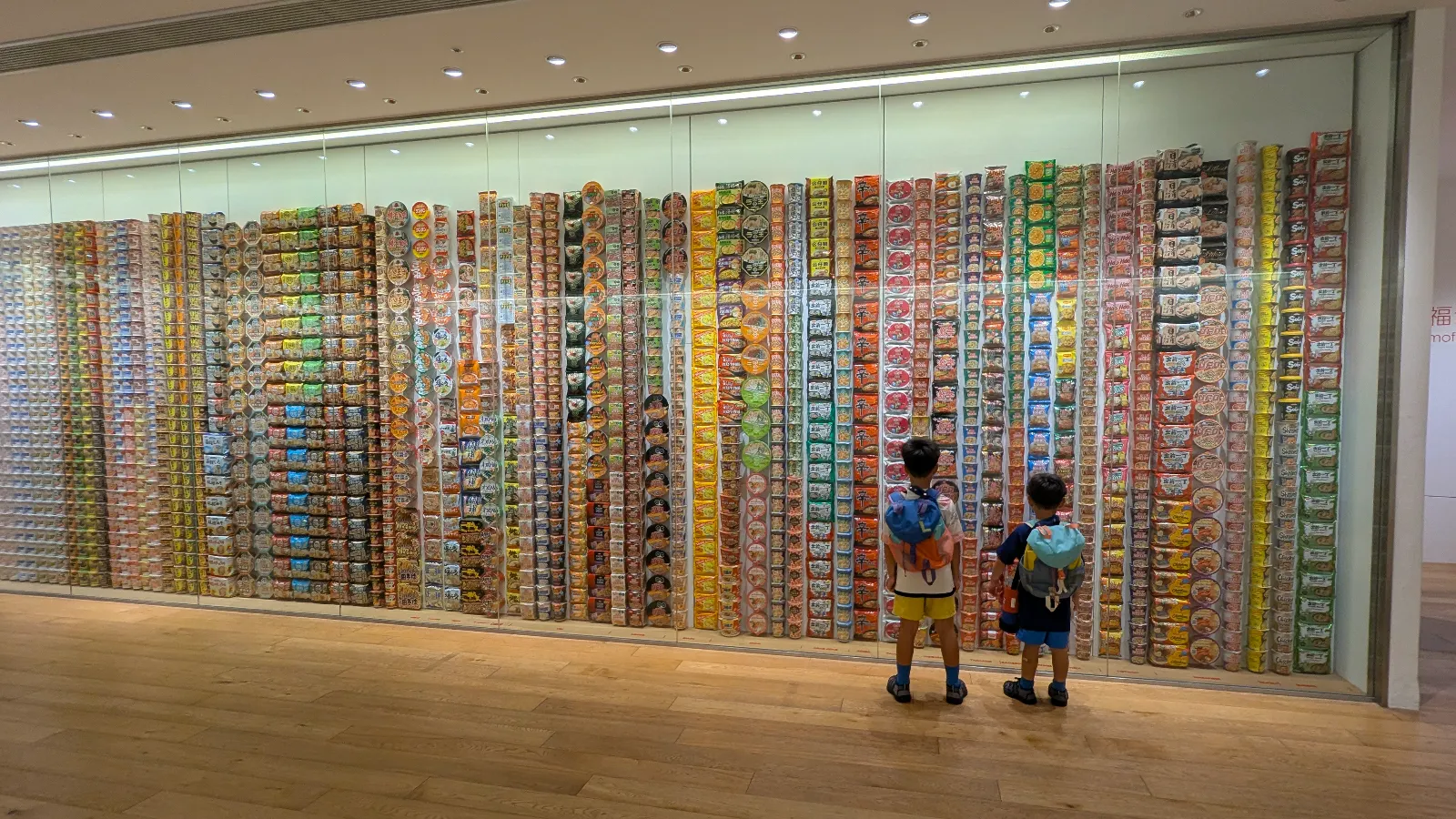
The museum’s My Cup Noodles Factory is a fixed, sequenced, hands-on task with a confirmable outcome: you decorate a cup, choose ingredients in a defined order, watch it sealed, and carry it out. That step-by-step structure is exactly what steadies an Anchor, who relies on knowing what comes next, and the whole building is indoor and predictable end to end. A younger Anchor follows the clear decorate-and-fill steps; an older one works through the invention exhibits and the noodle-making workshop that explain how the sequence connects. Families wanting the same confirmed, format-driven appeal for an older child will find it one stop over at the Shin-Yokohama Ramen Museum, a recreated retro streetscape of regional ramen counters.
Who it costs.The Sensor, at peak. The interactive halls concentrate noise and crowds as the building fills, so a sensory-sensitive child meets a higher load by early afternoon.
How to make it work.Go on a weekday morning when the workshops are quietest, and use the rest areas as a planned reset before the Noodles Bazaar food court at the busy midday hour.
If this isn’t your child: a hands-on, genuinely fun couple of hours with a souvenir at the end, one of the easiest indoor stops in the bay for any family.On the second floor of the Yokohama Mitsui Building, minutes from Shin-Takashima and Yokohama Station, the Hara Model Railway Museum is built around one of the world’s largest indoor model-train dioramas, a tennis-court-sized layout you take in from a fixed viewing walkway. For an Anchor that fixed observation format is the relief: there is one clear circuit, nothing improvises, and the trains run a confirmed, repeating day-to-night cycle a child can anticipate and watch again. A younger Anchor recognizes the original Thomas the Tank Engine models on sight and watches the loop; an older one follows the exhibit rooms tracing how the collection was built, in order.
Who it costs.The Sensor, mildly. The models reproduce real train sounds and the main diorama dims to a night cycle, so a sensory-sensitive child meets more ambient noise and light change than a static gallery, and the small hall can feel crowded at peak.
How to make it work.Reserve ahead and note it is closed Tuesdays and Wednesdays, go on a weekday when the diorama hall is quietest, and download the museum’s English app guide since signage is mostly Japanese.
If this isn’t your child: a genuinely absorbing indoor hour for any train-curious family and a strong rainy-day stop, just steps from the main bay.This hands-on science and technology museum is organized into clearly themed zones, space, deep-sea, transport, and energy, each with a defined set of interactive stations, so an Anchor can map the building and work it as a sequence of confirmable tasks. The simulators have rules and outcomes, which is the structured, repeatable challenge an Anchor returns to. A younger Anchor moves station to station through the contained exhibits; an older, science-minded child works the helicopter and submarine simulators to a measurable result.
Who it costs.The Sensor. The simulators and exhibits carry concentrated sound and flashing input in an enclosed space, so a sensory-sensitive child meets a higher load than the calm subject suggests.
How to make it work.Go late morning or early afternoon, ideal on a hot or rainy day, and let a Sensor sibling work the quieter static exhibits while an Anchor takes the loudest simulators.
If this isn’t your child: a strong rainy-day choice for curious children roughly 5 to 12, especially those drawn to machines and space.For the Sprinter
Short, low-stamina stops with little walking.
For a child who depletes through sustained walking and standing, the strongest stops are the Yokohama Air Cabin, Yamashita Park, and Yokohama Chinatown.
Japan’s first urban cable car runs a short, seated, scenic crossing between Sakuragicho Station and Unga Park, and for a low-stamina child that is the rare bay attraction that costs no stamina at all: you sit, the city moves beneath you, and you arrive somewhere new without a single step of walking. For a Sprinter it is movement banked rather than spent. A younger Sprinter watches the Ferris wheel and harbor slide past the glass; an older one tracks the skyline landmarks across the ride. It also lands beside the Red Brick Warehouse, whose flat waterfront plaza and indoor markets make an easy seated-arrival second stop with almost no added walking.
Who it costs.The budget. The fare is modest but it is a paid few-minute ride, so a family counting yen feels it more than a low-stamina child does.
How to make it work.Ride it early evening for the lit skyline, and take it one way as a transit link between Cosmo World and the Red Brick Warehouse rather than a round trip, so it does double duty as a stop and a shortcut.
If this isn’t your child: a quick, novel bird’s-eye view of the bay that connects the major Minato Mirai stops, a fun few minutes for any family.Yamashita Park is a flat seaside green strip along the waterfront with wide level paths, open lawns, and benches throughout, which makes it the lowest-effort outdoor stop in the bay for a low-stamina child: a family can do as much or as little of it as the legs allow, with a place to sit always in reach. For a Sprinter it is a stop with no stamina floor. A younger Sprinter watches the Hikawa Maru ship and the harbor traffic; an older one walks the promenade to the adjacent Marine Tower, a short, fully accessible glass-elevator climb to a harbor view that pairs naturally with the park.
Who it costs.The Anchor, mildly. The park is open and unstructured with no set route or sequence, so a child who relies on confirmed structure gets less to anchor to here than at a museum.
How to make it work.Go late afternoon for cooler air and harbor sunset, and for an Anchor give the visit a small fixed goal, finding the Hikawa Maru or riding the Marine Tower, so the open space has a defined endpoint.
If this isn’t your child: a free, scenic waterfront walk that pairs with Chinatown and the Marine Tower, an easy reset for any family between busier stops.One of the world’s largest Chinatowns, this is a compact, food-led grid of colorful gates, lantern-lit streets, and street-food stalls, and for a low-stamina child the appeal is that it is grazed rather than toured: short walks between dumpling and steamed-bun stops, with a payoff every few steps and no sustained distance to cover. A younger Sprinter samples sesame treats and watches the gate dragons; an older one navigates the stalls and picks the next thing to try.
Who it costs.The Sensor and the Anchor, both at high risk. The streets run dense, bright, and loud, with no contained interior to retreat into mid-visit, and the unstructured maze of stalls offers an Anchor little predictable sequence to hold.
How to make it work.Go at off-peak hours rather than the evening crush, enter through one gate and out another on a planned short loop so an Anchor has a defined route, and keep the visit to a single food circuit when a Sensor sibling is along.
If this isn’t your child: a vibrant, genuinely fun food walk and a highlight of any Yokohama day, best taken in daylight and kept short with a crowd-sensitive child.Open with the child who runs short first.
The order of a Yokohama day is set by Reserve, not by the map. Each route opens with the stop that protects the named child, then chains to the nearest compatible one.
Settle these first. Hakkeijima Sea Paradise is the one stop that controls the whole day: it is an island destination and a half to full day on its own, so it never shares an afternoon. The out-of-center stops, Zoorasia, Sankeien Garden, and Kodomonokuni, are each a deliberate trip rather than a Minato Mirai drop-in. Everything in the central bay (Cosmo World, the Cup Noodles Museum, the Air Cabin, Yamashita Park, Chinatown) is walk-up fill-in arranged around whichever of those you choose.
When to go, and what costs nothing.
Mornings hold the most Reserve, so the indoor, format-driven stops a structure-reliant child manages best (the Cup Noodles Museum, the Hara Model Railway Museum, Mitsubishi) belong early, before the crowds and noise build. The evening belongs to the bay: Cosmo World and the Air Cabin are at their best after dark, with the lit Ferris wheel over the water as the day’s close. The free stops carry real weight here: Yamashita Park, the free Nogeyama Zoological Gardens, and the open Red Brick Warehouse plaza all cost nothing, and they are also among the lowest-stimulation, lowest-walking stops in the city, so the free route and the reserve-protecting route are largely the same route. The Osanbashi Pier observation deck is a further free harbor viewpoint a short walk from Yamashita Park.
Three bases that fit a family’s Reserve.
A shortlist chosen for location logic, not price tier. The full set is in the complete Yokohama hotel guide.
| Property | The LuNi Reason | Budget |
|---|---|---|
|
LUNI Pick
The Westin Yokohama
In Minato Mirai, with a kids’ pool
|
Spacious family rooms and a kids’ pool in the heart of Minato Mirai, a short flat walk from Cosmo World and the Cup Noodles Museum. The central location keeps the daily walk short for a Sprinter, and the room to spread out lets a sensory-loaded child decompress at the end of a high-stimulation bay day. | ¥¥¥ |
| The Kahala Hotel & Resort Yokohama Waterfront, set back from the crowds | A calm waterfront base with an indoor pool and room-to-spread suites, set apart from the busiest blocks so a sensory-loaded child decompresses fully at the end of a high-stimulation bay day, while staying within reach of Minato Mirai. | ¥¥¥ |
| The Yokohama Bay Hotel Tokyu In Minato Mirai, by Cosmo World | Connecting rooms in the heart of Minato Mirai, a short flat walk from Cosmo World and the Cup Noodles Museum, which gives a Sprinter the shortest daily walk to the central stops and a Dynamo quick reach to the rides. | ¥¥ |
Budget: ¥¥¥
The Kahala Hotel & Resort Yokohama
Budget: ¥¥¥
Budget: ¥¥
For every family-friendly option across Yokohama, see the full Yokohama family hotel guide.