Kamakura With Kids:which stop is for which child.
- From Tokyo
- Under an hour by JR
- Is Enoshima Kid-Friendly?
- Aquarium for any age; the island from 5
- Room to Run
- Kamakura Seaside Park and Yuigahama
- Rainy Day
- The aquarium and the indoor halls
- Quieter Corners
- Hokokuji’s bamboo and Meigetsu-in
The area’s beaches, temples and play spaces, and how the weather changes which of them suit a family on the day.
Some links on this page are affiliate links. LuNi may earn a commission at no extra cost to you.
Kamakura is under an hour from Tokyo by JR, and the Enoden tram links its coast on the ground. Enoshima Aquarium suits any age, while the island itself works from about five, with stairs and uneven paths past the bridge. Kamakura Seaside Park, Yuigahama Beach and Tsurugaoka Hachimangu let an active child run. Hokokuji’s bamboo forest, Meigetsu-in and Hiroyama Park are the quiet corners. Komachi Street and the Great Buddha grounds go easy on tired legs, and on a rainy day the aquarium and the indoor halls hold the family. Ten stops, each mapped to a child.
Which stop is for which child.
These stops are not ordered best to worst. They are grouped by which child each one is for. The reason is simple: Kamakura packs temples, beaches, and hill trails into a compact coast, and the stop that restores one of your children is the stop that empties another. So instead of one list, you get four short ones, organized by how each child runs out of steam. The Dynamo runs short when they cannot move. The Sensor runs short on noise and crowds. The Anchor runs short when nothing is predictable. The Sprinter runs short on walking and standing. Find your child below, and start there.
For the Dynamo
Stops that relieve restricted-movement depletion.
For a child who depletes through restricted movement, the strongest stops are Kamakura Seaside Park, Yuigahama Beach, and Tsurugaoka Hachimangu.
Open lawns, playground equipment, and flat beach access give a movement-driven child the discharge that temple grounds deny them. It is the one stop that returns Reserve rather than spending it, which is why it anchors the Dynamo’s day rather than ending it. A younger Dynamo gets unbroken running room on the grass; an older one can range between the playground, the sand, and the promenade without a single rope line holding them still.
Who it costs.No profile pays much here. The Sensor’s only caution is an exposed, sun-bright openness with little shade at midday.
How to make it work.Use it as the reset between temple stops, not the finale, so the Dynamo discharges early and the rest of the day runs calmer.
If this isn’t your child: still an easy, low-stress break by the water, just not the reason you came to Kamakura.A wide, gentle stretch of sand with shallow water and summer lifeguards, Yuigahama lets a high-energy child move on their own terms, which for the Dynamo discharges energy rather than draining it. A younger Dynamo splashes and digs at the shoreline; an older one walks the long beach toward the Enoden tracks or hunts shells and stones along the tideline.
Who it costs.The Sensor, mildly, on a peak summer weekend when the beach crowds and the noise climbs. The Sprinter, on the soft sand, which is harder walking than it looks.
How to make it work.Go late morning on a weekday outside high summer, when the sand is warm and the crowd is thin, so the movement payoff comes without the sensory cost.
If this isn’t your child: a pleasant ocean pause after the temples, easy to fold in for an hour.Kamakura’s central shrine opens onto wide approach paths, broad grounds, and carp ponds that give a movement-driven child room to roam between the gates. The long Dankazura approach and open precinct let a Dynamo cover ground at their own pace. A younger Dynamo runs the flat central path; an older one climbs the stone steps to the upper hall and takes in the view back down the avenue.
Who it costs.The Sprinter, at the upper shrine, reached only by a flight of stone steps with little to sit on partway. The shrine’s gates open at 6:00 and close at 20:00 all year, so the steps can come first, while legs are fresh.
How to make it work.Enter from the top of Komachi Street and let the Dynamo lead the approach, keeping the upper-hall steps optional for a tired-legged sibling.
If this isn’t your child: a genuinely grand shrine approach, worth the walk for the avenue alone.For the Sensor
Stops that let a sensory-loaded child recover.
For a child who depletes through sensory input, the strongest stops are Hokokuji Bamboo Forest, Meigetsu-in, and Hiroyama Park.
A small, quiet grove where tall bamboo softens light and sound into something close to stillness, Hokokuji turns the sensory dial down rather than up. For a child whose threshold is spent by crowds, the hush is the point: dispersed sound, filtered light, and a short, contained loop with no sudden shifts. A younger Sensor settles over a matcha at the tea pavilion; an older one walks the grove slowly and notices the quiet.
Who it costs.The Dynamo, mildly. The grove is small and the loop is short, so there is little room to discharge, and the calm that restores the Sensor can leave a mover restless.
How to make it work.Go early, before the grove fills, and pair it with a movement stop afterward so a Dynamo sibling has somewhere to spend what Hokokuji asks them to hold in.
If this isn’t your child: a serene, photogenic grove worth a slow half hour from any family.Known for hydrangea-lined paths and a single round Window of Enlightenment, Meigetsu-in is a calm, low-stimulation garden temple with soft sightlines and an unhurried pace. For a Sensor child it is a gentle, predictable space where input stays low and nothing startles. A younger Sensor looks for the temple’s rabbit motifs along the paths; an older one frames the round window and takes in the garden through it.
Who it costs.The Sensor’s own calm flips in mid-June, when hydrangea season packs the narrow paths and the queue for the window builds. The Sprinter, on the garden’s steps and slopes.
How to make it work.Visit on a quiet spring or autumn weekday for the calm version; if you come for the June hydrangeas, arrive at opening before the paths fill.
If this isn’t your child: a beautiful small temple, loveliest in hydrangea season if you can take the crowds.A hilltop park of open lookouts and quiet trails well away from the temple crowds, Hiroyama trades density for air and distance. For a Sensor child the wide coastal views and the dispersed, low-noise setting are the recovery: nothing concentrates here. A younger Sensor visits the small animal area and counts what they spot; an older one takes the lookout for Enoshima and, on a clear day, Mount Fuji.
Who it costs.The Sprinter, plainly. The reward sits at the top of a hillside climb on uneven paths with sustained walking and few benches.
How to make it work.Treat it as a clear-morning detour for families with steady legs, and skip it on a low-stamina day rather than spending the whole group’s Reserve on the climb.
If this isn’t your child: a rewarding viewpoint if the legs are willing, easy to leave off a tired day.
For the Anchor
Stops with confirmed, predictable structure.
For a child who depletes through unfamiliarity and unconfirmed structure, the strongest stops are Zeniarai Benten and the Enoshima Aquarium.
The money-washing shrine runs on a single, clear ritual: enter through the rock tunnel, take a basket, wash your coins in the spring. For an Anchor that defined, repeatable sequence is the reassurance, a stop where the rules are stated and nothing improvises. A younger Anchor follows the simple steps with a parent; an older one learns the ritual once and leads it, already oriented because the structure never shifts.
Who it costs.The Sprinter, on the uphill walk in and the tunnel-and-steps approach. The Sensor, mildly, when the small cave space concentrates other visitors.
How to make it work.Walk the Anchor through the ritual once on the way in so the sequence is confirmed, and go earlier in the day before the compact grounds fill.
If this isn’t your child: a hands-on, slightly hidden shrine that most kids find genuinely fun.The aquarium runs on a fixed circuit and a posted show schedule: jellyfish rooms, touch pools, and dolphin performances at set times along a single defined route. For an Anchor that confirmed structure is the draw, a visit that can be previewed and anticipated rather than improvised. A younger Anchor follows the marked path tank to tank; an older one plans the day around the dolphin show time, holding a fixed point to build around.
Who it costs.The Sensor, during a crowded indoor show when sound and density peak in an enclosed hall. The Sprinter pays little here, which is part of why the aquarium, not the island, is the Enoshima stop for tired legs.
How to make it work.Check the show schedule on arrival and anchor the visit to one performance, choosing a weekday slot to keep the indoor crowd, and the Sensor cost, down.
If this isn’t your child: one of Japan’s better aquariums and the day’s strongest rainy-weather stop for any family.For the Sprinter
Short, low-stamina stops with little walking.
For a child who depletes through sustained walking and standing, the strongest stops are Komachi Street and the Great Buddha grounds.
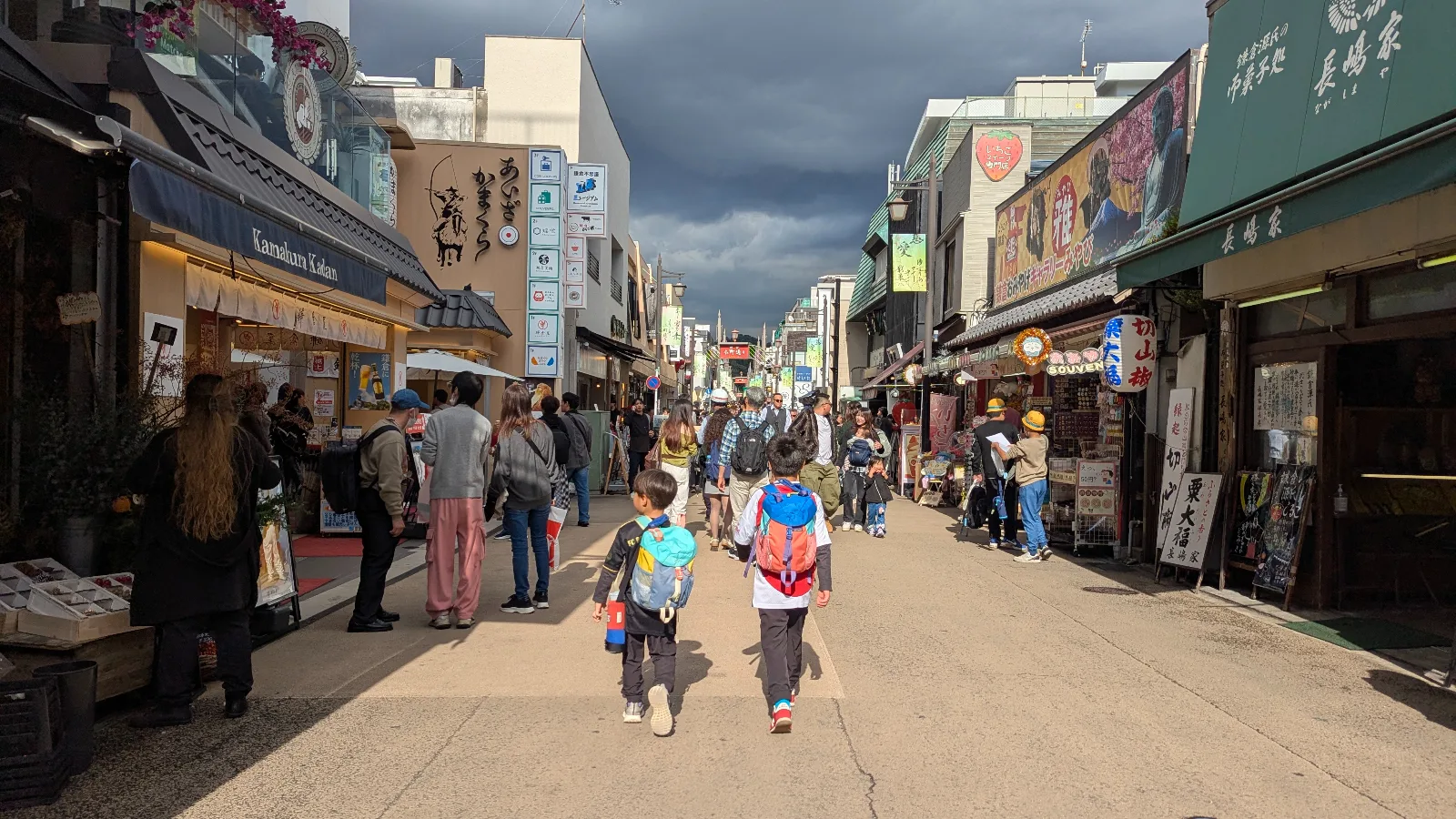
The pedestrian shopping street between Kamakura Station and the central shrine is flat, short, and paced by snacks rather than distance, which is exactly what a low-stamina child needs. For the Sprinter, Komachi is a real stop that costs almost no walking: a soft-serve, a souvenir, a few hundred level meters with somewhere to pause every few steps. A younger Sprinter grazes the snack stalls hand in hand; an older one browses the anime and craft shops at their own unhurried pace.
Who it costs.The Sensor, at high risk on a peak weekend, when the narrow street packs shoulder to shoulder and the noise and press build with no easy exit.
How to make it work.Walk it mid-morning on a weekday or early, before the crowd thickens, and use it as the rest corridor between the station and Tsurugaoka Hachimangu rather than a destination in itself.
If this isn’t your child: the most enjoyable food-and-souvenir stretch in Kamakura, woven into nearly every route anyway.The great bronze Buddha sits on compact, mostly level grounds about a seven-minute walk from Hase Station, so the payoff comes with very little walking, the rare headline sight that asks almost nothing of a low-stamina child’s legs. For the Sprinter it is the cheap landmark of a Kamakura day: a genuine wow with a short, even approach and room to sit nearby. A younger Sprinter cranes up at the scale and guesses the height; an older one steps inside the statue, a brief, self-contained extra that adds no real distance.
Who it costs.Very little. The grounds rate well across the board; the Sensor’s only caution is the dense entrance plaza at midday peak.
How to make it work.Come early or late for softer light and a thinner plaza, and take the stroller-friendly Hase Station route so the Sprinter spends arrival energy on the sight, not the walk.
If this isn’t your child: the one Kamakura sight nearly every family agrees is unmissable, and easy on every profile.Open with the child who runs short first.
The order of a Kamakura day is set by Reserve, not by the map. Each route opens with the stop that protects the named child, then chains to the nearest compatible one along the Enoden coast.
Ride the coast, don’t fight it. Kamakura runs on a single JR line in from Tokyo and the Enoden along the shore, and the train is itself one of the day’s best things to do. The Enoden threads between houses and ocean from Kamakura to Enoshima, and at Kamakura Kokomae the seaside crossing made famous by the Slam Dunk anime draws a steady crowd of fans timing the trains against the water. Build the route as a line along the Enoden rather than a hub-and-spoke from the station, and the connective ride does double duty as a rest between stops.
When to go, and what costs nothing.
Mornings are the widest window: every temple is calmest before the day-trip crowd arrives from Tokyo, and a single afternoon rarely holds the Great Buddha, Hasedera, and Tsurugaoka Hachimangu together without a child running short, so build around one profile’s route rather than all three. Spring and autumn bring the mildest paths, June the hydrangeas at Hasedera and Meigetsu-in, and summer the heaviest coastal crowds. The free stops carry real weight here: Tsurugaoka Hachimangu, Yuigahama Beach, Kamakura Seaside Park, and the Enoden coast views all cost nothing, and several of them are also the stops that protect a child’s Reserve best, so the budget route and the calm route often run together.
Three bases that fit a family’s Reserve.
A shortlist chosen for location logic, not price tier. Each one shortens the walk to a different profile’s day.
| Property | The LuNi Reason | Budget |
|---|---|---|
| LUNI Pick Hotel Metropolitan Kamakura Steps from Kamakura Station | Beside the station at the top of Komachi Street, this base puts the central shrine, the Enoden platform, and the morning temples within a short flat walk. The minimal transit holds an Anchor’s routine and spares the Sprinter the day’s first long haul. | ¥¥¥ |
| Kamakura Prince Hotel Seaside at Shichirigahama | An oceanfront base with larger rooms and quick Enoden access to Enoshima and Yuigahama, suited to a Dynamo-led trip where the beach and the coast open the day before the temples. | ¥¥¥ |
| WeBase KAMAKURA Near Yuigahama Beach | A calm, modern stay a short walk from Yuigahama and the Hase temples, a lower-stimulation coastal base that pairs naturally with a Sensor’s quiet-first route. | ¥¥ |
Budget: ¥¥¥
Budget: ¥¥¥
Budget: ¥¥