Japan Luggage Delivery (Takuhaibin):The Complete Family Guide.
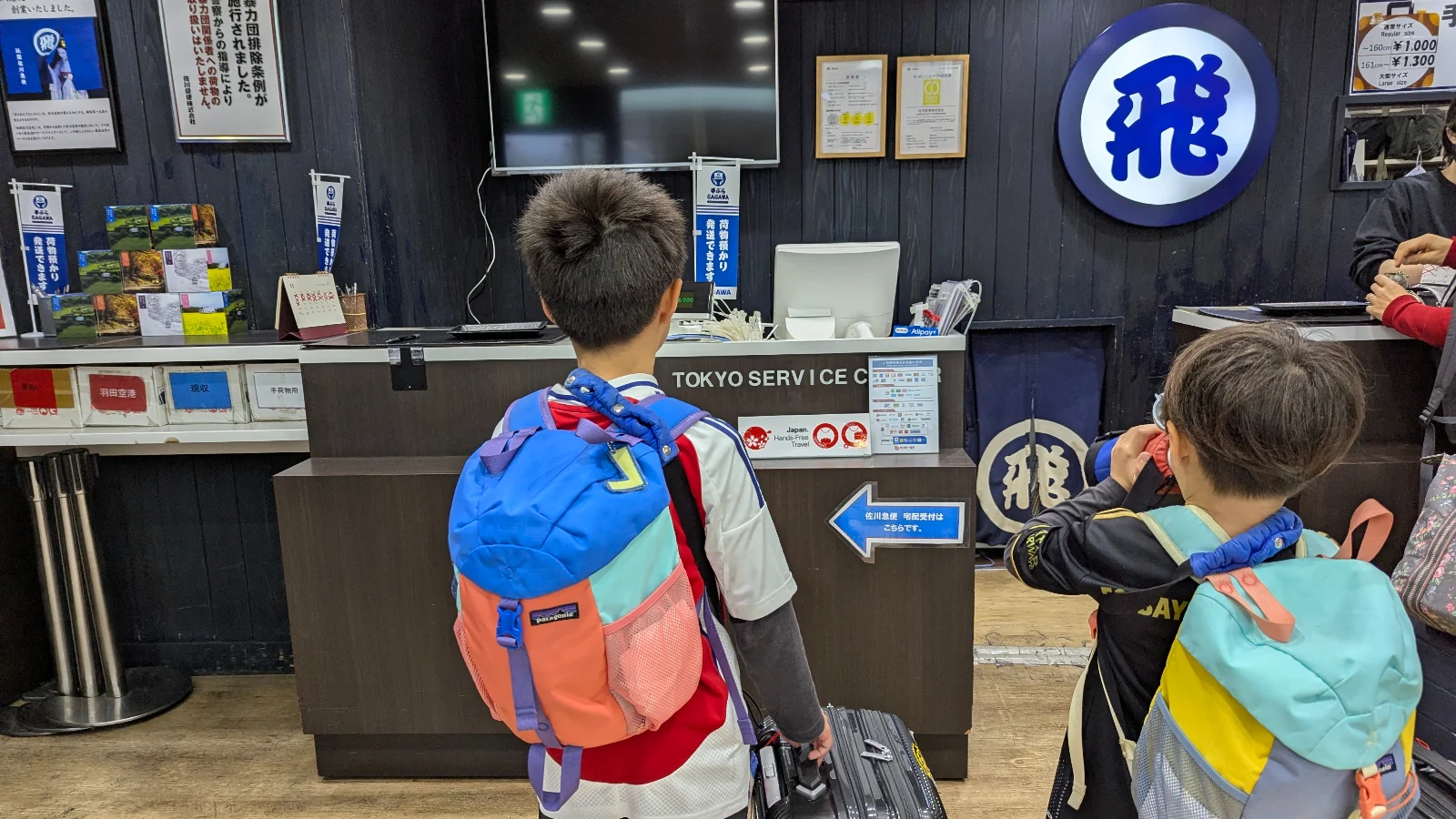
- What It Is
- Door-to-door luggage delivery, nationwide
- Cost Per Bag
- ¥2,780 to ¥3,160, Tokyo to Kyoto
- Who Runs It
- Yamato Transport, plus JAL ABC and Sagawa
- Tokyo to Kyoto or Osaka
- Next day, if dropped before the cutoff
- From the Airport
- Same day from Narita, sent by midday
How the luggage forwarding service fits a multi-city trip, and the drop-off places a family can use between hotels, stations and airports.
Some links on this page are affiliate links. LuNi may earn a commission at no extra cost to you.
Takuhaibin is Japan’s nationwide door-to-door luggage delivery network, and the most underused planning tool a family crossing the country has. Yamato Transport runs most of it, with JAL ABC and Sagawa Express alongside, and suitcases, strollers and oversized bags move between hotels, airports, stations and convenience stores. A standard suitcase from Tokyo to Kyoto costs ¥2,780 to ¥3,160 at Yamato’s cash rate and arrives the next day when the hotel desk takes it before its morning cutoff. The habit that makes it work: hand the bags over first thing after breakfast, and travel the day light.
What takuhaibin is, and how it works.
The system ships suitcases, strollers, and oversized bags between hotels, airports, train stations, and convenience stores, with the operational precision Japan applies to everything: standardized sizing, barcode tracking, guaranteed delivery windows, and handling that treats a family’s luggage as something fragile and important. The dominant provider is Yamato Transport, identifiable by the black cat logo on every delivery slip and hotel desk in Japan. JAL ABC and Sagawa Express run parallel networks, particularly at airports. Between the three, coverage is wide: any hotel, any major station, any Narita or Haneda terminal, and the 7-Eleven and FamilyMart stores that take Yamato parcels; Lawson accepts only Japan Post’s Yu-Pack slips, not Yamato or Sagawa.
The process is simpler than most parents expect. At a hotel, staff manage the paperwork entirely: drop your bags at the front desk after breakfast, confirm the destination address and delivery date, pay, and take a barcode tracking receipt. Your suitcases begin their own journey while the family begins its, lighter and faster. Each front desk sets its own morning cutoff for next-day delivery. Bags handed over later still ship, but the window slides by a day. The single most useful habit for families is treating bag drop as the first task after breakfast, not the last task before departure.
The four service configurations below map to how your travel days are sequenced and where you are staying, not to personal preference.
| Service Type | Best For Families Who | Delivery Speed | Relative Cost |
|---|---|---|---|
| Hotel to Hotel | Want fully managed, hands-free travel days | Next day | ¥¥ |
| Airport to Hotel | Arrive with multiple suitcases on flight day | Same day or next day | ¥¥¥ |
| Hotel to Airport | Want a final day without luggage | One day ahead | ¥¥ |
| Convenience Store | Are not staying in hotels | Next day | ¥ |
Hotel to Hotel
Cost ¥¥
Airport to Hotel
Cost ¥¥¥
Hotel to Airport
Cost ¥¥
Convenience Store
Cost ¥
What it costs, and how long it takes.
Pricing is standardized and predictable, set by two variables only: suitcase size, measured in total centimeters, and route distance. Families can budget the exact cost before the trip begins.
Suitcase size is length plus width plus height, added together in centimeters. Most families traveling with standard checked luggage fall in the size 140 to 160 range, which puts a hotel-to-hotel delivery from Tokyo to Kyoto at ¥2,780 to ¥3,160 per bag at Yamato’s cash rates, as of October 2026.
| Suitcase Size | Typical Use Case | Yamato Cost, Tokyo to Kyoto |
|---|---|---|
| Size 120 | Small carry-on or a child’s bag | ¥2,170 |
| Size 140 | Medium checked suitcase | ¥2,780 |
| Size 160 | Large checked suitcase | ¥3,160 |
| Size 180 | Extra-large suitcase | ¥4,480 |
| Size 200 | Oversized family bag | ¥5,410 |
Size 120
¥2,170
Size 140
¥2,780
Size 160
¥3,160
Size 180
¥4,480
Size 200
¥5,410
For a family with two large suitcases traveling Tokyo to Kyoto, the total at Yamato’s cash rates is ¥6,320, or ¥6,120 with both bags dropped at a Yamato office or convenience store. Delivery to the airport adds ¥660 per bag to the normal fare. The budget leverage is not in comparing provider rates. It is in treating one or two transfers per trip as a fixed line item rather than an optional upgrade, because that fixed expense reliably produces a qualitatively better travel day.
Timing is just as predictable. Delays are genuinely rare, reliable enough to plan a hotel check-in around.
| Route | Drop-Off Timing | Expected Delivery |
|---|---|---|
| Tokyo to Kyoto or Osaka | By the desk’s morning cutoff | Next day |
| Tokyo to other major cities | By the desk’s morning cutoff | Next day |
| Long-distanceHokkaido, Kyushu, Okinawa | Any time | 2 to 3 days |
| Airport to hotelArrival day | By midday | Same day, evening |
| Hotel to airportDeparture | One day before the flight | Ready at check-in |
Tokyo to Kyoto or Osaka
Tokyo to other major cities
Long-distanceHokkaido, Kyushu, Okinawa
Airport to hotelArrival day
Hotel to airportDeparture
One planning rule governs every multi-city itinerary: never schedule an overnight move with less than one night of buffer. Sending bags from Tokyo on Tuesday for arrival in Kyoto on Wednesday works reliably. Expecting them the same evening does not, except on confirmed same-day routes. For long-distance legs, particularly Hokkaido or Okinawa added to a standard Golden Route, the 2-to-3-day window means the luggage must leave before the family does, which keeps the family at least one destination ahead of their bags. The clean solution is two nights at each destination, so delivery completes without conflict.
Luggage weight is not just a physical variable on a Japan travel day. It is a pacing variable. When parents carry nothing, they move differently through a station: slower, more willing to follow a child’s detour, more present at the platform gate. The families who report the most connected travel days are almost always the ones moving between cities hands-free.

Where to send and receive bags across Japan.
No Japanese city puts a family more than a short walk from a valid drop-off point. The density of options is one of the system’s quiet structural advantages.
| Drop-Off Location | Best For | What to Know |
|---|---|---|
| Hotel Front Desk | Families staying in hotels of any tier | Staff manage paperwork and timing. The easiest option by far. |
| Airport Counter | Arrival and departure days | Dedicated Yamato, JAL ABC, and Sagawa counters at major terminals. |
| Major Train Stations | Sightseeing before check-in | Select large hubs only: Tokyo, Kyoto, Osaka, Sapporo. |
| Convenience Stores | Families in non-hotel accommodation | Complete the delivery slip yourself. Yamato at 7-Eleven and FamilyMart; Japan Post Yu-Pack only at Lawson. |
Hotel Front Desk
Airport Counter
Major Train Stations
Convenience Stores
Confirm bags-to-hotel service before you land, by arrival region.
The full takuhaibin counter coverage at the airports sits at Narita, Haneda, Kansai International, and Chubu Centrair. Families landing after a long international flight face one immediate decision: carry everything onto a train into the city, or send the large bags ahead and travel with a single carry-on. The calculus is plain. An adult managing a tired child on the Narita Express with no luggage is managing one problem. The same adult with two suitcases is managing three. Bags sent from the airport by midday typically reach the destination hotel by early evening the same day, and pre-booking the service above confirms availability before you land, so there is no counter to locate while shepherding tired children and carry-ons.
The operational sequence is consistent everywhere, with only the level of staff help changing. Drop the bags at a counter. Confirm the slip: at hotels and airports staff complete most of it, and you confirm the destination address, delivery date, and contact name, while at convenience stores you fill it in yourself. Choose the delivery date, most often next-day. Pay and keep the receipt, which carries the barcode for online tracking. Collect the bags at the destination front desk or airport counter. One habit smooths every later drop-off: at your first hotel, ask the front desk to write your next hotel’s address in Japanese and keep that slip with your receipt, which removes the need for a translation app at a convenience store counter. Before any drop-off, pack a day bag with everything the family needs before check-in: children’s medication, a change of clothes per child, snacks, chargers, and documents. Passports never travel in forwarded luggage, under any circumstances.
Carry your bags, or send them ahead.
Carrying bags onto the bullet train is a reasonable choice for very light travelers or day-trippers. For families with standard checked luggage and children, the comparison is less ambiguous than most guides suggest.
| Variable | Carrying Bags | Sending Ahead | LuNi Verdict |
|---|---|---|---|
| Recommended Sending Ahead |
The harder path with children | Move freely through any gate, stairs, or escalator. Board hands-free at any pace. Sit anywhere with no storage concern. | Best for families with standard checked luggage and children. ¥2,780 to ¥3,160 per bag from Tokyo to Kyoto at Yamato’s cash rates. |
| Station Navigation | Elevator-only routing and platform timing | Any gate, stairs, or escalator | Sending ahead removes every junction decision. |
| On the Train | Limited overhead space; oversized bags may need a reserved luggage spot | No storage concern | Certain trains now require reservations for oversized luggage. |
| Boarding & Strollers | Bags and children managed together in a short window | Full attention free for the stroller | The decisive difference for single-adult moments. |
Sending Ahead
Best for families with standard checked luggage and children. ¥2,780 to ¥3,160 per bag from Tokyo to Kyoto at Yamato’s cash rates.
Carrying Bags
Reasonable for light packers with one carry-on each.
The bag decision is a Reserve decision, and Reserve is the third currency of a travel day, alongside money and time. The Sprinter depletes through sustained walking and standing, and on a Shinkansen day that cost is paid in the station, not the seat: the long platform transfers at Tokyo, Shin-Osaka, and Nagoya, multiplied by every bag dragged into an elevator queue. Ship the luggage ahead and the Sprinter’s budget is protected before sightseeing starts. The Anchor depletes through unfamiliarity and unconfirmed structure, and a travel day where bags and people must arrive somewhere at once is exactly the open loop that drains them. Forwarding the night before closes it: the bags are confirmed waiting, and the only thing the family carries onto the platform is itself.
The adaptation spans the age range. For a younger child, sending bags ahead is what frees an adult’s hands to hold the toddler at the platform edge during the short boarding window. For an older child, it is what lets the Shinkansen register as the experience it should be, the speed and the quiet of the carriage, rather than something glimpsed past a parent wedging a 26-kilogram suitcase into an overhead rack while a conductor waits.
The questions parents actually ask.
How much does luggage delivery cost in Japan?
At Yamato’s cash rates, takuhaibin costs ¥2,780 to ¥3,160 per standard suitcase from Tokyo to Kyoto or Osaka. Pricing is set by suitcase size and distance: on that route a size 140 bag costs ¥2,780 and a size 160 ¥3,160, as of October 2026. Sending a bag to the airport adds ¥660 per bag to the normal fare.
How long does luggage delivery take in Japan?
Most deliveries between major cities arrive the next day when bags are dropped off before the morning cutoff. Routes to Hokkaido, Kyushu, or Okinawa take two to three days. Airport-to-hotel same-day delivery is available when bags are sent by midday, and hotel-to-airport delivery requires sending bags one day before the flight.
Is takkyubin the same as takuhaibin?
They refer to the same thing. Takuhaibin is the general Japanese term for door-to-door parcel and luggage delivery. Takkyubin (TA-Q-BIN) is Yamato Transport’s trademarked brand name for its own service, the black cat network most families use. Booking either at a hotel front desk or convenience store gets you the same result.
Can I send luggage from the airport to my hotel in Japan?
Yes. Narita, Haneda, Kansai International, and Chubu Centrair all have dedicated luggage delivery counters operated by Yamato Transport, JAL ABC, and Sagawa Express. Bags sent from the airport by midday typically reach the destination hotel the same evening. This is the recommended approach for families arriving on international flights with multiple suitcases.
Can I use luggage delivery when traveling by Shinkansen?
Yes, and it is the recommended approach for families with standard checked luggage. Send suitcases to the next hotel the day before and board carrying only a day bag. This avoids the restricted overhead storage on certain trains, removes the need for a reserved oversized-luggage spot, and lets families board and settle without managing large bags during a short platform window.
Where can I drop off luggage for delivery in Japan?
At hotel front desks, the easiest option for families; at airport delivery counters in major terminals; at takuhaibin desks in large stations including Tokyo, Kyoto, Osaka, and Sapporo; and at 7-Eleven and FamilyMart, which take Yamato parcels (not every 7-Eleven store does); Lawson accepts only Japan Post Yu-Pack slips. For families in standard hotels, the front desk is universally the most convenient.
Is Japan’s luggage delivery service safe and reliable?
Takuhaibin has an exceptional reliability record. Yamato Transport, JAL ABC, and Sagawa Express use barcode tracking, guaranteed delivery windows, and careful handling. Bags are rarely delayed and damage is very uncommon. You can check delivery status online through the Yamato English-language website using the barcode on the receipt.
Can I send luggage between hotels in different cities?
Yes. The system supports hotel-to-hotel delivery across all cities, including long routes like Tokyo to Sapporo or Osaka to Hiroshima. For most Golden Route itineraries, next-day delivery is standard. For routes involving Hokkaido, Kyushu, or Okinawa, plan for two to three days and build that window into the itinerary.