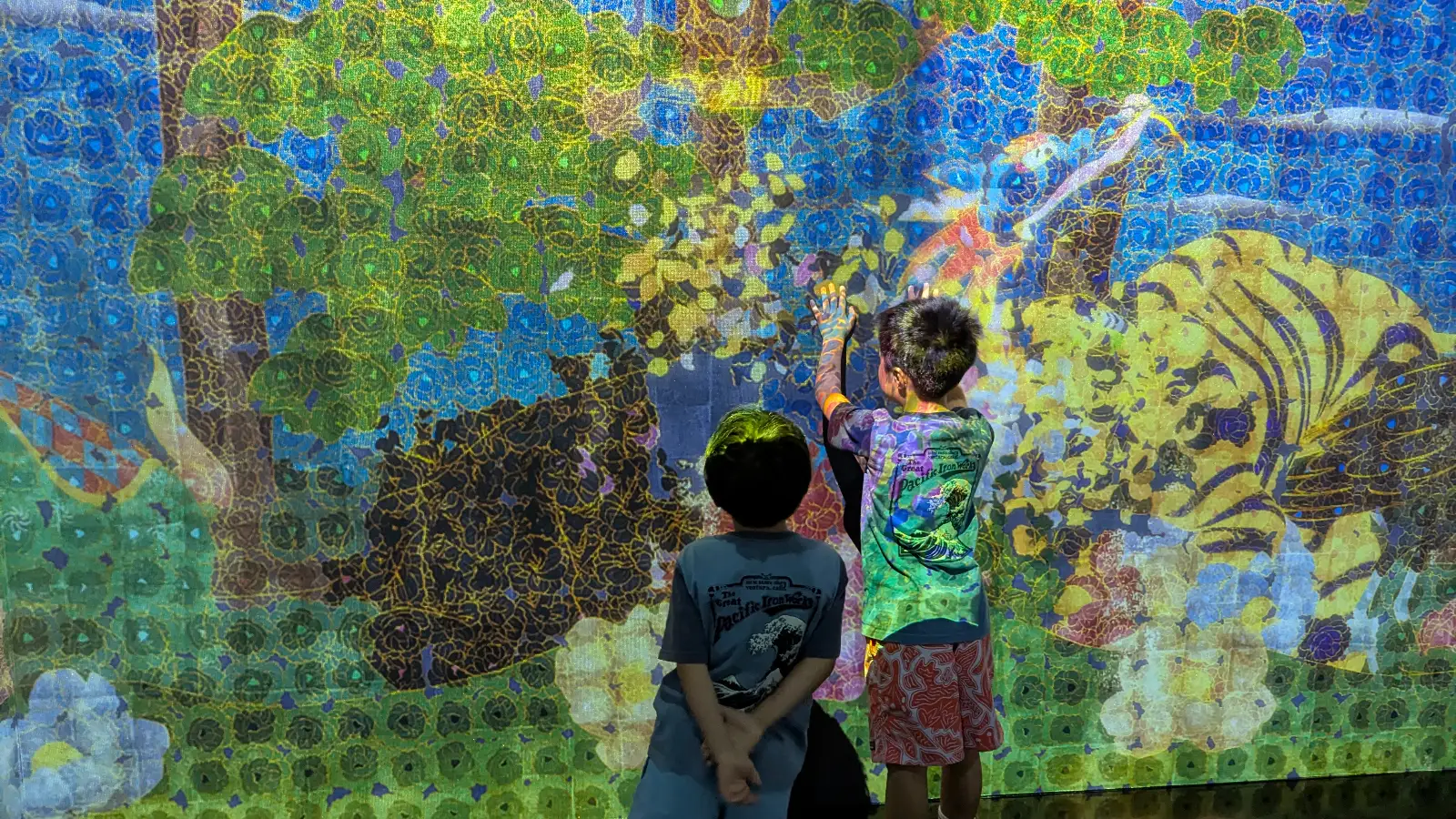
teamLab Borderless has no maps, no fixed routes, and no directional signage, and parents researching a visit for the first time are right to question what that means for a child who needs structure to stay regulated in unfamiliar environments. The pull is just as real: the borderless format makes the digital artwork mobile, letting it migrate across walls and follow visitors through the space in a way that no static museum can replicate.
Whether that experience is a highlight or a stressor depends entirely on the child in the room, and the Family Fit™ framework makes that distinction predictable before the ticket is purchased. Families planning a broader Tokyo itinerary will find the Tokyo Family Travel Hub the right resource for sequencing this attraction alongside the rest of the city.
Is teamLab Borderless Tokyo Worth Visiting with Kids? (Quick Answer)
teamLab Borderless is worth visiting for school-age children and teens who thrive in open-ended, high-stimulation environments, and it is not a suitable visit for children under three or children whose regulation depends on predictable spatial structure. The mapless format naturally rewards Dynamos, who can pursue migrating digital artworks across rooms without a fixed path, while the pitch-dark transition corridors and inescapable ambient soundscapes make it a genuine risk for children who cannot anticipate or exit sudden sensory spikes. The profile-by-profile breakdown below gives every family the specific analytical framework they need to make this decision before purchasing a non-refundable ticket.
Pros of Visiting teamLab Borderless with Kids
- The absence of a designated route means digital artworks physically migrate across walls and can be chased from room to room, giving high-energy kids a museum experience that rewards continuous movement rather than penalizing it; a direct match for Dynamos, who benefit most when physical engagement is embedded in the activity itself rather than restricted to a designated zone.
- The open-ended layout allows school-age children to set the direction and pace of discovery independently, which converts the visit from a passive viewing experience into an active, child-led exploration that holds attention far longer than traditionally sequenced exhibits.
- The Bubble Universe installation and other endlessly reflecting rooms deliver layered visual rewards that sustain engagement for older children and teens who typically rush through conventional museum floors; the depth of each room’s detail means repeat visits still surface new things to notice.
- The contained building structure means parents always know their child is within the same space even when a child has moved ahead into an adjoining room, which gives families traveling with Anchors a specific reassurance: disorientation is part of the design, but physical containment remains constant throughout the visit.
- The fluid, constantly shifting nature of the digital projections ensures that no two passes through the same corridor produce an identical experience, making this a strong option for families revisiting Tokyo who want a different encounter from their first trip.
Cons of Visiting teamLab Borderless with Kids (Important for Parents)
- The transition corridors between exhibit rooms are intentionally pitch-dark and enclosed, and they deliver sudden concentrated surges of LED light and ambient sound that cannot be predicted, muted, or exited quickly; for Sensors, this is not a manageable friction point but an architectural feature of every transition in the museum that makes the visit not worth it regardless of how well-prepared the family arrives.
- The deliberate removal of all maps, directional signage, and marked exits means children who require visible structure to feel secure in an unfamiliar space will experience the museum’s core design feature as a source of sustained anxiety rather than wonder, and for Anchors specifically, no amount of in-the-moment reassurance fully substitutes for the verbal preparation that should happen before the family enters the building.
- Strollers are not permitted inside the exhibit areas, and the combination of dark corridors and mirrored floors makes carrying young children the only safe option, placing significant and ongoing physical demand on parents throughout the entire visit.
- The uneven terrain and mirrored flooring across the exhibit space require continuous active balance management from every visitor, which depletes Sprinters at a rate that outpaces the available seating, most of which is confined to a small number of static observation zones that must be identified and planned for before the visit begins.
- Crowd density in the corridors during mid-morning and early afternoon dramatically amplifies the sensory intensity of the transition spaces, making the difference between an early entry time and a standard mid-day arrival a meaningfully different visit for any child operating near their threshold.
Why “Worth It” Depends on Your Child
Two families can visit teamLab Borderless on the same morning and walk out with entirely opposite assessments of whether it was worth the ticket price. The difference is not the exhibition. The Family Fit™ framework makes that distinction predictable rather than accidental.
The Dynamo – Go. The borderless design removes every conventional museum constraint: no viewing rails, no prescribed viewing distances, and no direction of travel. Digital artworks physically migrate through the space and can be followed, chased, and intercepted across rooms, which is the mechanism that makes this experience directly serve a profile that needs movement embedded in the activity itself. Let Dynamos set the direction from the moment of entry and allow full freedom to double back, sprint ahead, and pursue artwork into adjacent rooms.
The Sensor – High Risk. The transition corridors between major exhibit rooms are pitch-dark, enclosed, and engineered to deliver sudden shifts in visual and auditory intensity without warning or opportunity to exit. This is not ambient background noise or soft lighting variation; the sensory load is concentrated, close-range, and architecturally unavoidable at every point of movement between exhibit spaces. For families whose child is highly sensitive to unpredictable sensory input, this is a skip; teamLab Planets offers the same creative universe in a format built around a calm, predictable sequence rather than intentional disorientation.
The Anchor – Caution. The entire navigation structure of the museum, with maps withheld, exits unmarked, and room boundaries made intentionally invisible, removes the structural predictability this profile depends on to remain regulated in unfamiliar environments. The building is contained, and the format can be prepared for in advance. Walk Anchors through the format explicitly before the day of the visit: framing getting temporarily turned around as the intended experience converts a potential distress trigger into a clearly defined expectation.
The Sprinter – Caution. The uneven terrain, mirrored floors, and near-complete absence of fixed seating across the exhibit areas require continuous standing and active physical balance management throughout the visit. This is not incidental fatigue from covering distance; it is a persistent physical demand embedded in the flooring design of the space itself. Identify the small number of static observation zones with seating before the visit begins and build them into the day as mandatory rest stops rather than optional pauses.
Identifying your child’s exact Family Fit™ profile before purchasing a non-refundable ticket is the single most important planning step this visit requires.
The LUNI Framework
Most families skip this.
It's why Day 3 falls apart.
The LUNI Profile Quiz identifies the specific planning adjustments your child needs. Three minutes now saves the whole trip.
Who Will Enjoy teamLab Borderless Tokyo with Kids (By Age Group)
Toddlers (under 3)
A toddler’s developing spatial awareness and depth perception cannot process pitch-dark rooms, invisible mirrored walls, or sudden visual shifts without genuine confusion and physical risk of collision. teamLab Borderless is not worth visiting for children under three; parents will spend the visit carrying them continuously for safety, exhausting the adult and providing the child with no meaningful engagement.
Preschoolers (3 to 5)
Children at this stage are imaginative and visually drawn to large-scale light displays, but their emotional regulation systems are not developed enough to process intense, inescapable sensory input without significant parental intervention. This is a conditional visit at best, and only appropriate for a preschooler who is demonstrably comfortable in dark, loud, crowded environments with no visible exit; if any doubt exists, skip it and visit teamLab Planets instead.
School-Age Kids (6 to 10)
School-age children have developed the cognitive capacity to understand that their physical movement is altering the digital projections around them, which transforms the museum from a passive light show into an active cause-and-effect experience. This is a strong fit for this age group, particularly for children who find conventional museums too passive; the absence of a fixed route empowers them to lead the visit independently.
Older Kids and Teens (11+)
Teens consistently rate teamLab Borderless among the strongest experiences of a Tokyo trip because the open layout, the visual sophistication of the installations, and the complete absence of a prescribed path give them genuine autonomy in a high-aesthetic environment. This is worth prioritizing for teenagers; it does not feel like a family attraction managed by adults.
Best Alternatives to teamLab Borderless Tokyo for Families with Kids
- teamLab Planets Tokyo. teamLab Planets follows a single linear path through barefoot, water-based installations that are grounded, tactile, and structured, delivering the teamLab experience without the inescapable dark corridors and disorienting maze format that overwhelm sesory-sensitive children. teamLab Planets guide
- Sumida Aquarium. A one-way routed layout and gently illuminated jellyfish exhibits provide sustained visual engagement at a sensory register that remains consistent throughout the visit, with no sudden spikes or unmarked transitions between spaces. Sumida Aquarium guide
- Tokyo Toy Museum. Brightly lit, tactile wooden play rooms give toddlers and preschoolers direct physical engagement with their environment in a format built specifically for their developmental stage, without the anxiety created by dark, unnavigable corridors. Tokyo Toy Museum guide
For families still building their Tokyo plan around their child’s profile, the Tokyo Family Travel Hub covers every major family destination in the city by profile match.
Final Recommendation: Is teamLab Borderless Tokyo Worth It with Kids?
teamLab Borderless rewards families with older children who are comfortable pursuing art through a dark, mapless, sound-heavy environment on their own terms, but the intentional disorientation and inescapable sensory architecture make it an actively stressful visit for any child whose regulation depends on visible structure or a predictable sensory baseline. The Dynamo is the profile for whom this attraction is an unambiguous priority; Sensors should not visit, and the families in the conditional range, those with Sprinters or Anchors, can both succeed here if they prepare the child for the format before arrival rather than attempting to manage the anxiety in the moment. Booking the earliest available morning entry slot meaningfully reduces crowd density in the transition corridors and gives families with conditional-profile children the best available conditions for a successful visit.
The teamLab Borderless Tokyo Briefing: Essential Intel
Families deciding whether teamLab Borderless Tokyo is the right call for their specific child ask these questions most consistently, from whether the mapless format poses a genuine risk for sensory-sensitive children to what school-age kids actually get from the interactive installations that toddlers cannot.
A: It is an excellent destination for children who are comfortable navigating dark, loud, unpredictable environments independently. The movement-reactive digital installations are designed to reward physical curiosity and spatial exploration, making the experience genuinely captivating for children who do not require a fixed route to stay regulated. Families with young children or sensory-sensitive children should weigh the profile analysis above carefully before purchasing.
A: The environment presents serious challenges for sensory-sensitive children because the dark transition corridors deliver sudden, concentrated bursts of light and sound that are architectural, not incidental, meaning they cannot be avoided or exited quickly. Families whose child is easily overwhelmed by unpredictable auditory or visual spikes should visit teamLab Planets instead, where a single linear route, calm pacing, and a consistent sensory register create a fundamentally different experience.
A: The attraction is not a suitable visit for children under three. A toddler’s developing spatial awareness cannot safely process pitch-dark rooms and invisible mirrored walls, and parents will carry them throughout the visit to prevent collisions, making the experience physically exhausting for the adult and meaningless for the child. Toddlers are better served by teamLab Planets or the Tokyo Toy Museum, both of which are built around physical engagement at the correct developmental scale.
A: School-age children between six and ten tend to find this the most engaging type of museum they have ever visited, because their cognitive development allows them to grasp that their physical movement is directly altering the digital projections around them. That cause-and-effect understanding, which toddlers and most preschoolers cannot yet access, is what makes the interactive installations genuinely rewarding rather than just visually interesting. The absence of a fixed map gives school-age children the rare experience of leading the visit entirely on their own terms.
A: The deliberate absence of directional signage and the constantly shifting visual environment between exhibit rooms can produce significant anxiety in any child who relies on visible exits and predictable spatial sequences to feel safe. For Anchors specifically, the format’s intentional disorientation is the mechanism most likely to trigger distress, and verbal preparation about what the layout will feel like before entering is not optional; it is the single intervention that most changes the outcome of the visit for this profile.
A: teamLab Borderless is one of the most genuinely compelling experiences available to teenagers in Tokyo because the open layout, the visual complexity of the installations, and the lack of any adult-directed route give them full autonomy in a high-aesthetic environment. Unlike most museum visits, which teens process as supervised experiences, Borderless is structured to feel like discovery they are driving themselves, and that distinction is what makes it consistently land as a trip highlight for this age group.
