Tokyo Toy Museum with Kids: A Morning of Play in Yotsuya.
A museum of toys sounds like a day out, but the Tokyo Toy Museum is built for a small child’s best morning: two hours of play in a former school in Yotsuya.
From November 1, 2026. On the day, ¥1,500 and ¥1,100. Through October 31, ¥1,100 and ¥800 online, ¥1,300 and ¥1,000 at the counter. Under 6 months free. Book online: counter sales stop once the day’s tickets run out.
Closed Thursdays, for maintenance in February and September, and over the year end.
On weekdays, re-entry allows a break outside; not on weekends or holidays.
The Baby Room is for age 2 and under only; children under school age come with a guardian.
Folded at the building entrance, since many passages inside are narrow; an elevator serves wheelchairs.
Some links on this page are affiliate links. LuNi may earn a commission at no extra cost to you.
Is the Tokyo Toy Museum worth it with kids?
The short version, before the costs, the timings and the case for each child.
Yes, and it is one of the gentlest mornings in Tokyo for a family with younger children. The Tokyo Toy Museum fills a former elementary school in Yotsuya with toys and play, and a visit runs 90 to 120 minutes, which is exactly the length of a small child’s good morning. The one condition is the day. On a weekday a family can step out for air and come back, and on weekends and holidays it cannot, so the weekday morning is the visit to plan, booked online ahead, since counter sales stop once the day’s tickets run out and a wasted trip costs a small child the morning. Finish with lunch and a walk in Shinjuku Gyoen nearby, and the morning ends before the child does.
Planning Your Visit to the Tokyo Toy Museum with Kids.
Three decisions shape a visit here, and the first and simplest is the day. A weekday gives the family re-entry, which weekends and holidays do not, so choose one, and check it against the weekly closing day before anything else is fixed. The second is the ticket: buy online, because counter sales stop once the day’s tickets run out, and buying ahead is cheaper for every person. The third is food, since none is allowed inside, so plan lunch for afterward, outside, and let the morning of play end on a meal and a walk rather than on a hungry child at the exit. The rest of the day belongs to Shinjuku’s family stops, with a garden and a fire museum both a short walk away.
Every LuNi attraction guide starts with a visit, with our own children
LuNi rates and writes about attractions only after visiting them with children. Luca and Nico were at the Tokyo Toy Museum, and what they did there is recorded further down this page, including how each child actually met it.
Children arrive with different tolerances: for noise, for lines, for standing still, for being on their feet all day. A guide written for the average of them helps almost nobody. So every place on this site is read four ways, and each verdict says which children it already suits and what makes it work for the rest. Whoever you are bringing, the answer here is built for your family rather than for a general reader.
Restricted-movement depletion eases in a museum of toys with rooms to move between, so let the child set the pace from one room to the next.
Sensory-input depletion can build in rooms full of toys and families, and re-entry works only on weekdays, so plan a weekday and a break outside.
Unfamiliarity eases with fixed hours, tickets booked online and a suggested visit of about two hours, so describe the morning before arriving.
Walking and standing stay modest over a visit of about two hours, with an elevator and corridor benches, though strollers stay at the entrance.
Hotels we would book for this visit.
A small child’s best two hours come in the morning, and the museum is built for them, so the trip there should be short. Three Tokyo family hotels around Shinjuku, the pick first.
| Property | The LuNi Reason |
|---|---|
| LUNI Pick Citadines Shinjuku Tokyo | Citadines Shinjuku Tokyo is for a family that wants the toy museum and the garden on the same morning. A small child’s good morning is short, and a base in the same ward keeps the trip to Yotsuya brief, so the play starts while the child is fresh and ends before they tire. |
| Hotel New Otani Tokyo The Main | Hotel New Otani Tokyo is for a family giving the morning to the museum and the afternoon to rest. After two hours of play a younger child is ready for a nap, and a room on this side of the city turns lunch and bed into a short trip rather than a long ride across Tokyo. |
| Hotel Gracery Shinjuku | Hotel Gracery Shinjuku suits a child who does best when the museum, the garden and bed all sit in one ward. Its morning goes like this: the toy museum early on a weekday, lunch outside on the re-entry, and a slow walk in Shinjuku Gyoen before the family heads back to rest for the afternoon. |
Hotel New Otani Tokyo The Main
Nearby attractions, matched to your child.
Three pairings: a national garden with wide lawns for a child who needs quiet after busy rooms, a fire museum close by for a child who wants something to climb into, and a forest shrine for a child who likes a set order.
| Pairing | Why This Solves the After-Visit | For Your |
|---|---|---|
| LUNI Pick Shinjuku Gyoen National Garden About 8 minutes on foot | About eight minutes on foot, Shinjuku Gyoen National Garden gives a Sensor wide lawns after rooms full of families and toys, where sensory input finally thins. A child worn thin by the busy floors gets open air and room to spread out. | Sensor |
| Tokyo Fire Museum About 5 minutes on foot; Yotsuya-sanchome | About five minutes on foot, and connected to Yotsuya-sanchome Station, the Tokyo Fire Museum has a helicopter cockpit children can sit in. For a Dynamo whose restricted movement wants a new thing to climb into, it is a short, easy second stop. | Dynamo |
| Meiji Jingu Shrine Harajuku; free, gates open at sunrise | For an Anchor, Meiji Jingu Shrine is a visit with a known order: the washing at the basin, then the bows and claps at the main hall, all learnable at home. Unfamiliarity eases when the steps are practiced before the gate, and the grounds cost nothing to enter, opening at sunrise. | Anchor |
Shinjuku Gyoen National Garden
About 8 minutes on foot For YourSensor
Tokyo Fire Museum
About 5 minutes on foot; Yotsuya-sanchome For YourDynamo
Meiji Jingu Shrine
Harajuku; free, gates open at sunrise For YourAnchor
How two children actually met this attraction.
Two children came into the same museum and headed for opposite ends of it. One ignored the busy rooms and went straight for the traditional toys, working at each until he understood it; the other went everywhere at once, in and out of the play spaces, building and taking apart and moving on. Both of them were happy, which is what a good toy museum does for two very different children. A toy with a skill to learn holds the child who wants to master something, and a run of rooms holds the child who needs to keep moving. Let each of them choose, and do not hurry either one. The reader will find his table; the mover will find his circuit, and both will leave happy.
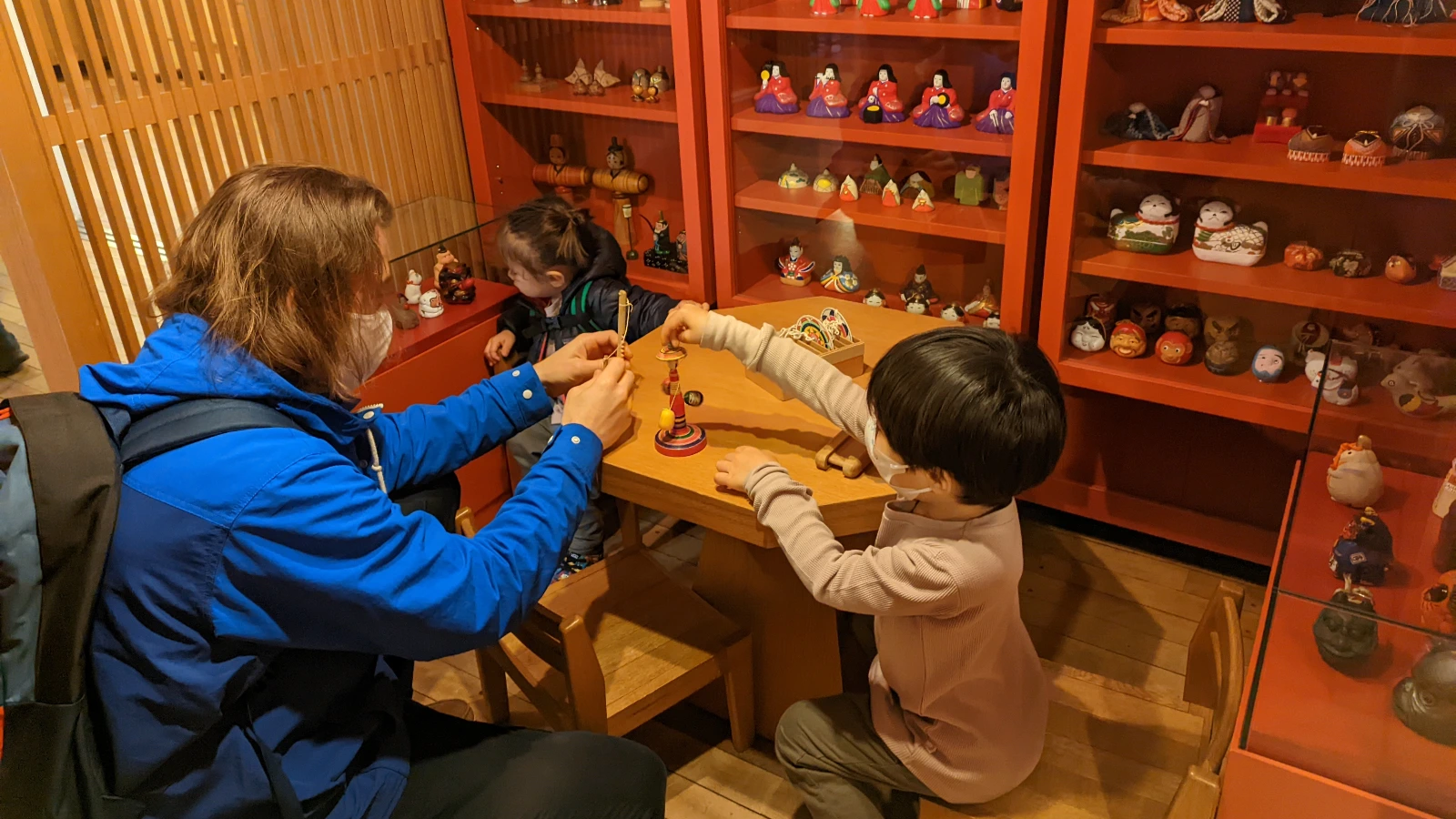
Luca walked past the ball pit and the busier rooms without stopping and went straight for the traditional Japanese toys. He picked up a kendama and worked at it until he understood the motion, then moved to the koma spinning tops and the daruma otoshi, testing each one to see how it behaved. He stayed with the skill toys long after the room had emptied around him.
This is the Anchor pattern. A child whose Reserve depletes through unfamiliarity and unconfirmed structure trusts a toy whose rule he can confirm while the room keeps changing, and a skill toy gives him exactly that: the same move, the same result, every time. For a similar child, let him skip the busy rooms and find the quiet table, and do not hurry him. A child who has mastered one toy in a morning has had a better visit than one who has touched them all.
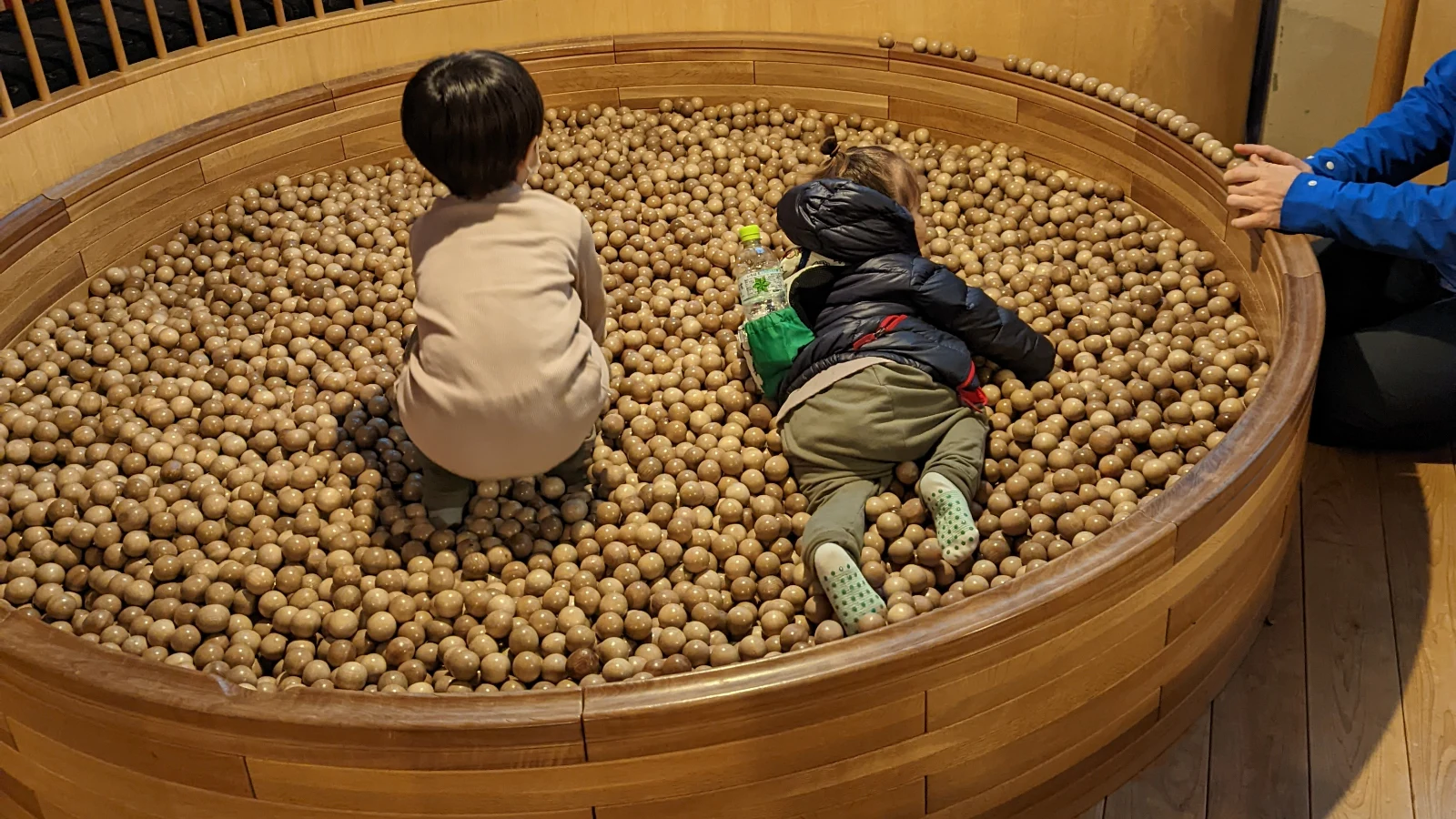
Nico never stayed in one room. He dropped into the wooden ball pit, climbed out, built something at the craft table, dismantled it, and was three rooms away before anyone caught up. He talked the entire time, narrating what he was doing to no one in particular. His energy was highest in the first hour, and the constant permission to move from one thing to the next kept him steady.
This is the Dynamo pattern. A child whose Reserve depletes through restricted movement stays steady as long as he is allowed to move from one thing to the next, and a museum of toys, room after room, gives him that. For a similar child, let him lead the route, put the visit early in the day while his energy is highest, and plan the walk to the garden afterward as the next stretch of movement.
Traditional toys ask something of a child that screens rarely do: skill, patience and a willingness to be bad at something before getting better. A spinning top that falls over, a cup and ball that misses, a wooden puzzle that refuses to close all teach persistence in the gentlest way. Play is how young children learn, and a museum that invites them to handle its collection treats play as serious work, which it is. A child who masters one old toy has learned that practice pays, a lesson that reaches far beyond the museum.
The LUNI Rating for the Tokyo Toy Museum.
The verdicts split on the rooms. For a child who needs to move, a museum of toys to go between is ideal, so the Dynamo does well, as does the Anchor, with fixed hours and a suggested visit of about two hours that is easy to explain. The Sprinter is well served by a short visit with an elevator and benches. The Sensor needs a plan, because the rooms fill with families and the chance to step out exists only on weekdays. Legoland Discovery Center Tokyo is the building version of this morning, for a child who wants bricks rather than toys.
Let the child lead the route. The Dynamo depletes through restricted movement, and a toy museum is one of the kinder places in Tokyo for a moving child. The Tokyo Toy Museum fills a former elementary school with toys, room after room, and a child can move from one to the next as fast as their interest runs. For a Dynamo, the permission to keep moving is what keeps the visit steady.
So let the child lead. Put the visit early in the day, while their energy is highest, and do not try to hold them in any one room. When the museum is done, take the eight-minute walk to Shinjuku Gyoen for open space, or the five minutes to the Fire Museum for a helicopter cockpit to climb into. A Dynamo given movement at both ends of the morning will manage the middle well, and may not want to leave.
What this means for your Dynamo: a museum of toys, room after room, gives restricted movement space to move. A younger Dynamo needs a free route through the rooms; an older one needs the garden or the Fire Museum straight after.Visit on a weekday, and plan a break outside. The Sensor depletes through sensory input, and a museum full of toys and other families can build up for this child. A reset in the Baby Room is not an option for an older child, since that room is for children of 2 and under only, and older brothers and sisters are not admitted. So for a Sensor of 3 or older, the break has to come from somewhere else.
It comes from the calendar. On weekdays, re-entry is allowed, so a family can step out for a walk in Shinjuku Gyoen, eight minutes away, and come back; on weekends and holidays, there is no re-entry. Choose a weekday, keep the visit near the suggested 90 to 120 minutes, and let the child choose the quieter rooms and leave when they have had enough. A Sensor who knows a break is possible will enjoy the rest of the morning far more.
What this means for your Sensor: input builds in rooms full of toys and families, and a break outside works only on weekdays. A younger Sensor needs a weekday visit and a walk in the garden; an older one can choose the quieter rooms.Describe the morning before you arrive. The Anchor depletes through unfamiliarity and unconfirmed structure, and the Tokyo Toy Museum is simple to describe in advance. The hours are fixed, 10:00 to 16:00 with last entry at 15:30, and the museum itself suggests a visit of 90 to 120 minutes. Tickets are bought online ahead, and the rules are clear: no food inside, strollers left at the entrance, and the Baby Room for children of 2 and under only.
So tell the child how the morning will go: the walk from Yotsuya-sanchome, the stroller folded at the door, the rooms inside, and lunch outside afterward. For a child who likes to master something, let them find one toy and stay with it as long as they like. An Anchor who knows the shape of the morning will settle into it quickly, and stay settled to the end.
What this means for your Anchor: unfamiliarity eases with fixed hours, online tickets and a visit of about two hours. A younger Anchor needs the morning described at home; an older one can choose which rooms to see first.Leave the stroller at the door, and keep it short. The Sprinter depletes through sustained travel-style walking and standing, and the Tokyo Toy Museum asks for little of either. The suggested visit is 90 to 120 minutes, there is an elevator, and there are benches in the corridors where water or tea may be drunk. The museum is five minutes on foot from Exit 2 of Yotsuya-sanchome Station.
Plan for the stroller, which is not allowed inside because the passages are narrow. Fold it at the building entrance and bring a carrier for a baby. Sit on the corridor benches for a drink between rooms, and keep the visit to the suggested length. For a Sprinter, this is one of the easier mornings in the city, and a good choice after a long walking day elsewhere in the city.
What this means for your Sprinter: a short visit with an elevator and corridor benches keeps walking and standing modest. A younger Sprinter needs a carrier, since strollers stay at the door; an older one manages the morning easily.The questions parents actually ask.
Tickets can run out at the counter and the Baby Room admits only children of 2 and under, so the morning needs booking and a split planned in advance. Book online, since a trip made for nothing costs a small child the whole morning. The museum closes on Thursdays, and re-entry works only on weekdays. Strollers stay at the entrance, and food is not allowed inside, so plan lunch for afterward, outside the building. Book the weekday, and every other rule follows from it. Inside the museum, a weekday morning gives a small child the most room to play at their own pace.
Is the Tokyo Toy Museum worth visiting with kids?
Yes, especially for younger children and for a family that wants a slower morning. It is a museum of toys and play in a former elementary school in Yotsuya, with a suggested visit of 90 to 120 minutes and a separate room for babies. It is best on a weekday, when re-entry is allowed, and never on a Thursday, when it is closed all day.
How much does the Tokyo Toy Museum cost?
From November 1, 2026, an advance ticket, sold online only, costs 1,200 yen for adults and anyone of junior high age and over and 900 yen for children from 6 months through elementary school, and a ticket on the day costs 1,500 yen and 1,100 yen. Through October 31, online tickets are 1,100 yen and 800 yen, and counter tickets 1,300 yen and 1,000 yen. Babies under 6 months are free. Online tickets can be canceled until 10:00 on the day.
Do you need to book the Tokyo Toy Museum in advance?
It is wise to. Counter sales stop once the day’s planned number of tickets has been sold, so a family arriving without a ticket can be turned away, and booking ahead is cheaper: through October 31 an online ticket costs 200 yen less than the counter, and from November 1 an advance ticket costs 300 yen less per adult and 200 yen less per child than a ticket on the day. Book online, and cancel by 10:00 on the day if plans change.
Can older children use the Baby Room at the Tokyo Toy Museum?
No. The Baby Room is for children of 2 and under only, in one-hour timed sessions that cannot be changed. For safety, children of 3 and over, including brothers and sisters, are not admitted. A family with a baby and an older child should plan for one parent to stay outside with the older one.
When is the Tokyo Toy Museum closed?
It closes every Thursday, with maintenance closures in February and September and a year-end closure. Hours are 10:00 to 16:00, with last entry at 15:30. On weekdays, visitors may leave and come back in; on Saturdays, Sundays and holidays, re-entry is not allowed, apart from exceptions such as Obon.
Can you bring a stroller into the Tokyo Toy Museum?
No. Strollers are not allowed inside, because many of the passages are narrow, so fold yours and leave it at the building entrance. There is an elevator, wheelchairs are welcome, and lockers are free. A carrier is the easiest way to move a baby around, and the Baby Room, for children of 2 and under, has a nursing space.
Can you eat at the Tokyo Toy Museum?
No food is allowed inside. Water or tea may be drunk at the benches in the corridors. On a weekday, the family can leave for lunch and come back in; on a weekend or holiday, re-entry is not allowed, so eat before the visit or plan the museum as a morning that ends with lunch outside, nearby.
What is near the Tokyo Toy Museum for kids?
Two good neighbors are close by. Shinjuku Gyoen National Garden is about eight minutes on foot, and the Tokyo Fire Museum, connected to Yotsuya-sanchome Station, about five, with a helicopter cockpit children can sit in. The museum is five minutes from Exit 2 of Yotsuya-sanchome Station.
Where the Tokyo Toy Museum fits your Japan trip.
Official site and opening information: Tokyo Toy Museum