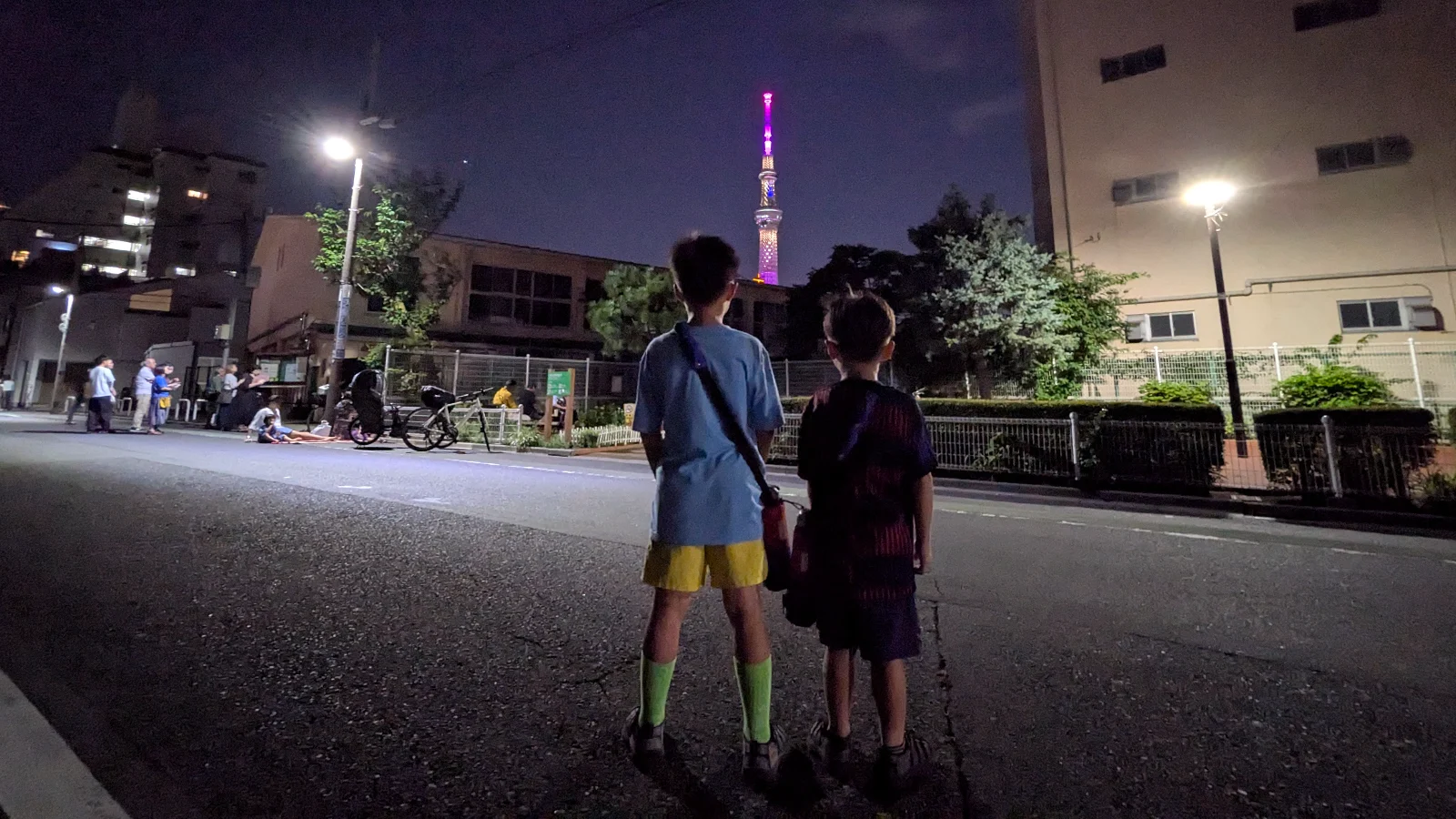
The enclosed observation decks and elevator-only exit structure of Tokyo Skytree give parents genuine reason to pause: once you are at 350 meters, leaving is not a decision you can make quickly. What pulls families toward it anyway is the tower itself: Japan’s tallest structure, with glass floor panels that produce a physical reaction in children old enough to understand what they are standing above.
Whether the experience justifies the friction depends entirely on your child’s specific Family Fit™ profile, and the breakdown below makes that determination straightforward. For families still building their broader Tokyo itinerary, the complete hub to Tokyo family friendly travel covers the city’s full planning picture.
Is Tokyo Skytree Worth Visiting with Kids? (Quick Answer)
Tokyo Skytree is conditionally worth visiting with kids if your family can tolerate a structured, passive environment with high crowd density: the altitude and glass floor panels deliver a genuine visual payoff, but the inescapable nature of the observation deck makes it a poor match for families whose children need physical freedom or sensory relief. Anchors and Sprinters find the tower straightforwardly rewarding; Sensors face a high-risk environment that is difficult to mitigate once you are inside it; and Dynamos require deliberate planning around discharge zones to make the visit functional. The guide below maps exactly where your child falls and what that means for your booking decision.
Pros of Visiting Tokyo Skytree with Kids
- The reinforced glass floor panels on the 340th floor produce an immediate, visceral reaction in children old enough to understand altitude; this is one of the few Tokyo experiences that registers as genuinely thrilling rather than culturally educational, and it requires no prior knowledge of the city to land.
- The observation deck is entirely flat and climate-controlled from the moment the elevator doors open, making the tower an unusually low physical output visit for families whose children need a high visual reward without a demanding physical route to reach it.
- The experience follows a clearly bounded loop, ticket scan, elevator ascent, circular viewing deck, elevator descent, giving Anchors a structure they can hold onto before they arrive, because the format does not change by time of day or season.
- Oyokogawa Shinsui Park sits immediately adjacent to the Skytree complex and gives Dynamos a genuine open-air physical outlet before or after the contained observation period without requiring any additional transit.
- For school-age children with enough geographical awareness to locate landmarks in the panorama below, the observation deck transforms from a passive viewing platform into an active spatial puzzle, Mount Fuji on clear days, Tokyo Dome, Asakusa’s Senso-ji, which meaningfully extends engagement time.
Cons of Visiting Tokyo Skytree with Kids (Important for Parents)
- The elevator staging corridors funnel all visitors into a single slow-moving bottleneck with no lateral escape route; for Dynamos, this is the highest friction point of the entire visit, because there is no adjacent space to absorb energy while the queue advances.
- The peak-hour observation deck combines dense body heat, sunlight reflecting off expansive floor-to-ceiling glass, and amplified crowd noise in an enclosed space from which there is no quick exit to the ground; for Sensors, the problem is not the intensity of any single element but the structural inability to step away from all three simultaneously.
- The primary activity is passive visual observation behind safety glass with no tactile component, which means toddlers and highly active children typically exhaust their engagement within fifteen minutes and begin seeking physical outlets that the environment cannot safely provide.
- Unexpected height aversion is a genuine risk at this altitude for children who are not usually afraid of heights at ground level: the combination of glass underfoot and the visible drop below functions differently than a rooftop railing, and families have limited options if a child shuts down mid-deck.
- The tower’s cultural visibility creates a planning bias toward including it regardless of child profile fit, which means families most likely to have a difficult visit are often the ones most likely to book it without scrutinizing it first.
Why “Worth It” Depends on Your Child
Two children can stand at the same panoramic window at Tokyo Skytree and have entirely opposite experiences, because the difference is not the view but the child. The Family Fit™ framework makes the distinction predictable before tickets are purchased, not after.
The Dynamo – Caution. The enclosed observation deck and slow-moving elevator queues remove the physical freedom that keeps this profile regulated, and there is no nearby outlet to burn energy between the bottlenecks. Plan the tower visit as a stop between two high-movement locations, Sumida Park to the south or the lower levels of Solamachi immediately below, and treat the queue as the moment to deploy any fidget tools your family already uses.
The Sensor – High Risk. The Tembo Deck is a reflective, acoustically amplified environment with crowd noise that cannot be escaped or reduced by repositioning, and the elevator dependency means a family cannot exit the building on short notice if the sensory load becomes unmanageable. Skip this attraction unless your family can secure the first entry slot of the morning and your child already has a reliable personal toolkit for managing high-input enclosed environments; the lower crowd density and reduced glare at opening time are the only conditions under which a visit becomes viable for this profile.
The Anchor – Go. The tower’s three-zone layout, entry corridor, circular viewing ring, and perimeter cafe, gives children an explicit, trackable spatial map that removes the ambiguity of unstructured environments, and the format does not change between visits or by time of day. Review a walkthrough of the elevator ascent with your child before arrival so the high-speed pressurized rise feels familiar rather than startling.
The Sprinter – Go. The Tembo Deck requires no meaningful physical output after the elevator doors open: the viewing area is compact, contained, and fully accessible without covering any significant ground, and the perimeter seating means families can settle in one position and take in the skyline without remaining on their feet. The entire visit sits comfortably within the stamina window this profile can sustain, which makes the tower one of the few high-impact Tokyo experiences that does not ask anything physical in return.
If you have not yet identified your child’s travel profile, the Family Fit™ Quiz is the most useful step to take before finalizing any Tokyo itinerary stop.
The LUNI Framework
Most families skip this.
It's why Day 3 falls apart.
The LUNI Profile Quiz identifies the specific planning adjustments your child needs. Three minutes now saves the whole trip.
Who Will Enjoy Tokyo Skytree with Kids (By Age Group)
Toddlers (under 3)
Children at this stage lack the visual depth perception and contextual understanding to process what a 350-meter altitude means; a skyline from that height registers as a flat image rather than a spatial experience. Tokyo Skytree is not worth it for this age group; the restrictive environment and queue demand significantly outweigh the brief window of engagement the view provides.
Preschoolers (3 to 5)
Preschoolers can be genuinely excited by the speed of the elevator ascent and the novelty of the glass floor panels, but their capacity for passive observation is short enough that interest typically expires before parents are ready to leave. The tower is conditionally worth it at this age only if families treat it as a rapid thirty-minute visual stop rather than a destination in itself, and only if an active reward at Solamachi immediately follows.
School-Age Kids (6 to 10)
Children in this range have developed enough geographical and spatial awareness to turn the observation deck into something active, identifying landmarks, tracing the city grid below, locating water features and sports stadiums, which meaningfully extends engagement beyond the initial altitude thrill. Tokyo Skytree is worth it for this age band, and the glass floor panels land particularly well on children who are old enough to feel the height without being overwhelmed by it.
Older Kids and Teens (11+)
Teens bring their own agenda to an observation deck: the photography opportunity, the scale of the panorama, and the freedom to move around the viewing ring independently all align with what this age group wants from a high-profile destination. Tokyo Skytree is worth it for this age band, and the Tembo Galleria on the 445th floor adds a secondary ascent that gives teens a reason to stay engaged rather than declare the visit finished after the first deck.
Best Alternatives to Tokyo Skytree for Families with Kids
- Tokyo Tower. Tokyo Tower’s lower altitude, shorter elevator queues, and open-air exterior observation platform deliver a classic skyline experience without the enclosed bottlenecks that create the most friction at Skytree. Tokyo Tower guide
- Shibuya Sky. The open-air rooftop design at Shibuya Sky creates a physically dynamic, photogenic environment that engages children who find conventional observation decks too contained.
- Sumida Aquarium. Located at the base of the Skytree complex, the aquarium replaces reflective glass and amplified crowd noise with low-light aquatic environments and genuine tactile engagement, a structurally opposite experience in the same geographic footprint. Sumida Aquarium guide
Families deciding how all of these options fit within a full Tokyo visit will find the Tokyo family friendly travel hub the most complete planning resource for sequencing them.
Final Recommendation: Is Tokyo Skytree Worth It with Kids?
Tokyo Skytree earns its visit for families whose children can engage productively with a contained, passive, high-altitude environment: the glass floor panels and the scale of the panorama are genuinely unlike anything else available in Tokyo, and for the right child the experience is memorable precisely because of how structurally unlike the rest of the city it is. Anchors and Sprinters find the tower a clean, rewarding addition to a Tokyo itinerary; Sensors faces a structural mismatch that advance planning cannot reliably resolve, and the visit should be skipped for this profile unless opening-slot timing is secured and a strong personal sensory management routine is already established. For families with a Dynamo or a child in the conditional range, the visit succeeds or fails based on a single variable: whether the observation deck is reached before the tour group wave arrives, which makes first-slot arrival the most important preparation decision this attraction requires.
The Tokyo Skytree Briefing: Essential Intel
Families planning a Tokyo Skytree visit with kids most consistently ask these questions, from whether the altitude thrill translates to younger children to how the observation deck environment affects children who are easily overwhelmed.
A: The tower is worth visiting for families whose children can engage with a passive, high-altitude environment: the glass floor panels and the panoramic scale of the city below create a genuine payoff for children old enough to process what they are seeing. The visit is a poor match for children who need physical freedom or sensory relief, because the observation deck is enclosed, reflective, and exit-dependent in ways that cannot be adjusted mid-visit.
A: For children under five, the tower’s restrictive environment and long queue demand significantly outweigh the engagement that the view itself provides at that developmental stage, making it a difficult visit to justify. Preschoolers who are brought should be treated as thirty-minute visitors with an active reward planned immediately after, not half-day destination guests.
A: The tower is not worth the logistical effort for families with babies. The dense peak-hour corridors and narrow viewing areas are structurally difficult to navigate with a stroller, and the sensory environment at altitude is lost entirely on infants; families with babies will find the pedestrian-friendly pathways of the nearby Asakusa district a far more productive use of the same time window.
A: The tower heavily favors adults and children aged six and above who can derive sustained value from spatial observation and photography. Children below school age typically lose interest once the elevator novelty expires, because the entire experience takes place behind glass with no tactile or interactive element to hold attention once the height itself stops being novel.
A: The tower is a strong match for teens, who are drawn to the photography conditions, the visual scale, and the autonomy of being able to move in the viewing ring independently. The secondary ascent to the Tembo Galleria on the 445th floor extends the visit enough to prevent the flat viewing deck experience from feeling finished too quickly, which is the most common complaint from this age group at observation-only attractions.
A: The tower is a high-risk environment for children who are easily overwhelmed, because the amplified crowd noise, sunlight reflecting off floor-to-ceiling glass on all sides, and the elevator-dependent exit combine into a sensory load that cannot be reduced by repositioning within the deck. The visit should be skipped under normal conditions for this type of child; it only becomes viable at the first entry slot of the morning, when crowd density is at its lowest and glare has not yet peaked, and only if your child already has a reliable personal toolkit for managing high-input enclosed environments.
