Tokyo Skytree with Kids: The Tower That Rewards a Confirmed Plan.
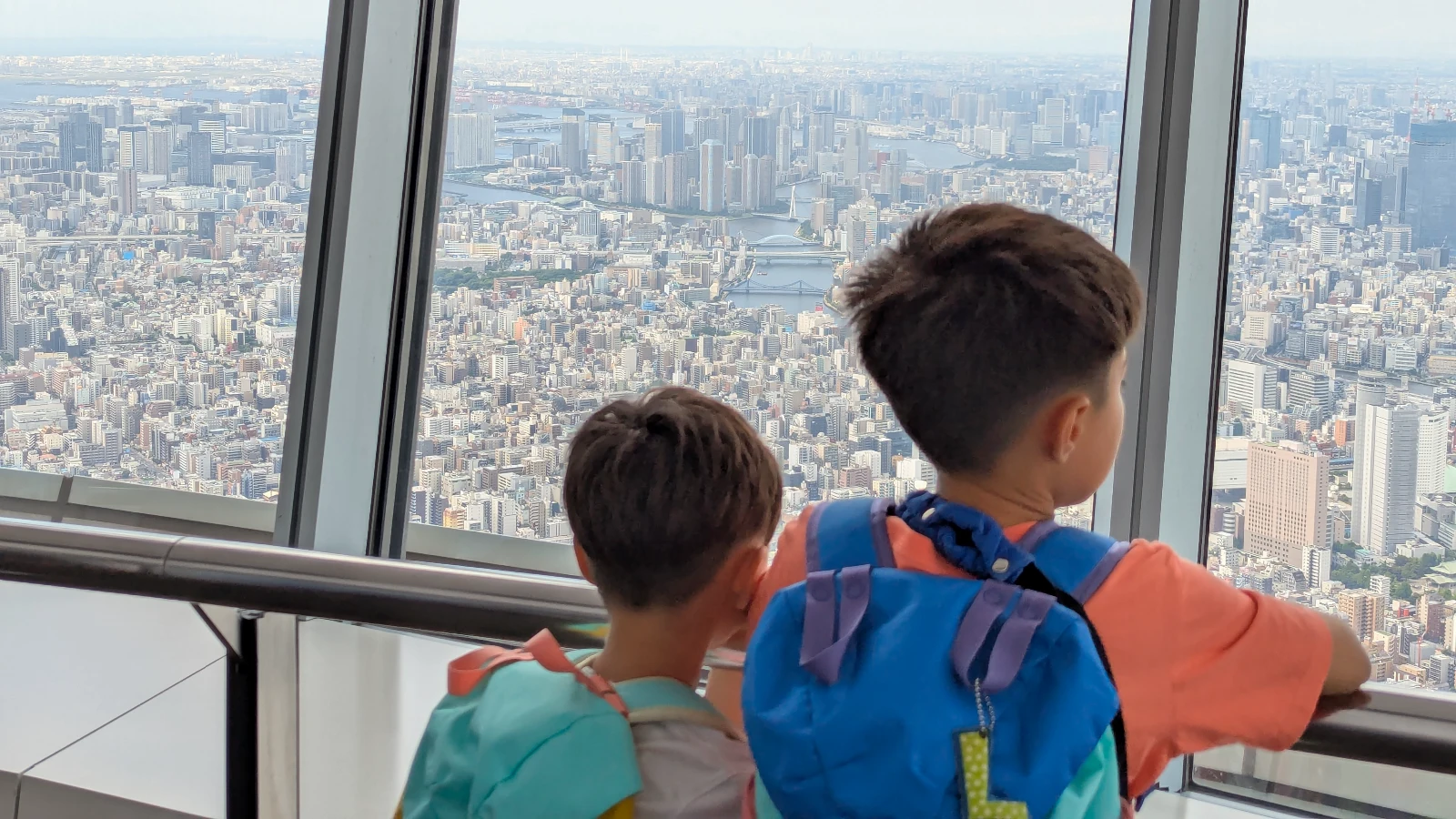
Tokyo Skytree sells a fixed time and a known route, which suits a child who needs a plan, but the decks can be busy, and there is no stepping out once inside.
Both decks from ¥3,000 and ¥1,500; preschoolers free. Booking online is offered, not required; the fourth-floor counter adds ¥500.
Last entry one hour before closing; hours are set by date and can change without notice.
Both decks fit inside it, at a child’s pace.
Preschoolers go free, and there is a baby care room inside the observatory.
Lent on the day while they last; stroller parking on the fourth floor.
Some links on this page are affiliate links. LuNi may earn a commission at no extra cost to you.
Is Tokyo Skytree worth it with kids?
The short version, before the costs, the timings and the case for each child.
Yes, and it is worth doing properly rather than squeezing into a Tokyo week. The visit is shorter than families expect, one to one and a half hours with children for the Tembo Deck and the Tembo Galleria together, and it runs on a ticket that fixes the time. That structure is the whole secret. Book the slot, tell the children exactly how the elevators work, and plan a stop at the seated cafe on the deck. What the tower does not forgive is improvisation: a ticket cannot be changed after purchase, only canceled and bought again, and once inside there is no stepping out. Choose a slot late in the day, when the crowds tend to thin.
Planning Your Visit to Tokyo Skytree with Kids.
Three decisions shape the visit, and all of them happen at home. The first is the slot. Tickets fix the date and time and cannot be changed afterward, only canceled and rebought, so treat the booking as a promise to the children, and since crowds tend to thin toward closing, pick a later slot you can keep. The second is the ticket itself: the Tembo Deck alone, or both decks, and buying online avoids the counter’s surcharge. The third is the stroller. Only a limited number are lent on the day, so bring a carrier for a small child and use a loan only if one is free when you arrive. A late slot leaves the whole day before it free for Asakusa’s temple streets or anything else.
Every LuNi attraction guide starts with a visit, with our own children
LuNi rates and writes about attractions only after visiting them with children. Luca and Nico were at Tokyo Skytree, and what they did there is recorded further down this page, including how each child actually met it.
Children arrive with different tolerances: for noise, for lines, for standing still, for being on their feet all day. A guide written for the average of them helps almost nobody. So every place on this site is read four ways, and each verdict says which children it already suits and what makes it work for the rest. Whoever you are bringing, the answer here is built for your family rather than for a general reader.
Restricted-movement depletion builds over a visit of standing at glass with no way to step out, so walk the Galleria slope and keep it short.
Sensory-input depletion peaks on a busy deck where staff move visitors along, so book a slot near closing and plan the seated cafe as the break.
Unfamiliarity eases when the fixed time and the route are known, elevator change and escalator included, so describe both before the family arrives.
Walking and standing stay modest on a short elevator route, with a seated cafe on the deck and strollers lent in limited numbers.
- Cost
- Deck from ¥1,800 age 15 and up / ¥900 age 6 to 14Both decks from ¥3,000 and ¥1,500; preschoolers free. Booking online is offered, not required; the fourth-floor counter adds ¥500.
- Booking
- Online, date and time fixedNo changes after purchase: cancel and rebuy, with a fee from 30 days before.
Hotels we would book for this visit.
The tower is quieter near closing, and a late slot needs a short evening after it, so all three are Tokyo family hotels on the city’s east side. The pick comes first.
| Property | The LuNi Reason |
|---|---|
| LUNI Pick The Gate Hotel Ryogoku by Hulic | The Gate Hotel Ryogoku is for a family that books the late slot the tower rewards. A visit that ends near closing asks a child to stay up past the usual hour, and a room in the same ward makes the ride back the shortest part of a long evening rather than its hardest. |
| Tobu Hotel Levant Tokyo | Tobu Hotel Levant Tokyo is for a family whose child needs an evening without surprises after a busy deck: the same room, the same short route, and nothing new to take in before bed. The tower asks for a fixed plan, and a base on this side of the city keeps the rest of the day as fixed. |
| The Gate Hotel Kaminarimon by Hulic | The Gate Hotel Kaminarimon by Hulic is for a family pairing the tower with Asakusa: a late slot on the deck one evening, and Senso-ji’s early hall the next morning. A child who stayed up for the view can start the second day slowly, with the temple as the only plan. |
The Gate Hotel Ryogoku by Hulic
The Gate Hotel Kaminarimon by Hulic
Nearby attractions, matched to your child.
Three pairings for what the tower leaves unmet: a contained stop with seats after the busy deck, open ground for a child who has stood at glass long enough, and a museum that explains itself for a reader.
| Pairing | Why This Solves the After-Visit | For Your |
|---|---|---|
| LUNI Pick Sumida Aquarium Solamachi 5F and 6F, Tokyo Skytree Town | In the same Tokyo Skytree Town, Sumida Aquarium is an indoor hour and a half with chairs at the big Ogasawara tank. Sensory input eases after a busy deck when the next place is contained and has seats, and a hand stamp allows a break outside. | Sensor |
| Senso-ji Temple Asakusa; free, open-air precinct | A visit of standing at glass is the Dynamo’s hardest kind of wait, and Senso-ji Temple in Asakusa answers it with a free, open-air precinct that the temple keeps flat. Restricted movement lifts once the child has ground to cross. | Dynamo |
| National Museum of Nature and Science Ueno Park; free through high school | For an Anchor who liked the tower’s fixed slot, the National Museum of Nature and Science is a day whose galleries can be picked in advance, room by room, and children up to the end of high school pay nothing. Unfamiliarity eases when the plan is made together at home, before anyone reaches Ueno. | Anchor |
Sumida Aquarium
Solamachi 5F and 6F, Tokyo Skytree Town For YourSensor
Senso-ji Temple
Asakusa; free, open-air precinct For YourDynamo
National Museum of Nature and Science
Ueno Park; free through high school For YourAnchor
How two children actually met this attraction.
Two children stood on the same deck and used it in opposite ways. One read the view like a map and worked it for as long as it had answers to give; the other went straight for the one part of the floor he could do something with, and made the rest of the visit a story. That split is the useful thing to know about the Skytree with children. The deck is a place for looking, and a child who likes looking will find the visit too short, while a child who needs to act will look for the one surface that lets him. Plan for both: a named landmark to find for the reader, and the glass floor early, before the waiting, for the one who needs to move.
Luca worked the deck slowly and methodically. He spent most of the visit at the glass, picking out and naming landmarks, and when he located Yokohama in the distance he stopped on it, placing it against the ground he had walked the day before. He broke from the windows only for the information boards with the Toy Story details, which he read in full. The glass floor he approached with caution, then dismissed.
This is the Anchor pattern. A child whose Reserve depletes through unfamiliarity and unconfirmed structure settles by turning an open view into something known, and Luca did it by fixing on places he had already been. For families with a similar child, hand them the city before the elevator: two or three landmarks to find, and a place they visited earlier in the trip. The view then becomes a checklist they control rather than a sky full of unknowns.
Nico went straight to the glass floor and stayed there. He looked down, declared that his feet were monster feet stomping the cars below, and tried to jump on the panel until he was stopped. He pressed against the glass the moment he found Yokohama far below, calling out that they had just been there. The rest of the visit he spent narrating the tower as a rocket primed to launch.
This is the Dynamo pattern. A child whose Reserve depletes through restricted movement looks for the one thing in a room he can act on, and on an observation deck that is the glass floor. For families with a similar child, go to it first and set the rule before he steps onto it: standing and looking, nothing more. Then give him a job at the windows, finding a place from earlier in the trip, so the rest of the hour has something to do in it.
Standing above a city changes how a child understands it. From the deck the streets they walked become a map, the river becomes a line, and the places from the week turn into points they can name and connect. That shift, from being inside a place to seeing it whole, is one of the quieter lessons of travel, and children often grasp it before adults put words to it. A view is worth most when a child uses it to tell the story of where they have been and where they are going next.
The LUNI Rating for Tokyo Skytree.
The verdicts split on one question: does the child need to act, or can they look? The tower is a visit of looking on busy decks with no stepping out, which is why the Sensor pays most and the Dynamo needs a plan. The tower also runs on a fixed ticket and a route that can be described in advance, which is why the Anchor and the Sprinter are both well served, with a seated cafe on the deck for anyone who tires. The tower is easy to plan and hard to improvise. Book late, describe the route, and let the deck cafe catch whoever tires.
Give the hour a job, and go to the glass floor first. The Dynamo depletes through restricted movement, and the Skytree asks for one to one and a half hours of standing and looking, with no way to step outside once inside and no re-entry. The elevators do the climbing, so even the journey up and down offers nothing to spend energy on. For a child who needs to move, that is the whole cost of the tower.
Two things help. The Tembo Galleria is a slope-shaped corridor, so a child who adds it gets a walk rather than another window, and the glass floor on the deck gives a moving child the one surface he can act on. Go to it first, set the rule about standing on it, then give the child a job at the windows. Keep the visit short, and put open ground straight after it.
What this means for your Dynamo: long looking with no exit is where restricted movement builds. A younger Dynamo needs the glass floor first and a short visit; an older one can walk the Galleria slope as the second half.Book late, and treat the cafe as part of the ticket. The Sensor depletes through sensory input, and a busy observation deck concentrates it. When the deck is busy, staff may ask visitors to move along, so a child who needs to stop and settle is kept moving in a crowd. There is also no stepping out: once inside there is no re-entry, and the way down runs through an elevator, an escalator and another elevator before the exit.
None of that can be switched off, only planned around. Choose a slot near closing, when crowds tend to thin, and plan a break at SKYTREE CAFE 340, the seated cafe on the Tembo Deck, before the child needs it rather than after. Skip the Galleria for a child already near their limit, and treat the hour as the ceiling rather than the target.
What this means for your Sensor: input peaks on a busy deck with no way out. A younger Sensor needs a late slot and the cafe booked into the plan; an older one can choose the quieter windows and decide when to sit.Describe the route, change and all. The Anchor depletes through unfamiliarity and unconfirmed structure, and the Skytree is unusually easy to describe in advance. The ticket fixes the date and time. From the fourth-floor entrance an elevator goes to Floor 350 on the Tembo Deck; for the Tembo Galleria, a second elevator goes on to Floor 445. On the way down, an elevator runs from 450 to 345, an escalator takes you to 340, and a last elevator reaches the exit on the fifth floor.
That is more steps than a child expects from one tower, so say them before the trip. A child who knows about the change of elevator and the escalator will not be caught out by either. Keep the slot, because it cannot be changed, and if the morning runs late, know that a late arrival is still admitted that day at the back of the line, though the wait can be long when it is busy. Say both parts to a child who counts minutes.
What this means for your Anchor: unfamiliarity eases once the route is named step by step. A younger Anchor needs the elevator change told in advance; an older one can hold the whole sequence and call out each step.Let the elevators and the cafe carry it. The Sprinter depletes through sustained travel-style walking and standing, and the Skytree asks for less of both than its height suggests. Elevators carry the family up and most of the way down, with one escalator on the descent. A visit with children takes one to one and a half hours with both decks, which keeps the standing short.
What remains is the standing at the windows, and the deck has an answer for it: SKYTREE CAFE 340 is a seated cafe. Plan a sit-down there halfway through. Strollers are lent in limited numbers on the day, with a stroller park on the fourth floor, and wheelchairs are lent too, so bring a carrier as the fallback for a small child who may tire. For this child the tower is one of the easier big sights in the city.
What this means for your Sprinter: walking and standing stay modest on an elevator route. A younger Sprinter needs a carrier and a seat at the cafe; an older one can add the Galleria slope if the first hour went well.The questions parents actually ask.
A Skytree ticket fixes the slot and there is no re-entry, so the visit is decided before the family arrives. A ticket cannot be changed, only canceled and rebought; a late arrival is still admitted that day, though the wait can be long. There is a seated cafe on the deck, and the visit with children is shorter than most families expect, which frees the rest of the day for something on the ground. Arrive a little early for the slot rather than late, since a late family waits while a child’s patience runs out. At the tower, book the slot first.
Is Tokyo Skytree worth visiting with kids?
Yes, for most children, if the family chooses its time well. A visit with children takes one to one and a half hours with both decks, the Tembo Deck and the Tembo Galleria, and the deck has a seated cafe. A child who finds busy places hard is the one to plan for, and the later slots help.
How much are Tokyo Skytree tickets?
Prices vary by date. The Tembo Deck starts at 1,800 yen for visitors 15 and over and 900 yen for children 6 to 14; both decks start at 3,000 yen and 1,500 yen. Children 5 and under, and children aged 6 who are not yet in school, go free. Buying at the fourth-floor counter or machines adds 500 yen per ticket.
Can you change a Tokyo Skytree ticket?
Not directly. The number of people, the date and the time cannot be changed after purchase, so the way to move a visit is to cancel and buy again, with a cancellation fee from 30 days before. Bad weather does not give a transfer, so check the forecast before committing to a clear-view day.
How long do you need at Tokyo Skytree with kids?
One to one and a half hours with children, the Tembo Deck and the Tembo Galleria both included, at an unhurried pace. There is no time limit inside, though staff may ask visitors to move on when it is busy, so the figure is a guide rather than a rule.
Is there anywhere to sit at Tokyo Skytree?
Yes. The Tembo Deck has two cafes, and SKYTREE CAFE 340 is a seated cafe, which makes it the place to plan a break for a tired child or one who needs a pause from the windows. There is also a baby care room inside the observatory for a family with an infant.
Can you bring a stroller to Tokyo Skytree?
Strollers are parked on the fourth floor, the entrance floor, and a limited number are lent on the day, so a family relying on one should arrive with a carrier as a fallback. Wheelchairs are also lent. The route runs by elevator, with one escalator on the way down, so a small child can be carried where needed.
How do you get to the Tembo Galleria at Tokyo Skytree?
From the fourth-floor entrance, an elevator goes to Floor 350 on the Tembo Deck, and a second elevator from there goes up to Floor 445 on the Tembo Galleria. There is no direct elevator to the Galleria. On the way down, an elevator runs from 450 to 345, an escalator to 340, then an elevator to the fifth-floor exit.
What happens if you are late for a Tokyo Skytree time slot?
A late arrival on the same day is still admitted from the back of the line, though the wait can be long when it is busy. What a family cannot do is leave and come back: once inside, there is no re-entry, so settle bathroom visits and snacks before the elevator rather than planning to step out.
Where Tokyo Skytree fits your Japan trip.
Official site and opening information: Tokyo Skytree