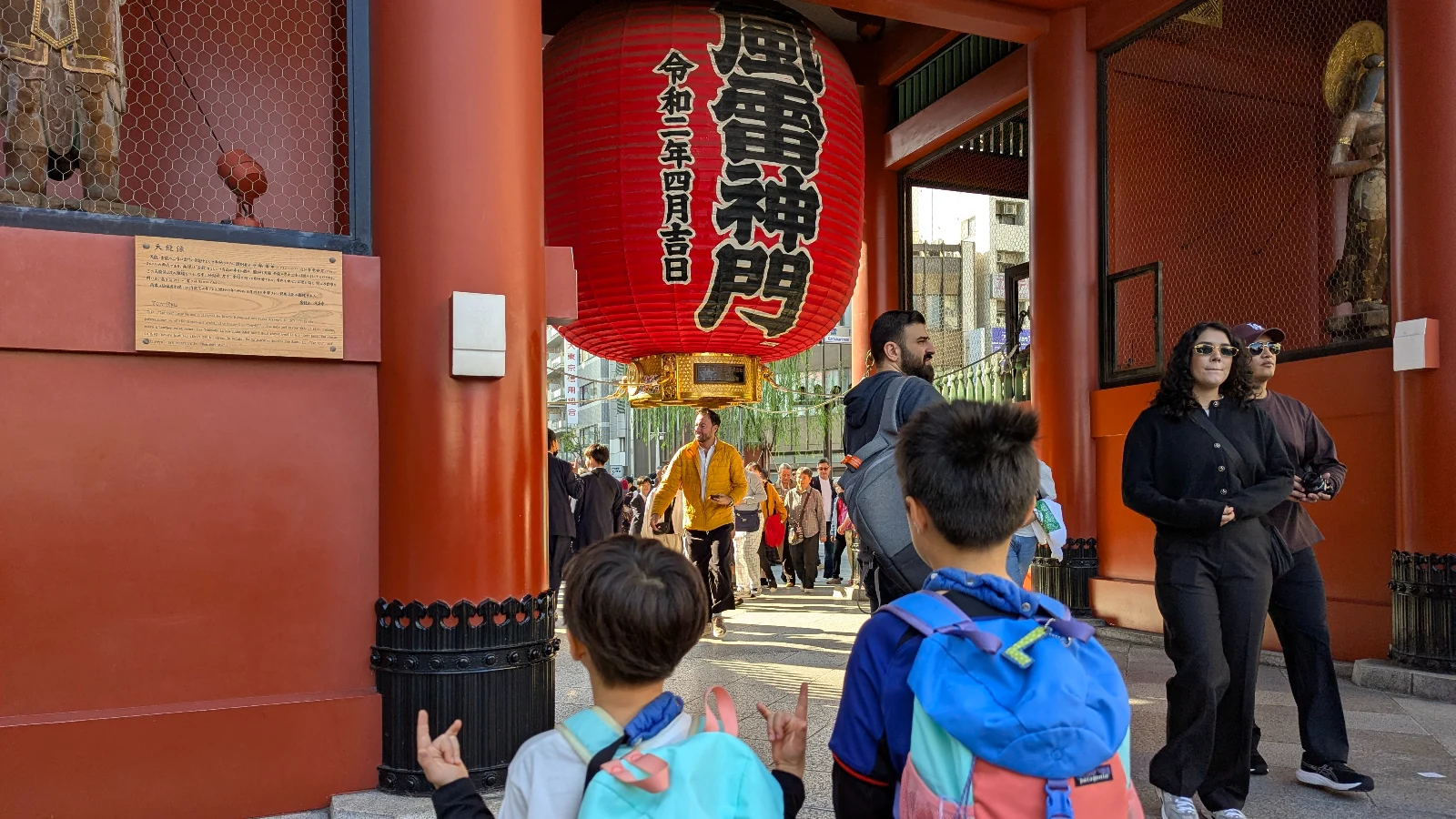
The crowd density on Nakamise Street, a walled commercial corridor with no practical exit mid-approach, causes many parents to question whether Senso-ji Temple is manageable with children. Yet Tokyo’s most recognizable cultural landmark, anchored by the towering Kaminarimon lantern, holds a position on most family itineraries that no other Tokyo attraction can claim.
Whether that environment will energize or overwhelm your child is not a universal question, and the Family Fit™ framework is the tool that makes the outcome predictable before you arrive. Families building their broader Tokyo itinerary alongside this decision can consult our Tokyo family friendly travel hub for city-level planning structure.
Is Senso-ji Temple Worth Visiting with Kids? (Quick Answer)
Senso-ji Temple is conditionally worth visiting with kids when the visit is timed to avoid the midday crowd peak on Nakamise Street. The high-stimulation outdoor environment and tactile ritual stations make it a strong fit for Dynamos and a structurally sound experience for Anchors, but the inescapable crowd density of the main approach makes it a genuinely poor fit for Sensors. This guide identifies exactly which children will thrive here, which friction points to anticipate by profile, and what determines whether the visit succeeds for families in the conditional range.
Pros of Visiting Senso-ji Temple with Kids
- The Kaminarimon Gate delivers an immediate, outsized visual spectacle. The scale of the red lantern registers within seconds of arrival and produces the kind of unscripted child reaction that no museum exhibit or indoor attraction can replicate, making the approach worthwhile even before entering the temple grounds.
- The omikuji fortune stations and incense rituals give Dynamos structured physical engagement. Shaking the metal canister, drawing a numbered stick, and collecting a fortune slip is a contained, repeatable interaction that absorbs high-energy children without requiring them to stand still or stay quiet in a regulated space.
- The linear sequence from outer gate to main hall provides Anchors with a predictable visit architecture. The site follows a clear and logical progression with no branching decisions required, allowing parents to brief children on the exact sequence before arrival and remove the anxiety of an undefined or open-ended environment.
- The surrounding Nakamise stalls provide tactile, visually engaging variety that keeps children moving forward. The colorful vendor displays and food options, including ningyoyaki and other recognizable street treats, serve as motivational anchors at close intervals for children whose attention requires regular re-engagement.
- The outdoor format removes the regulated behavior expectations of enclosed cultural sites. Unlike interior museum or shrine spaces where noise and movement are actively constrained, the temple grounds absorb a child’s natural energy level without creating social friction for the family.
Cons of Visiting Senso-ji Temple with Kids (Important for Parents)
- The Nakamise approach functions as a crowd funnel with no mid-route escape. The walled stands channel visitors into a slow-moving mass that cannot be exited laterally until the approach ends, meaning a child who becomes distressed partway through has no immediate relief option without backtracking against foot traffic.
- The continuous slow-pace walking of the main approach rapidly depletes Sprinters. This is not a stroller-through attraction or a compact walk: the approach requires sustained low-speed forward movement in a dense crowd, which is physically exhausting for low-stamina children in a different way than active walking because the pace cannot be controlled.
- The combination of thick incense smoke, loud vendor calls, and shoulder-to-shoulder pedestrian density creates a compounding sensory environment that cannot be managed in layers. These three inputs occur simultaneously and cannot be isolated or modulated, meaning a Sensor will encounter all three at once with no practical way to reduce the total load mid-approach.
- Stroller navigation on the Nakamise approach creates a secondary friction layer for parents of young children. The narrow shared walking space means a stroller becomes a source of constant social friction, requiring parents to manage the equipment, the child, and the crowd simultaneously.
- The unshaded main approach becomes a heat retention zone during warmer months. The lack of overhead canopy along the primary walking path means families visiting from late spring through summer absorb direct sun for the full duration of the approach without a shade interval.
Why “Worth It” Depends on Your Child
Two parents can walk Nakamise on the same morning and reach opposite conclusions about whether Senso-ji was worth bringing their child, and both can be entirely correct, because the determining factor is not the temple but the child’s specific threshold for stimulation and physical demand. The Family Fit™ framework makes that outcome predictable rather than a matter of guessing.
The Dynamo – Go. The outdoor, loosely structured environment of the temple grounds imposes no behavioral ceiling on a high-energy child, and the incense and omikuji ritual stations provide hands-on physical engagement that channels that energy productively. Allow Dynamos to interact fully with both ritual stations rather than moving them through as observers.
The Sensor – High Risk. The Nakamise corridor delivers three simultaneous, inescapable sensory inputs, dense crowd contact, loud vendor calls, and concentrated incense smoke, in a space with no lateral exit until the approach is complete. The side streets flanking Nakamise offer a quieter entry path to the temple grounds, but even this route does not fully neutralize the sensory environment near the main hall during peak hours; early arrival is the most reliable mitigation available.
The Anchor – Go. The site’s linear progression from Kaminarimon Gate through the Nakamise approach to the main prayer hall provides a clear, sequential visit structure with no decision points that introduce uncertainty. Brief Anchors on the exact sequence before arriving, gate, approach, incense station, hall, and the visit format will match their expectations precisely.
The Sprinter – Caution. The slow-moving crowd pace of the Nakamise approach requires sustained physical output from a child who has limited stamina reserves, and the density of the corridor limits the family’s ability to set their own pace or stop freely. Identify the quieter seating areas around the secondary temple structures in advance and treat them as mandatory rest intervals rather than optional detours.
Knowing your child’s profile before booking transforms this from an uncertain gamble into a planned decision. Families who haven’t yet identified their child’s profile can use the Family Fit™ Quiz as a starting point.
The LUNI Framework
Planning around Japan.
Or planning around your child?
Every child travels differently. The LUNI Profile Quiz identifies your child's specific profile in three minutes, and tells you exactly how to structure your itinerary around it.
Who Will Enjoy Senso-ji Temple with Kids (By Age Group)
Toddlers (under 3)
Toddlers lack the physical height to see anything beyond the legs of the adults surrounding them on the Nakamise approach, which eliminates the visual spectacle that is Senso-ji’s primary offer for young children. A visit is conditionally worth it only if you carry them in a structured front or back carrier and arrive early enough that the approach corridor has not yet reached its peak density.
Preschoolers (3 to 5)
The Kaminarimon lantern’s scale and the bright visual variety of the Nakamise stalls are immediately legible to a preschooler’s developmental stage without requiring historical context or sustained attention. A brief, tightly focused visit centered on the gate and one or two vendor interactions is worth it for this age group; a slower, more extended attempt to explore the full grounds is not.
School-Age Kids (6 to 10)
Children in this range have the physical height to see the approach clearly, the coordination to participate independently in the omikuji and incense rituals, and enough abstract curiosity to register that these interactions carry cultural weight. This age group gets the fullest return from Senso-ji, and the visit is worth it without qualification for school-age children whose profile is not a Sensor.
Older Kids and Teens (11+)
Teenagers respond to Senso-ji’s energy differently than to its cultural content: the density and visual variety of the Nakamise stalls, the freedom to browse independently, and the photographic drama of the architecture make it a high-value stop for adolescents who are given autonomy within the visit. It is worth it for this age group, with the caveat that teens who chafe at structured itineraries will enjoy Senso-ji most when they are given time to move through the Asakusa surrounding at their own pace rather than guided point-to-point.
Best Alternatives to Senso-ji Temple for Families with Kids
- Meiji Jingu Shrine. Best for families whose primary goal is a meaningful cultural shrine experience without crowd pressure. The forested approach to the main shrine is wide, shaded, and consistently uncrowded compared to Nakamise, providing cultural weight in a sensory environment that remains escapable throughout the visit. Meiji Jingu guide
- Ueno Zoo. Best for families with toddlers and younger children who cannot yet navigate or see over a dense pedestrian environment. The zoo’s layout gives children under 3 genuine visual engagement at ground level without a crowd-funnel approach that renders the experience inaccessible by height. Ueno Zoo guide
- Sumida Aquarium. Best for families managing a low-stamina child alongside older siblings. The compact indoor footprint with integrated seating means the visit can be paced entirely around the child’s energy reserves rather than around an approach corridor that cannot be shortened. Sumida Aquarium guide
For broader help structuring a Tokyo itinerary around your family’s specific profiles, our Tokyo family friendly travel hub covers neighborhood selection, transit strategy, and multi-day pacing by profile.
Final Recommendation: Is Senso-ji Temple Worth It with Kids?
Senso-ji Temple is conditionally worth visiting with kids, provided the family has a realistic assessment of what the Nakamise approach demands before committing to it: not the temple’s cultural significance, which is genuine, but the specific physical and sensory environment of the route that leads there. Families with Dynamos, Anchors, or older children have a clear path to a rewarding visit; families with Sensor or Sprinter children face a more conditional calculation that depends heavily on timing and how the approach is managed. The visit succeeds for families in the conditional range when arrival is timed carefully: the difference between a rewarding cultural stop and an overwhelming one at this specific site is crowd density, and crowd density at Senso-ji is directly tied to time of day.
The Senso-ji Temple Briefing: Essential Intel
Families deciding whether Senso-ji Temple belongs on their Tokyo itinerary consistently return to the same questions, not about the temple’s history, but about whether their specific child will find the environment energizing or exhausting.
A: Yes, for most families, with the timing of arrival as the determining condition. The Kaminarimon Gate and the ritual stations deliver the kind of immediate, tactile engagement that justifies the visit, but the Nakamise approach at midday is a materially different experience than the same route in the early morning, and that distinction matters more at Senso-ji than at almost any other Tokyo landmark.
A: Senso-ji is a poor fit for children who fall into The Sensor profile. The Nakamise corridor combines three simultaneous, inescapable sensory inputs, crowd contact, loud vendor noise, and concentrated incense smoke, in a space with no practical exit until the approach is complete, making it one of the more challenging environments in Tokyo for a sensory-sensitive child even with advance preparation.
A: Conditionally, if you carry them. A toddler on foot on the Nakamise approach cannot see past the surrounding adults, which removes the visual spectacle that makes Senso-ji worth visiting in the first place. A structured carrier resolves the height barrier; arriving early resolves the crowd density; without both conditions in place, the visit does not deliver enough for a child under 3 to justify the effort.
A: Strongly yes. The visual drama of the Kaminarimon Gate, the photographic variety of the Nakamise stalls, and the freedom to browse the wider Asakusa neighborhood independently make Senso-ji one of the more rewarding cultural stops in Tokyo for adolescents. Teens who are given space to explore at their own pace rather than guided point-to-point will get the most from this site.
A: With significant caveats. The Nakamise approach has no overhead canopy, which turns it into a direct-sun corridor during the warmer months. The visit remains worthwhile in summer only if the family arrives early in the day before peak heat and peak crowd density converge; the two conditions tend to arrive together from late morning onward, which makes timing the single most important planning variable for a summer visit.
