Senso-ji Temple with Kids: free, flat, with an elevator up.
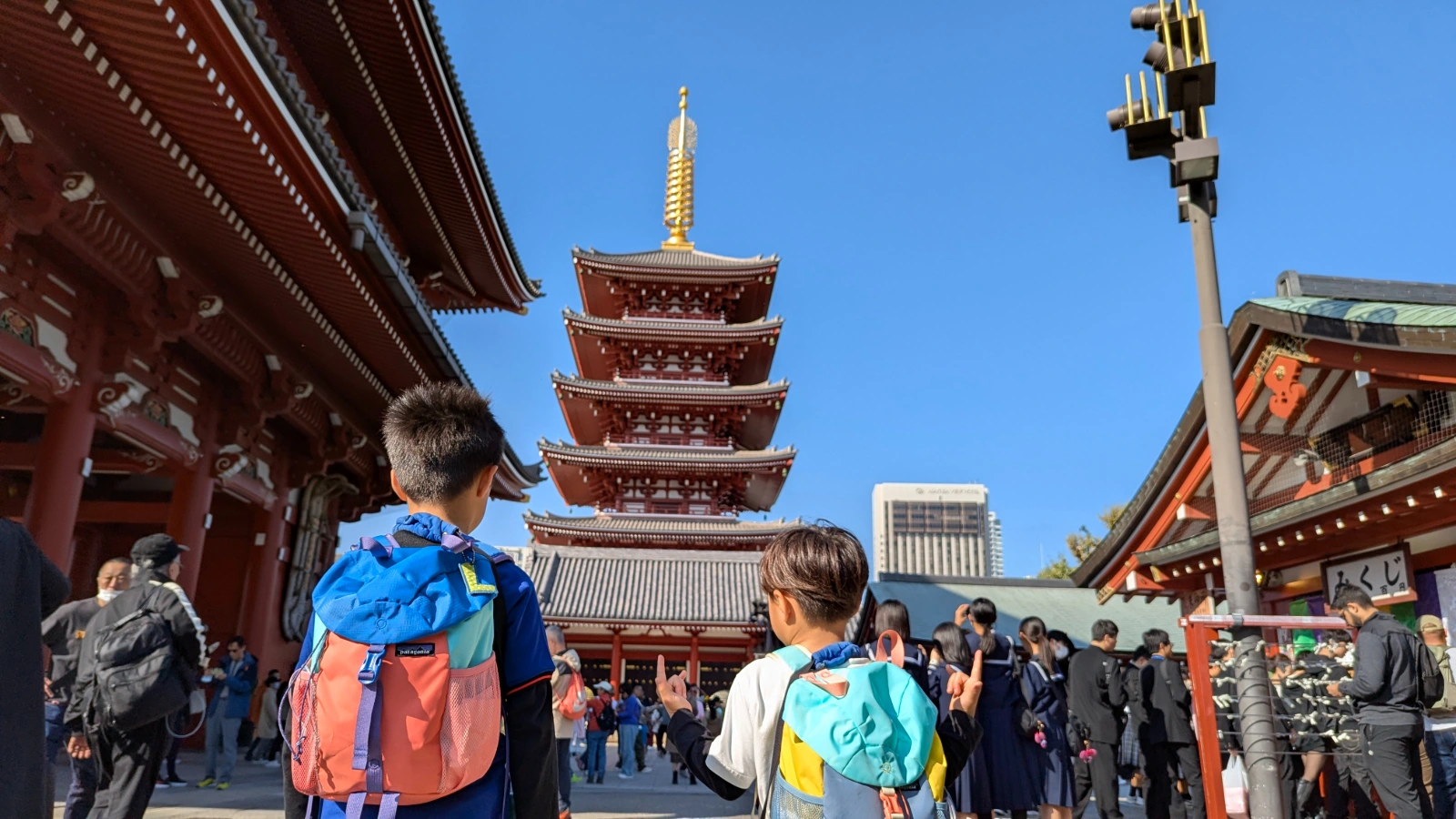
Senso-ji is free, flat and open from early morning, which suits most children well, but an open-air temple holds whoever arrives, and some children feel that more than others.
No ticket for the precinct or the main hall; omikuji and shopping are separate choices.
Opens at 6:30 from October to March; open every day.
The precinct first, then the main hall.
The precinct is flat; the main hall is up a flight of stairs.
Facing the main hall, an elevator to its left serves anyone who has difficulty with the stairs.
Some links on this page are affiliate links. LuNi may earn a commission at no extra cost to you.
Is Senso-ji Temple worth it with kids?
The short version, before the costs, the timings and the case for each child.
Yes, and it is one of the few great sights in Tokyo that asks almost nothing in return, with one condition: the hour. There is no ticket, the precinct is flat, and the way through, from the Kaminarimon gate to the main hall, is simple enough for a child to lead. But an open-air temple holds whoever arrives, so a child who feels every sound pays for a busy precinct, and a child who tires on foot meets the main hall’s stairs at the very end. The main hall opens early, so come then, keep the visit short, give the children the omikuji to try and the gate to find, and leave while everyone is still enjoying it, before the precinct asks more of them.
Planning Your Visit to Senso-ji Temple with Kids.
Three decisions matter, and none of them is about tickets, because there are none. The first is the hour. The main hall opens early, half an hour later in the winter months, so a start before breakfast is always available and the rest of the day stays free for whatever the children choose next. The second is how you arrive: Asakusa Station is about five minutes away and served by four lines, so choose the one your hotel is on. The third is what carries a small child. The precinct is flat and a stroller crosses it easily, but the main hall is up a flight of stairs, so bring a carrier for the last part. A child carried up those stairs reaches the hall with energy left for the omikuji. For the whole neighborhood around the temple, Asakusa with kids goes stop by stop.
Every LuNi attraction guide starts with a visit, with our own children
LuNi rates and writes about attractions only after visiting them with children. Luca and Nico were at Senso-ji Temple, and what they did there is recorded further down this page, including how each child actually met it.
Children arrive with different tolerances: for noise, for lines, for standing still, for being on their feet all day. A guide written for the average of them helps almost nobody. So every place on this site is read four ways, and each verdict says which children it already suits and what makes it work for the rest. Whoever you are bringing, the answer here is built for your family rather than for a general reader.
Restricted-movement depletion stays low in a free, flat, open-air precinct with no ticket and no route to follow, so let the child lead the way in.
Sensory-input depletion depends on the hour in an open precinct that holds everyone who comes, so arrive when the main hall opens and leave early.
Unfamiliarity eases on a clear sequence, main gate to main hall, with omikuji rules a child can learn in advance, so rehearse that order at home.
Walking and standing are gentle on the flat grounds, but the main hall is up stairs, so carry a small child for the last stretch.
Hotels we would book for this visit.
It all comes down to the hour: the main hall opens early, and a family that wakes up in Asakusa can be there at opening without a train first. Three rooms in Asakusa, the pick first.
| Property | The LuNi Reason |
|---|---|
| LUNI Pick The Gate Hotel Kaminarimon by Hulic | The Gate Hotel Kaminarimon, named for the temple’s main gate, is for a family that wants to be at the main hall as it opens. The early hour is the lever for a child who feels every sound, and a room in the temple’s own neighborhood makes that early start far easier to keep. |
| OMO3 Asakusa by Hoshino Resorts | OMO3 Asakusa is for a family that splits the district in two: the temple early one morning, the shops on a later, shorter visit another day. A room in Asakusa makes two short visits easy, where one long one would cost a child who feels every sound, and the second morning starts just as simply. |
| Asakusa View Hotel | Asakusa View Hotel sleeps up to four in its standard rooms and lets a preschooler share a parent’s bed, so a family of four can stay together in one room for the early start. A child who feels every sound gets the temple before the day fills it, and the room is still there for a rest by midmorning. |
The Gate Hotel Kaminarimon by Hulic
OMO3 Asakusa by Hoshino Resorts
Nearby attractions, matched to your child.
Three pairings for what a temple morning leaves unmet: a child who wants the next part of the day fixed on a ticket, a child whose legs are ready to sit down indoors, and one who wants a museum that explains itself.
| Pairing | Why This Solves the After-Visit | For Your |
|---|---|---|
| LUNI Pick Tokyo Skytree Timed Tembo Deck tickets | At Tokyo Skytree the ticket fixes the date and time, so an Anchor’s unfamiliarity eases with a plan made at home, though a Sensor’s sensory input meets busy decks. Book a slot near closing and name the elevator change before arriving. | Anchor |
| Sumida Aquarium Tokyo Skytree Town; about 1.5 hours | For a child whose legs are done, Sumida Aquarium in Tokyo Skytree Town is an indoor hour and a half with chairs at its big Ogasawara tank. Walking and standing ease there once the opening stairs are climbed, and there is no stroller to borrow. | Sprinter |
| National Museum of Nature and Science JR Ueno Park Exit, 5 min; free under 18 | For an Anchor, the National Museum of Nature and Science is a day of galleries that can be chosen and ordered at home, and it charges nothing for children through high school. Unfamiliarity has little to catch on when the route is settled before the doors open, five minutes from JR Ueno’s Park Exit. | Anchor |
Tokyo Skytree
Timed Tembo Deck tickets For YourAnchor
Sumida Aquarium
Tokyo Skytree Town; about 1.5 hours For YourSprinter
National Museum of Nature and Science
JR Ueno Park Exit, 5 min; free under 18 For YourAnchor
How two children actually met this attraction.
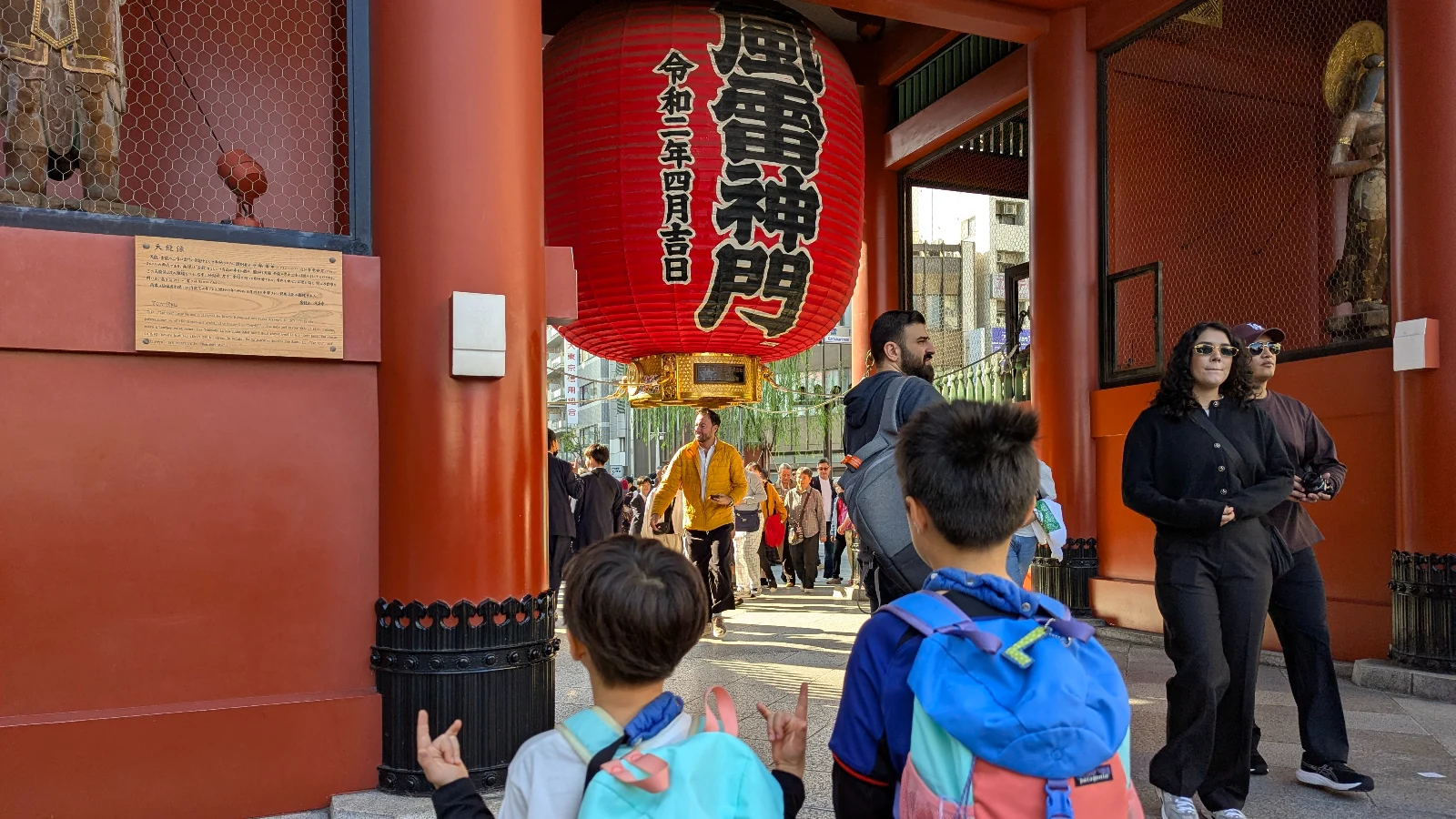
Two children stood under the same gate and saw two different things. One asked how it was made, and the other watched everyone around it; neither of them was much interested in why a temple is built the way it is, and that is fine. Senso-ji works for children because it is a place people use rather than a museum they walk past, and a child notices the using long before the meaning. A parent does not need to explain the temple before the visit. Give the child something to do in it, the omikuji or the walk from the main gate to the main hall, and let the questions come in their own order, whether they are about religion, engineering or the other people around them.
Luca fixed on the pagoda first, because it was tall and red, and red is a color he likes. What held him longest was not the temple’s purpose but a question of engineering: how do they make such a big lantern? He watched the people ahead of him reaching up to touch the bottom of the Kaminarimon lantern, registered that everyone was doing it, and wanted to do the same.
This is the Anchor pattern. A child whose Reserve depletes through unfamiliarity and unconfirmed structure watches before joining, and Luca did exactly that: he confirmed what everyone else was doing, then took his turn. For families with a similar child, give the visit a known sequence before arriving, main gate first, then the precinct, then the main hall, and let the child watch the first person at each step. His question can wait; he will ask it again somewhere else.
Nico’s attention went straight to the lantern’s size (the tall lantern was huge), and he stayed locked on the crowd’s behavior around it: people kept trying to touch the bottom of it. He was less interested in standing still to look than in the movement happening underneath it, tracking hands reaching up, narrating what he saw, and kept in motion by the activity around the gate.
This is the Dynamo pattern. A child whose Reserve depletes through restricted movement is held by activity, not by objects, and Nico stayed with the gate only as long as people kept moving under it. For families with a similar child, let the temple’s own movement do the work: walk the precinct rather than stopping at every hall, give him the omikuji to shake, and move on the moment the activity around him thins, before standing still starts to cost him.
Senso-ji shows a child that a famous place can also be an everyday one. People come to pray and draw fortunes in the same precinct where families stroll, and children pick up the rhythm of worship by watching it around them. Shaking an omikuji and tying a bad fortune to the rack is a gentle first lesson that other cultures carry their own ways of hoping, and that a disappointing result can be left behind by choice. A temple a child has joined in with is remembered as a living place, not a monument.
The LUNI Rating for Senso-ji Temple.
The four verdicts rest on a temple that is free, flat and open from early morning, and they split on what an open precinct asks of a child. A child who needs to move and a child who needs a known sequence both do well, because the ground is flat and the way from gate to hall is simple. A child who feels every sound and one who tires on their feet need a plan, because an open-air temple holds whoever comes and the main hall is up a flight of stairs. For a full city plan, the Tokyo three-day itinerary places this early.
Let the child lead through the gate. The Dynamo depletes through restricted movement, and Senso-ji is kind to a moving child in almost every way. There is no ticket and no line to enter, no fixed route to hold to, and the precinct is flat, so the child can set the pace from the Kaminarimon, the main gate, to the main hall, and stop wherever something catches their eye. Nothing about the visit asks a Dynamo to wait still for long unless the family decides it should.
Use that freedom. Let a moving child lead the way in, give them the omikuji to shake as the thing to do at the hall, and keep the stops short. A temple is a place to be respectful, so set that one rule clearly at the gate: walk, look, and keep voices low inside the hall. Then let the open ground do the rest of the work. A Dynamo who has had the run of the precinct will usually give the hall the minute it asks for.
What this means for your Dynamo: restricted movement stays low on flat, open ground with no fixed route. A younger Dynamo needs the omikuji as the job at the end; an older one can lead the whole walk from the gate.Arrive when the hall opens. The Sensor depletes through sensory input, and an open-air temple has no walls between a child and whatever is happening in it. Senso-ji is free and open to anyone who walks in, so the precinct holds whoever arrives, all at once, with nothing to pace the arrivals. For a child who feels every sound and every movement around them, that openness is the cost, and the family is the only thing that can manage it.
The clock is this child’s friend. The main hall opens at 6:00, or 6:30 from October to March, and closes at 17:00, so an early visit is always possible. Arrive as the hall opens, keep the visit short, and choose one thing to do there, the omikuji or the main hall, rather than trying to see everything. Leave before the child reaches the end of their patience, not after, and save the shops for a second, shorter visit on another day. The temple will still be free and open early tomorrow, so nothing is lost by leaving.
What this means for your Sensor: input rises in an open precinct that anyone can enter. A younger Sensor needs the visit timed to the hall’s opening and kept short; an older one can pick the single part of the temple worth staying for.Rehearse the order at home. The Anchor depletes through unfamiliarity and unconfirmed structure, and Senso-ji has a structure that can be learned before the day. The Kaminarimon is the main gate. From there the way leads through the precinct to the Hozomon and on to the main hall. The omikuji has rules of its own: a numbered stick is shaken out, the stick goes back to its holder, and a bad fortune is tied at the place set aside for it.
Give the child all of that in advance, in order. A child who knows the gate comes first, then the walk, then the hall, can hold the whole visit, and one who knows the omikuji rules will not be caught out by a bad fortune. Tell them that a bad fortune is simply tied up and left behind; for some children that is the best part of the morning, and it turns the one bad outcome into a small ceremony they control. Let them do the tying themselves.
What this means for your Anchor: unfamiliarity eases when the gate, the walk and the hall come in a known order. A younger Anchor needs the omikuji rules told at home; an older one can lead the family through each step.Carry them up the last stairs. The Sprinter depletes through sustained travel-style walking and standing, and Senso-ji asks for less walking than its size suggests but more standing than a family expects. The precinct is flat, and the temple is removing its remaining steps. The main hall, though, is reached by stairs, with an elevator to its left for people who have difficulty with stairs.
So plan the last stretch, which is where the standing gathers. Bring a carrier for a small child or take the elevator to the left of the main hall, and keep the stop there short: one look inside, the omikuji if the child wants it, and back down. What tires a Sprinter here is the waiting around the hall, not the walk, so cut the waiting rather than the walk. Let the walk back through the precinct be slow, since the ground is flat and a child can dawdle on it at no cost.
What this means for your Sprinter: walking and standing gather at the main hall’s stairs. A younger Sprinter needs a carrier for the last stretch; an older one can manage the stairs if the rest of the visit stays short.The questions parents actually ask.
Senso-ji has no ticket to buy, so a visit turns on the hour and the ground. The main hall opens at 6:30 from October to March rather than 6:00, the grounds are flat, and the restrooms are well equipped for a family. For how Asakusa compares with the other districts families stay in, our ranking of Tokyo neighborhoods for families sets them side by side. At the temple itself, the omikuji and the difference between a temple and a shrine are what children tend to ask about, sooner or later, so have both answers ready before the gate.
Is Senso-ji Temple worth visiting with kids?
Yes. It costs nothing, the precinct is flat and open-air, and the path from the Kaminarimon, the main gate, to the main hall is one a child can follow without a map. The child to plan for is one who finds busy places hard, and the answer there is timing: the main hall opens early, so arrive with it.
What time does Senso-ji open?
The main hall is open from 6:00 to 17:00, except from October to March, when it opens at 6:30 instead. For the other halls, ask the temple by phone before planning around them. For a family, the early opening is the useful part: it lets a visit happen before breakfast or before the rest of the day’s plans.
Is Senso-ji free to visit?
Yes. There is no charge to walk through the Kaminarimon, cross the precinct and visit the main hall, so a family can come for twenty minutes or stay for longer without weighing the cost. Drawing an omikuji fortune is a small separate choice made at the temple, and the shops in Asakusa are a separate matter too.
Is Senso-ji stroller friendly?
The grounds are, for the most part. The temple keeps the precinct flat and is working to remove the remaining steps, so a stroller crosses it easily. The main hall itself is reached by stairs, with an elevator to its left for people who have difficulty with stairs; plan to fold up or carry a small child at the hall.
Where are the restrooms at Senso-ji?
There are multipurpose restrooms to the right of the Hozomon gate and behind the main hall. Both have wheelchair handrails, a changing sheet and a baby chair, which makes them useful for a family with an infant or a toddler. Knowing where they are before arriving saves a search at exactly the wrong moment.
How do you get to Senso-ji Temple?
Asakusa Station is about five minutes away on foot, and four lines stop there: the Tokyo Metro Ginza Line, the Toei Asakusa Line, the Tobu Skytree Line and the Tsukuba Express. From the Toei Asakusa Line, use Exit A4. Choose whichever line your hotel is on; none of them is a long walk from the gate.
How does omikuji work at Senso-ji?
Senso-ji’s fortunes come from a set of one hundred, drawn by shaking out a numbered stick. The stick goes back to its holder, and a fortune that turns out badly is tied up at the place set aside for it rather than carried home. Walk a child through those rules before drawing; for many children they are half the fun.
Is Senso-ji a temple or a shrine?
Senso-ji is a Buddhist temple. Meiji Jingu, the other great religious site families visit in Tokyo, is a Shinto shrine, with its own worship order: rinse hands and mouth at the water basin, then bow twice, clap twice and bow once. Telling a child which is which helps them read each place instead of blending them together.
Where Senso-ji Temple fits your Japan trip.
Official site and opening information: Senso-ji