Kyoto Indoor Activities With Kids:which roof holds which child.
- On a Rainy Kyoto Day
- Eleven indoor stops stand in for the gardens
- The One to Choose
- Kyoto Municipal Science Center for Youth
- Two in One Stop
- Railway Museum and Aquarium, in Umekoji Park
- Age Floor
- VS PARK: elementary-school age and up only
- No Way Back In
- teamLab Bio Vortex: leaving ends the ticket
Some links on this page are affiliate links. LuNi may earn a commission at no extra cost to you.
When rain takes the gardens and temple approaches out of a Kyoto day, eleven indoor stops in and around the city stand in for them, and the right one depends on the child. Kyoto Municipal Science Center for Youth is the one to choose when the plan has to suit everyone: two halls of exhibits, nearly all of them to be touched, and a planetarium show that sits the family down partway through. The Kyoto Railway Museum and the Kyoto Aquarium both sit in Umekoji Park, one stop on the Sagano Line, so a single wet morning can hold the two of them.
Which stop suits which child.
These stops are not ordered best to worst. They are grouped by which child each one is for, across the four profiles. Those profiles belong to The LUNI Framework, whose premise is that parents spend a third currency beside money and time: the child’s Reserve, their finite capacity to absorb what travel asks of them. In Kyoto, a wet day turns on what a building lets a child do with that Reserve rather than on how old or celebrated the building is. The Dynamo empties out when made to keep still, the Sensor on noise and crowding, the Anchor when the day is unconfirmed, the Sprinter on sustained walking and standing.
Kyoto Municipal Science Center for Youth.
The claim is not that it is the best stop in Kyoto for any one child. Its case is that it asks little of each of them: two halls of exhibits, nearly all of them to be touched, and a planetarium show that sits the whole family down partway through. It is the stop to keep for a day whose other plans are fragile.
| The Stop | What It Settles | Best For |
|---|---|---|
| Kyoto Railway MuseumRailway museum | Real train cabs to climb into, in an open hall and an outdoor yard. | Dynamo |
| Round One KawaramachiIndoor amusement | Bowling, an arcade, billiards and darts on several floors in central Kyoto. | Dynamo |
| VS PARK Aeon Mall KyotoActive play | Running, jumping and reaction games where the visit itself is the exercise. | Dynamo |
| teamLab Bio VortexImmersive art | An Athletics Forest of things to climb, bounce and balance on, inside a museum of light. | Dynamo |
| Kyoto National MuseumTraditional museum | Wide, quiet galleries set out for looking, a short walk from Shichijo Station. | Sensor |
| Museum of Crafts and DesignCraft museum | A contained basement of Kyoto crafts, quiet enough to reset a child after a crowd. | Sensor |
| Manga MuseumReading library | Walls of manga to take down and read, in rooms kept quiet by the readers. | Sensor |
| Nintendo MuseumBrand museum, Uji | A date won by lottery months ahead, in a world the child already knows. | Anchor |
| Gion CornerArts theater | One seated hour of traditional arts, in an order that can be read out beforehand. | Anchor |
| Kyoto AquariumAquarium | Two floors that start with Kyoto’s own rivers, a short walk from the trains. | Anchor |
| Science Center for YouthScience center | A planetarium show in the middle of the visit, so the family sits down partway through. | Sprinter |
Kyoto Railway Museum
Dynamo
Round One Kyoto Kawaramachi
Dynamo
VS PARK Aeon Mall Kyoto
Dynamo
teamLab Bio Vortex Kyoto
Dynamo
Kyoto National Museum
Sensor
Kyoto Museum of Crafts and Design
Sensor
Kyoto International Manga Museum
Sensor
Nintendo Museum
Anchor
Gion Corner
Anchor
Kyoto Aquarium
Anchor
Kyoto Municipal Science Center for Youth
Sprinter
For the Dynamo
Places where a moving child is the point, not the problem.
For the child who empties out when made to keep still.
Trains a child climbs into, in a building made for walking among them. Real cabs, a driving simulator and an open hall carry most of the museum, with part of it outside in the yard, so a wet morning loses only the yard. A child who runs short when kept still gets hours of climbing in, taking a seat at the controls and moving on to the next. A younger child rides the steam train in the yard on a dry spell; a teenager lines up for the simulator, which takes its own ticket.
Who it costs.The Sensor, who runs short on noise and crowding. A hall of trains draws a crowd and the steam train is loud by nature, so go at opening on a weekday and keep the yard for last.
How to make it work.Entry and simulator tickets can be bought ahead from Seven-Eleven machines or Asoview, though neither is required; book the simulator if a child has come for it. Bring lunch: food is eaten in the rest areas, the restaurant or the courtyard, never in the exhibit rooms. Strollers and wheelchairs are lent free.
If this isn’t your child: a long indoor morning in Umekoji Park, best taken early and paired with the aquarium a short walk away.Bowling, an arcade, billiards and darts in the middle of the city. It is an entertainment center rather than a museum, and on a wet afternoon that is its value: nothing to read, everything to roll, throw or aim. A child who has spent the morning keeping quiet in temples can be loud here where loud is normal. A younger child takes a few frames of bowling and the prize games; a teenager takes the darts and billiards.
Who it costs.The Sensor, who runs short on noise, light and crowds. The game floors are loud and bright, so take a sensory-led child in the first couple of hours after opening and leave when the floor fills.
How to make it work.Treat it as a block of an hour or two rather than an outing. In the evening, a child under sixteen may use the arcade only with a guardian.
If this isn’t your child: a loud, central hour that a calmer child will not thank you for.Active games, built to use the whole body. They run from Jump x Jump and SHINOBI RACE to a slackline and VS PARKOUR, most of them five or ten minutes long, physical and scored. For a child who runs short when made to sit, the visit itself is the exercise, and it sits off Kyoto Station’s Hachijo exit, so it costs almost no travel. Children below elementary-school age cannot enter at all, even with a parent.
Who it costs.The Sensor, who runs short on noise and fast input. The games come loud, scored and one after another, so give a sensory-led child a set number of games and a known end.
How to make it work.Book the two-hour pass and agree the games before you go in. Check every child’s age first: a preschool sibling cannot come in, so the family splits, one parent each.
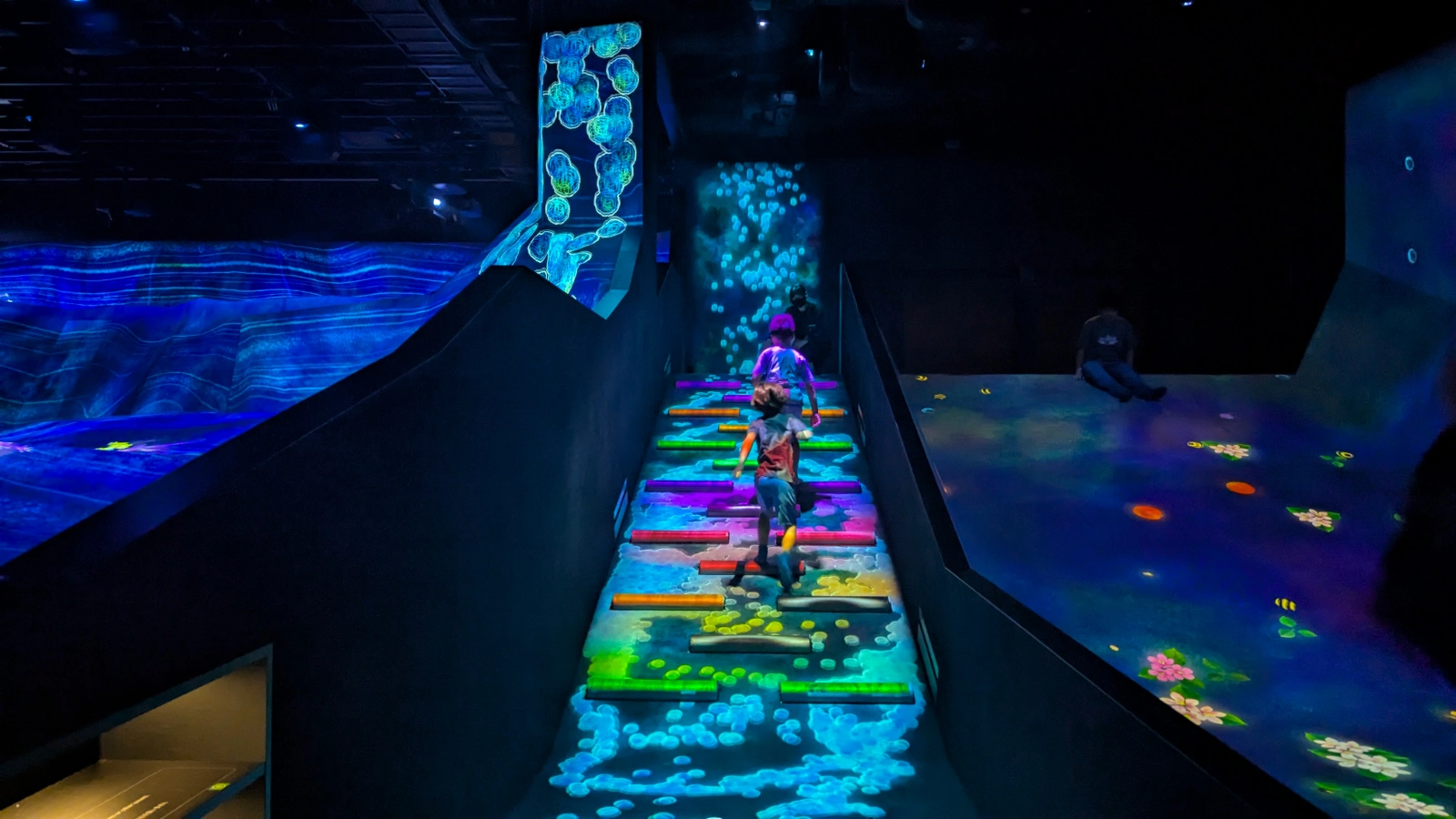
If this isn’t your child: a short, sharp burst by the station for a school-age child, and closed to the preschooler outright.An Athletics Forest of things to climb, bounce and balance on, inside a museum of light. Works with names like Multi Jumping Universe and Balance Stepping Stones in the Invisible World ask a child to use the whole body, and there is no limit on time once you are in. For a child who empties out when kept still, that makes it a rare museum where moving is the way in. Some works carry height and age limits, and every three children of elementary age or under need one adult with them.
Who it costs.The Sensor, and heavily. The building is dark with many level changes, light flashes, the sound is loud and some rooms carry scent, so a child short on input has nowhere quiet on the route. Plan it only for a sensory-robust child, and take the earliest slot.
How to make it work.Book online, because tickets can sell out and there is no way back in once you leave. Strollers go to the baggage area and some works are reached only by stairs, and staff may turn away a parent carrying a child from some works, so a small child walks.
If this isn’t your child: an extraordinary hour for a sensory-robust older child, and one to leave out entirely for a child easily flooded by input.For the Sensor
Rooms that hold the noise down and the crowd apart.
For the child who empties out on noise, glare and crowding.
Wide, quiet galleries, large enough that a crowd thins out across them. The displays change with each exhibition and are set out for looking rather than handling. For a child who runs short on noise and crowding, that space is the reason to go. A teenager takes the exhibition at their own pace; a younger child is best brought in a collection-gallery period, when the museum sets out hands-on carts on the first floor.
Who it costs.The Dynamo, who runs short when held still. It is a looking museum from end to end, so keep the visit to a set length and put a park or a walk straight after it.
How to make it work.Come from Keihan Shichijo Station, seven minutes on foot, or by bus to Higashiyama Shichijo, a minute from the door. From Kyoto Station it is a twenty-minute walk, best saved for a dry day.
If this isn’t your child: a serious, roomy collection for a reader, and a long hour for a child who needs to move.A basement museum of Kyoto crafts, under Miyako Messe in Okazaki. Textiles and ceramics fill contained, quiet rooms, which suits a child who has spent the morning in crowds: a dry, low hour with a clear edge to it. An older child studies the textile and ceramic work; a younger one is best given something to look for in each room.
Who it costs.The Dynamo, who runs short when held still. There is little to do but look, so it holds a restless child for minutes rather than an afternoon; plan it as a reset between two moving stops.
How to make it work.It is about ten minutes on foot from Higashiyama Station, exit 1, or five from the Okazaki Koen bus stops, so it pairs with anything else in Okazaki on the same wet day.
If this isn’t your child: a quiet hour in Okazaki and not much more; go when calm is the thing the day lacks.A library first and a museum second, which is what a sensory-tired child needs. Japan’s first manga museum keeps walls of manga to take down and read anywhere in the building, or on a dry day on the lawn outside, and the rooms run quiet because the people in them are reading. Much of the collection is in Japanese, so the value depends on a child who reads or browses with intent; the shelves in other languages widen it for an English reader.
Who it costs.The Dynamo, who runs short when held still. A child who cannot yet read is better taken to the first-floor children’s library, or to a kamishibai picture-story show when one is on, than to the main wall; a drawing workshop, when one is running, is another way in.
How to make it work.It is two minutes on foot from Karasuma Oike Station, which keeps the wet part of the trip to two minutes and makes it the stop to move to when a plan falls apart in the center.
If this isn’t your child: a quiet library hour for an older reader, and a shorter one in the children’s library for a child who cannot yet read.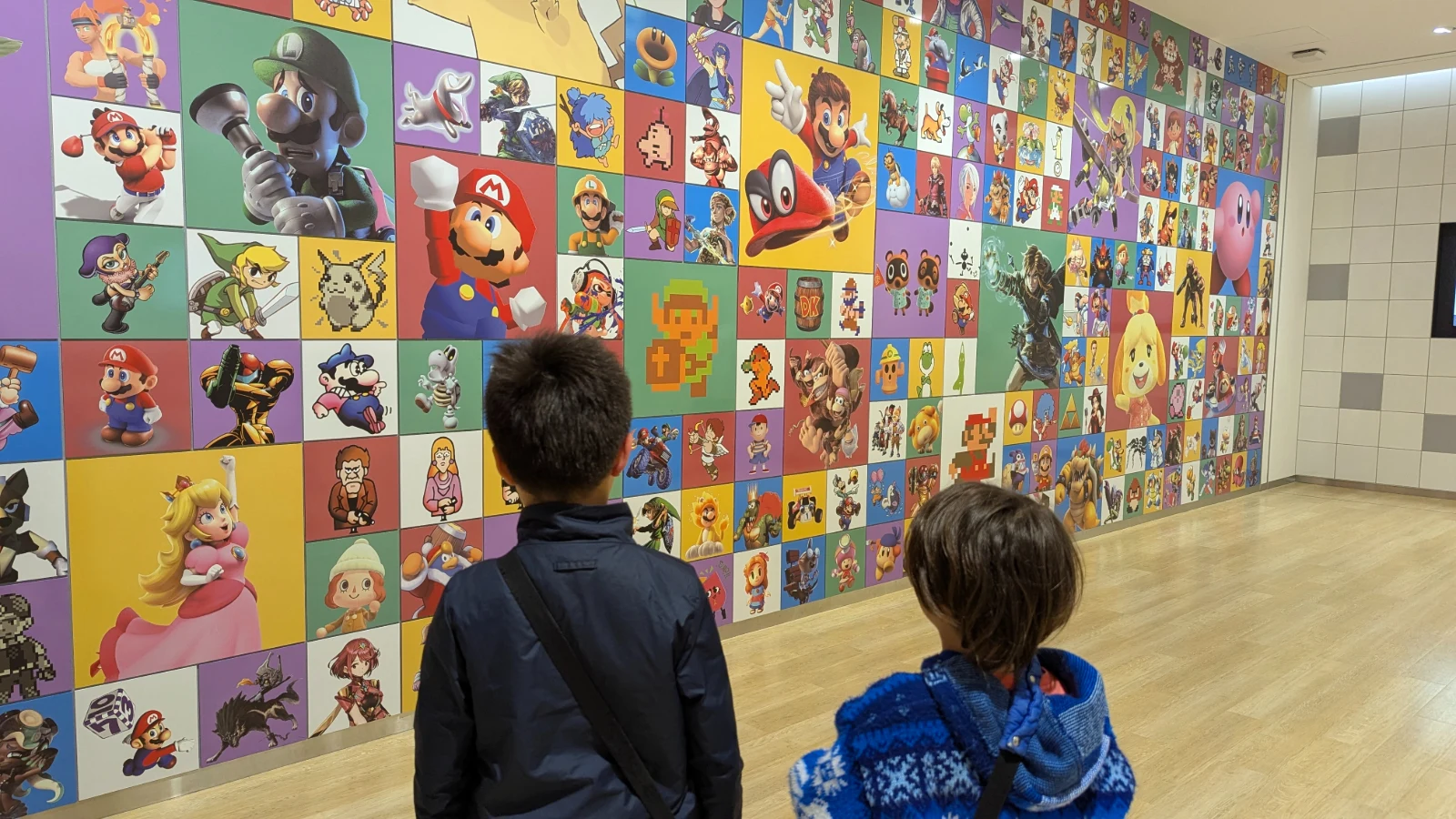
For the Anchor
A known shape, settled before the day.
For the child who empties out when nothing is confirmed.
The ticket is won months in advance, so the day it happens is fixed long before the trip. Entry is by lottery three months ahead, at the time printed on the ticket, and the building runs in a clear order: the history of Nintendo’s products on the second floor of Building 1, the hands-on versions of them on the floor below. For a child who runs short on the unconfirmed and the new, a confirmed slot in a world they already know is a rare combination. Every child of elementary age or under comes with a ticket-holding adult.
Who it costs.The Dynamo, who runs short when held still. Each visitor gets ten play coins for the hands-on hall and ten will not cover every exhibit, so a child who wants to play everything ends up watching. Agree the exhibits before the first coin is spent.
How to make it work.Enter the lottery with a free Nintendo Account three months ahead, in the name of the person who will show photo ID at the door; freed slots go first come after the draw. It is five minutes from Kintetsu Ogura Station’s east exit in Uji, so it is a half-day of its own.
If this isn’t your child: a long trip to Uji for a family without a Nintendo fan, and worth it for a child who already loves the games.One hour, one seat, and a program that can be read to a child before the curtain. It is a sampler of Kyoto’s traditional arts, tea ceremony, court dance and koto among them, staged in a small theater in Gion, and the order of the program is set. A child who runs short when things are unconfirmed knows how long it lasts and what comes next. It suits an older child who can sit through an hour far better than a small one.
Who it costs.The Dynamo, who runs short when kept still. An hour of sitting and watching is the whole visit, so put it after a day that has spent their energy, never before one.
How to make it work.Go through the program together beforehand, so the sequence is known. It is about five minutes on foot from Keihan Gion-shijo Station.
If this isn’t your child: a seated culture hour that suits a calm older child and asks too much of a restless young one.A compact aquarium that starts with Kyoto’s own rivers. It sits in Umekoji Park with the Railway Museum, its tanks on two floors, the seals on the first and the dolphin stadium on the second. For a child unsettled by the unfamiliar, the signs inside are in English as well, and food brought in may be eaten in its seating areas, the seal areas and the dolphin stadium among them, so pack a lunch the child already knows and the meal, at least, holds no surprises. A three-year-old watches the seals; a ten-year-old reads the river tanks.
Who it costs.The Dynamo, whose energy needs somewhere to go when kept still. Tanks are for looking, so spend that energy at the Railway Museum first and bring the child here to wind down, not the reverse.
How to make it work.It is seven minutes on foot from JR Umekoji-Kyotonishi Station, one stop from Kyoto Station on the Sagano Line, or fifteen minutes from Kyoto Station’s central exit.
If this isn’t your child: a calm visit of an hour and a half to two, which pairs with the trains in the same park.For the Sprinter
A seat built into the visit.
For the child who empties out on long walking and standing.
A science center with a planetarium in it, which puts a seat in the middle of the visit. Nearly all of its exhibits are to be touched, and the planetarium show sits a tired family down for its length before the second half. A younger child works the exhibits with their hands; an older one follows the live science demonstrations.
Who it costs.The Sensor, who runs short on noise. Hands-on rooms are loud by design, so use the planetarium as the quiet reset rather than the finale.
How to make it work.Planetarium tickets go on sale at opening and cannot be reserved, so buy the show first on arrival and build the exhibits either side of it; latecomers are not let in.
If this isn’t your child: an easy, hands-on few hours that a family with children of mixed ages can share.Begin with the child closest to empty.
Open with the stop for whichever child will run short first, the Dynamo on stillness, the Sensor on input, the Anchor on the unconfirmed, the Sprinter on standing, and add a second stop only where it shares a station.
Two tickets to settle first.
The Nintendo Museum decides a Kyoto trip in advance: tickets are sold by lottery only, entered three months before the visit, with results on the first of the following month and freed slots sold first come after the draw.
teamLab Bio Vortex sells timed entry that can sell out, and an official ticket can be moved to another date up to two hours before, three times. A child sensitive to light and noise should take the earliest slot.
The Kyoto Railway Museum sells entry and simulator tickets ahead but needs neither, which makes it the stop to keep for the morning a plan falls through.
How a stop earns its group.
The order here is by child, and the measure is what a building asks of that child once the doors close behind them.
Four things decide it: whether there is something to work rather than watch, whether noise and crowding can be escaped, whether the shape of the visit is known before it starts, and whether there is a seat built into it. Sorted that way, a manga library sits with a national museum, and a science center with a planetarium is the one to choose, because it asks little of any child.
The questions parents actually ask.
What are the best indoor activities in Kyoto with kids?
If you only do one, make it the Kyoto Municipal Science Center for Youth, which asks little of any child: hands-on rooms and a planetarium show that seats the family partway through. After that the choice belongs to the child. The Railway Museum, Round One, VS PARK and teamLab Bio Vortex suit a child who must move; the National Museum, the Museum of Crafts and Design and the Manga Museum a child short on quiet; the Nintendo Museum and Gion Corner a child who needs the day confirmed, and the Kyoto Aquarium a child unsettled by the unfamiliar.
What are the best indoor things to do in Kyoto on a rainy day?
Pair two stops at one station. The Kyoto Railway Museum and the Kyoto Aquarium share Umekoji Park, a short walk apart, so a wet half-day needs only JR Umekoji-Kyotonishi, one stop from Kyoto Station on the Sagano Line. Most of the railway museum is indoors, with part of it in the yard. For a third stop, the Manga Museum is two minutes from Karasuma Oike Station.
What indoor activities in Kyoto are best for hot summer weather?
The ones with the shortest walk in the heat: the Manga Museum, two minutes from Karasuma Oike Station; VS PARK and teamLab Bio Vortex, off Kyoto Station’s Hachijo side; and the Umekoji Park pair, a short walk from JR Umekoji-Kyotonishi. The Nintendo Museum is the long indoor afternoon if the lottery went your way.
Are Kyoto’s indoor attractions stroller-friendly?
Mixed. The Kyoto Railway Museum lends strollers free and has slopes and elevators in most places, and the Nintendo Museum takes them inside, parking them beside the hands-on exhibits. teamLab Bio Vortex sends them to the baggage area and has works reached only by stairs, so a carrier is the easier choice there.
Which Kyoto indoor attractions need advance reservations?
Two need settling before anything else. The Nintendo Museum sells by lottery only, entered three months ahead with a free Nintendo Account, and teamLab Bio Vortex sells timed entry that can sell out. The Kyoto Railway Museum offers advance tickets without requiring them.
What is the best indoor activity in Kyoto for an active child?
VS PARK at Aeon Mall Kyoto, for a child of elementary age or older: running, jumping and reaction games where the visit itself is the exercise, and no entry at all below elementary age. For a sensory-robust child, the Athletics Forest at teamLab Bio Vortex Kyoto is the other answer, but its dark, loud, flashing rooms empty a child who runs short on sensory input, so take the earliest slot or leave it out.
What are the best indoor activities in Kyoto for toddlers?
The Kyoto Aquarium and the Kyoto Railway Museum, side by side in Umekoji Park: two compact floors of tanks, and trains a small child can climb into, with free strollers to borrow at the museum. VS PARK admits no child below elementary age, and teamLab Bio Vortex keeps strollers in the baggage area and may turn away a parent carrying a child from some works, so leave both for an older sibling.