Yokohama Cosmo World with Kids: The Free-Entry Waterfront Park.
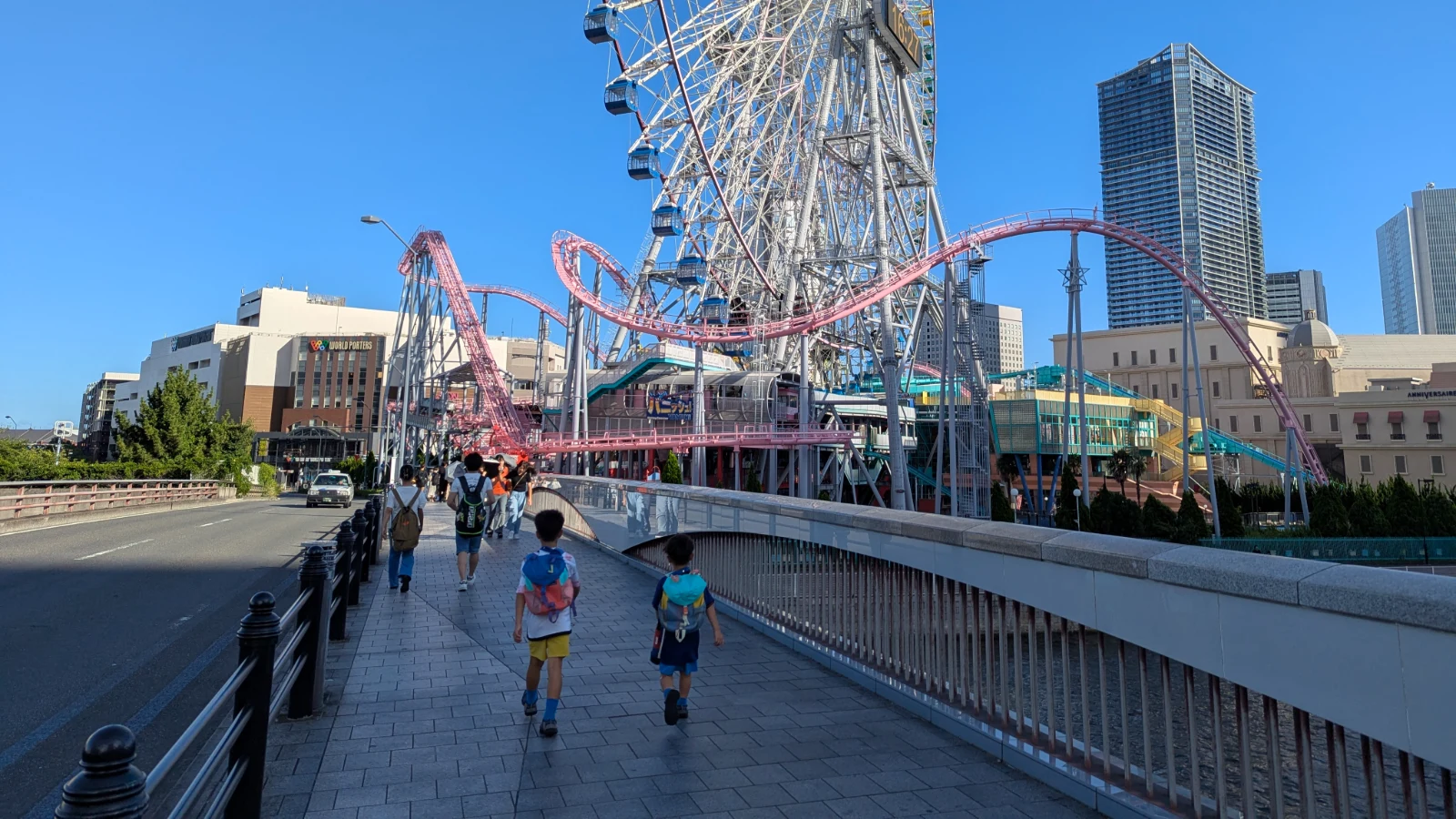
Cosmo World looks like an evening of many rides, but for a small child the best of it can be one slow turn of the wheel above the whole park.
Cash only; no all-day pass; bundles such as ¥2,500 of tickets for ¥2,200. No booking needed.
Closed most Thursdays; the Kids Carnival Zone closes at 19:00.
One turn of the Cosmo Clock 21 takes about 15 minutes.
Preschoolers ride with a paying companion aged 16 or over; some rides set a height, such as 110 cm.
No strollers or wheelchairs are lent, so bring your own; a baby rest room is on the second floor of Wonder Amuse.
Some links on this page are affiliate links. LuNi may earn a commission at no extra cost to you.
Is Yokohama Cosmo World worth it with kids?
The short version, before the costs, the timings and the case for each child.
Yes, for a child who loves rides, and as an evening rather than a whole day. The child who needs to move and the child who likes to choose both do well, because the rides come one at a time and each one is picked as the family goes, with no pass to use up and no schedule to keep. For a child who needs to know what comes next, pick the first three rides at home, so the evening has a shape before it starts. It costs most the child whose legs tire first, since the walking and standing between rides add up and no stroller is lent. Keep that child’s evening to a handful of rides, and end it before the legs do.
Planning Your Visit to Yokohama Cosmo World with Kids.
Four decisions make a Cosmo World day easy. The first is the date, since the park keeps a weekly closing day and a closing time that moves from day to day. The second is money: decide the ride budget, bring it in cash, and buy it as a bundle, so the child spends from a fixed pile rather than asking at every ride. The third is who rides with whom, because a preschooler needs a paying companion of 16 or over on the big wheel and many other rides. The fourth is the first ride. Make it the Cosmo Clock 21, whose one turn takes about fifteen minutes and shows the child the whole park before anyone walks it, which settles a hesitant child and gives a restless one a plan to chase.
Every LuNi attraction guide starts with a visit, with our own children
LuNi rates and writes about attractions only after visiting them with children. Luca and Nico were at Yokohama Cosmo World, and what they did there is recorded further down this page, including how each child actually met it.
Children arrive with different tolerances: for noise, for lines, for standing still, for being on their feet all day. A guide written for the average of them helps almost nobody. So every place on this site is read four ways, and each verdict says which children it already suits and what makes it work for the rest. Whoever you are bringing, the answer here is built for your family rather than for a general reader.
Restricted-movement depletion stays low moving between rides in a free-entry park, so let the child choose the next ride and walk there with them.
Sensory-input depletion stays low when rides are chosen one ticket at a time and the park is free to leave, so buy small and stop early.
Unfamiliarity and unconfirmed structure ease once the cash rule, the usual Thursday closing and each ride’s age and height limit are known, so check them first.
Sustained walking and standing build between rides with no stroller to borrow, so bring your own and keep the ride list short.
Hotels we would book for this visit.
Three Yokohama family hotels chosen by district and by evening: one in the district of the park’s station, one by the Cup Noodles Museum, and one in Yamashita Park’s district for a quieter night.
| Property | The LuNi Reason |
|---|---|
| LUNI Pick The Yokohama Bay Hotel Tokyu | For a family making Cosmo World the evening after a day elsewhere, this room is in the same district as the park’s station, so the walk back after the last ride is the shortest of the day, and a child who fell asleep on the final turn of the wheel is carried only a short way to bed. |
| InterContinental Yokohama Pier 8 | InterContinental Yokohama Pier 8 is in the Cup Noodles Museum’s district. It suits a family pairing a morning of making noodles with an afternoon of rides, with the museum in the hotel’s own district and the park two minutes from Minatomirai Station, so the day moves one way and never doubles back. |
| Hotel New Grand | Hotel New Grand stands in the district of Yamashita Park, for a family that ends a day of rides in open air rather than under the lights. After the noise of the park, a quieter district by the water gives a child the evening back, and the next morning can begin among the park’s gardens. |
InterContinental Yokohama Pier 8
Nearby attractions, matched to your child.
Three nearby visits for what an amusement park leaves: a museum with elevators and re-entry for tired legs, a free park for a child who has had enough of rides, and streets of gates for a child still moving.
| Pairing | Why This Solves the After-Visit | For Your |
|---|---|---|
| LUNI Pick Cup Noodles Museum Yokohama Shinko: Minatomirai or Bashamichi Station, 8 minutes | After a park with no strollers to borrow, the Cup Noodles Museum asks far less of the legs. It is eight minutes on foot from Minatomirai Station, its floors are linked by elevators, and a family can step out and come back on one ticket, so a Sprinter’s walking and standing stay short. | Sprinter |
| Yamashita Park Motomachi-Chukagai Station Exit 4, 3 minutes | When the rides have been enough, Yamashita Park is the opposite kind of afternoon: free, open to the sky and planted with some 1,900 roses, with the Guardian of Water fountain in its central plaza. Sensory-input depletion eases where a child can wander without a ticket in hand. | Sensor |
| Yokohama Chinatown Motomachi-Chukagai Station, 1 minute | Ten gates and some 630 shops make Yokohama Chinatown a walk for a Dynamo who still has energy after the rides, a minute from Motomachi-Chukagai Station. For a Sensor, though, its sensory input is heavy, and for an Anchor its unfamiliarity and unconfirmed structure are, so send only the Dynamo. | Dynamo |
Cup Noodles Museum Yokohama
Shinko: Minatomirai or Bashamichi Station, 8 minutes For YourSprinter
Yamashita Park
Motomachi-Chukagai Station Exit 4, 3 minutes For YourSensor
Yokohama Chinatown
Motomachi-Chukagai Station, 1 minute For YourDynamo
How two children actually met this attraction.
One child needed to see the whole park before he would enjoy any of it, and the big wheel gave him that; the other needed to keep moving and found the stretches between rides as good as the rides themselves. That pairing says a lot about how to run a day here. Ride the Cosmo Clock 21 early, so the careful child has his map; keep the waits short, since standing still is where the restless child fades; and plan the day to end while both still have something left. A park with free entry makes that easy, because leaving early costs nothing but the tickets not yet bought, and cash for rides is already in hand, so the decision to stop belongs to the child’s energy rather than the budget.
Luca hung back at the entrance, taking in the layout before he committed to anything. He wanted to ride the Cosmo Clock 21 first, and from the top he studied the park below, tracing where each zone sat and how the water ride and the coaster fit together. Once he had the wheel fixed as his reference point he used it to navigate the rest of the visit, and the earlier hesitation disappeared.
This is the Anchor pattern. A child whose Reserve depletes through unfamiliarity and unconfirmed structure holds back until the layout is confirmed, and Luca did it by turning the big wheel into a fixed landmark to map the park from. Families with a similar child should ride the Cosmo Clock 21 early, so the child builds bearings from the top, and point back to it through the day, because a confirmed map at the start turns hesitation at the entrance into confidence for the rest.
Nico barely stopped moving, and barely stopped talking. Between rides he ran the open stretch of waterfront rather than waiting still in the next line, and the bumper cars held him far longer than the gentler seated rides because he could steer and crash and reset on his own. Standing in line was where his energy drained fastest, and by the later part of the visit the constant motion had caught up with him.
This is the Dynamo pattern. A child whose Reserve depletes through restricted movement stays regulated while moving, which is why the walking between rides and the rides he could steer held Nico while the lines did not. Families with a similar child should treat the walking between rides as part of the fun, choose rides the child controls, and avoid long waits, because a Dynamo made to stand still in line starts spending energy on a stillness he never chose.
An amusement park where every ride is paid for separately teaches a child to choose, and choosing well is a skill. Deciding which ride is worth a ticket, or saving the big wheel for last, lets a child feel in charge of their own fun. Children often enjoy a few rides they picked more than many rides handed to them. A slow turn above the lit harbor at the end of an evening, chosen by the child, can become the moment they remember from the whole of Yokohama.
The LUNI Rating for Yokohama Cosmo World.
One fact sits under all four verdicts: Cosmo World is free to enter and paid ride by ride, in cash, two minutes from Minatomirai Station. For the child who needs to move, the child sensitive to input and the child who needs structure, that shape works, since rides are chosen one at a time and the rules are known in advance, so three children do well. The Sprinter needs a plan, because the walking and standing between rides add up and no stroller is lent. Place it in the evening of a Yokohama stay, after a calmer morning, so every child arrives with something left.
Let the child choose, then walk to it. The Dynamo depletes through restricted movement, and Cosmo World keeps this child moving by design: free to enter, with rides spread through the park and paid one at a time, so the day is a walk from one choice to the next. Some rides carry limits, the diving coaster Vanish from elementary age and 120 centimeters, the Cliff Drop from age 3 and 110 centimeters, and a child who meets them has plenty to aim at.
Choice and motion keep this child going. Hand the child the next decision, walk to the ride together, and keep each wait short. Carry a bundle of tickets so the next ride is never held up by buying them. Outside food is not allowed, so the Cosmo Court snack stand is the refueling stop, and the Kids Carnival Zone, open until 19:00, is the place to start a younger child before the bigger rides come into view.
What this means for your Dynamo: Cosmo World gives restricted movement a walk between choices. A younger Dynamo needs the Kids Carnival Zone and a companion; an older one can take on the coasters that fit his height.Buy small, and stop early. The Sensor depletes through sensory input, and an amusement park sounds like the wrong place for this child. Cosmo World works for this child by letting a family control the dose: entry is free, every ride is a separate choice paid in cash, and nothing commits the family to a set number of rides. The Cosmo Clock 21 takes about fifteen minutes for a single turn, and the park can be left at any point without losing money on a pass.
Plan the dose rather than the day. Buy a small number of tickets, choose the gentler rides first, and leave while the child is still enjoying it. The baby rest room on the second floor of Wonder Amuse is a retreat for the youngest, though it has no hot water. After dark the Cosmo Clock 21 is lit until about midnight, which is beautiful to watch from outside and a good reason to head home rather than stay.
What this means for your Sensor: at Cosmo World the family controls the dose of sensory input. A younger Sensor needs a few tickets and an early exit; an older one can choose the rides and the stopping point.Learn the rules first. The Anchor depletes through unfamiliarity and unconfirmed structure, and Cosmo World has more rules than it first appears to: tickets in cash only, no all-day pass, the same price for everyone from age 3, a paying companion aged 16 or over for preschoolers on the Cosmo Clock 21 and many other rides, and a separate age and height limit on each ride. Every one of them is written down in advance, which is why this child is well served.
Turn the rules into a plan. Check the calendar, since the park closes on most Thursdays and its closing time moves from day to day, then bring cash, decide who rides with whom, and measure a younger child against the limits of the rides they want. Ride the Cosmo Clock 21 early for the view of the whole park, and tell the child its reception closes fifteen minutes before the park does.
What this means for your Anchor: in a park of stated rules, unfamiliarity has little to work on. A younger Anchor needs each rule said before the gate; an older one can check the ride limits himself.Bring the stroller, and keep the list short. The Sprinter depletes through sustained travel-style walking and standing, and an amusement park is walking and standing by nature: to the ride, waiting for it, and on to the next. Cosmo World is close to the train, about two minutes from Minatomirai Station and ten from Sakuragicho, but it lends no strollers or wheelchairs, so whatever the child cannot walk, the family has to have brought along.
A short list and the family’s own wheels are the answer. Bring a stroller for a younger child, choose the few rides that matter, and put them close together in time, so the walking between them does not become the day. Lockers from 200 to 400 yen take the bags off tired shoulders. Keep the evening short, since the park stays open until 20:00 or later on most days, and the day should end before the legs do.
What this means for your Sprinter: at Cosmo World the walking and standing come between the rides. A younger Sprinter needs a stroller from home; an older one needs a short ride list and an early finish.The questions parents actually ask.
Cosmo World is free to walk into and paid ride by ride, in cash, with no all-day pass. Preschoolers need a paying companion aged 16 or over on the big wheel and many other rides, children from 3 pay the adult fare, and the park closes on most Thursdays. Together those add up to one plan: bring cash, plan around the Thursday closings, and decide who rides with the youngest before leaving the hotel. A family that learns it at the gate loses the first half hour to it, and the children notice. Settled at breakfast, those rules leave the evening free for the rides themselves.
Is Yokohama Cosmo World worth visiting with kids?
Yes, if the family brings cash and a plan. It costs nothing to walk in; each ride takes tickets worth 100 to 1,000 yen, sold for cash only, with no all-day pass. Children under school age ride with a companion aged 16 or over who pays too. Most Thursdays are closed, so check the calendar first.
How do ride tickets work?
Rides are paid with tickets in 100-yen units, from 100 to 1,000 yen a ride, bought in cash only. There is no all-day pass, but bundles cost less: 2,500 yen of tickets for 2,200, 3,500 for 3,200, or 5,000 for 4,500. From age 3, children pay the same as adults.
What are the opening hours?
The park opens at 11:00, and its closing time changes from day to day. The Kids Carnival Zone closes at 19:00, and the Cosmo Clock 21 stops taking riders 15 minutes before closing.
Is Cosmo World open every day?
No. It closes on most Thursdays, though it opens on some Thursdays in school vacations and Golden Week, and it closes on some other days too. Check the calendar for the date before going, since the closing time also changes from day to day, and a late plan on the wrong day meets a shut gate.
What are the age and height limits?
The Cosmo Clock 21 has no age or height limit, though children ride alone only from elementary school and preschoolers need a paying companion aged 16 or over. The diving coaster Vanish takes elementary age to 64 and 120 centimeters; the Cliff Drop takes ages 3 to 64 and 110 centimeters, with a companion for a child under elementary age or under 120 centimeters.
Can you bring food or a stroller?
Outside food and drink are not allowed; the Cosmo Court snack stand sells food inside. Strollers and wheelchairs are not lent, so bring your own. Coin lockers cost 200 to 400 yen, and the baby rest room is on the second floor of Wonder Amuse, though it has no hot water, so bring a thermos.
How long does the Cosmo Clock 21 take?
One full turn takes about 15 minutes. It is the park’s landmark and the best first ride for a child who likes to see the whole layout. After sunset it is lit until about midnight, even on days the park is closed, so it can be enjoyed from outside on a Thursday evening.
How do you get to Cosmo World?
Minatomirai Station is about 2 minutes on foot and JR Sakuragicho about 10. With small children, the Minatomirai Line is the easy choice, and among Yokohama’s stops for children the Cup Noodles Museum, about 8 minutes on foot from the same station, makes a natural second stop on the same day.
Where Yokohama Cosmo World fits your Japan trip.
Official site and opening information: Yokohama Cosmo World