Asakusa With Kids:which stop is for which child.
- How Long
- About 2 to 3 hours, or half a day
- Playgrounds
- Sumida and Hanakawado, north of the temple
- Rides and Running Room
- Asakusa Hanayashiki and Sumida Park
- Best Time
- Early morning, in spring or autumn
- Rest the Legs
- Tokyo Skytree and the Sumida River cruise
Some links on this page are affiliate links. LuNi may earn a commission at no extra cost to you.
Asakusa works with kids for about two to three hours, or half a day once the river stops join in, and it is best early in the morning or late in the afternoon, in spring or autumn. North of the temple, Sumida Park and Hanakawado give children real run-around space, and Asakusa Hanayashiki adds the rides. Sumida Aquarium and the Asakusa Culture Tourist Information Center are the quieter rooms. When legs give out, the Sumida River cruise and Tokyo Skytree do the moving for the family. Senso-ji Temple sits at the center of the eight stops, each mapped to the child it suits.
Which stop is for which child.
These stops are not ordered best to worst. They are grouped by which child each one is for. Asakusa and the riverside across at Oshiage make a dense, busy stretch of Old Tokyo, and the stop that delights one of your children is the stop that empties another. So instead of one list you get four short ones, organized by how each child runs out of steam. The Dynamo runs short when held still. The Sensor runs short on noise and crowds. The Anchor runs short when nothing is predictable. The Sprinter runs short on walking and standing. This way of reading a destination is the heart of The LUNI Framework: find your child below, and start there.
For the Dynamo
Stops that relieve restricted-movement depletion.
For a child who depletes through restricted movement, the strongest stops are Asakusa Hanayashiki and Sumida Park.
Japan’s oldest amusement park sits one block behind Senso-ji, small, retro, and built on exactly the sanctioned movement a high-energy child is denied everywhere else in Asakusa. For the Dynamo the rides are discharge, not spectacle: the restricted-movement pressure that builds along Nakamise and in the temple queue finally has somewhere to go. A younger Dynamo rides the gentle carousel and the low coaster on repeat; an older one treats the compact park as a 45-minute energy burn rather than the afternoon’s centerpiece, since the scale skews young.
Who it costs.The Sprinter, through the queue-and-stand rhythm between short rides, and the Sensor at peak, when the tight midway runs loud and close.
How to make it work.Go at opening or on a weekday afternoon so the Dynamo gets the movement without the Sprinter paying the queue cost, and steer toward the rides that move rather than the arcade floor.
If this isn’t your child: a charming retro hour, though not the reason most families come to Asakusa.The riverside park along the Sumida is the open ground the temple precinct and Nakamise never offer: lawns to run and an actual playground that gives a movement-driven child somewhere to spend what the crowds make them hold in. It is the one nearby stop that returns Reserve rather than draining it. A younger Dynamo gets unbroken running room and the play structures; an older one can take the longer riverside loop with the Skytree in view across the water. On the north side, quieter Hanakawado Park has a second playground with far less foot traffic, the better choice when the main park fills.
Who it costs.The Sprinter. The distance that frees the Dynamo is real walking for a low-stamina child, and the long riverbank stretches have limited seating.
How to make it work.For less walking, start at Hanakawado Park on the north side, closer to the temple, so a Sprinter sibling gets the same green break without the full riverside loop.
If this isn’t your child: a calm green break from the temple crowds, lovely in cherry-blossom season even if no one in the family runs on movement.For the Sensor
Stops that let a sensory-loaded child recover.
For a child who depletes through sensory input, the strongest stops are Sumida Aquarium and the Asakusa Culture Tourist Information Center.
Across the river in the Skytree complex, Sumida Aquarium is the rare stop that asks nothing of any profile and gives the Sensor real recovery: dim light, slow-drifting jellyfish tanks, soft sound, and benches set in front of the big displays. For a child whose threshold has been spent on the street, the dial turns all the way down here while the visit continues. A younger Sensor settles in front of the penguins at eye level; an older one moves slowly through the jellyfish gallery at their own pace, with nothing sudden to brace against.
Who it costs.Almost no one. It reads as a genuine all-profile stop, which is why it doubles as the calm reset the rest of the day is built around.
How to make it work.Pair it with Tokyo Skytree in the same complex so the river crossing buys two stops at once, and lead with the aquarium when a Sensor needs the quiet first.
If this isn’t your child: a calm, well-judged aquarium that suits any family, and an easy indoor anchor on a hot or wet day.The Center faces Kaminarimon across the street, and its top-floor observation terrace is the quiet step-back that Asakusa otherwise denies a sensory-sensitive child: free, enclosed, climate-controlled, with seating and a wide still view over the Nakamise roofline and the temple beyond. For a Sensor whose threshold is filling on the street, it is where input drops without leaving the area. A younger Sensor recovers on a bench out of the crowd flow; an older one reads the layout of the whole district from the deck before going back down into it.
Who it costs.Almost no one. The lower floors can bottleneck at peak, but the climb to the terrace leaves the crowd behind.
How to make it work.Use it as the planned reset between the temple and the street, not as a destination, so the Sensor refills before Nakamise rather than after the overload has already landed.
If this isn’t your child: a free, well-placed viewpoint and a clean restroom stop, useful to any family passing the gate.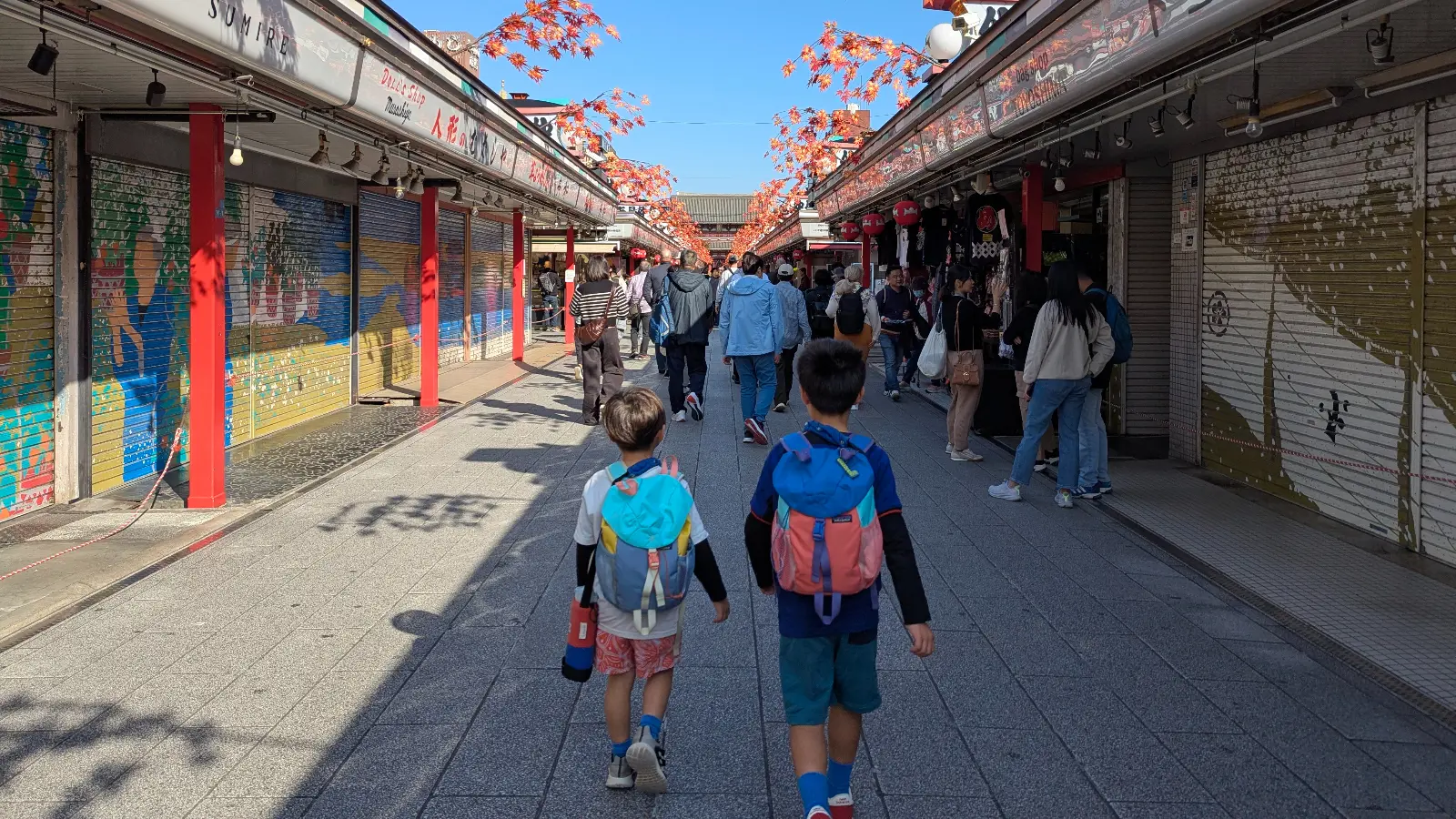
For the Anchor
Stops with confirmed, predictable structure.
For a child who depletes through unfamiliarity and unconfirmed structure, the strongest stops are Senso-ji Temple and the Samurai Ninja Museum.
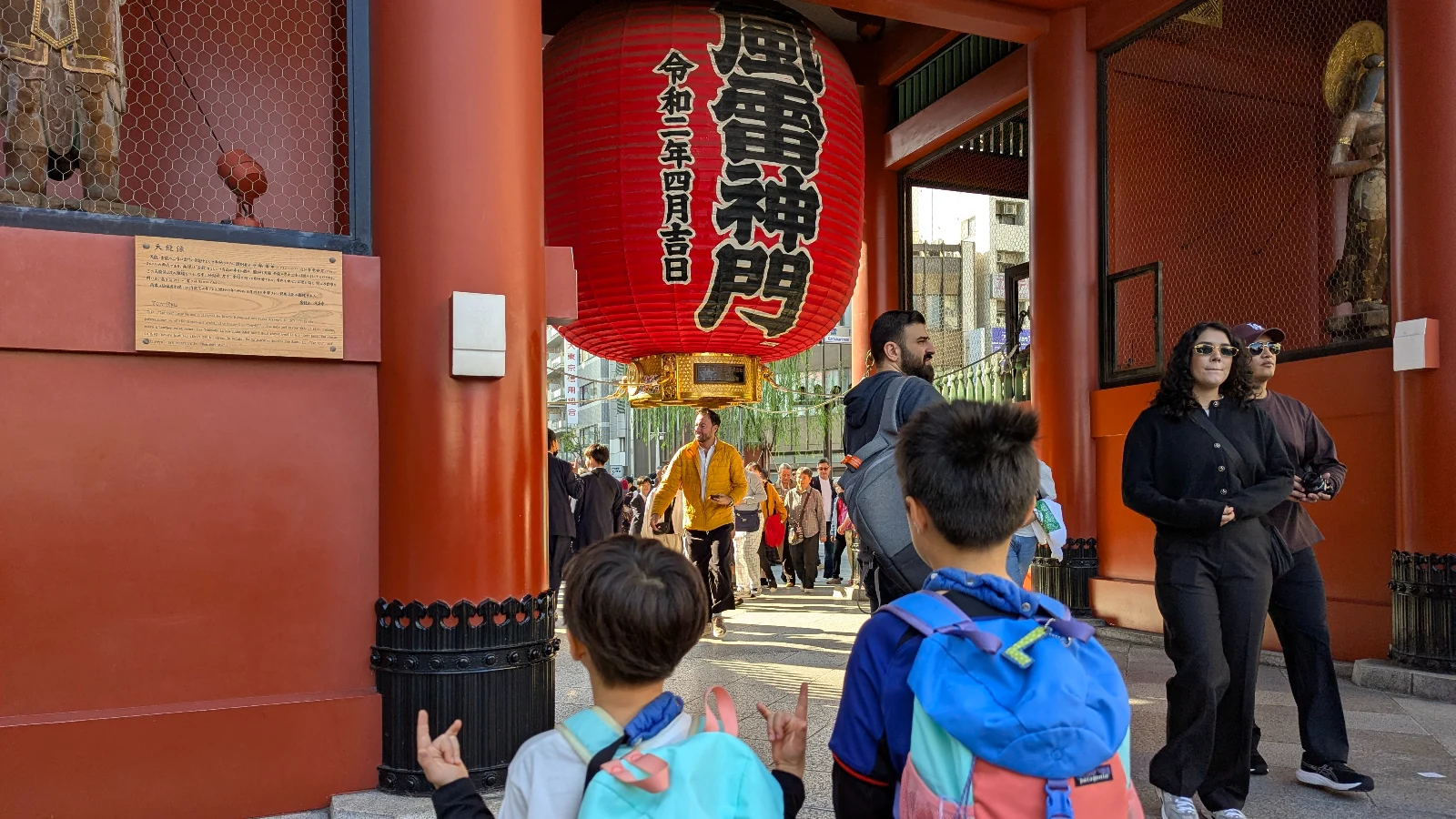
A temple runs on a fixed, repeatable sequence, and that is exactly what an Anchor relies on: through the Kaminarimon gate, along Nakamise, a wave of incense smoke at the cauldron, a fortune slip drawn from the omikuji drawers, then the main hall. Nothing about the order improvises, and a child who needs to know what comes next can be walked through it once and then lead it. The omikuji draw is the small ritual within the ritual, shake the box, read the number, find the matching drawer, good or bad it is always the same steps. A younger Anchor likes the predictable rhythm; an older one anticipates each stage they already know is coming.
Who it costs.The Sensor and the Sprinter, both at caution. Nakamise concentrates crowd noise toward midday, and the gate-to-hall walk with its standing pauses is a sustained one for low-stamina legs.
How to make it work.Arrive before 10 a.m., the temple’s calmest window, and walk the ritual in order so the Anchor gets the structure while the Sensor and Sprinter avoid the midday crush.
If this isn’t your child: Tokyo’s oldest temple and the heart of Asakusa, worth the early start for the sight alone.A guide who narrates each step and a fixed route through costume, sword forms, and star-throwing make this one of the most structurally predictable hours in Asakusa, which is what makes it land for an Anchor. The sequence is confirmed before you arrive and a guide holds it together throughout, so a child who needs to know what happens next is told, continuously. A younger Anchor follows the guide’s lead through the dress-up and demonstrations; an older one, often the harder age to reach in Asakusa, gets a genuine hook in the hands-on samurai and ninja segments.
Who it costs.The Sensor, mildly. The demonstrations have bursts of noise and the rooms are enclosed, though a guided group is calmer than an open floor.
How to make it work.Book a slot in advance so the Anchor has a confirmed start time and sequence, and choose an earlier slot when the groups are smaller.
If this isn’t your child: a fun, hands-on hour that earns its keep most with older kids who have outgrown the fortune draw.For the Sprinter
Short, low-stamina stops with little walking.
For a child who depletes through sustained walking and standing, the strongest stops are Tokyo Skytree and the Sumida River cruise.
One stop across the river, the Skytree gives a low-stamina child a major sight that costs almost no walking: the elevator does the climbing, the viewing floors are a slow loop with places to lean, and the payoff is height rather than distance. For the Sprinter it is the rare big-ticket stop that spends no stamina, which is why it works best as the morning opener, a short train hop to Oshiage first, then back to Asakusa for the afternoon on rested legs. A younger Sprinter is carried by the elevator thrill and the glass floor; an older one takes in the view and the layout of the city without a single tiring stretch.
Who it costs.The Sensor, at high risk at peak. The viewing floors compress crowd density, height, and bright open sightlines at once, with no contained quiet corner to retreat to.
How to make it work.Book a timed slot in advance and choose an off-peak one, so the Sprinter gets the easy big sight while the Sensor avoids the worst of the crush, then ride one stop back to the temple.
If this isn’t your child: the best high view in the area, worth booking for the sight, and an easy pairing with the aquarium below it.A water bus from Asakusa pier turns getting somewhere into the thing itself: the child covers real distance sitting down, watching bridges and the skyline go by, with no demand on their legs. For the Sprinter a cruise is rest that still counts as sightseeing, the opposite of the standing-and-shuffling that empties them. A younger Sprinter spots the bridges and boats from a seat by the window; an older one gets a calm, scenic stretch of the city between the busier stops.
Who it costs.The Anchor. A timetable, an unfamiliar pier, and a boarding sequence are exactly the unconfirmed structure that unsettles them.
How to make it work.Check the departure board first and show an Anchor the plan before boarding, then take the cruise one direction rather than a round trip so it shortens the walking instead of adding a wait.
If this isn’t your child: a scenic, restful way to see Tokyo from the water, and a genuine break for tired adults too.Asakusa is a half-day, not a full one.
Plan about two to three hours for Asakusa proper, then decide at the river whether to extend across to Oshiage.
Asakusa proper is a tight loop. The temple ritual, a fortune draw, and a snack along Nakamise fill ninety minutes to two hours comfortably, and that is the first natural exit: most families have seen the heart of the district by the time the treats are gone. The honest turning point is Reserve, not the clock. Watch which currency runs out first, and leave or extend on that, not on a fixed schedule.
The age spread is wide here, so plan for the child you have. A younger child is often ready to move on after about an hour, content once the gate, the smoke, and a sweet are behind them. A school-age child takes more time with the rituals, the people-watching, and choosing a treat. An older child is the one who extends the day across the river, to Sumida Aquarium, up the Skytree, or onto a cruise, which is what pushes a Asakusa visit past the three-hour mark. Build the day so the marquee stop for your child’s profile sits early, while Reserve is highest, and let the softer stops fill the time after.
Open with the child who runs short first.
The order of an Asakusa day is set by Reserve, not by the map. Each route opens with the stop that protects the named child, then chains to the nearest compatible one.
Settle these first. Tokyo Skytree is timed entry and the Samurai Ninja Museum runs on booked tour slots: reserve both in advance, because a booking-gated stop controls the day’s shape more than the route does. The river cruise runs to a timetable, so check the departure board. Hanayashiki, the parks, Senso-ji, and the Information Center are all walk-up fill-in arranged around those three.
When to go, and what costs nothing.
Late morning on a weekday is the widest window, and earlier is better still: before 10 a.m. the Nakamise approach and the temple are quietest, which matches Senso-ji’s calmest morning hours and keeps the crush off a sensory-sensitive child. Spring brings cherry blossom along the Sumida, and autumn colors the riverside paths and temple grounds. The free stops carry real weight here: the temple grounds, the omikuji draw, browsing Nakamise, and both Sumida and Hanakawado parks cost nothing, and they are also among the stops that protect a child’s Reserve best, so the free route and the calm route largely overlap.
Three bases that fit a family’s Reserve.
A shortlist chosen for location logic, not price tier. The full set is in the complete Asakusa hotel guide.
| Property | The LuNi Reason | Budget |
|---|---|---|
| LUNI Pick The Gate Hotel Kaminarimon by Hulic At the gate | The closest base to Kaminarimon itself, which puts the calm early hours and Senso-ji’s morning-only window a step from the door. An Anchor keeps the temple’s confirmed structure within reach with no commute, so the whole day’s early-start logic is easiest from here. | ¥¥¥ |
| MIMARU SUITES Tokyo Asakusa Suite layouts | Apartment-style suites with room for a multi-child family to spread out and reset at the end of a high-stimulation Nakamise day, and space to hold a routine across a multi-night stay. | ¥¥¥ |
| Asakusa View Hotel Annex Rokku North side | A north-side base near Hanayashiki and Hanakawado Park, close to the Dynamo’s run-space stops and set back from the Nakamise crush for a calmer end to the day. | ¥¥ |
The Gate Hotel Kaminarimon by Hulic
Budget: ¥¥¥
Budget: ¥¥¥
Asakusa View Hotel Annex Rokku
Budget: ¥¥
For every family-friendly option in the area, see the full Asakusa family hotel guide.