HOKUSHU Sendai City Science Museum with Kids: Built to Be Touched.
A museum whose own postal address is the park it stands in offers a family two different days, and the only real decision is how much of each one to take.
High school ¥320. Cash or card at the counter, with nothing to book for a family.
Closed Mondays (open on holidays), most days after a holiday, the fourth Thursday outside December, and December 28 to January 4.
A child who works one station properly spends the visit there.
The earthquake theater is closed to children 120 cm and under.
Some links on this page are affiliate links. LuNi may earn a commission at no extra cost to you.
Is HOKUSHU Sendai City Science Museum worth it with kids?
The short version, before the costs, the timings and the case for each child.
Yes, and with less planning than most stops ask for. This is Sendai’s city science museum, one subway line north of the station and a short walk from the stop, and it is built for a child to do things rather than read about them: stations to start and walk away from, with the heart of it in seven numbered zones on the third floor and a full Allosaurus skeleton replica in the entrance hall. It stands inside Dainohara Forest Park, so the outdoor half of the day is already attached to the indoor half, and a child who has spent the building has somewhere to run it off. The one thing to get right is the date, because the closed days run well past Mondays, and a family that checks only for Monday can arrive to a locked door.
Planning Your Visit to HOKUSHU Sendai City Science Museum with Kids.
Two things settle this visit before the family leaves the hotel, and the first is the only real way to waste the trip. It is the date. The museum’s closing days follow Japan’s holiday calendar as well as the weekday, so they move from month to month, and a week that looks ordinary can hide one. That is how a family can find a locked door on a day that looks open. Check the exact date, not the weekday. The second is the way in, and it is the easy part: one subway line to Asahigaoka, out at East Exit 1, which has an elevator, and five minutes on foot, so spend the planning on the date, where one mistake costs the whole trip out.
Every LuNi attraction guide starts with a visit, with our own children
LuNi rates and writes about attractions only after visiting them with children. Luca and Nico were at HOKUSHU Sendai City Science Museum, and what they did there is recorded further down this page, including how each child actually met it.
Children arrive with different tolerances: for noise, for lines, for standing still, for being on their feet all day. A guide written for the average of them helps almost nobody. So every place on this site is read four ways, and each verdict says which children it already suits and what makes it work for the rest. Whoever you are bringing, the answer here is built for your family rather than for a general reader.
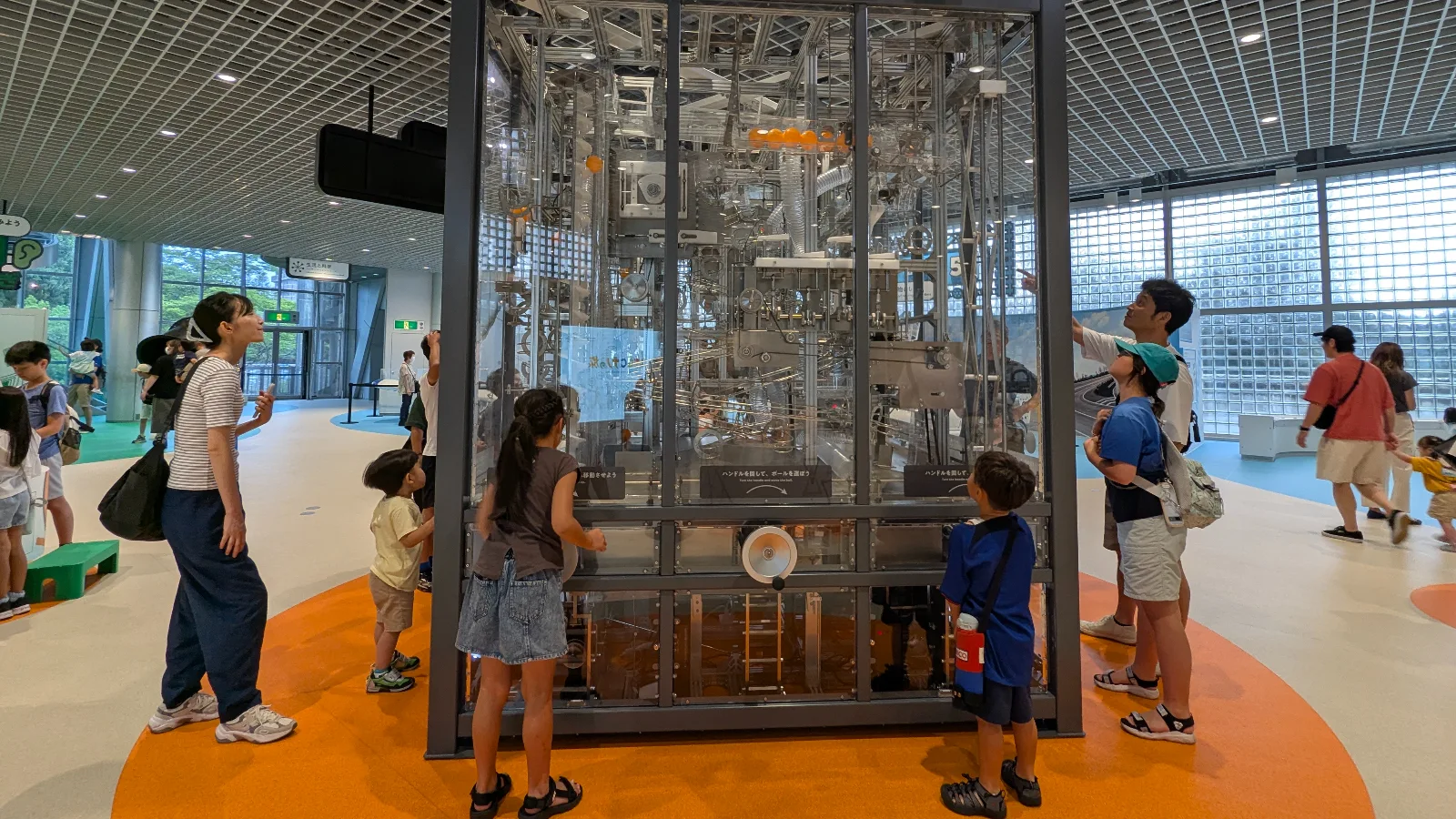
Restricted-movement depletion discharges on stations a child works rather than views, from a subway cab simulator to a three-meter tower of gears and pulleys.
Sensory-input depletion is concentrated in one numbered zone rather than spread, so read the 120 cm floor before promising the earthquake theater.
Unfamiliarity and unconfirmed structure are answered by three named areas and seven numbered zones, so name the floor before the room inside it.
Sustained walking and standing stay low inside, so the approach is the whole cost: five minutes on foot from East Exit 1, which has an elevator.
Hotels we would book for this visit.
Three family hotels judged on one question, because one subway line does the whole journey: how cleanly a family reaches the Namboku platforms from the lobby, with a child in tow.
| Property | The LuNi Reason |
|---|---|
| LUNI Pick Hotel Metropolitan Sendai East Connected to Sendai Station | The whole journey is one line: Namboku from Sendai Station to Asahigaoka, about ten minutes, no change, then five minutes on foot. Connected to the station, this property puts a family onto that line without a transfer first, which is the difference between a short trip and a cross-city haul. |
| The Westin Sendai Sendai Trust Tower, 6 to 9 minutes’ walk from the station | Its nearest door is the subway’s rather than the railway’s: about six minutes on foot to a Sendai Station subway entrance, so the walk from the lobby ends at the Namboku line itself, and a child is on the platform minutes after breakfast. On a one-line museum morning, that short and direct walk is the whole case. |
| Sendai Royal Park Hotel Izumi Ward, about 30 minutes by taxi from Sendai Station | This is the one hotel already on the museum’s side of the city, north of the center rather than across it, which is worth something on a morning that wants to start at 9:00. It costs the rest of the trip the same distance back into town, so book it for a night that ends in northern Sendai. |
Hotel Metropolitan Sendai East
Nearby attractions, matched to your child.
Three pairings, one outside the door and two further out, chosen for what each adds to a morning spent working machines indoors, when a child has pressed every button and needs something else.
| Pairing | Why This Solves the After-Visit | For Your |
|---|---|---|
| LUNI Pick Dainohara Forest Park Surrounds the building; it is the museum’s own address | The building answers a moving child with stations to work, and the park answers the same child with ground. Dainohara Forest Park is the museum’s postal address, and the museum’s own nature observation deck looks out over it, so the outdoor half of the day is attached to the indoor half rather than planned separately. | Dynamo |
| Sendai Astronomical Observatory West of the center | Two hours across three floors is a lot of standing, so a Sprinter needs the next stop to be a seat. The planetarium at the Sendai Astronomical Observatory runs to a posted schedule, but weekday mornings outside the long school vacations are group-only, and a family leaving here at eleven lands inside that window. | Sprinter |
| Zuihoden Across the city | A morning of stations a child operates is a morning of things happening back at them, so a Sensor who has had enough needs the opposite next. Zuihoden is outdoors, and what it asks of a child is looking, at whatever pace the family sets. | Sensor |
Dainohara Forest Park
Surrounds the building; it is the museum’s own address For YourDynamo
Sendai Astronomical Observatory
West of the center For YourSprinter
Zuihoden
Across the city For YourSensor
How two children actually met this attraction.
Two children spent the same morning in the same building, and between them they used a small fraction of it. Neither walked the floors in order and neither showed any interest in what the areas were called. What held them was a handful of machines that did something back: one that turned effort into a number, another that put the inside of an arm on a screen. They went back to those two, again and again, while whole floors stood unvisited. That is not a failure of the museum and it is the most useful thing a parent can know before paying at the counter. A child here will find two or three stations and stay at them, and the building is built to let that happen.
Luca settled at the bicycle generator and stayed, pedaling to see how many watts he could push the readout to and then trying again to beat his own number, treating each ride as a test of the last rather than a race. He carried the same analytical patience to the vacuum and water displays, working out how an object’s weight changed when it was placed under a bell jar or lowered into water.
This is the Anchor pattern. A child whose Reserve depletes through unfamiliarity and unconfirmed structure stops spending the moment a room hands them something with rules, and a number to beat is a rule that can be tested. Families with a similar child should let one machine be understood properly rather than all of them briefly, because an Anchor who has worked out how a single station behaves carries that settled state through the rest of the building.
Nico moved with his whole body the entire time. What held him longest was pushing his arms into the anatomy machines to watch his own bones, veins, and temperature appear on the screen, doing it again and again to see what changed when he shifted his hands. The stations that kept him were the ones that let him do something physical rather than stand and look.
This is the Dynamo pattern. A child whose Reserve depletes through restricted movement was, in working those machines as hard as he could, refilling rather than spending. Families with a similar child should let the stations be operated hard rather than demonstrated gently, because effort is the input they are built to take. Point a Dynamo at the interactive and body-science stations first, and the quieter areas stay available for later, once the charge has already gone somewhere.
A science museum that lets a child drive a simulated subway along a line they have just ridden turns a passenger into an operator, and that shift is thrilling. Understanding how a machine works from the controls outward gives a child confidence, and a sense that the systems around them are run by people. Museums built around doing rather than reading reward curiosity with action. A child who has sat at the controls of something they once only rode sees every train afterward as something that can be understood.
The LUNI Rating for HOKUSHU Sendai City Science Museum.
One fact drives all four verdicts. This is a building organized into named areas rather than a single hall, and the names are the museum’s own. Nature of Miyagi and Sendai and Inquiry into Science hold the fourth floor. Life and Science holds the third, divided into seven numbered zones: Challenge Lab, Nature and Disaster, Yourself and Wonder, Wonder Tower, Vehicle Garage, Senses and Wonder, and Partnership Lab, the last run with universities and companies. A special exhibition room and laboratories sit on the second floor below them. Almost everything in those areas is a station a child operates rather than a case they read, and that single property is what carries all four verdicts.
Effort is the intended input. The Dynamo depletes through restricted movement, and this building spends almost none of it, because what it asks of a child is to do something with their body. A child can climb into a real airplane and a formula car, drive a subway simulator, send a ball through a tower of gears and pulleys, and stand inside a giant soap bubble, and each of those starts when the child starts it. Go straight to the third floor and let the child pick the first station rather than steering them to a list.
The zones do not have to be taken in order. Zone 3, Yourself and Wonder, holds Wonder Scan: a child puts a hand in and sees their own bones, blood vessels, muscles and surface temperature, then the same hand as a bat’s wing, a whale’s fin and a horse’s leg. A floor up, Inquiry into Science takes the same hands-on idea into physics, which suits an older child who wants a result to argue about. A Dynamo who finds one station and will not leave it is doing what the building was built for, and the park is outside the door when the charge outlasts the floor.
What this means for your Dynamo: restricted movement barely gets charged here. A younger Dynamo runs the third-floor zones and stops there; an older one takes the fourth floor too, where the same effort returns a result worth arguing about.The concentrated part of this building is one numbered zone. The Sensor depletes through sensory input, and almost everything here is a station a child chooses to start and can walk away from. The exception is Zone 2, Nature and Disaster. A tornado and typhoon generator stands at its entrance, and at its center is an earthquake theater that reproduces the shaking Sendai felt in 2011, which makes it the one exhibit in the building a parent should decide on in advance rather than discover.
That theater has a height floor, and it is not a parental judgment. Anyone 120 cm or under cannot use it, which is roughly a six or seven year old, so for a small sensitive child the decision is already made at the door. Say it before the zone rather than at it. For a taller child it is a real choice, and the one exhibit here that starts without being started. The rest of the mitigation is the building: nursing rooms on every exhibition floor, a sick room on request at reception, and an outdoor observation deck over the park. The calendar matters too: the building is busiest from late April to mid-June, with school trips, and mid-July to late August, with the special exhibitions.
What this means for your Sensor: sensory input is concentrated in one zone rather than spread through the building. A younger Sensor is excluded from the earthquake theater by height and loses nothing; an older one should be told what it reproduces before choosing.The building announces its own shape, and the names are the ones on it. The Anchor depletes through unfamiliarity and unconfirmed structure, and this museum answers both before the first exhibit. Two areas hold the fourth floor: Nature of Miyagi and Sendai, and Inquiry into Science. One holds the third, Life and Science, in seven zones numbered one to seven: Challenge Lab, Nature and Disaster, Yourself and Wonder, Wonder Tower, Vehicle Garage, Senses and Wonder, and Partnership Lab. Below them the second floor carries the special exhibition room and the laboratories. A child told which floor and which number comes next is handed the structure this profile arrives without.
Check for a science show; never promise one. Shows run on an irregular schedule, free and with nothing to book, so look at the museum’s event listing for the day before telling an Anchor anything. If one is on, it is the appointment to build the visit around; if none is, the numbered zones carry the structure on their own. The hands-on classes are a different thing: applied for weeks ahead through the city’s own service, capped, and sometimes drawn by lot, so they are not something a visiting family decides at the door. Science interpreters work both exhibition floors and can be asked directly.
What this means for your Anchor: unfamiliarity is cheap here, because the building is already labeled. A younger Anchor holds one zone number at a time; an older one can be handed the floor plan and left to decide the order.The cost is the approach, and the approach is short. The Sprinter depletes through sustained travel-style walking and standing, and what there is of it here comes before the door. Asahigaoka is about ten minutes from Sendai Station on the Namboku line with no change, and the museum is five minutes on foot from there. Use East Exit 1, which has an elevator, and borrow a stroller free at reception for a younger Sprinter.
Then the building stops charging. Driving is the other route, with a large free lot beside the museum and spaces held for visitors who find walking hard; it closes shortly after the exhibitions do. Inside, the visit is three exhibition areas over two floors with a third below them, and the pace belongs entirely to the family.
What this means for your Sprinter: the standing is front-loaded into the journey rather than the visit. A younger Sprinter should be carried from East Exit 1; an older one paces once the five-minute walk is named as the whole of the outdoor cost.The questions parents actually ask.
Two things decide a visit here, and the first is a calendar problem rather than a question about the building. The closed days run well past Mondays: the day after a public holiday usually counts, and so does the fourth Thursday of nearly every month, which is the one nobody thinks to check. Both rules have exceptions, so check the exact day rather than trusting the pattern. The second is the station, and the subway ride there is short: ten minutes on one line with no change, then East Exit 1, which has an elevator, and five minutes on foot.
Is HOKUSHU Sendai City Science Museum worth visiting with kids?
Yes, and with unusually little planning. It is about ten minutes north of Sendai Station on the Namboku subway line and five minutes on foot, at 550 yen for an adult and 210 for elementary and junior high. Almost everything inside is a station a child operates rather than a case they read, and the building stands in a forest park.
What days is HOKUSHU Sendai City Science Museum closed?
Mondays, or the Tuesday when Monday is a holiday. Also the day after a public holiday, unless that day is a weekend, a holiday or the day after October’s second Monday; the fourth Thursday of each month except December, unless it is a holiday; and December 28 to January 4. The day-after rule and the fourth Thursday are the two that catch families out.
Do you need cash at HOKUSHU Sendai City Science Museum?
No. Cash and cashless payment are both taken, including VISA, Mastercard and American Express. Payment is made on the day rather than in advance, so there is nothing to reserve and no reason to find an ATM first. Admission is 550 yen for an adult, 320 for high school and 210 for elementary and junior high.
How long do you need at the science museum with kids?
Allow about two hours. There are three exhibition areas across two floors, with a special exhibition room on the floor below them, and a child who settles at one station will spend the whole visit there. Last entry is 16:00 and the building closes at 16:45, so an afternoon arrival gets less than half of it.
What is inside HOKUSHU Sendai City Science Museum?
Four groupings. Nature of Miyagi and Sendai and Inquiry into Science hold the fourth floor. Life and Science holds the third, in seven numbered zones. The entrance and outdoor exhibits carry a full Allosaurus skeleton replica, a student-built human-powered aircraft and a rock garden of thirty-five specimens. A library and reference room sits alongside them.
Can young children use the earthquake simulator?
Not if they are 120 cm or under, which is roughly a six or seven year old. The Gurari-kun earthquake theater in Zone 2 reproduces the shaking recorded in Sendai during the 2011 Tohoku earthquake, and compares shindo 3 with shindo 5-upper. Telling a small child the rule before reaching the zone saves a refusal at the door.
How do you get to the science museum from Sendai Station, and is it stroller friendly?
The Namboku subway line runs to Asahigaoka in about ten minutes with no change, then it is five minutes on foot. Use East Exit 1, which has an elevator. Strollers and wheelchairs are both lent free at the main reception, and nursing rooms are on three floors.
What age is HOKUSHU Sendai City Science Museum best for?
Five to twelve, when a child can work a station and then want to know why it did that. Below five the machines work and the explanations do not. Teens hold it best when a zone is handed to them to run, with a younger sibling as their crew.
Where HOKUSHU Sendai City Science Museum fits your Japan trip.
Official site and opening information: HOKUSHU Sendai City Science Museum