Sendai Astronomical Observatory with Kids: A Universe to Look Through.
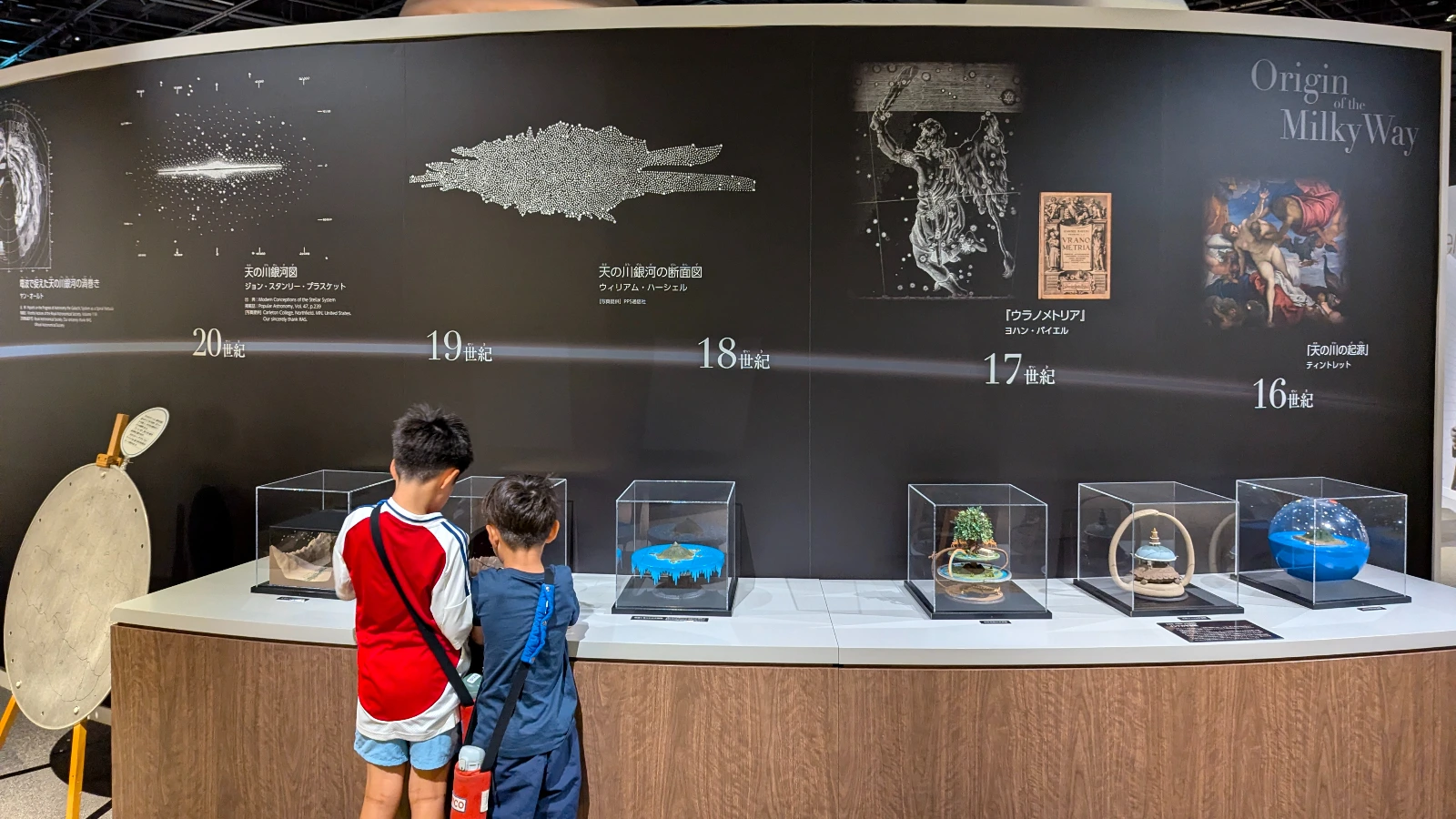
The planetarium is the reason to make the trip and the one thing a school-year weekday morning cannot sell you, which makes the hour of arrival the whole decision.
The set: the exhibition room plus one projection; high school ¥610, preschoolers free. Tickets can also be bought ahead online.
Exhibition rooms close at 17:00 daily. Closed Wednesdays and the third Tuesday (the next weekday if a holiday), and December 29 to January 3.
Build it around one projection; the exhibition room takes the rest.
Below five a full projection runs long; older children pick their slot off the board.
An elevator, wide restrooms, a kids’ room and a nursing room.
Some links on this page are affiliate links. LuNi may earn a commission at no extra cost to you.
Is Sendai Astronomical Observatory worth it with kids?
The short version, before the costs, the timings and the case for each child.
Yes, on a weekday afternoon, and the qualifier is the whole of the advice. This is a hilltop in western Aoba Ward about thirty minutes by car from Sendai Station, and the visit comes in two priced halves, an exhibition room and a planetarium show, of which the set ticket for both is the one to buy. The show is what most families come for, and it is the half a school-year weekday morning does not sell them, because those slots are held for groups outside the long school vacations. Shift the same plan four hours later and everything the morning promised is on the board. The other decision is the approach, and one of the two buses out of Sendai Station removes it entirely.
Planning Your Visit to Sendai Astronomical Observatory with Kids.
Two choices decide this day and both are made before anyone leaves the hotel. The first is the hour. Buy the set ticket and pick a projection, and then make sure the projection exists: on an ordinary school-year weekday morning it is held for groups, and the exception is Japan’s long school vacations. An afternoon slot is the same visit with the show attached. The second is which bus. Two services leave the West Exit at Sendai Station, and only one of them sets a family down at the building itself, which is the one to take; the other ends five minutes away on foot, and the road is crossed at the stop. Tell the child which bus it is before the stop, so the ride has a known end.
Every LuNi attraction guide starts with a visit, with our own children
LuNi rates and writes about attractions only after visiting them with children. Luca and Nico were at Sendai Astronomical Observatory, and what they did there is recorded further down this page, including how each child actually met it.
Children arrive with different tolerances: for noise, for lines, for standing still, for being on their feet all day. A guide written for the average of them helps almost nobody. So every place on this site is read four ways, and each verdict says which children it already suits and what makes it work for the rest. Whoever you are bringing, the answer here is built for your family rather than for a general reader.
Restricted-movement depletion is charged early, because what the two ticketed halves ask of a child is looking and then sitting for a posted show.
Sensory-input depletion concentrates in one darkened dome sold as its own ticket, so declining it is a purchase decision rather than a negotiation at the door.
Unfamiliarity and unconfirmed structure meet a posted projection schedule, so take a weekday afternoon, which is when that schedule includes a family walking in.
Sustained walking and standing are charged on the approach alone, and the Seibu Liner from Sendai Station West Exit sets down at the door.
Hotels we would book for this visit.
Three family hotels judged on one thing, because this is a hill with no lodging of its own: how directly a family reaches the two Sendai Station bus stops that serve it.
| Property | The LuNi Reason |
|---|---|
| LUNI Pick Hotel Metropolitan Sendai East Connected to Sendai Station | Both buses to the observatory leave the West Exit at Sendai Station, from stops 52 and 63, and the car route starts there too. Connected to the station, this property puts a family at the head of whichever route it picks without a cross-city leg first, which is the only thing a hilltop with no lodging asks of a base. |
| The Westin Sendai Sendai Trust Tower, 6 to 9 minutes’ walk from the station | The observatory buses leave from the West Exit, about nine minutes on foot from here, a walk to price twice on a day that ends after a show, when a child has spent the afternoon sitting still and looking up. The tower’s basement parking is the other answer: a family driving up can keep the car beneath the room. |
| Sendai Royal Park Hotel Izumi Ward, about 30 minutes by taxi from Sendai Station | This is a driving base rather than a bus one, for a family that wants the car at the door. A child worn out by the show can be carried to a car seat rather than a bus stop, with the observatory’s free parking at the far end. |
Hotel Metropolitan Sendai East
Nearby attractions, matched to your child.
Three pairings, all north of the center or across it, chosen for what each adds to an afternoon spent looking and then sitting, when a child needs to move or to be somewhere quieter.
| Pairing | Why This Solves the After-Visit | For Your |
|---|---|---|
| LUNI Pick HOKUSHU Sendai City Science Museum North of the center, by car or subway | An afternoon here is mostly looking and then sitting, which is the bill a moving child pays first. The science museum is the opposite arrangement: numbered zones of stations a child works with their hands, and a forest park at the door when the charge outlasts the floor. | Dynamo |
| Zuihoden Across the city, by car or the Loople bus | A projection is a room deciding how much light and sound a child gets and when. Zuihoden hands that back: it is outdoors, it asks only for looking, and the family sets the pace and the volume of the whole thing themselves. | Sensor |
| Sendai Dai Kannon North of the center, by car | The board here confirms one appointment and leaves the rest of the day loose. Sendai Dai Kannon is the other shape a child can hold: one building whose twelve levels are reached by elevator, and 108 figures counted off across nine of them. | Anchor |
HOKUSHU Sendai City Science Museum
North of the center, by car or subway For YourDynamo
Zuihoden
Across the city, by car or the Loople bus For YourSensor
Sendai Dai Kannon
North of the center, by car For YourAnchor
How two children actually met this attraction.
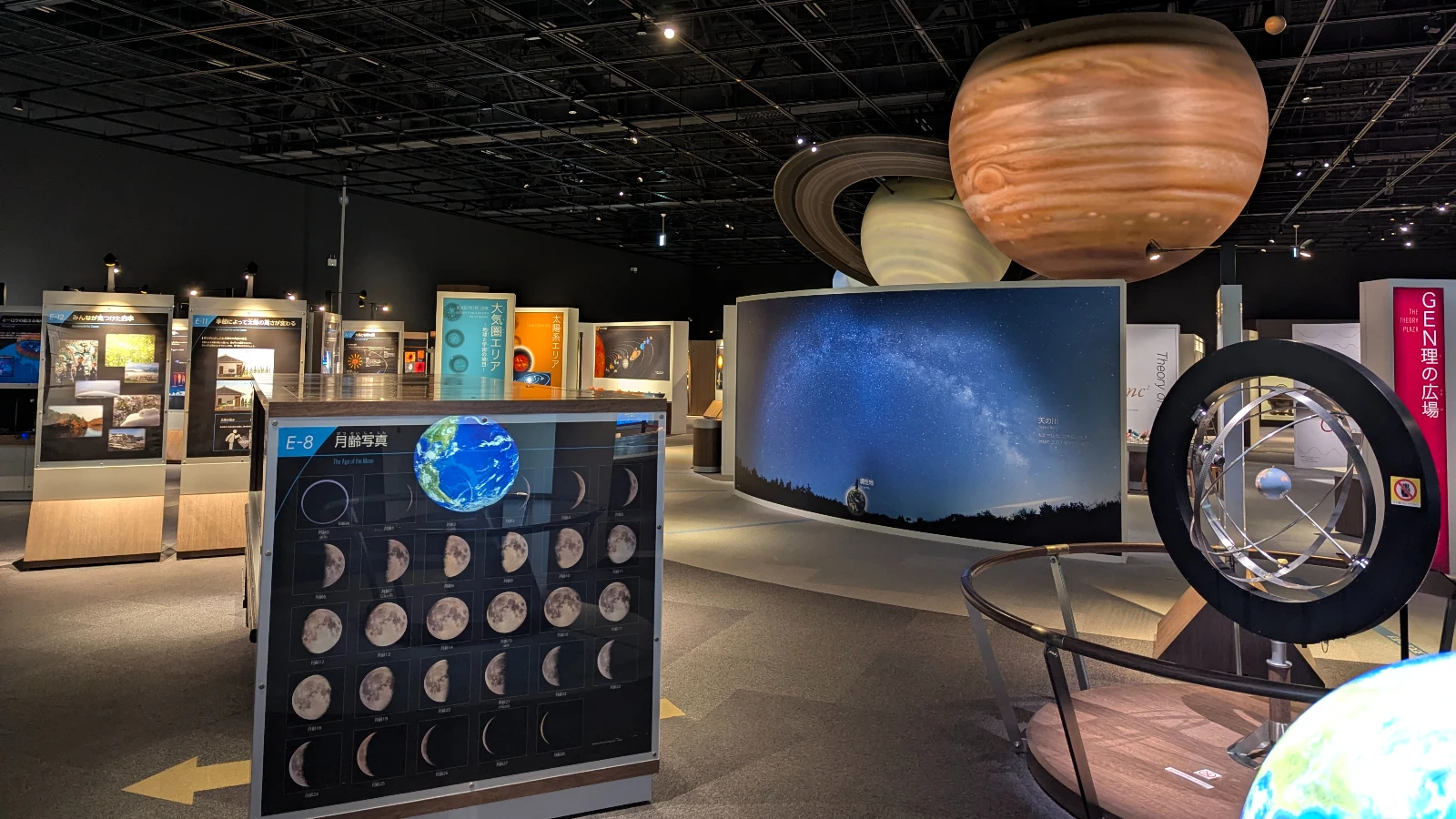
The two halves of this place split the two children almost cleanly, and neither of them split the way the building’s own billing would predict. The headline instrument held one of them for a moment and lost him. A single small machine in the exhibition room held the other for most of the visit. What a family should take from that is not that the show is oversold, because it is the reason to come and the reason to take an afternoon slot. It is that the room you walk through first is where a child decides what kind of day this is, and neither child decided it at the thing the building is named for. Budget the exhibition half as the part that does the deciding, and let the projection be the fixed point the day is built around.
Luca gave the telescope its due and then went and found the gravity machine, where a coin dropped at the rim spirals faster and faster toward the center. He fed it coins. What he wanted was not the trick but the reason for it, and he stayed with the thing, testing it, until he could say out loud why it behaved the way it did.
This is the Anchor pattern. A child whose Reserve depletes through unfamiliarity and unconfirmed structure stops spending the moment something in the room turns out to obey a rule they can test. Families with a similar child should let one exhibit be understood properly rather than all of them briefly, and should name the projection time at the counter, because an Anchor who knows what is coming next carries that settled state through the room.
Nico stopped at the telescope long enough to be struck by one thing: that the object in it looked close when he knew perfectly well it was not. He said so out loud, turned it over for a beat, and then moved. The looking was finished as far as he was concerned, there was more building to get through, and he went and got through it at his own speed rather than anybody else’s.
This is the Dynamo pattern. A child whose Reserve depletes through restricted movement will pay for one good look and then need somewhere to put the rest of himself, and a room of panels is not built to take it. Families with a similar child should keep the exhibition half short and deliberate, spend the Reserve on the projection itself, and have the walk or the park that follows it chosen before anybody arrives rather than negotiated afterward.
A planetarium on a hill offers a child a first real sense of how vast the sky is, and how small and connected our world is within it. Watching a projected night sky under a dome invites the biggest questions a child can ask, the ones about distance, time and where everything came from. Astronomy rewards wonder with more wonder. An afternoon under the dome teaches a child that the universe is not only something in books, but something they can look at and keep wondering about for life.
The LUNI Rating for Sendai Astronomical Observatory.
One fact drives all four verdicts, and it is a ticketing fact rather than an architectural one. This place is sold as two separable halves. An exhibition room is one price, a single planetarium projection is the same price again, and a set ticket buys both for less than the pair. That structure is what lets a family take one half and decline the other, and it is also why the hour of arrival matters so much: on a school-year weekday morning the second half is held for groups, and the set ticket loses the thing it was bought for.
Most of the visit is paid for in stillness. The Dynamo depletes through restricted movement, and the two things this hilltop sells are a room of panels and models, some of them hands-on, and a show to sit through. That is the shape of the visit, and it spends first the currency this child is shortest of. A family that has already used the morning on something physical will find the cost barely bites. One arriving fresh, after half an hour in a car, is starting the day at the wrong end of it.
The discharge is on the approach, and it is real. From JR Aiko Station the walk up is thirty to forty minutes on a gentle slope, worth allowing extra time for. A family with a movement-led child can buy the afternoon by spending the hour before it on that climb. The alternative is to make the projection the fixed point, keep the exhibition room short, and have the next stop chosen.
What this means for your Dynamo: restricted movement gets charged here, so buy the charge back before you arrive. A younger Dynamo does the exhibition room in one pass and the projection second; an older one can take the Aiko walk up and earn the seat.The high-input room is behind its own ticket. The Sensor depletes through sensory input, and the concentrated part of this visit is the dome: a darkened projection with sound, which a light-sensitive or sound-sensitive child can find either mesmerizing or abruptly too much. What makes it work is commercial rather than architectural. The dome is not folded into the admission; it is a ticket of its own. A family that decides against it buys the exhibition room alone and never has a door to argue about, which is easier than talking a child out of a room already paid for.
And the dome itself has come in a gentler version. A baby-oriented program has run here in which the dome is not made fully dark, built for exactly the child a parent would otherwise keep outside it, and announced with the line that if a child cries partway through, everyone is in the same boat. Nothing further is scheduled yet, so treat it as a reason to check the calendar rather than a plan.
What this means for your Sensor: sensory input gathers in one room here, and the counter lets a family decline it. A younger Sensor takes the exhibition ticket and loses nothing; an older one should be told what the dome does before choosing to buy into it.A posted schedule is the thing this child came for, and it has one window it does not cover. The Anchor depletes through unfamiliarity and unconfirmed structure, and a posted projection schedule is about as confirmable as a family attraction gets: a named start, a named end, printed on the board. The catch is that on a weekday morning outside the long school vacations those slots are group-only. An Anchor sent somewhere precisely because its schedule is fixed, who finds the schedule does not include them, has met the exact thing this profile depletes on. The fix costs nothing and is a matter of when you go.
The date needs the same care as the hour. The building closes on Wednesdays and on the third Tuesday, and when either falls on a public holiday the closure moves to the next weekday instead, so the day that looks safe on a calendar is the day after the holiday. It stays open through the long school vacations, which is also when the morning restriction lifts. Name the day and the time at the counter, and an Anchor has the visit in hand before the first room.
What this means for your Anchor: unfamiliarity is cheap here as long as the schedule is really yours. A younger Anchor holds one named projection time; an older one can be handed the board and left to pick the slot and work backward from it.The whole walking cost is the approach, and one route deletes it. The Sprinter depletes through sustained travel-style walking and standing, and on a hilltop that ordinarily means the day is decided before the door. Two buses run from the West Exit at Sendai Station, and the choice between them is the whole plan. One ends a five-minute walk short of the building. The other, the Seibu Liner, sets a family down at the observatory itself and asks for no walk at all, which makes it this child’s bus every time. It is a regional liner rather than a city shuttle, so it keeps its own calendar and skips the observatory on the building’s closed days.
If you take the other bus, take the crossing first. There is no pedestrian crossing near the observatory, so cross at the one by the bus stop before walking up. That is a five-second decision a family does not get a second chance at with children in tow. Driving removes the question: the lot is free, has accessible spaces, and stays open late on Saturdays, so a family staying for a telescope evening is not racing the gate.
What this means for your Sprinter: sustained walking is a route choice here, not a property of the venue. A younger Sprinter should be on the Seibu Liner; an older one can take the other bus and the five minutes, as long as the crossing is done at the stop.The questions parents actually ask.
Two things decide a visit here, and neither of them is on the front of the building. The first is the price, which looks like one ticket and is really two, because the room and the show are separate purchases and the set ticket is the one most families actually want. The second is the hour, because the show a family is buying the set ticket for is held for groups on school-year weekday mornings. A family traveling Japan with school-age children during the school year at home should plan around the afternoon show. Choose the projection here with the child.
Is Sendai Astronomical Observatory worth visiting with kids?
Yes, on a weekday afternoon. The visit is two ticketed halves, an exhibition room and a planetarium show, and the set ticket is 1,000 yen for an adult and 400 for elementary and junior high. It sits on a hill in western Aoba Ward, about thirty minutes by car from Sendai Station.
What does Sendai Astronomical Observatory cost?
The exhibition room alone is 610 yen for an adult, 350 for high school and 250 for elementary and junior high. One planetarium show alone is the same. The set is 1,000, 610 and 400. Groups of thirty or more pay 810, 480 and 320 for the set.
Why go to the planetarium in the afternoon rather than the morning?
Because weekday-morning projections are held as group-only slots outside the long school vacations. A family that follows the usual advice and arrives early on a school-year Tuesday can buy an exhibition ticket and no morning show. The same plan in the afternoon gets everything the morning was supposed to buy.
What days is Sendai Astronomical Observatory closed?
Wednesdays and the third Tuesday of the month, and December 29 to January 3. When either of those days is a public holiday the closure moves to the next weekday instead, which is the rule that catches families out. It stays open through the long school vacations.
How do you get to Sendai Astronomical Observatory from Sendai Station?
Two buses leave the West Exit. The Seibu Liner from stop 63 sets down at the observatory itself with no walk, and its last weekday run back leaves at 16:37. The Nishikigaoka service from stop 52 leaves five minutes on foot. By car it is about thirty minutes, or ten from the Sendai-Miyagi interchange.
Is there parking at Sendai Astronomical Observatory?
Yes, and it is free: 125 car spaces, five of them accessible, plus motorcycle and bicycle parking. The parking lot runs 9:00 to 17:00, and to 21:30 on Saturdays, so it stays open for the evening telescope session rather than closing with the exhibition rooms.
Is the planetarium too dark for a sensitive child?
It is the one darkened room here, and it is sold as its own ticket, so a family can buy the exhibition alone and never open that door. A baby-oriented program has also run in which the dome is not made fully dark and crying is expected rather than treated as a problem.
What age is Sendai Astronomical Observatory best for?
Five to twelve. Below five a full-length projection runs long and the panels do not read. Older children hold it easily once the projection is theirs to pick off the board, and some will want to read every panel on the way back out to the bus.
Where Sendai Astronomical Observatory fits your Japan trip.
Official site and opening information: Sendai Astronomical Observatory