Kegon Waterfall with Kids: A 97-meter drop, watched standing still.
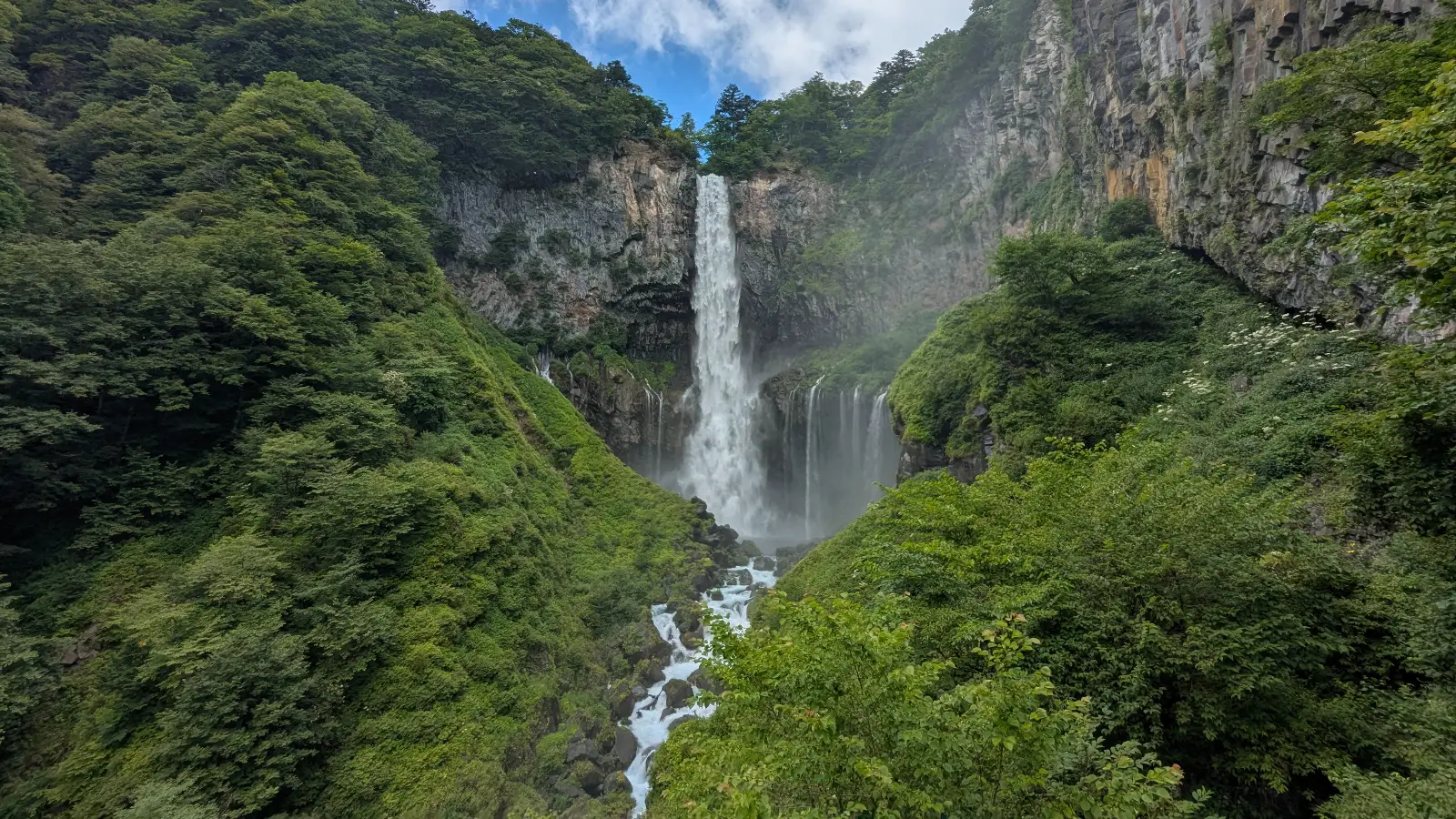
The elevator that carries a family down through the rock to the foot of the falls, sparing tired legs, delivers a child who needs to move to a deck built for looking.
Round-trip fares; preschoolers ride free and junior high pays adult. The upper deck is free. No reservation: first come, first served.
9:00 to 16:30 in winter; last ride 20 minutes before closing, and bad weather can stop it.
The elevator takes about a minute each way; the rest is time on one deck or both.
Preschoolers ride free; the passage below stays at about 15 degrees even in midsummer.
The free deck’s ramp is steep and needs a helper; the elevator drops 100 m to the lower deck.
Some links on this page are affiliate links. LuNi may earn a commission at no extra cost to you.
Is Kegon Waterfall worth it with kids?
The short version, before the costs, the timings and the case for each child.
Yes, and for most children without conditions. Kegon is the great waterfall above Nikko, counted among the country’s three finest, and it takes under an hour. There are two ways to see it. A free viewing deck looks down from the top, a short walk from the Chuzenji Onsen bus stop, and a paid elevator drops through the bedrock to a second deck near the level of the plunge pool, then brings you back up. A child whose legs tire first is carried through the hard part by a machine. A child who needs to move is the one to plan around, because both decks are places to stand and look. The two decisions that change the outcome are whether to ride down at all, and what open ground comes straight after.
Planning Your Visit to Kegon Waterfall with Kids.
Three decisions are worth making before the bus, because the falls themselves ask very little. The first is whether to ride down. The free upper deck shows the falls from above, while the elevator runs to a lower deck near the level of the plunge pool and back, and it is the only part of the visit that costs anything. The second is the clock. The elevator opens at eight in season and nine in winter, stops selling a little before it closes, and can halt without notice in bad weather, so an early ride leaves room for a second attempt. The third is a layer, because the passage at the bottom stays cold even in midsummer. Kegon is rarely the whole day, and how it sits among Nikko’s other stops is the larger decision.
Every LuNi attraction guide starts with a visit, with our own children
LuNi rates and writes about attractions only after visiting them with children. Luca and Nico were at Kegon Waterfall, and what they did there is recorded further down this page, including how each child actually met it.
Children arrive with different tolerances: for noise, for lines, for standing still, for being on their feet all day. A guide written for the average of them helps almost nobody. So every place on this site is read four ways, and each verdict says which children it already suits and what makes it work for the rest. Whoever you are bringing, the answer here is built for your family rather than for a general reader.
Restricted-movement depletion builds when the visit is a one-minute elevator ride between two decks built for standing, so put open ground immediately before and after.
Sensory-input depletion stays low with one natural spectacle in open air, so describe the cold passage below in advance and let the child choose which deck.
Unfamiliarity and unconfirmed structure ease on a round-trip elevator ride with one destination, so narrate it: the walk, a minute down, the deck, back up.
Sustained walking and standing stay cheap when a machine makes the whole descent, so keep deck time brief and save the legs for later.
Hotels we would book for this visit.
Three bases on Lake Chuzenji itself, listed in the order the Tobu bus reaches them from Nikko, and chosen because sleeping up here takes the long climb from town out of the morning the elevator opens.
| Property | The LuNi Reason |
|---|---|
| LUNI Pick The Ritz-Carlton, Nikko On the lake, with its own bus stop | Sleeping at the lake takes the long bus climb from Nikko out of the morning, so the elevator opens the day instead of ending a tiring ride. For a child who steadies on a known shape, the morning becomes a fixed sequence: the bus stop at the door, the Chuzenji Onsen stop, a short walk, then down. |
| Hotel Shikisai Up a steep, unlit walk from its bus stop | A lake base that suits a family arriving by car. On foot, the walk up from the stop is steep and unlit, which is the wrong way to end a day for a child whose legs are already spent. Plan a daylight arrival and let the car do the climbing the elevator did at the falls. |
| Chuzenji Kanaya Hotel On the lakeshore, with its own bus stop | On the shore itself, the farthest of the three along the bus line. For a child who spent the falls standing at a deck, what matters is that the lake is right outside the door, so the movement the decks withheld can be spent before dinner rather than owed to the next day. |
Nearby attractions, matched to your child.
Three pairings for what the falls leave unspent or unsettled: movement, a quieter view of water, and a route somebody else holds. A child who needs a whole afternoon of movement takes the free shuttle from JR Nikko to Edo Wonderland instead.
| Pairing | Why This Solves the After-Visit | For Your |
|---|---|---|
| LUNI Pick Lake Chuzenji A short walk from the same bus stop | The falls ask a moving child to stand at a deck twice. Lake Chuzenji is the open air next door, a short walk from the same bus stop, with a shoreline that runs for kilometers. Restricted-movement depletion discharges on room to move rather than on another view, and the lake supplies the room. | Dynamo |
| Yudaki Cascades Under half an hour up the Tobu line | A second waterfall with no elevator and no underground passage: at Yudaki Cascades the viewing deck faces its plunge pool in the open air, and the path from the parking lot has no steps. For a child whose sensory input rose in the cold passage below Kegon, nothing on the way in is enclosed. | Sensor |
| Tobu World Square The Kinugawa side of Nikko | Free guided tours at Tobu World Square leave on a fixed daily clock and walk a set route through a park of miniature buildings. Unfamiliarity and unconfirmed structure ease when somebody else holds the route, and a published start time is structure a child can wait for. | Anchor |
Lake Chuzenji
A short walk from the same bus stop For YourDynamo
Yudaki Cascades
Under half an hour up the Tobu line For YourSensor
Tobu World Square
The Kinugawa side of Nikko For YourAnchor
How two children actually met this attraction.
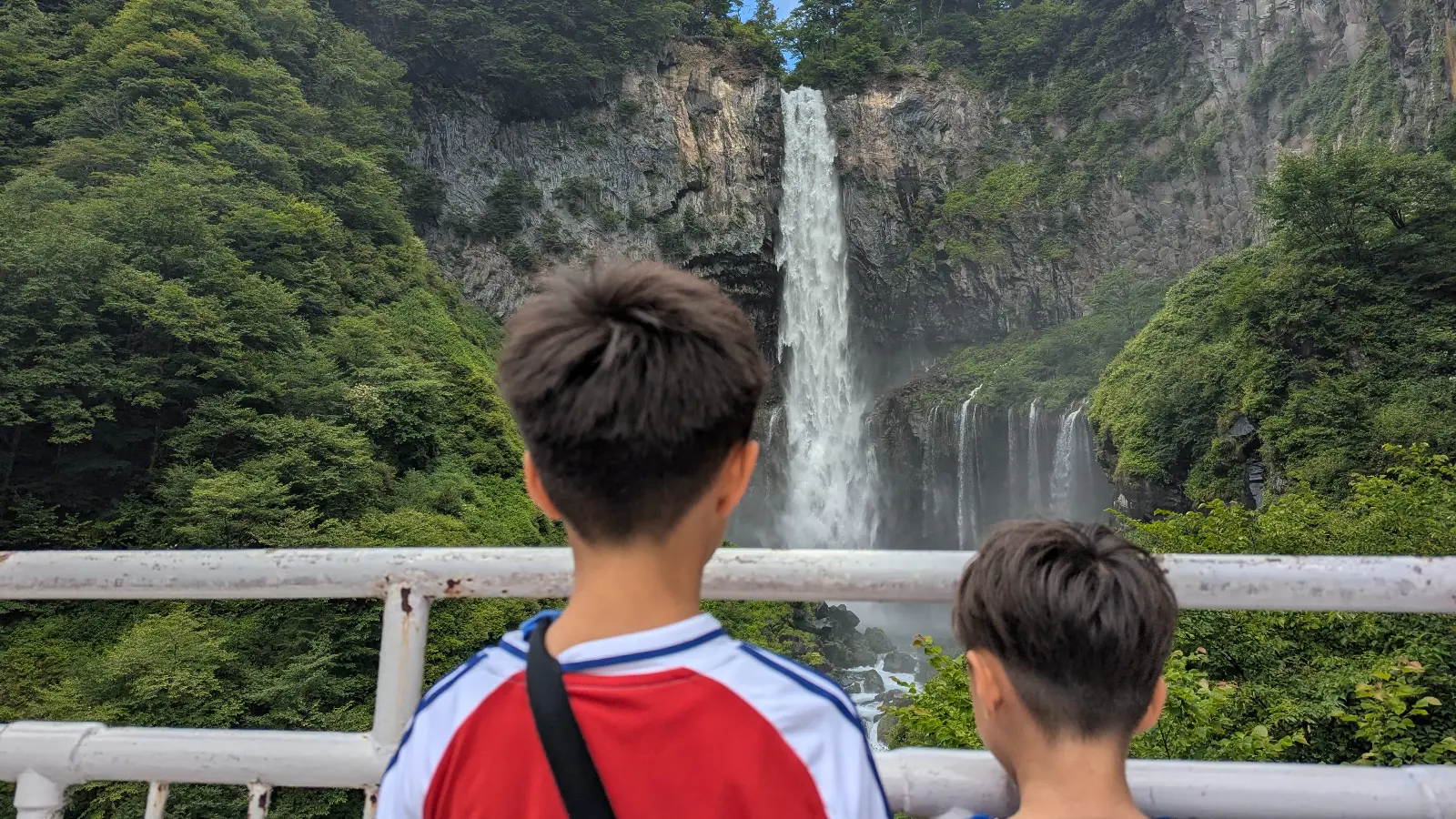
Two children stood at the same falls on the same visit and took entirely different things from them. For one, the drop was a problem to work out: where the water went, what it met at the bottom, and what that meeting would feel like. For the other, the falls were a sound to test and a ride to take, and the looking was finished quickly. Neither cared about the waterfall’s standing among the country’s great three. What separated them was not attention but what each of them did once the looking was over. One kept thinking at the railing for exactly as long as the question lasted. The other needed a next thing, and on a deck built for looking, the next thing had to be invented.
Luca did not react to the size of the falls the way the crowd around him did. He stood at the railing and worked it out instead, following the water all the way down to where it hits the rocks. If he were the water, he decided, it would probably hurt, falling that far and then smashing into the rocks at the bottom. The spectacle reached him as a problem to think through rather than a sight to gasp at.
This is the Sensor pattern, with an analytical hook. A child whose Reserve depletes through sensory input does not only absorb a scene; an observant one processes it, and here the processing surfaced as reasoning about force rather than recoil from scale. Families with a similar child can lean on engagement over shielding: hand over the height, the 97 meters, the physics of it. The signal to watch is the shift from processing to withdrawing, when the input has stopped being interesting.
Nico went straight for the elevator ride down and the noise waiting at the bottom. The lower platform gave him what the upper one could not, proximity and sound, and he pressed against the railing and shouted to test whether the water would drown him out. Once he had looked, he had looked: about ten minutes on the platform was his ceiling. After that he was on the railing and the coin telescopes, inventing something to do with his hands.
This is the Dynamo pattern in its clearest form. A child whose Reserve depletes through restricted movement can pour energy into a loud, close moment, which is why the ride and the shouting held Nico; but a platform gives that energy nowhere to go once the looking is done, and his ceiling arrived as invention. Families with a similar child should use sequence rather than suppression: the lower deck early and briefly, then open ground straight after.
A waterfall seen from a deck reached through the rock gives a child a lesson in the scale and power of nature, and in how people found ways to meet it up close. The sound and the sheer height fill the senses at once. That the flow is controlled, and changes through the year, adds a quieter lesson: even great natural forces are shaped by human decisions. A child who has stood before falling water, and understood a little of how it works, looks at every river differently afterward.
The LUNI Rating for Kegon Waterfall.
One fact drives all four verdicts: the whole visit is two decks with a machine between them. The free upper deck is a short walk from the bus stop. The elevator descends through the bedrock to an underground passage that stays cold even in midsummer, and beyond it to a deck near the level of the plunge pool, before bringing the family back up the way it came. That structure costs a child almost nothing in legs and almost nothing in uncertainty. What it does ask, twice over, is that a child who needs to move stand still and look.
Put the movement on both sides of it. The Dynamo depletes through restricted movement, and Kegon is built almost entirely from the things that restrict it. The visit is a short walk from the bus stop, a deck, a ride down in a shared elevator car, an underground passage, and a second deck below. Every stage after the walk in is a place to stand and look. None of it is hard and none of it is long, but a child whose Reserve drains when the body is held still has nothing here to spend movement on, and the drop itself is something to watch rather than something to do.
Sequence matters here, not duration. Walk in, ride down while the novelty is fresh, keep the lower deck brief, and come straight back up. Then take the open ground the falls sit beside: Lake Chuzenji is a short walk from the same bus stop. Hold the snack until the lakeshore, so the stop after the falls is movement rather than more standing.
What this means for your Dynamo: being held still is what this stop charges, and the bill is short. A younger Dynamo gets the ride and a few minutes on the lower deck; an older one can hold longer if the lake walk is promised next.Let the child choose the deck. The Sensor depletes through sensory input, and Kegon’s input comes from one natural source, a great fall of water, seen either from the free deck at the top in the open air or from a deck near the level of the plunge pool. The only enclosed stretch is the route to that lower deck, an elevator ride through the bedrock and then an underground passage that stays cold even in midsummer. That cold is the input most likely to surprise a child who was dressed for a summer day, and it arrives before the falls do, in the one place a family cannot simply step back from.
Offer choices, and prepare the child for each. Describe the passage and the cold before the doors open, and bring the layer. Then offer both decks: the upper one sees the falls from above, and a child who would rather skip the elevator loses the close view but not the falls. During the November light-up the free deck is lit after sunset and the ground is dark enough that flashlights are advised, so plan that evening as a separate visit.
What this means for your Sensor: sensory input is low and comes from one source. Start a younger Sensor on the upper deck, with the cold described first; an older one can take the lower deck once they know what the passage holds.Narrate the four steps before the bus. The Anchor depletes through unfamiliarity and unconfirmed structure, and Kegon’s structure can be stated in full before anyone leaves the hotel: a short walk from the Chuzenji Onsen stop, the free deck, an elevator ride down, the passage and the lower deck, then the same ride back up, on a ticket priced as a round trip. Nothing branches and nothing is timed. The elevator takes no reservations, first come, first served, which means there is no slot for a child to worry about missing.
The genuine unknown is the machine, not the falls. The elevator can stop without notice in bad weather, and a child promised the lower deck would meet a closed door. Name the fallback in advance: if the elevator is stopped, the free upper deck is the visit. Name the bus, too, because the ride up from the Nikko stations is long and slower in congestion, so the arrival time is a range rather than a promise.
What this means for your Anchor: unfamiliarity is small here and can be previewed in full. A younger Anchor needs the down-and-back sequence and the fallback said aloud; an older one can hold the elevator hours and choose the timing.Let the machine do the descent. The Sprinter depletes through sustained travel-style walking and standing, and Kegon asks for little of either. The falls are a short walk from the Chuzenji Onsen bus stop, and both parking lots sit within a few minutes of the elevator. The elevator then makes the descent and brings the family back up, so the height a child’s legs would otherwise have to pay for is covered by a machine, and the walking that is left is the walk in.
What remains is standing time on the decks, and it is the part to budget. A visit this short keeps it small, but it lands at the end of a long bus ride, so treat the lower deck as a short stop rather than an open-ended stay, and keep the rest of the legs for the afternoon. The snack and souvenir building about a minute from the elevator is the nearest place to regroup before the lake.
What this means for your Sprinter: walking and standing stay cheap because a machine carries the drop. A younger Sprinter needs only the short walk in; an older one reaches the lake afterward with most of the day’s legs intact.The questions parents actually ask.
The elevator is the visit at Kegon, and a family plans the stop around it. It is the only thing on the visit that costs money, it takes no reservations, it opens earlier in summer than in winter, and it can stop without notice in bad weather. Everything else follows from that one machine: the cold passage it arrives at, the lower deck near the plunge pool, and the free upper deck that stays open to anyone who does not ride. Settle the elevator first, and the rest of the stop, the lake, the bus back and any evening light-up, arranges itself around it.
Is Kegon Waterfall worth visiting with kids?
Yes, for most children with no conditions attached. The free upper deck is a short walk from the Chuzenji Onsen bus stop, and the paid elevator drops through the rock to a deck near the plunge pool and back. The child to plan around is one who needs to move: keep the decks brief and follow the falls with open ground at the lake.
How much is the Kegon Waterfall elevator?
The round trip is 600 yen for adults and 400 yen for elementary school children, and preschoolers ride free; junior high students pay the adult fare. Fares rose to these levels on September 1, 2024. The upper viewing deck costs nothing, and parking at either of the two lots near the elevator is 500 yen a car.
What are the Kegon Waterfall elevator hours?
8:00 to 17:00 from March 1 to November 30, and 9:00 to 16:30 from December through February, with the last ride 20 minutes before closing. It runs all year, but it can stop without notice in bad weather, so keep the free upper deck as the fallback and tell a child in advance that it is one.
Is the lower deck at Kegon Waterfall cold?
Yes. The elevator arrives at an underground passage that holds about 15 degrees even in midsummer, and the lower deck beyond it sits near the level of the plunge pool. Bring a layer in any season, and describe the cold to a young child before the doors open, because the drop in temperature surprises children more than the height does.
How tall is Kegon Waterfall?
About 97 meters from top to base, and about 7 meters wide. It is counted among Japan’s three great waterfalls, with Nachi and Fukuroda. The flow over it is regulated and changes through the year, so the falls a family meets may be fuller or thinner than the photographs, which is worth saying before a child arrives expecting a torrent.
Can you see Kegon Waterfall at night?
Only during the light-up. From November 14 to 23, 2026, the free upper deck is lit from sunset to 19:00, and the event can be called off for weather or wildlife. The ground around the deck is dark, so bring flashlights. The elevator stops at 17:00 in that season, so the lit view is from above only.
Can you see Kegon Waterfall and Toshogu in one day?
Yes, on one bus line. The Tobu bus from Nishisando Iriguchi, the stop nearest Nikko Toshogu Shrine, reaches Chuzenji Onsen in about 39 minutes. Do the shrine first, in the morning: its stairways spend a Sprinter’s walking and standing reserve, and Kegon asks for almost none, so fix the shrine’s turnaround at the Sleeping Cat before you arrive.
How does Kegon Waterfall compare to Yudaki Cascades for kids?
Kegon is the bigger, sheerer drop, seen from a free deck above or by a paid elevator to a deck near the plunge pool. Yudaki is lower and longer, seen from a deck in front of its plunge pool that is step-free from the parking lot, with no machine involved. The two are under half an hour apart by Tobu bus.
Where Kegon Waterfall fits your Japan trip.
Official site and opening information: Kegon Waterfall Elevator