Yudaki Cascades with Kids: An easy deck at the end of a long ride.
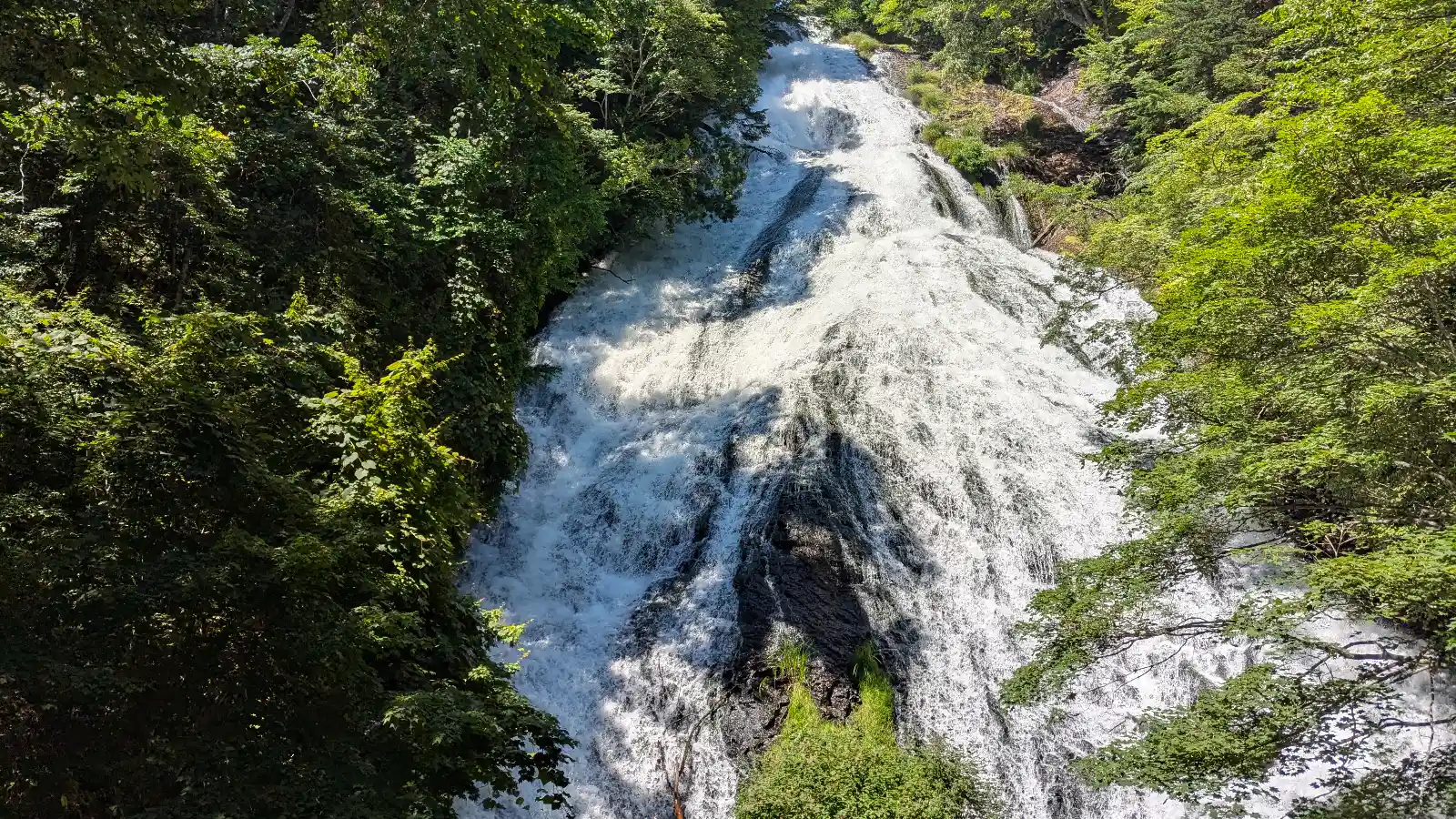
The trails that begin at the foot of the falls hand a child who needs to move a whole afternoon, and hand a child whose legs tire first a walk to refuse.
Nothing to book. By bus, Nikko to Yumoto Onsen is ¥1,950, and Yudaki Iriguchi is two stops before it.
The parking lot and its restroom close from early December to around April.
Deck only; the Yunoko loop is a longer walk beyond it.
The trails beyond the deck are where age and legs start to matter.
No steps between the parking lot and the viewing deck.
Some links on this page are affiliate links. LuNi may earn a commission at no extra cost to you.
Is Yudaki Cascades worth it with kids?
The short version, before the costs, the timings and the case for each child.
Yes, and the falls themselves are the easy part. Yudaki is a broad, long cascade at the south end of Lake Yunoko, high in Oku-Nikko, and the viewing deck sits right in front of its plunge pool, a few minutes’ walk from the bus stop and step-free from the parking lot. What costs a child is everything around that deck. It is a long bus ride up from Nikko, and the falls sit where the area’s walking routes begin and end, trails measured in hours rather than minutes. A child who needs to move will want those trails. A child whose legs tire first should see the falls and stop there, which is a perfectly good visit. Decide which of those two days you are having before the bus, and in winter expect less, because the restroom closes and parking is uncertain.
Planning Your Visit to Yudaki Cascades with Kids.
Three decisions come before the bus, and they matter more here than at most waterfalls because the falls themselves are so simple. The first is how to arrive. The Yumoto-bound bus from Nikko is a long ride to the Yudaki Iriguchi stop, then a short walk; by car there is a parking lot at the foot of the falls, step-free to the deck, and a second parking space near the top. The second is the season. In winter the restroom and the lakeside loop close and parking is uncertain, so a winter visit is a shorter and barer thing. The third is the trail. The falls sit where walking routes begin, and the family should decide at breakfast whether today is the deck alone, the loop around the lake above, or the long walk in across Senjogahara.
Every LuNi attraction guide starts with a visit, with our own children
LuNi rates and writes about attractions only after visiting them with children. Luca and Nico were at Yudaki Cascades, and what they did there is recorded further down this page, including how each child actually met it.
Children arrive with different tolerances: for noise, for lines, for standing still, for being on their feet all day. A guide written for the average of them helps almost nobody. So every place on this site is read four ways, and each verdict says which children it already suits and what makes it work for the rest. Whoever you are bringing, the answer here is built for your family rather than for a general reader.
Restricted-movement depletion stays low where walking routes begin at the falls, so keep the deck brief and let a trail carry the movement afterward.
Sensory-input depletion stays low with one open-air spectacle and a short approach, so arrive unhurried and keep the view from above as the gentler option.
Unfamiliarity and unconfirmed structure ease on a stop this short and legible, so name the plan, including the trail decision, before the family arrives.
Sustained walking and standing cost little at the falls and much around them, so treat the deck as the destination and settle the trails beforehand.
Hotels we would book for this visit.
Three lakeside bases on the Tobu line that runs on to the falls, in the order the bus reaches them from Nikko. The last of them is the nearest to Yudaki, worth weighing on a day spent mostly on the bus.
| Property | The LuNi Reason |
|---|---|
| LUNI Pick The Ritz-Carlton, Nikko On the lake, with its own bus stop | First of the three on the bus from Nikko and farthest from the falls, but the natural base for a day that also takes in Kegon and the lake. For a child who steadies on a known shape, a hotel with its own stop on the line turns a long day into one ride out and one ride back. |
| Hotel Shikisai Up a steep, unlit walk from its bus stop | Best for a family with a car, since the walk up from its bus stop is steep and unlit. The car is also what opens the second way to see Yudaki, from the parking space near the top, where a child who found the deck too much can watch the same water from above. |
| Chuzenji Kanaya Hotel On the lakeshore, the nearest of the three to the falls by bus | The nearest of the three to the falls along the bus line, which matters on a day whose real cost is the ride. For a child whose legs tire first, less time on the way up means more of the day’s walking left for the deck and the lakeshore, and the hotel has its own stop at the door. |
Nearby attractions, matched to your child.
Three pairings for what the falls leave over: tired legs with a sight still wanted, movement a deck could not absorb, and a child who needs the day in order. A child who wants play rather than scenery belongs at Edo Wonderland instead.
| Pairing | Why This Solves the After-Visit | For Your |
|---|---|---|
| LUNI Pick Kegon Waterfall Under half an hour down the Tobu line, then a short walk | Yudaki’s own walking is short, but the day around it is long, and Kegon Waterfall adds a second great waterfall without adding to it: an elevator does the whole descent to the lower deck. For a Sprinter, whose walking and standing reserve is already paying for the ride, it is the sight that costs nothing. | Sprinter |
| Lake Chuzenji Under half an hour down the Tobu line | A deck is a place to stand, and Lake Chuzenji is open shore on a scale a moving child cannot use up, a few minutes’ walk from the Chuzenji Onsen stop. Restricted-movement depletion is discharged by room rather than by another view, and the lake has room to spare. | Dynamo |
| Tobu World Square The Kinugawa side of Nikko | An open-air stop with no fixed order suits most children, but a child who needs the day ordered does better at Tobu World Square, where free guided tours set off at published times. Unfamiliarity and unconfirmed structure ease when somebody other than a parent announces what comes next. | Anchor |
Kegon Waterfall
Under half an hour down the Tobu line, then a short walk For YourSprinter
Lake Chuzenji
Under half an hour down the Tobu line For YourDynamo
Tobu World Square
The Kinugawa side of Nikko For YourAnchor
How two children actually met this attraction.
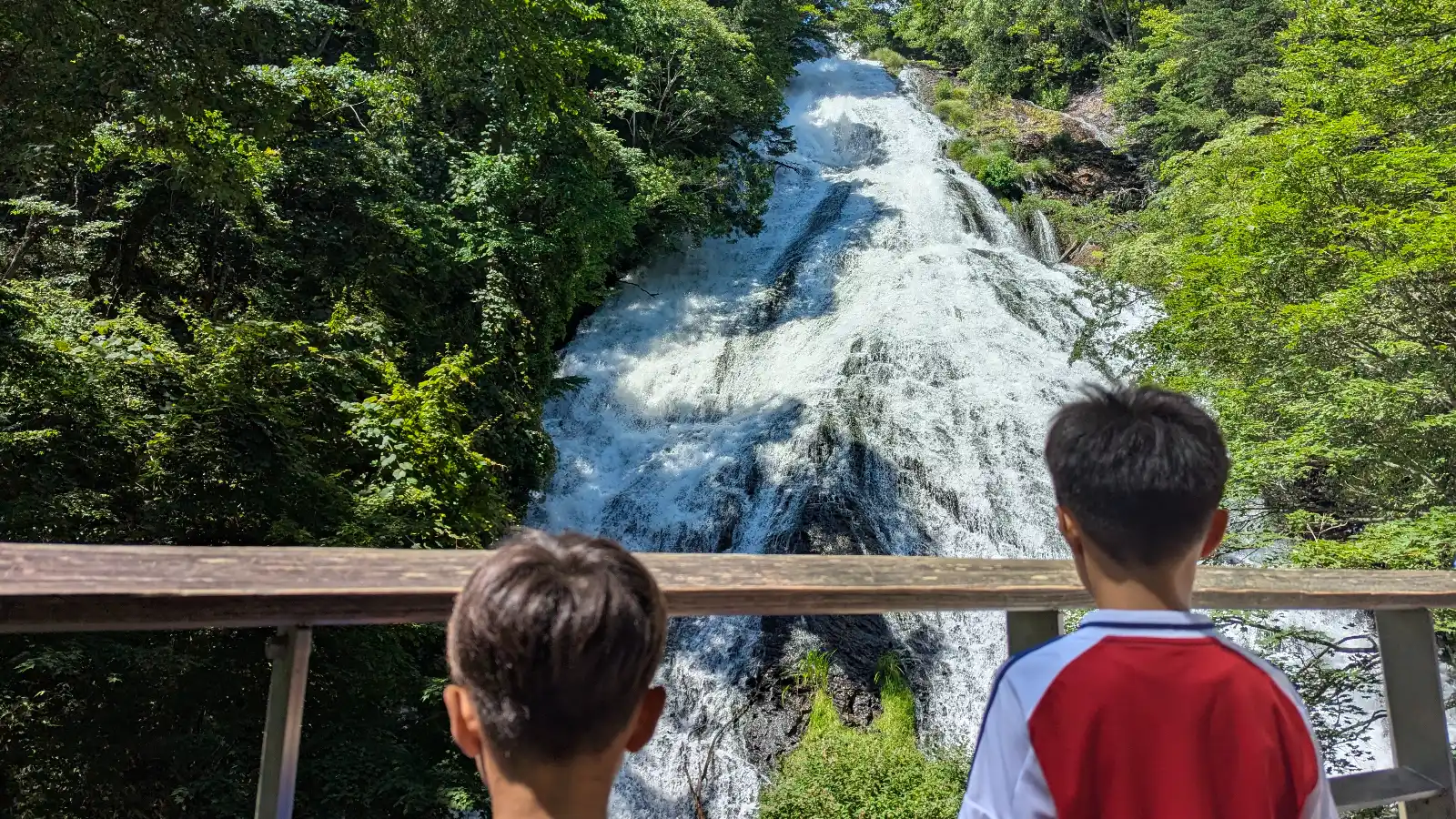
Two children reached the same deck and wanted two different kinds of nearness. One wanted the water itself, on his hands and his face, and went as close as the deck would let him. The other wanted a single good look, a verdict and then the path again, and had all three within minutes. Neither of them asked about the lava that made the falls or the lake above them. What they showed between them, without meaning to show anything, is how little a waterfall has to do to hold a child, and how differently two children spend the minutes once it has: one staying put for as long as the water held him, the other using the falls as a stop on a longer walk.
Luca wanted to get down to the bottom of the falls and feel the water on his hands and face. He was not content to watch from a distance: he worked his way to the closest point on the base deck, held out his palms to catch the spray, and stayed there, testing how the mist changed as he leaned in and back. The direct contact was the whole draw, on his own terms rather than described to him.
This is the Sensor pattern, seen from its friendly side. A child whose Reserve moves with sensory input is not only at risk from it; in the open air, the same sensitivity can become a pull toward an experience rather than a retreat from it. Families with a similar child should offer the encounter rather than impose it: let the child decide how close to go, and a waterfall becomes something they seek out instead of something that overwhelms them.
Nico took in the falls in a quick burst, decided the best thing about them was that the water split into two separate sections, and announced it before he was ready to move again. He was not built to stand and study: he clocked the split, said it was cool, and was straight back to moving along the pathways, keeping up a running commentary. His interest was immediate, and then his body needed the trail more than the railing.
This is the Dynamo pattern. A child whose Reserve depletes through restricted movement takes a spectacle in fast and then needs the body given a job, which is why the paths around a waterfall matter as much as the waterfall. Families with a similar child should front-load the visit into the morning, when the budget is highest, let a trail absorb the energy the viewpoint cannot, and read a quick look followed by motion as the profile working, not as a lack of interest.
A cascade running down a long slope of rock shows a child that water can move in many ways, and that the same falls feel different from below and from above. Hearing it roar at the foot, then watching it quietly from a lakeside path above, teaches a child that perspective changes experience. Children notice contrasts like these when they are given the time. A visit that offers two views of one waterfall is a gentle lesson that how we look at something shapes what we find in it.
The LUNI Rating for Yudaki Cascades.
One fact drives all four verdicts: the falls are the easy part of their own visit. The viewing deck sits right in front of the plunge pool, a short walk from the bus stop and step-free from the parking lot, and it takes in the whole cascade at once. Everything that costs a child sits around that deck instead: the long ride up from Nikko, the walking routes that begin and end at the falls, and the season, which closes the parking lot and the lakeside loop in winter. Three children meet an easy stop. The fourth meets an easy stop at the end of a hard day.
Use the falls as a trailhead, not a destination. The Dynamo depletes through restricted movement, and Yudaki is one of the rare sights where the movement is built into the place rather than bolted onto it. The deck itself is a place to stand, and a moving child will be finished with it quickly. But the falls sit on the area’s walking routes: a nearly flat loop around Lake Yunoko starts from the parking space at the top, and the long walk across Senjogahara begins or ends at the parking lot at the bottom. For a child who runs down when made to stand, that is the opposite of a viewing stop. It is a view that comes with somewhere to go.
Choose the walk before arriving rather than at the deck, where a child who wants to keep moving and a parent who wants to stop will meet head on. The lakeside loop is the right size for most families; the Senjogahara walk is a half day in its own right, and only for a child who has done long walks before. Both close in winter, and so does the parking lot.
What this means for your Dynamo: restricted movement is barely engaged when the falls come with trails. A younger Dynamo takes the deck briefly and runs part of the lakeside loop; an older one can take the whole loop, or the long walk in.Offer the deck, and the view from above. The Sensor depletes through sensory input, and a waterfall sounds like the wrong place for this child until you stand in front of one this open. The deck faces the plunge pool in the open air, reached by a short, step-free path from the parking lot, so a child arrives without having spent anything on the way in. What it delivers is intense but single: one broad fall of water, seen whole, with open sky around it and nothing else asking for attention at the same time.
A second viewpoint is the answer. From the parking space near the top, a nearly flat loop around Lake Yunoko passes above the falls, and from there the same water is further away and framed by the lake. A child who finds the deck too much has somewhere else to be, and one who loved it gets the same falls from a new angle. Describe the noise before the path, so that it arrives as something expected rather than something sprung.
What this means for your Sensor: sensory input is high at the deck but single and brief. Start a younger Sensor with the view from above; an older one can take the deck and decide for themselves how long to stay.Say the whole visit in one sentence. The Anchor depletes through unfamiliarity and unconfirmed structure, and Yudaki can be described completely before anyone leaves the hotel: off the bus, a few minutes’ walk, the deck, and back; or out of the car, a short step-free path, the deck, and back. Nothing is timed and nothing branches at the falls themselves. Even the long part of the day is long in a predictable way, because the bus follows one line past the lake and on toward Yumoto, and the stop two before the terminus is yours.
What an Anchor needs named is the decision the falls invite, not the falls. A family arriving without a plan meets two walking routes and a parent weighing them aloud, which is exactly the unconfirmed structure this child spends on. Settle it at breakfast, the deck and back, the lakeside loop or the long walk in, and say which. In winter, name the closures too, so that a shut parking lot or restroom arrives as information rather than as a surprise.
What this means for your Anchor: unfamiliarity stays low once the day’s one decision is made in advance. A younger Anchor needs the sequence said aloud; an older one can help choose the walk and then hold the plan.Treat the deck as the destination. The Sprinter depletes through sustained travel-style walking and standing, and at the falls themselves Yudaki asks for almost none of it: a few minutes on foot from the bus stop, or a short, step-free path from the parking lot. The difficulty is everything around the deck. The ride up from Nikko is long, so whatever walking the day holds happens at the far end of it, with no quick way home for a child who runs out early. And the falls sit where walking routes measured in hours begin and end, which means a tired child is standing at a trailhead, being invited to spend what they do not have.
Decide the walking before the bus, and keep it small. The deck and back is the Sprinter’s visit. If the family wants the view from above as well, drive to the parking space near the top rather than walking up, and take only as much of the nearly flat loop as the child wants, turning back at the first sign of tiredness. In winter, with the parking lot and its restroom closed, the day gets harder rather than easier.
What this means for your Sprinter: walking is cheap at the falls and expensive around them. A younger Sprinter does the deck and back; an older one can add part of the lakeside loop from the top if the ride up has not already spent them.The questions parents actually ask.
Yudaki is a trade: the falls are close, and everything else is far. The deck is a short walk from the bus stop and step-free from the parking lot, so the planning goes into the ride, the season and the trails. A small child reaches the deck within minutes of the car. The ride is long enough to shape the whole day. The season closes the restroom and the lakeside loop in winter and leaves parking uncertain. And the trails are a choice to make over breakfast rather than at the deck, with a child already tugging toward one. Settle those three, and the falls take care of themselves.
Is Yudaki Cascades worth visiting with kids?
Yes, and the falls are the easy part. The viewing deck faces the plunge pool, about five minutes on foot from the Yudaki Iriguchi bus stop and step-free from the parking lot. The harder part is the long ride up from Nikko and the trails that start here, so decide before the bus whether the day is the deck alone or a walk as well.
How do you get to Yudaki Cascades from Nikko Station?
Take the Yumoto-bound Tobu bus from JR or Tobu Nikko to Yudaki Iriguchi, two stops before the Yumoto Onsen terminus, about 80 minutes, then walk about five minutes. The fare to the terminus is 1,950 yen, and the published schedule runs April 1 to November 30. By car, parking is 500 yen, and the path to the deck is step-free.
Is Yudaki Cascades stroller-friendly?
The deck itself, yes: there is no step between the parking lot and the viewing deck. Beyond the deck the trails are another matter, and the long walk in from Senjogahara runs about 5 kilometers with a height difference of about 100 meters, so plan a stroller visit as parking lot, deck and back. The restroom at the parking lot closes in winter.
How long do you need at Yudaki Cascades?
Thirty minutes to an hour for the deck alone. The nearly flat loop around Lake Yunoko, from the parking space near the top, takes 1 to 1.5 hours for about 3 kilometers, and the Senjogahara walk from Akanuma takes 2.5 to 3 hours. Add the ride: about 80 minutes each way by bus from Nikko.
Can you visit Yudaki Cascades in winter?
With care. From early December to around April the parking lot is either closed or free until snow closes it, so plan winter parking as uncertain; the restroom there shuts for the season, and the Yunoko loop closes. The published Tobu bus schedule covers April 1 to November 30, so check winter service before planning. Expect a short, bare visit rather than a day out.
Can you see Yudaki Cascades from above?
Yes. A parking space near the top of the falls is a start point for the loop around Lake Yunoko, and from that loop the falls are seen from above. The loop is about 3 kilometers with a height difference of about a meter, so it suits a child who would find a climb too much, and it closes in winter.
Can you combine Yudaki Cascades with Toshogu in one day?
Yes, on one Tobu line, but it is a long day. The bus from Nishisando Iriguchi, the stop nearest Nikko Toshogu Shrine, reaches Yumoto Onsen in 71 minutes, with Yudaki Iriguchi two stops before. The shrine opens at 9:00, and its stairways spend a Sprinter’s walking and standing reserve, so set its turnaround at the Sleeping Cat.
What else is near Yudaki Cascades?
Kegon Waterfall and Lake Chuzenji are under half an hour back down the Tobu line, both a few minutes on foot from the Chuzenji Onsen stop, and the Senjogahara walking route ends at the falls. Which of those, and which of the region’s other stops, suit which child is set out in Nikko with kids.
Where Yudaki Cascades fits your Japan trip.
Official site and opening information: Yudaki Cascades, Nikko City Tourism Association