Lake Chuzenji with Kids: open shore, and a walk that adds up.
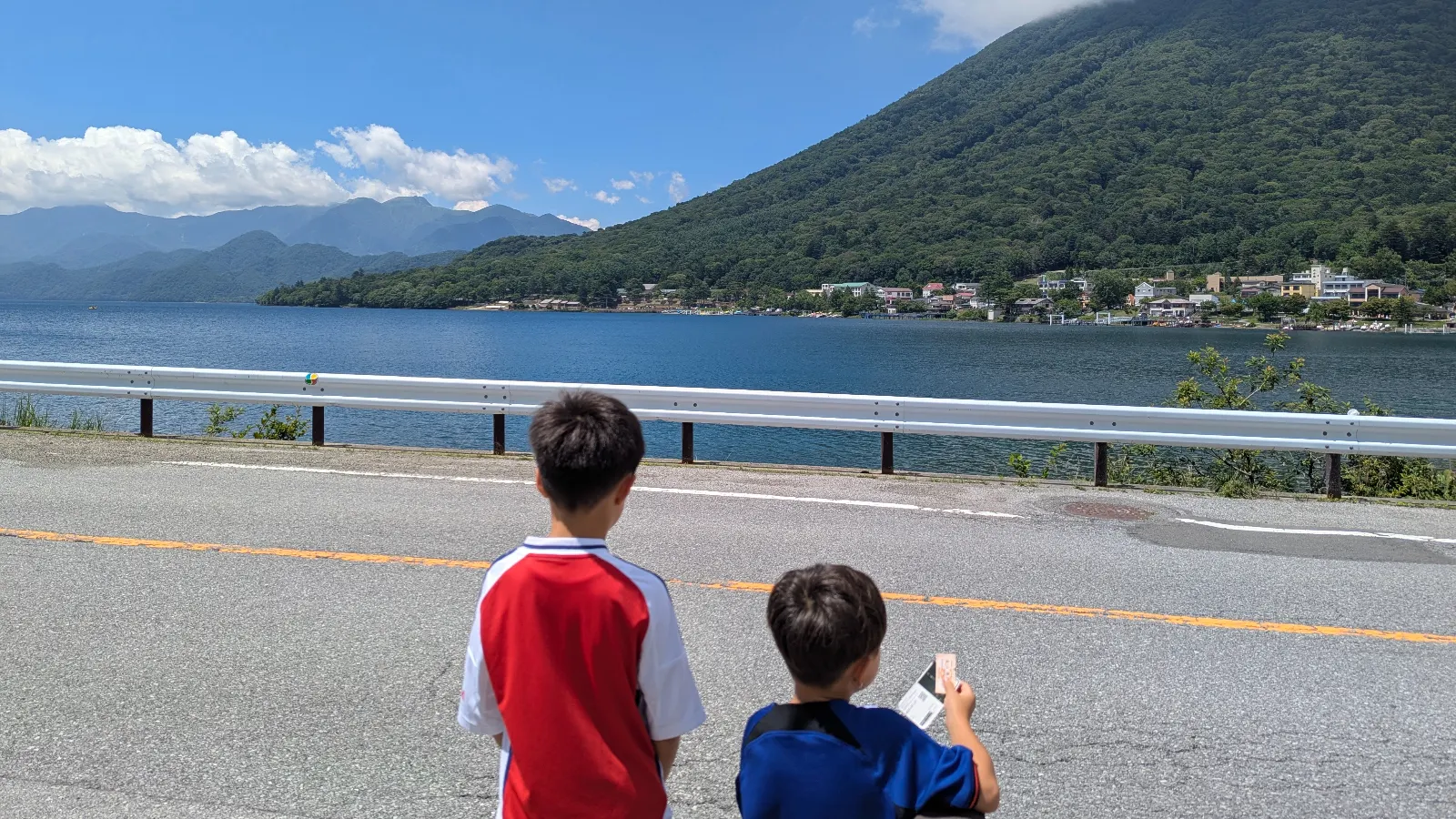
The same shoreline that gives a child who needs to move open air and no end of room gives a child whose legs tire first no natural place to stop.
JR or Tobu Nikko to Chuzenji Onsen; nothing to book for the lake. The Natural Science Museum by the stop is ¥510 adult, ¥260 child.
The shore keeps no hours; the boats rest from December 1 to mid-April and stop in strong wind or fog.
The cruise runs in season; the museum by the stop stands in when the boats do not.
The shore asks nothing of age; its 25 kilometers ask a great deal of legs.
Wheelchairs are lent free at the cruise boarding point.
Some links on this page are affiliate links. LuNi may earn a commission at no extra cost to you.
Is Lake Chuzenji worth it with kids?
The short version, before the costs, the timings and the case for each child.
Yes, for nearly every child, with a turnaround chosen in advance. Lake Chuzenji is a big mountain lake above Nikko, and it fills anything from a couple of hours to a whole day. A child who needs to move gets open air and room that nothing sequences. A child who needs to know what comes next gets a bus stop with named places a few minutes’ walk from it: the shore, Kegon Waterfall and a natural science museum. The child it costs is the one whose legs tire first, because a shore that long has no natural end, and the seated cruise that would break it up sails only from mid-April to November. Decide where the walk stops, and check the cruise on the morning before relying on it.
Planning Your Visit to Lake Chuzenji with Kids.
Three decisions shape a lake day, and the first is the calendar. The sightseeing cruise does not sail at all in winter, and even in season it is called off in strong wind or fog, so treat it as something to confirm on the morning rather than the spine of the plan. The second is the bus stop. Get off at Chuzenji Onsen and the shore, Kegon Waterfall and the Natural Science Museum are all a few minutes’ walk away, while the cruise boards from a stop of its own, Funenoeki Chuzenji, further along the line. The third is the turnaround. Choose where the walk ends before anyone starts it, and make it something the child can see from the stop, the falls or the museum, rather than a distance along the water.
Every LuNi attraction guide starts with a visit, with our own children
LuNi rates and writes about attractions only after visiting them with children. Luca and Nico were at Lake Chuzenji, and what they did there is recorded further down this page, including how each child actually met it.
Children arrive with different tolerances: for noise, for lines, for standing still, for being on their feet all day. A guide written for the average of them helps almost nobody. So every place on this site is read four ways, and each verdict says which children it already suits and what makes it work for the rest. Whoever you are bringing, the answer here is built for your family rather than for a general reader.
Restricted-movement depletion stays low where open air and a long shore impose no sequence, so let the child set the route and choose the turnaround together.
Sensory-input depletion stays low in open mountain air, with input spread across a wide shore, so the only planning is which stretch and an unhurried arrival.
Unfamiliarity and unconfirmed structure ease around one bus stop with named places a short walk apart, so name them first and check the cruise that morning.
Sustained walking and standing accumulate on a shore with no natural end, so fix the turnaround at Kegon or the museum before anyone sets out.
Hotels we would book for this visit.
Three lakeside bases, set out by their stops on the Tobu line, because a lake day is best begun here rather than after the ride up. A family centered on Tobu World Square sleeps at Kinugawa and comes up for the day.
| Property | The LuNi Reason |
|---|---|
| LUNI Pick The Ritz-Carlton, Nikko On the lake, with its own bus stop | A lake base takes the long bus climb off both ends of the day, and for a child whose legs are the scarce currency that is the saving that counts: the walking budget goes on the shore, not on bus stops. The hotel’s own stop puts Chuzenji Onsen, Kegon and the museum one ride away. |
| Hotel Shikisai Up a steep, unlit walk from its bus stop | Between the other two on the bus line, and best reached by car, since the walk up from the stop is steep and unlit. For a child who needs the evening confirmed, arrive before dark and walk the route from the stop once, so that the next morning’s walk down is already known. |
| Chuzenji Kanaya Hotel On the lakeshore, with its own bus stop | For a child who discharges movement outdoors, the lake is the first thing outside the door, before breakfast and after dinner, with no bus in between. It is also the nearest of the three to Yudaki, further along the same line, for a family whose next morning is the falls. |
Nearby attractions, matched to your child.
Three pairings for what an open shore leaves unsolved: tired legs with a sight still owed, movement that wants a shape, and a child who needs the day named in order. All three sit on the same Tobu line as the lake.
| Pairing | Why This Solves the After-Visit | For Your |
|---|---|---|
| LUNI Pick Kegon Waterfall A short walk from the Chuzenji Onsen stop | After a shore that invites more walking than the legs hold, Kegon Waterfall is a short walk from the same stop, and an elevator does the whole descent to the lower deck. A Sprinter’s walking and standing reserve gets a headline sight for almost no further cost, and the day ends on a high. | Sprinter |
| Yudaki Cascades Under half an hour up the Tobu line | The lake’s shore has no set end; the loop above Yudaki Cascades does, a nearly flat loop around Lake Yunoko that comes back to where it started. Restricted-movement depletion discharges well on a walk with a shape and a finish, and a moving child can take this one at a run. | Dynamo |
| Nikko Toshogu Shrine About half an hour down the same Tobu line | For a child who steadied on named places, Nikko Toshogu Shrine lists the buildings its ticket covers, gate to Okumiya. That suits the Anchor, but its stairways spend a Sprinter’s walking and standing reserve fast, so fix the turnaround at the Sleeping Cat before the gate. | Anchor |
Kegon Waterfall
A short walk from the Chuzenji Onsen stop For YourSprinter
Yudaki Cascades
Under half an hour up the Tobu line For YourDynamo
Nikko Toshogu Shrine
About half an hour down the same Tobu line For YourAnchor
How two children actually met this attraction.
Two children arrived at the same shore and asked it for opposite things. One wanted to understand the lake before he would walk around it, and walked readily once a walk had a reason and a named end. The other wanted the water itself, within arm’s reach, and was at his best in the first hour, before the walking began to add up. Neither was interested in the view the lake is usually photographed for. Between them they found the two edges of a lake day: the purpose a walk needs before one kind of child will start it, and the distance a walk costs before another kind of child is finished with it. Both edges showed up early, and neither needed the whole shore to show itself.
Luca wanted to understand the lake before he would walk around it. His first question was how a body of water this size sits this high in the mountains, and the answer landed as genuinely satisfying. From there he walked readily, but only with a stated destination: the promenade meant something when it led to the falls or a viewpoint. Left open-ended, he wanted to know the point first.
This is the Anchor pattern with an analytical hook. A child whose Reserve depletes through unfamiliarity and unconfirmed structure settles fastest when the shape and purpose of a thing are known in advance, and an open lake supplies neither until someone frames it. Families with a similar child should lead with information: name the purpose of each walk before it starts, give every walk a named endpoint, and a shoreline that would read as aimless becomes a sequence the child commits to.
Nico was happiest the moment he reached the water’s edge. He threw stones to see how far they would skip, crouched to test how cold the lake actually was, and climbed whatever the shoreline offered, content as long as the water was within arm’s reach. What thinned him out was open walking with no object at the end: on the longer promenade stretches his commentary trailed off. His best window was clearly the first hour.
This is the Sprinter pattern. A child whose Reserve depletes through sustained walking and standing, and whose stamina runs highest early, does best in short active bursts tied to a base rather than in long open walks. Families with a similar child should sequence the day: front-load the shore into the first hour, keep the play close to a point where the child can stop, and make the seated part of the day real rest, so the legs never end the day before the interest does.
A mountain lake with an open shore gives a child room to run, wander or simply watch the water, and that unstructured time outdoors restores a child in a way no attraction can. The scale of the lake and the mountains around it offers a gentle sense of wonder. Children rarely need a program on a day like this; they need space and permission to explore. A day at the water’s edge teaches a family that some of the best hours of a trip are the ones with nothing planned but fresh air.
The LUNI Rating for Lake Chuzenji.
One fact drives all four verdicts: the lake is open, and almost everything a family does here starts at a single bus stop. From Chuzenji Onsen the shore, Kegon Waterfall and the Natural Science Museum are all a few minutes’ walk away, which is as much structure as a lake day ever needs. Beyond that the shoreline runs on for kilometers with nothing to say where a walk should end, and the one seated leg, the cruise, does not sail in winter and is called off in wind or fog. Open space suits three children outright. The fourth pays for it in distance.
Let the shore carry the movement. The Dynamo depletes through restricted movement, and the lake restricts very little of what a child’s body wants to do. It is open mountain air with a shoreline that runs on for kilometers, a short walk from the bus stop, and no part of a lake day has to be spent in a seat, a line or a sequence somebody else has set. The one seated element, the cruise, is optional and seasonal. Where most sights ask a moving child to hold still in front of something, this one asks only that the family decide how far to go, which is a question a Dynamo is glad to be asked.
Give the movement a shape without shrinking it. Name a destination along the shore rather than a distance, walk there at the child’s pace, and let the return be the second half of the same outing. If the day needs a harder outlet, the nearly flat loop around Lake Yunoko above Yudaki is a short ride up the same bus line, and a moving child can run most of it.
What this means for your Dynamo: restricted movement is barely a cost here. A younger Dynamo needs a named spot on the shore to race toward; an older one can take the Yunoko loop as the day’s real distance and still have the lake after it.Choose the stretch, not the lake. The Sensor depletes through sensory input, and an open lake spreads what input there is across a very wide space. The air is mountain air, the view runs out across water, and the only enclosed parts of the day are the ones a family chooses: the bus up, the Natural Science Museum beside the stop, and the cruise when it is sailing. The scale is large, but none of it arrives at close range, and none of it arrives all at once.
It is the ride that needs planning, not the lake. The bus is the one input a family cannot choose around: a long, winding ride each way from the Nikko stations, and slower in congestion. Leave with time to spare, sit the child by a window, and let the first stretch at the water carry no plan at all, so the day at the lake begins with the open air rather than with the next destination.
What this means for your Sensor: sensory input is spread thin across open water. A younger Sensor needs an unhurried arrival and a first stretch of shore with nothing scheduled; an older one can pick the stretches and the museum to suit themselves.Build the day around one bus stop. The Anchor depletes through unfamiliarity and unconfirmed structure, and an open lake is, on its face, the kind of shapelessness that costs this child. What answers it is geography. Almost everything a lake day holds starts from the Chuzenji Onsen stop: the shore, Kegon Waterfall and the Natural Science Museum are each a few minutes’ walk from it. The day can be named in full as three short walks from one point, and a child who needs the shape confirmed before spending anything in it can hold that.
The one part of the plan that can fail is the cruise. It does not sail in winter, is called off in strong wind or fog, and boards at its own stop, Funenoeki Chuzenji, so promise it only after checking on the day, and name the museum as the fallback in the same sentence. And hand over the plan before the questions start: three named places from one stop, and the cruise only if it is running.
What this means for your Anchor: unfamiliarity eases once the day is three named walks from one stop. A younger Anchor needs the cruise fallback said before the bus; an older one can check the cruise and choose the order.Choose the turnaround before the first step. The Sprinter depletes through sustained travel-style walking and standing, and the lake hides its cost inside its generosity. The shoreline runs on for kilometers with nothing to say where a walk should end, so a walk tends to end when the child does rather than when the path does, and every step out is a step to be walked back. Add the long bus ride at each end, and a lake day is hard on the legs even though nothing in it is steep.
Pick a destination close to the stop. Kegon Waterfall is about five minutes on foot from Chuzenji Onsen and its elevator does the descent; the Natural Science Museum is beside the stop itself. Either makes a turnaround a child can see. In season the cruise is the day’s seated leg, boarding at Funenoeki Chuzenji, where wheelchairs are lent free. In winter it does not sail, and the day has to find its rest elsewhere.
What this means for your Sprinter: walking accumulates here without a natural stop. A younger Sprinter turns at Kegon or the museum; an older one can go further along the shore if the turnaround was fixed before setting out.The questions parents actually ask.
One seasonal fact and one geographic one decide most of a day at Lake Chuzenji. The seasonal fact is the cruise: it stops completely in winter, and even in season it gives way to strong wind or fog. The geographic fact is the Chuzenji Onsen bus stop, with the shore, Kegon Waterfall and the Natural Science Museum all a few minutes’ walk from it, which means a lake day can be planned as a set of short outings from one place. Plan the day around the stop, confirm the cruise on the morning, and most of what follows falls into place from those two.
Is Lake Chuzenji worth visiting with kids?
Yes, for nearly every child, as long as the walk has an end chosen in advance. The shore is about five minutes on foot from the Chuzenji Onsen bus stop, 48 minutes from the Nikko stations, with Kegon Waterfall and the Natural Science Museum just as close. A child whose legs tire first should turn at one of those rather than follow the shore.
When does the Lake Chuzenji cruise run?
From mid-April to November 30. It does not run from December 1 to mid-April, it is called off in strong wind or fog, and it can be suspended on other irregular days, with the route changing when the water is low. It boards at the Funenoeki Chuzenji bus stop, about 55 minutes from the Nikko stations. Check on the morning before promising it.
How do you get to Lake Chuzenji from Nikko?
By Tobu bus from JR or Tobu Nikko to Chuzenji Onsen, about 48 minutes for 1,250 yen, with delays in congestion; the shore is about five minutes on foot from the stop. For the cruise, stay on to Funenoeki Chuzenji, about 55 minutes from the stations. From October 1 to November 8, 2026, a seasonal bus runs from Chuzenji Onsen to the cruise pier.
Is Lake Chuzenji good for young children who tire easily?
Yes, if the day is built around the bus stop rather than the shoreline. Kegon Waterfall is about five minutes on foot from Chuzenji Onsen and its elevator does the descent, and the Natural Science Museum is beside the stop. The cruise is the seated option in season. What costs a tired child is walking the shore with no turnaround fixed.
Is Lake Chuzenji wheelchair or stroller accessible?
The cruise is the easiest part. Wheelchairs are lent free at the Funenoeki Chuzenji boarding point, and the vessel Nantai has wheelchair seating. For the shore itself, plan short stretches out from the bus stop and back, and keep the Natural Science Museum and the cruise as the day’s main stops rather than a long push along the water.
What is there to do at Lake Chuzenji in winter?
Less, because the cruise does not run from December 1 to mid-April. The Natural Science Museum beside the Chuzenji Onsen stop stays open, 10:00 to 16:00 from November 11 to March 31, closed Mondays from December to April and December 29 to January 3, and the Kegon elevator runs 9:00 to 16:30 in winter. Build a shorter day around both.
Can you visit Ashio from Lake Chuzenji?
Yes, by car. The Ritz-Carlton on the lake and the Ashio Copper Mine Museum each sit about 20 minutes from Kiyotaki IC, so the mine is a realistic half day from the lake. Its trolley goes one way only, about 150 meters in, and the rest of the visit, about 300 meters, is on foot.
What else is there to do near Lake Chuzenji with kids?
Kegon Waterfall is about five minutes on foot from the Chuzenji Onsen stop, the Natural Science Museum sits beside it, at 510 yen for adults and 260 for children, and Yudaki Cascades is under 27 minutes up the same bus line. How those fit with the rest of the region, child by child, is set out in Nikko with kids.
Where Lake Chuzenji fits your Japan trip.
Official site and opening information: Lake Chuzenji, Nikko City Tourism Association