SCMaglev and Railway Park with Kids: Trains to Board, and to Drive.
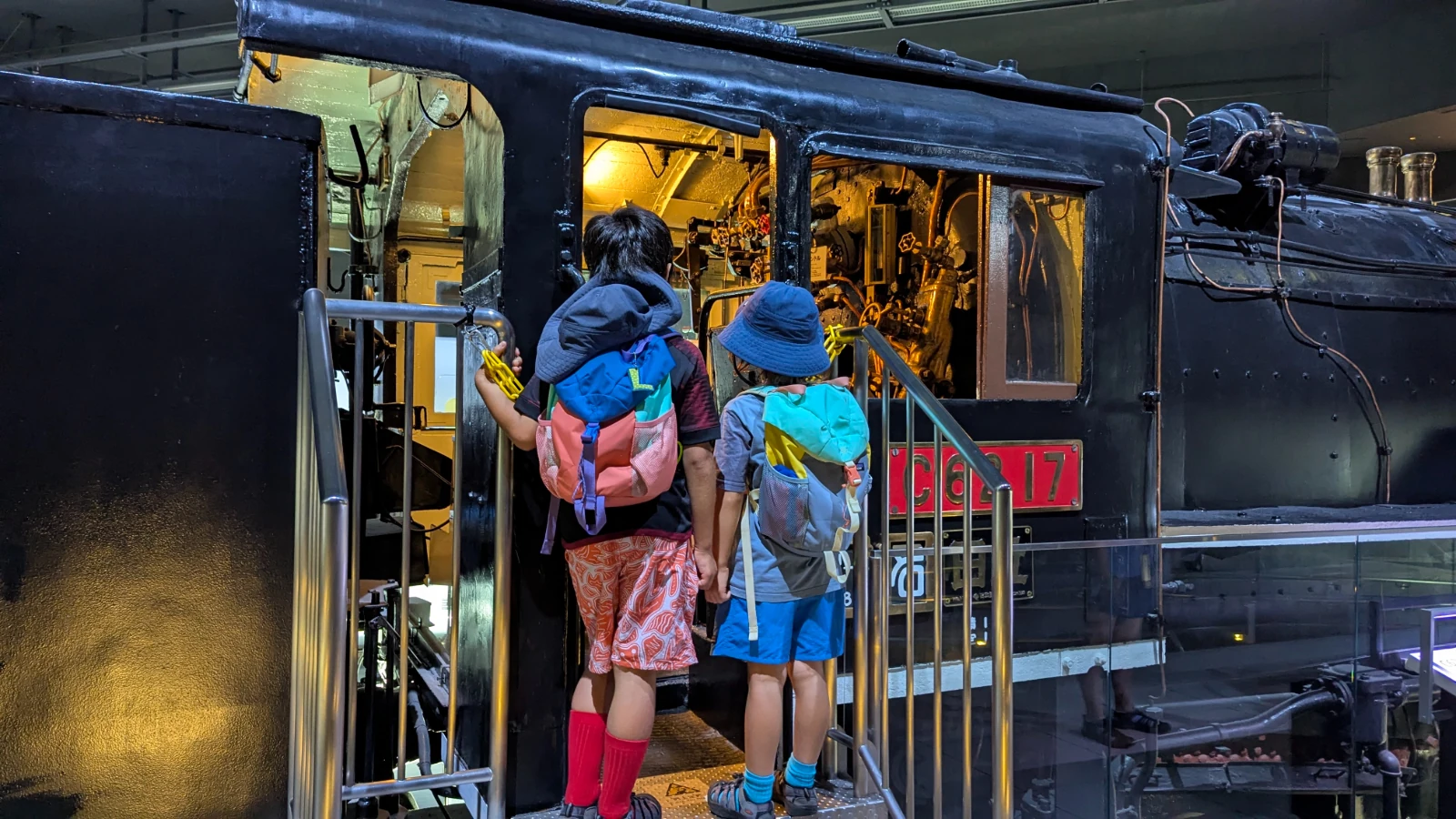
Thirty-nine real trains to see and touch, some of them open to board, a maglev that set a world record, and driving simulators that can sell out on a busy day.
Age 3 to preschool ¥200. Dated online tickets with a QR code skip the counter.
Last entry 17:00. Closed Tuesdays (the next day after a holiday) and December 28 to January 1.
The driving simulators run about 10 to 15 minutes each.
A parent stays with the child at the exhibits throughout.
A few strollers on loan at the entrance desk, on conditions; own strollers need a belt and wheel lock, up to 1,000 mm wide.
Some links on this page are affiliate links. LuNi may earn a commission at no extra cost to you.
Is SCMaglev and Railway Park worth it with kids?
The short version, before the costs, the timings and the case for each child.
Yes, and for a child who loves trains it is a first-choice stop in Nagoya. The museum belongs to Central Japan Railway, the company that runs the shinkansen through Nagoya, and it shows the real thing: 39 full-size vehicles, from a steam locomotive to the maglev that set a world speed record, many of them there to be boarded rather than admired from a rope. The simulators are the other draw, a chance to drive a train, and they are limited, so the morning matters. The one adjustment for an active child is the rule against running. The hall is made for walking slowly between trains, and a parent stays close throughout, which suits some children better than others.
Planning Your Visit to SCMaglev and Railway Park with Kids.
Two decisions shape the visit, and the first is about time of day. If a simulator is the goal, arrive at opening and buy that ticket before anything else, because the popular ones sell out and a family arriving after lunch may find none left. The second is tickets: dated online tickets skip the counter entirely, which saves the first wait of the day. Lunch can be part of the visit, since an ekiben shop on site sells the boxed lunches of Japan’s railway stations. And the ride out is its own small event, 24 minutes on the Aonami Line, which Japan’s trains with small children prepares a family for. Let the child hold the ticket, and tell the child the two house rules on the way, no running and a parent always close, so the first minutes inside go smoothly.
Every LuNi attraction guide starts with a visit, with our own children
LuNi rates and writes about attractions only after visiting them with children. Luca and Nico were at SCMaglev and Railway Park, and what they did there is recorded further down this page, including how each child actually met it.
Children arrive with different tolerances: for noise, for lines, for standing still, for being on their feet all day. A guide written for the average of them helps almost nobody. So every place on this site is read four ways, and each verdict says which children it already suits and what makes it work for the rest. Whoever you are bringing, the answer here is built for your family rather than for a general reader.
Restricted-movement depletion eases when a child can climb aboard real trains and drive a simulator, so plan the hall as a route between cabs.
Sensory-input depletion stays moderate among indoor trains that stand still the whole visit, so let the child set the pace and the distance.
Unfamiliarity and unconfirmed structure ease with fixed hours, an English audio guide and trains the child knows, so preview the vehicles at home.
Sustained walking and standing build across all 39 full-size vehicles, the diorama and the simulator lines, so decide the stopping point before arriving.
Hotels we would book for this visit.
Three hotels for a family making Kinjo-futo a day out: one at Kinjo-futo itself, one on the same Aonami Line as the museum’s station, and one above Nagoya Station, where that line begins. Each puts the simulator desk within one ride of breakfast.
| Property | The LuNi Reason |
|---|---|
| LUNI Pick Nagoya Prince Hotel Sky Tower Sasashima Live Station, Aonami Line, 2 min | Sasashima Live is on the Aonami Line, the same line as Kinjo-futo, so the morning ride to the museum involves no change of trains, which matters when the aim is to be first at the simulator desk. The rooms all start at the 32nd floor, and the largest corner rooms, near 80 square meters, take a family of four. |
| Nagoya Marriott Associa Hotel Above JR Nagoya Station | Built above Nagoya Station, where the Aonami Line starts, so the museum is a single ride away and the shinkansen leaves from the same station for the next city. Family Triple and Family Fourth rooms sleep three and up to five, and a Japanese-style room of 101 square meters takes five as well. |
| LEGOLAND Japan Hotel About 10 min on foot | The LEGOLAND Japan Hotel stands at Kinjo-futo itself, the museum’s own station district, so a family can reach the simulator desk at opening without a train at all. Children under two share a parent’s bed, one per room, and cribs can be borrowed, which suits a family traveling with a baby as well as a train-minded older child. |
Nearby attractions, matched to your child.
Three more days out from Kinjo-futo: an outdoor park at the same station with a sensory rating for every ride, the castle’s settled route in the city, or open parkland to the east at Ghibli Park.
| Pairing | Why This Solves the After-Visit | For Your |
|---|---|---|
| LUNI Pick LEGOLAND Japan Kinjo-futo Station, the same station | At the same station, LEGOLAND Japan rates every attraction for sound, sight and touch and keeps a cool-down room for a child who needs a break. Sensory-input depletion stays manageable when the loud rides are known in advance and a quiet room waits. Check the ratings on the ride out. | Sensor |
| Nagoya Castle Nagoyajo Station, exit 7, 5 minutes on foot | About 15 minutes by subway from Nagoya Station, Nagoya Castle keeps fixed hours, a canteen for noodles and a picnic plaza, and its closed keep can be explained before the day. Unfamiliarity and unconfirmed structure ease where the whole route is known in advance. Name the palace as the goal. | Anchor |
| Ghibli Park Linimo, Ai-Chikyuhaku Kinen Koen Station | On the Linimo east of the city, Ghibli Park spaces its areas across open parkland, and keeps three play spaces for children of elementary age and under. After a walk among the trains, restricted movement gets ground to cover. Tickets are sold by reservation only. | Dynamo |
LEGOLAND Japan
Kinjo-futo Station, the same station For YourSensor
Nagoya Castle
Nagoyajo Station, exit 7, 5 minutes on foot For YourAnchor
Ghibli Park
Linimo, Ai-Chikyuhaku Kinen Koen Station For YourDynamo
How two children actually met this attraction.
Two children went through the same museum of trains and both named driving one, which is the part of the museum to plan around. One came for the numbers, how the maglev works and how fast it could go, and also wanted to drive. The other simply went aboard every train he could reach and finished in the driver’s seat as well. For a family, the lesson is that the vehicles hold a child’s interest for a long stretch and the simulators finish the visit well, and the simulators are the part that runs out. Go early, buy the simulator tickets first, and then let the child work through the hall at his own pace, knowing the best part is already secured and waiting for him at the end of the visit.
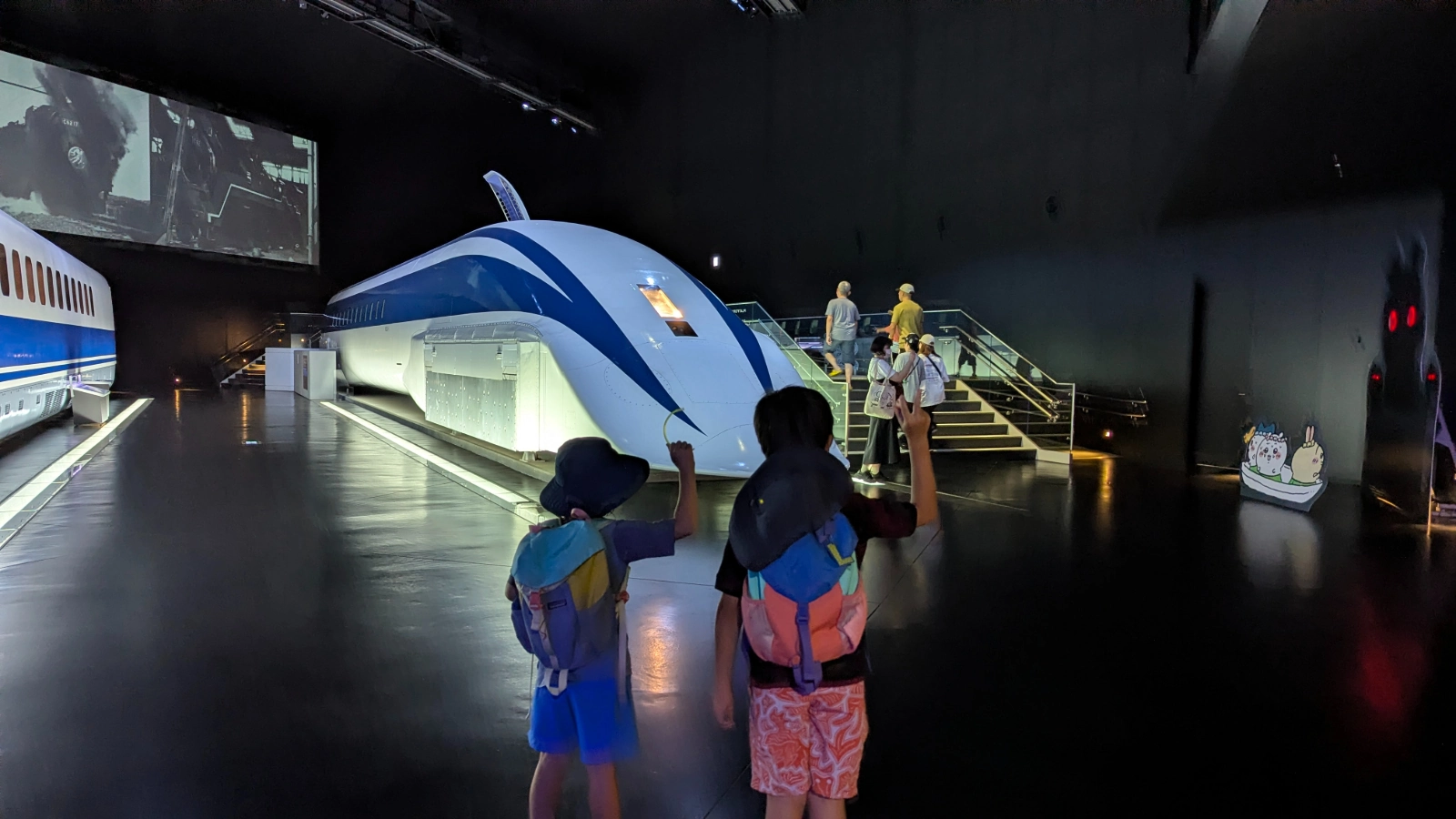
Luca liked learning about the maglev and seeing how fast it could go, and the park keeps the MLX01-1, one of its three record-setting vehicles, on the floor to show it. He also liked being able to drive the train himself on a simulator. The museum holds both for a child like him: the record setters for the facts about speed, and the driving simulators for the controls in his own hands.
This is the Anchor pattern. A child whose reserve depletes through unfamiliarity and unconfirmed structure settles by understanding how a thing works and where it ranks, and a train that holds a speed record gives him a fact to hold on to. Families with a similar child should look up the maglev’s story before the visit and give him the numbers to check on the spot, then let the simulator turn what he has learned into something he does with his own hands.
Nico enjoyed going on all the trains, and with 39 real vehicles on display that is a long list to work through. He went from train to train and then drove one on a simulator. Some of the vehicles are open to board, so for a child like him the museum is a set of doors to go through rather than a gallery to walk past, and the simulator turns the riding into driving.
This is the Dynamo pattern, in a child whose reserve depletes through restricted movement: he understands a train by getting into it, and a hall where boarding is allowed turns looking into climbing in and out. Families with a similar child should treat the vehicles as a route, one door after another, rather than a gallery, keep the no-running rule clear before the doors open, and save the simulator for last as the part he gets to do himself, the reward at the end of the route.
Standing beside a real locomotive, or a maglev that once set a record, shows a child that the machines in their picture books were built by people and actually ran. Seeing a train at full size, and climbing into its cab, turns an interest into something solid. Children who love trains often love them for their order, their power and their promise of going somewhere. A museum like this honors that love, and can grow it into a lasting curiosity about how people solve hard problems.
The LUNI Rating for SCMaglev and Railway Park.
One fact sits under all four verdicts: this is a museum of real trains a child can board, with simulators to drive and a firm set of house rules. The child who needs to move gets doors and cabs; the child who needs structure gets fixed hours and an English audio guide; the child sensitive to input gets vehicles that stand still indoors, to look at from whatever distance suits him. The Sprinter pays the most, because 39 full-size vehicles make a long walk and the simulators add lines. Among Japan’s museums for children few give a child quite so much to climb aboard.
Board, then drive. The Dynamo depletes through restricted movement, and most museums ask this child to stand and look. SCMaglev and Railway Park asks him to climb aboard: its real vehicles are there to be seen and touched, and some to be boarded, and the paid simulators put him at the controls. The one limit is the house rule against running and making noise, and a parent must stay with the child at the exhibits, so the energy goes into doors and steps rather than open floor. That is enough for this child, provided the rule is clear before the doors open.
Treat the hall as a sequence of trains to visit rather than a room to cross. Let the child choose the next vehicle, climb into the ones open to board, sit, and climb out, and keep moving at a walk. Buy a simulator ticket early and save the turn for when attention starts to fade, because driving is the one thing in the museum he gets to do himself. A kids corner is part of the floor plan too, for the moment the trains stop working.
What this means for your Dynamo: SCMaglev and Railway Park gives restricted movement doors and cabs to climb into. A younger Dynamo needs the rule against running said twice; an older one can take the simulator as the goal of the visit.Let the trains stand still. The Sensor depletes through sensory input, and the strength here is the format: indoor halls of vehicles that do not move, where a child can look as long as he likes and step back whenever he needs to. The large diorama runs through a full day and night in miniature, and the maglev room has a small theater with a ride simulation, both of which a child can choose or skip. This verdict is a judgment on the format, since no noise reading exists for the hall.
Leave the choices with the child. Walk the hall at his pace, describe the theater before offering it, and let the diorama be a place to sit and watch rather than a crowd to join. The house rule against making noise works in a Sensor’s favor, and it keeps the hall from turning into a play space. If the museum is busy at opening, visit the simulator desk first and then find a quieter corner of the hall.
What this means for your Sensor: at SCMaglev and Railway Park sensory input stays among standing trains indoors. A younger Sensor needs the theater described first; an older one can choose it himself.Preview the three record trains. The Anchor depletes through unfamiliarity and unconfirmed structure, and a railway museum starts with an advantage: trains are a subject most children know before they arrive. The museum adds firm structure around it, with fixed hours, a published rule for strollers, an audio guide in eight languages, English among them, and an ekiben shop for a lunch that fits the theme. Three symbol vehicles, a steam locomotive, a shinkansen test train and the record-setting maglev, give the visit a clear shape.
Show the three symbol vehicles before the trip and make finding them the plan. The C62 17 steam locomotive, the 300X test train and the MLX01-1 maglev each set a record, and a child who knows that walks in with a checklist rather than a question. Tell him the two house rules at breakfast, no running and a parent always close, so neither arrives as a correction. The simulator plan, early and first, belongs in the same conversation, so that a sold-out desk is a known risk rather than a surprise, and the cheaper conventional-line simulator is already agreed as the fallback.
What this means for your Anchor: SCMaglev and Railway Park gives unfamiliarity trains the child already knows and firm rules. A younger Anchor needs the three record trains shown at home; an older one can read about them himself.Decide where the visit ends. The Sprinter depletes through sustained travel-style walking and standing, and the museum spreads 39 full-size vehicles across its exhibit areas, with a diorama and a maglev room besides, and the simulators add standing in line on top of the walking. What helps is the approach: Kinjo-futo Station is about 2 minutes on foot from the door, so the walk in and out is short, and a stroller that meets the museum’s rule is allowed inside.
Fix the shape of the visit before arriving. Choose the three record trains and a simulator as the core, walk between them directly, and treat everything else as optional. Bring a stroller that meets the rule for a younger child, and park it in the stroller area while boarding. Lunch in the eating area is a natural seated break, and a family that stops after the simulator has seen the best of it. The walk back to the station is short, so ending early costs nothing.
What this means for your Sprinter: 39 trains at SCMaglev and Railway Park make a long walk unless the family sets the end. A younger Sprinter needs the stroller and a short core route; an older one can add the diorama.The questions parents actually ask.
SCMaglev and Railway Park is simple to plan once the simulators are understood, because they are the one thing that sells out. The rest is fixed: the hours, the Tuesday closing, the stroller rule and a short walk from Kinjo-futo Station. For a family arriving in Nagoya by shinkansen with children, the museum is the natural sequel, since it belongs to the railway that runs that line. Tickets can be bought online for a chosen date, which removes the one wait a family can avoid. Go early, buy the simulator ticket first, and walk the hall afterward at whatever pace suits the child.
Is SCMaglev and Railway Park worth visiting with kids?
Yes, for almost any child who likes trains. The museum holds 39 real vehicles, among them a steam locomotive, a record-setting shinkansen test train and a maglev that once ran at 581 km/h, and children may step aboard many of them. Paid simulators let a child drive a train. Arrive at opening if a simulator is the point of the visit.
How much does SCMaglev and Railway Park cost?
Adults pay 1,200 yen, elementary through high school students 500 yen, and children from age 3 through preschool 200 yen. Date-specific online tickets with a QR code skip both the counter and the ticket machines, which saves a wait at the door with small children. The simulators cost extra, from 100 to 500 yen each, and are bought inside.
How do the train simulators work?
The shinkansen N700 simulator costs 500 yen for about 15 minutes and is sold at the information desk. The conventional-line driving simulator costs 100 yen for about 10 minutes from a ticket machine, and a conductor simulator costs 500 yen. Each person or group may buy one N700 or conductor simulator ticket, not one of each, first come, and they sell out.
How do you get to SCMaglev and Railway Park?
Ride 24 minutes on the Aonami Line to Kinjo-futo Station, and the museum door is about 2 minutes away on foot. A city day ticket will not work on that line, so pay the ordinary fare at the machine. The museum has no parking of its own; drivers use the city’s parking garage at Kinjo-futo, the same one that serves LEGOLAND.
When is SCMaglev and Railway Park open?
From 10:00 to 17:30, with last entry at 17:00. It closes on Tuesdays, moving to Wednesday whenever Tuesday falls on a holiday, and over the New Year from December 28 to January 1. Some Tuesdays open during Golden Week, Obon and the New Year period, so check the museum’s calendar before planning a Tuesday visit around it.
Can you bring a stroller into SCMaglev and Railway Park?
Yes, if it meets the museum’s rule. A stroller must be pushed from behind, have a seat belt and a wheel lock, and be no wider than 1,000 mm; others are refused for safety. When the family leaves the stroller to board a train, it goes in the stroller area rather than beside the exhibit, so plan to carry a younger child aboard.
Can you eat at SCMaglev and Railway Park?
Yes, in the places set aside for it, and nowhere else. The museum has an ekiben shop selling the boxed train lunches Japan’s stations are known for, which turns lunch into part of the visit for a train-minded child. Eat only in the designated areas, and keep snacks in the bag while walking the hall among the trains themselves.
Is SCMaglev and Railway Park good for children who don’t speak Japanese?
Yes. The audio guide runs in English, Chinese, Korean, French, German, Spanish and Portuguese as well as Japanese, and the vehicles themselves need no translation. Two house rules are worth explaining before arrival: no running or making noise inside, and parents must stay with their children at the exhibits for the whole visit.
Where SCMaglev and Railway Park fits your Japan trip.
Official site and opening information: SCMAGLEV and Railway Park (Central Japan Railway Company)