Toyota Automobile Museum with Kids: 150 Cars, a Few to Climb Into.
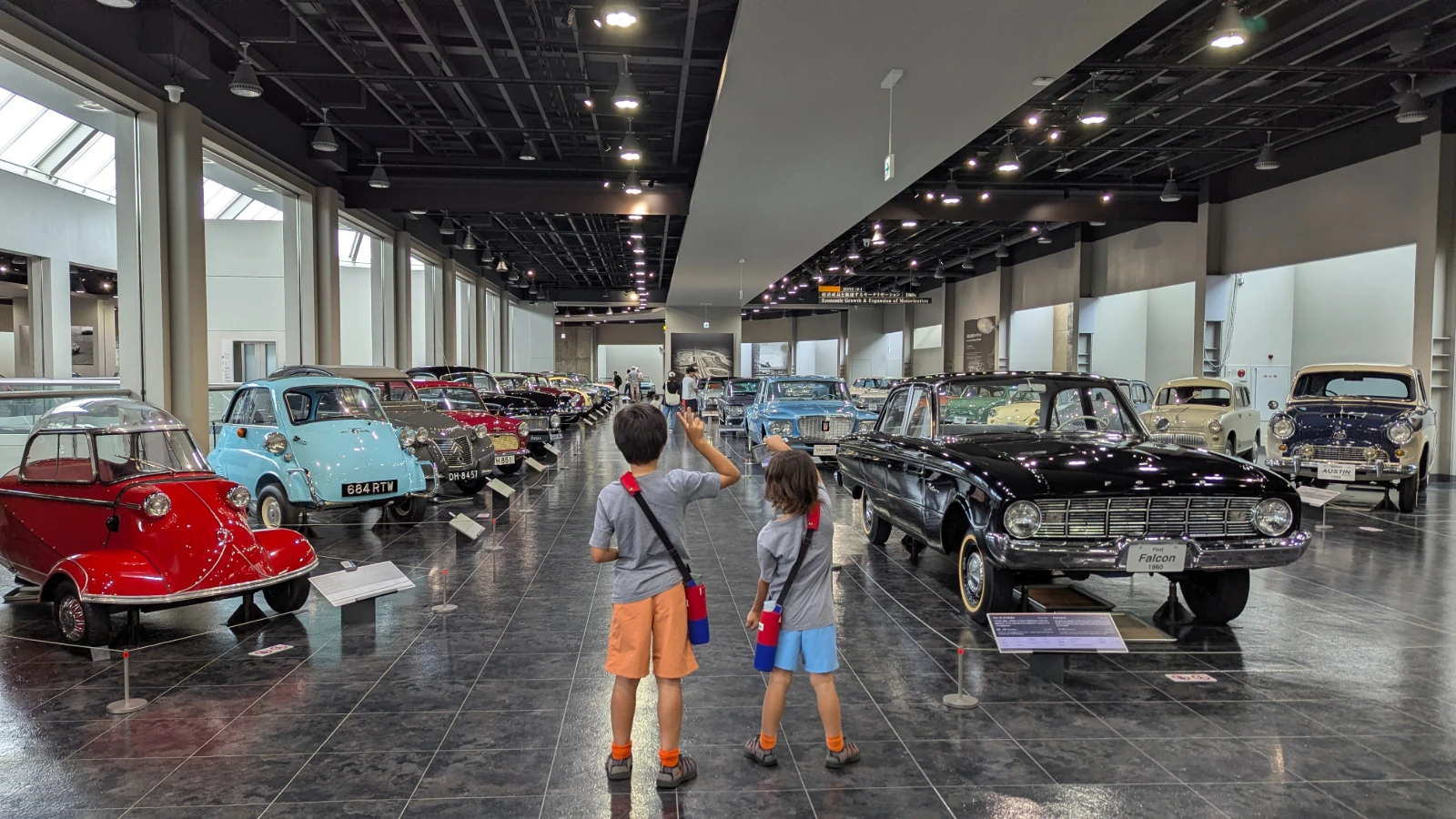
About 150 cars across 140 years, nearly all of them behind a fence, and a few, on a floor built for children, that a child is allowed to climb into.
Junior high and high school ¥600; preschoolers free. Dated web tickets with a QR code skip the counter.
Admission until 16:30. Closed Mondays (the next day after a holiday) and over the New Year.
About 150 cars from Japan, the United States and Europe.
Exhibit cars on the Culture Hall’s first floor are for children to board.
At the Kuruma-kan and Culture Hall desks; limited, and not on escalators.
Some links on this page are affiliate links. LuNi may earn a commission at no extra cost to you.
Is the Toyota Automobile Museum worth it with kids?
The short version, before the costs, the timings and the case for each child.
Yes, and it is a good car museum for a family because it solves the obvious problem head on. A hall of famous cars is a hard place for a child who is not allowed to touch them, and most of the cars here are exactly that, behind fences. But the museum also gives children cars to board: a vehicle or two in the main collection, and exhibit cars on the first floor of the Culture Hall that a child may climb into freely. The visit takes about an hour and a half to two hours, the restaurant has a children’s menu, and an outdoor lawn plaza gives a place to move after all the looking. Plan the day around those three, the boardable cars, the lunch and the lawn plaza, and the fences matter far less.
Planning Your Visit to the Toyota Automobile Museum with Kids.
Three decisions shape this day, and the first is the journey, because the museum is in Nagakute, east of the city, reached on the Linimo line and five minutes on foot from Geidai-dori Station. Ghibli Park sits on the same line, which lets the two share a day. The second is the order: start in the main halls while the child is still patient and fresh, then move to the Culture Hall, where the cars can be boarded, as the reward. The third decision is lunch, either the restaurant with its children’s menu and children’s chairs or a picnic on the lawn plaza outside, since outside food cannot come inside. For the transfers on the way out, Japan’s trains with small children covers the practical side, from IC cards to strollers on the train.
Every LuNi attraction guide starts with a visit, with our own children
LuNi rates and writes about attractions only after visiting them with children. Luca and Nico were at the Toyota Automobile Museum, and what they did there is recorded further down this page, including how each child actually met it.
Children arrive with different tolerances: for noise, for lines, for standing still, for being on their feet all day. A guide written for the average of them helps almost nobody. So every place on this site is read four ways, and each verdict says which children it already suits and what makes it work for the rest. Whoever you are bringing, the answer here is built for your family rather than for a general reader.
Restricted-movement depletion builds in halls of cars that may not be touched, so end the visit on the Culture Hall floor where cars can be boarded.
Sensory-input depletion stays low among cars that stand still, so let the child set the pace and choose which rooms to linger in.
Unfamiliarity and unconfirmed structure ease with a children’s menu, set tour times and clear rules, so tell the child the touching rule at breakfast.
Sustained walking and standing fill an hour and a half to two hours, so borrow a free stroller at the desk and plan a seated lunch.
Hotels we would book for this visit.
Three hotels for a family making Nagakute a day out from the city, with the museum and Ghibli Park on one Linimo line: the Associa above JR Nagoya Station, the Prince Sky Tower on the Aonami Line, and Hilton Nagoya, which lends cribs.
| Property | The LuNi Reason |
|---|---|
| LUNI Pick Nagoya Marriott Associa Hotel Above JR Nagoya Station | Above Nagoya Station, a central base for a day east to Nagakute, where the museum and Ghibli Park share the Linimo line, so one day out can hold both. Family rooms sleep up to five, and the pool takes children from 4 to 12 until 18:00 for a fee, for a family leaving the museum early in the afternoon. |
| Nagoya Prince Hotel Sky Tower Sasashima Live Station, Aonami Line, 2 min | For a family doing both Nagakute and the port, the Nagoya Prince Hotel Sky Tower works as one base: Sasashima Live, two minutes away, is on the Aonami Line to Nagoya Station one way and Kinjo-futo the other. Its corner rooms sleep four, high in the tower. |
| Hilton Nagoya | For a family with a baby or toddler, Hilton Nagoya lends a crib for a child under two and bed guards from 18 months to five, free on request while stock lasts, and its Japanese-style suites lay futons for up to four, so the youngest sleep at floor level after the Linimo ride back. |
Nearby attractions, matched to your child.
Three ways to extend the stay: a park of film worlds one Linimo line away, the sister museum on a joint ticket, or a science museum in the center where the loudest lab is optional.
| Pairing | Why This Solves the After-Visit | For Your |
|---|---|---|
| LUNI Pick Ghibli Park Linimo, Ai-Chikyuhaku Kinen Koen Station | On the same Linimo line, Ghibli Park spreads five areas across a large park, with play spaces kept for children of elementary age and under. Restricted movement, held behind the car fences all morning, gets open ground to walk freely between the areas. Tickets are by reservation only, so book it first. | Dynamo |
| Toyota Commemorative Museum Meitetsu Sako Station, 3 minutes on foot | A joint ticket covers this museum and the Toyota Commemorative Museum in the city, where free guided tours in English start at set times each afternoon. Unfamiliarity and unconfirmed structure ease when the second museum is already paid for and its tours keep a fixed schedule. Leave it for a fresh morning. | Anchor |
| Fuji Nagoya Science Museum Fushimi Station, exit 4 or 5, 5 minutes on foot | Back in the center, the Fuji Nagoya Science Museum is five minutes from Fushimi Station, one subway stop from Nagoya Station, with free entry for children through junior high. Sensory-input depletion stays low where the one loud lab, the Tesla coils, is a show to join or skip. Keep it for a wet day. | Sensor |
Ghibli Park
Linimo, Ai-Chikyuhaku Kinen Koen Station For YourDynamo
Toyota Commemorative Museum
Meitetsu Sako Station, 3 minutes on foot For YourAnchor
Fuji Nagoya Science Museum
Fushimi Station, exit 4 or 5, 5 minutes on foot For YourSensor
How two children actually met this attraction.
Two children walked the same halls of old cars and both named getting on the vehicles, which is the part of this museum to plan the other halls around. One looked closely at the old and expensive cars and at their details, the brand emblems and the hoods, and also enjoyed getting on some of the vehicles. The other liked looking at the old cars and liked going on the special vehicles. For a family, the lesson is that the looking holds a child for a good while and the boarding finishes the visit well. Keep the cars a child may board for last, as the reward for the halls, so the day ends on the part both children named, and let a detail-minded child set the pace in the main halls, where for him the looking is the whole visit.
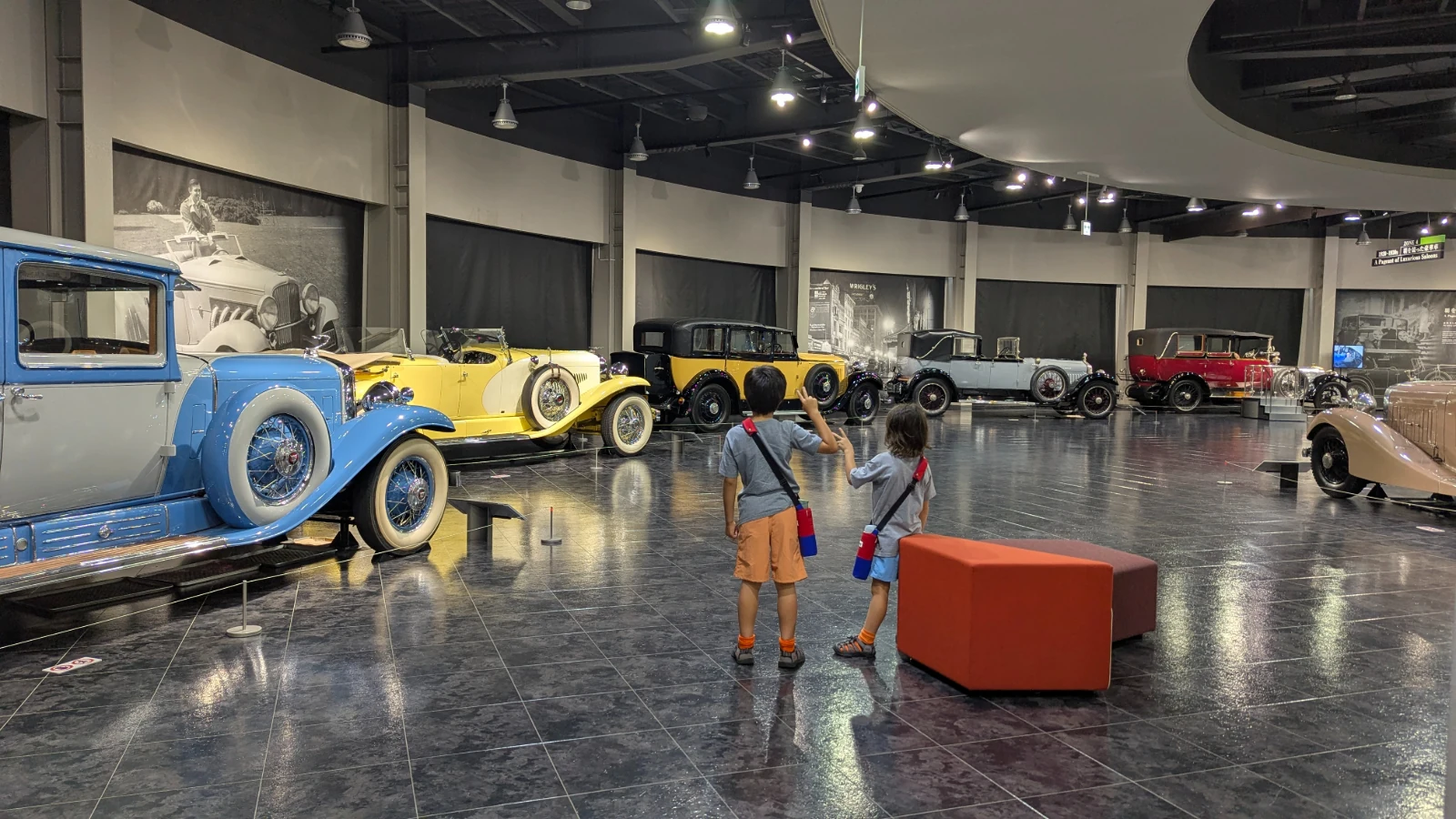
Luca enjoyed looking at the expensive cars from the old days, and in a collection of about 150 cars from Japan, the United States and Europe, spanning some 140 years, there were plenty of them. He also enjoyed the details: the car brand emblems and the hood designs, which change from maker to maker and decade to decade. And he enjoyed being able to get on some of the vehicles, where looking gives way to climbing aboard.
This is the Anchor pattern, in a child whose reserve depletes through unfamiliarity and unconfirmed structure: a room full of new things steadies him once it becomes a set he can sort. Small details that repeat and differ from car to car give a careful child a collection to work through. Families with a similar child should hand him that job, what changes from one decade to the next and what stays the same, and let the main halls run at his pace, however slow that turns out to be.
Nico thought the old cars were nice to look at, and in halls where the cars stand behind fences, looking is most of what a visit offers. What he enjoyed was going on the special vehicles, the few a visitor may board. Those are the places where the museum stops being a gallery and lets a child in, and in a building of cars that may not be touched, they are worth knowing about before arriving.
This is the Dynamo pattern. Restricted movement is what drains this child, so a museum of cars behind fences holds him only so long, and the vehicles he could go on are what he named. Families with a similar child should keep the looking brief, find the boardable vehicles early in the plan, and finish on the Culture Hall’s first floor, where climbing into a car is the point of the room rather than a rule to remember.
Walking past more than a century of cars lets a child see time pass in shapes and colors. The early cars, the later ones and the familiar cars of today tell a story of invention a child can follow without reading a single label. Objects make history concrete for children in a way dates rarely can. A child who notices how a thing has changed begins to ask why it changed, and that question is the start of thinking like an inventor, at any age.
The LUNI Rating for the Toyota Automobile Museum.
One fact sits under all four verdicts, and every one of the levers below follows from it: this is a museum of about 150 cars that mostly may not be touched, with a few that may be boarded and a floor built for children. The child who needs structure gets a children’s menu and clear rules; the child sensitive to input gets cars that stand still. The Dynamo and the Sprinter feel it most, for the fences and the time on foot. Among Japan’s museums for children it is a strong car day, and the levers below cover the rest.
End on the cars that can be boarded. The Dynamo depletes through restricted movement, and a hall of famous cars behind fences asks this child to stand and look, over and over, which is the hard part for him. What rescues the visit is that the museum is not all fences. One vehicle outdoors and one indoors can be boarded, though which ones may change, and the first floor of the Culture Hall has exhibit cars children may climb into freely. Outside, the lawn plaza is open for picnics, which makes it the place to move before or after the halls.
Bracket the looking with moving. Start with a run on the lawn plaza if the child arrives restless, walk the main halls briskly, and finish in the Culture Hall, where boarding is the point. Give an older child a task in the halls, a decade to find or a country’s cars to count, so the looking has a purpose. A picnic on the lawn at lunch resets a younger child before the second half of the visit, and an older one can use it too.
What this means for your Dynamo: the Toyota Automobile Museum holds restricted movement behind fences, then frees it on the Culture Hall floor. A younger Dynamo needs the lawn and the boardable cars; an older one can take a task.Let the cars stand still. The Sensor depletes through sensory input, and a museum of cars that stand still is a gentle place for this child. The cars stand still, and the child can choose how close to go and how long to stay in each hall. Guided tours run at set times, so a family can join one or avoid it. Lunch is the one part of the day worth timing around the child, early or late, so the restaurant is calm when the family sits down.
Control stays with the child. Let the Sensor choose which halls to linger in and which to pass through, and do not push the full collection if one era holds the child’s attention, since a Sensor who settles in one room is having a good visit. Eat early or late to miss the lunch hour at the restaurant, or picnic on the lawn plaza outside in good weather. The car picture-book library on the Culture Hall’s third floor is a place to sit with a book if the child needs a pause from the halls.
What this means for your Sensor: at the Toyota Automobile Museum sensory input stays low among still cars. A younger Sensor needs a quiet lunch; an older one can choose his own route through the halls.Fix lunch and the touching rule. The Anchor depletes through unfamiliarity and unconfirmed structure, and the museum gives this child plenty to hold. Restaurant AVIEW in the Kuruma-kan has a children’s menu and children’s chairs, a cafe waits in the Culture Hall, and the outdoor lawn plaza takes a packed lunch. The rules are few, and they are plain: no touching the cars in the halls, no food inside, and capped drinks allowed. Guided tours run at set times, which gives a structured child a fixed point in the day.
Describe the day before it starts. Say where lunch will be, restaurant or lawn, and when, and explain the touching rule with its exception, the cars he may board. Show him pictures of two or three famous cars to look for, so the halls hold targets rather than surprises. For an older Anchor, one of the Japanese guided tours at a set time, or an English one reserved ahead, gives the visit a fixed spine.
What this means for your Anchor: the Toyota Automobile Museum gives unfamiliarity a set lunch, clear rules and tour times. A younger Anchor needs the touching rule said at home; an older one can hunt for cars from a list.Take a free stroller at the desk. The Sprinter depletes through sustained travel-style walking and standing, and a car museum is a long stand by nature. The visit takes about an hour and a half to two hours, most of it on foot between cars. What helps is that strollers and wheelchairs are lent free at the desks in both buildings, the station is about five minutes away on foot, and the restaurant and the lawn plaza give two places to sit. Strollers cannot ride the escalators, so plan the route with that in mind.
Lighten the load at the door. Borrow a free stroller at the desk on arrival for a younger child, since the number is limited, and plan a seated lunch in the middle of the visit rather than at the end. Cut the halls a child does not care about, and treat the Culture Hall’s boardable cars as the finish, where sitting in a car is itself a rest. A visit that ends before the child tires is the better visit.
What this means for your Sprinter: an hour and a half to two hours on foot at the Toyota Automobile Museum adds up. A younger Sprinter needs the free stroller; an older one needs a seated lunch.The questions parents actually ask.
The Toyota Automobile Museum turns on one rule and its exception: the cars in the halls may not be touched, and a few cars may be boarded. Around that, the practical facts are simple, with fixed hours, a Monday closing, free strollers and a station five minutes away on the Linimo line. For a family putting Nagoya into a longer trip, planning a family trip to Japan sets out the order of decisions. Arrive with the rule explained and the boardable cars promised for later, and the museum becomes an easy morning for the whole family, with the lawn plaza and lunch as the breaks.
Is the Toyota Automobile Museum worth visiting with kids?
Yes, for a child who likes cars, and for more children than one might expect. About 150 vehicles tell the story of the car across roughly 140 years, and the Culture Hall has exhibit cars a child may climb into, plus a picture-book library on cars. Allow an hour and a half to two hours, and plan one break outdoors on the lawn plaza.
How much does the Toyota Automobile Museum cost?
Adults pay 1,200 yen, junior high and high school students 600 yen, elementary school children 400 yen and those 65 and over 700 yen, and preschoolers enter free. The first and third floors of the Culture Hall are free to everyone. Dated web tickets with a QR code let a family skip the admission counter on arrival, a small saving with young children.
What are the museum’s opening hours?
From 9:30 to 17:00, with admission until 16:30. The museum closes on Mondays, or on the next day when a Monday is a public holiday, and over the New Year. Closing days in spring and summer can differ from that pattern, so a family visiting in those seasons should check the museum’s own calendar online before setting the day of the visit.
How do you get to the Toyota Automobile Museum?
Take the Linimo line to Geidai-dori Station, which also carries the museum’s name, and walk about five minutes from exit 1. A Meitetsu bus to the Toyota Hakubutsukan-mae stop is another option, then five minutes on foot to the door. Drivers find free parking for 320 cars on site. Ghibli Park is on the same Linimo line, at its own station nearby.
Can children touch or sit in the cars?
Only in the right places. In the main halls, the cars may not be touched and the fences may not be crossed. But one vehicle outdoors and one indoors can be boarded, though which vehicles may change, and on the first floor of the Culture Hall there are exhibit cars children may climb into freely. Tell the child which is which before the visit.
Is the Toyota Automobile Museum stroller friendly?
Yes. Strollers and wheelchairs are lent free at the reception desks in the Kuruma-kan and the Culture Hall, first floor, though the number is limited and they cannot go on the escalators. Nursing rooms with hot water and baby beds are in both buildings, and there are children’s restrooms, which makes it an easy museum to visit with a baby in tow.
Can you eat at the Toyota Automobile Museum?
Yes. Restaurant AVIEW in the Kuruma-kan has a children’s menu and children’s chairs, and there is a cafe in the Culture Hall. Food brought from outside cannot be eaten inside the museum, but the outdoor lawn plaza is open for picnics. Capped drinks are allowed in the halls, so a water bottle can stay in the bag for the whole visit.
Are there guided tours in English?
Only by reservation. Japanese tours run in the Kuruma-kan at 10:15 and 14:00, about an hour each, and in the Culture Hall at 13:00 for about 30 minutes. For English, reserve ahead. Without a tour, a family does well on its own: the cars need little translation, and the car picture-book library on the Culture Hall’s third floor works in any language.
Where the Toyota Automobile Museum fits your Japan trip.
Official site and opening information: Toyota Automobile Museum