Port of Nagoya Public Aquarium with Kids: Orcas, Dolphins, Long Halls.
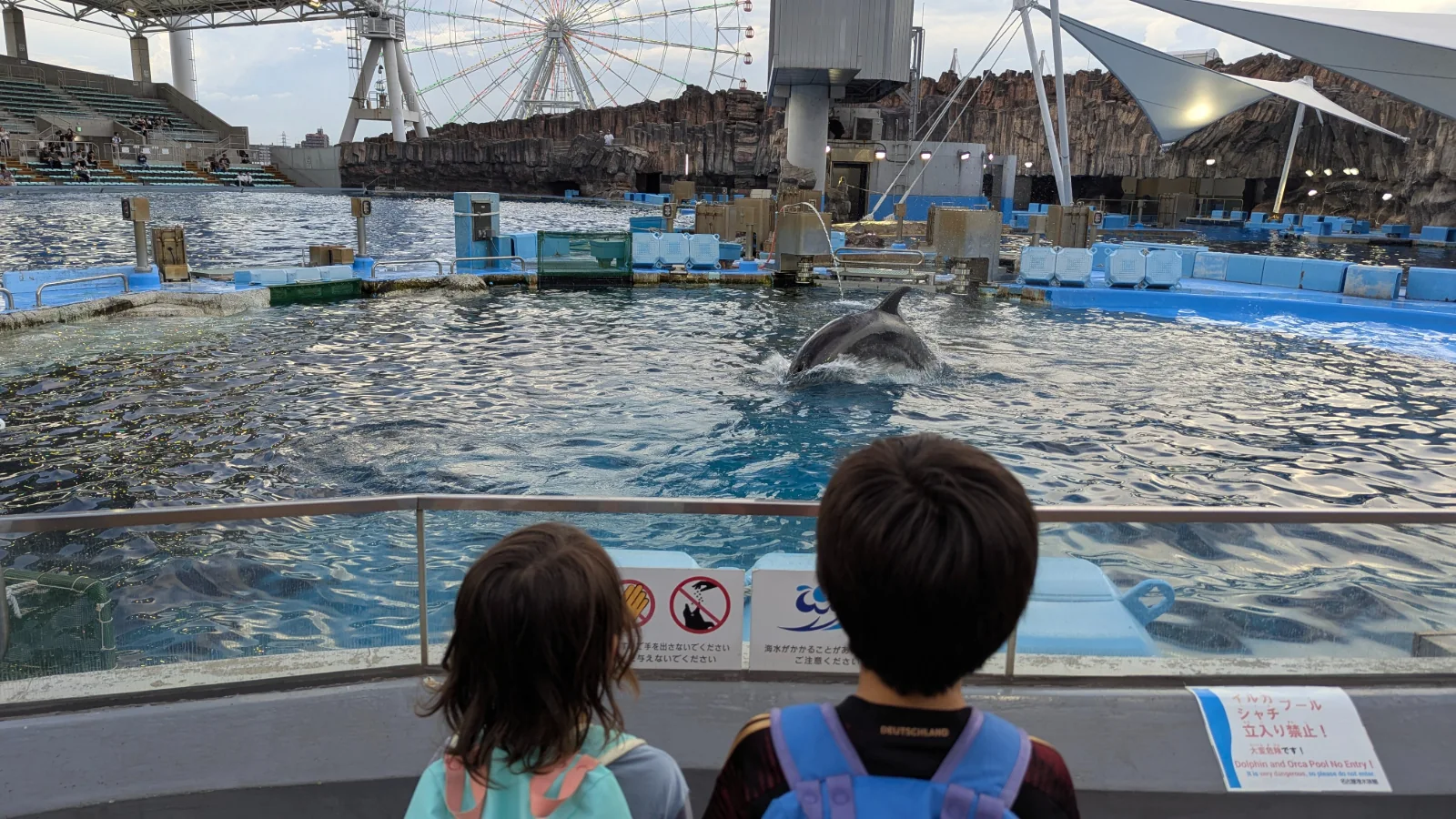
Orcas and dolphins, penguin feeding and a sardine tornado on one program, in a building long enough that comfortable shoes belong in every visiting family’s plan.
Age 4 and over, preschool: ¥500. A same-day city subway or bus day ticket lowers each price.
Later in Golden Week and summer, earlier in winter. Closed Mondays, except in July to September and the holiday seasons.
The whole building, with the dolphin performance of about 15 minutes.
Elementary and junior high children can get an observation notebook on weekends.
For 7 to 24 months, inside only; the building is barrier-free, with elevators.
Some links on this page are affiliate links. LuNi may earn a commission at no extra cost to you.
Is the Port of Nagoya Public Aquarium worth it with kids?
The short version, before the costs, the timings and the case for each child.
Yes, and for a child who loves whales and dolphins it is a very strong aquarium day. The aquarium keeps orcas as well as dolphins, and its program of events, a dolphin performance, orca training in public, penguin feeding and a sardine tornado, turns a walk past tanks into a day with a schedule a child can follow. Two things decide the visit. The first is distance: the building is long, a full visit takes two to three hours, and a child who tires early will need that plan to bend. The second is cost, since a same-day city subway or bus day ticket lowers the admission for the whole family. Buy the day ticket first, at the station, and the ride and the discount come together in one purchase that serves the whole family for the rest of the day.
Planning Your Visit to the Port of Nagoya Public Aquarium with Kids.
Three decisions settle the day before it starts. The first is the route: choose the one or two events that matter most, the dolphins or the orca training, and plan the walk around them, because the building rewards a family that knows where it is going and punishes one that wanders. Arrive with the events chosen and the day runs itself. The second is the ticket, since the city’s subway and bus day ticket both carries the family to the port and lowers the admission. The third is food, and here the aquarium is generous, with two places to eat a packed lunch, one of them the roofed Stadium seats, and a restaurant for a family that would rather buy. For the shoes and the day bag, what to pack for Japan with children covers the long-walk days.
Every LuNi attraction guide starts with a visit, with our own children
LuNi rates and writes about attractions only after visiting them with children. Luca and Nico were at the Port of Nagoya Public Aquarium, and what they did there is recorded further down this page, including how each child actually met it.
Children arrive with different tolerances: for noise, for lines, for standing still, for being on their feet all day. A guide written for the average of them helps almost nobody. So every place on this site is read four ways, and each verdict says which children it already suits and what makes it work for the rest. Whoever you are bringing, the answer here is built for your family rather than for a general reader.
Restricted-movement depletion builds along tank after tank of watching, so break the long halls with the outdoor plaza and the scheduled events.
Sensory-input depletion stays manageable with events on a set program and a crowd forecast for each day, so choose a quieter date first.
Unfamiliarity and unconfirmed structure ease with food on site, two picnic areas and same-day re-entry, so set lunch and the events in advance.
Sustained walking and standing add up across a long building over two to three hours, so plan the seated events and bring a stroller.
Hotels we would book for this visit.
Three hotels for an early start at the port: one above Nagoya Station, which sells the subway day ticket that lowers the aquarium’s admission, one on the Aonami Line with corner rooms for four, and Hilton Nagoya, where young children share a parent’s bed free.
| Property | The LuNi Reason |
|---|---|
| LUNI Pick Nagoya Marriott Associa Hotel Above JR Nagoya Station | Above Nagoya Station, where a family can buy the city’s subway day ticket before the ride to the port and show it at the aquarium door for a discount. Family Fourth rooms sleep up to five, and its pool is open to children aged 4 to 12 until 18:00, with an adult in the water and a fee. |
| Nagoya Prince Hotel Sky Tower Sasashima Live Station, Aonami Line, 2 min | Sasashima Live, the Nagoya Prince Hotel Sky Tower’s station two minutes away, is on the Aonami Line, which meets the city subway at Nagoya Station for the ride down to the port. Its corner rooms sleep four, every one of them from the 32nd floor up, which gives a family space after the long halls. |
| Hilton Nagoya About 35 to 40 min by subway | A family of four fits one Family Deluxe room at Hilton Nagoya, two wide beds shared with the children, and each child of elementary-school age or under sleeps free beside a parent, one to an adult. The pool, free to guests, gives the children a swim after the long halls; below 140 centimeters, a grown-up swims too. |
Nearby attractions, matched to your child.
Three stops for the days around the aquarium: the castle’s settled route on the same day ticket, a science museum where the child picks each lab, or open parkland at Ghibli Park for the child the glass held still.
| Pairing | Why This Solves the After-Visit | For Your |
|---|---|---|
| LUNI Pick Nagoya Castle Nagoyajo Station, exit 7, 5 minutes on foot | On the same day ticket, Nagoya Castle is five minutes on foot from Nagoyajo Station, and a noodle canteen and a picnic plaza in its grounds settle lunch before the family leaves the port. Unfamiliarity and unconfirmed structure ease where the child knows the keep is closed before arriving. | Anchor |
| Fuji Nagoya Science Museum Fushimi Station, exit 4 or 5, 5 minutes on foot | Five minutes from Fushimi Station, the Fuji Nagoya Science Museum keeps its big labs in separate rooms, and the loudest, the Tesla coils, runs as a show a child may skip. Sensory-input depletion eases when every loud moment is a choice. Children through junior high enter free. | Sensor |
| Ghibli Park Linimo, Ai-Chikyuhaku Kinen Koen Station | For a separate day east of the city, Ghibli Park sets its five areas in open parkland, with the surrounding park kept for picnics and room to run. Restricted movement, held at the tank glass, spends itself across a day on foot. Reserve the tickets before the rest of the trip. | Dynamo |
Nagoya Castle
Nagoyajo Station, exit 7, 5 minutes on foot For YourAnchor
Fuji Nagoya Science Museum
Fushimi Station, exit 4 or 5, 5 minutes on foot For YourSensor
Ghibli Park
Linimo, Ai-Chikyuhaku Kinen Koen Station For YourDynamo
How two children actually met this attraction.
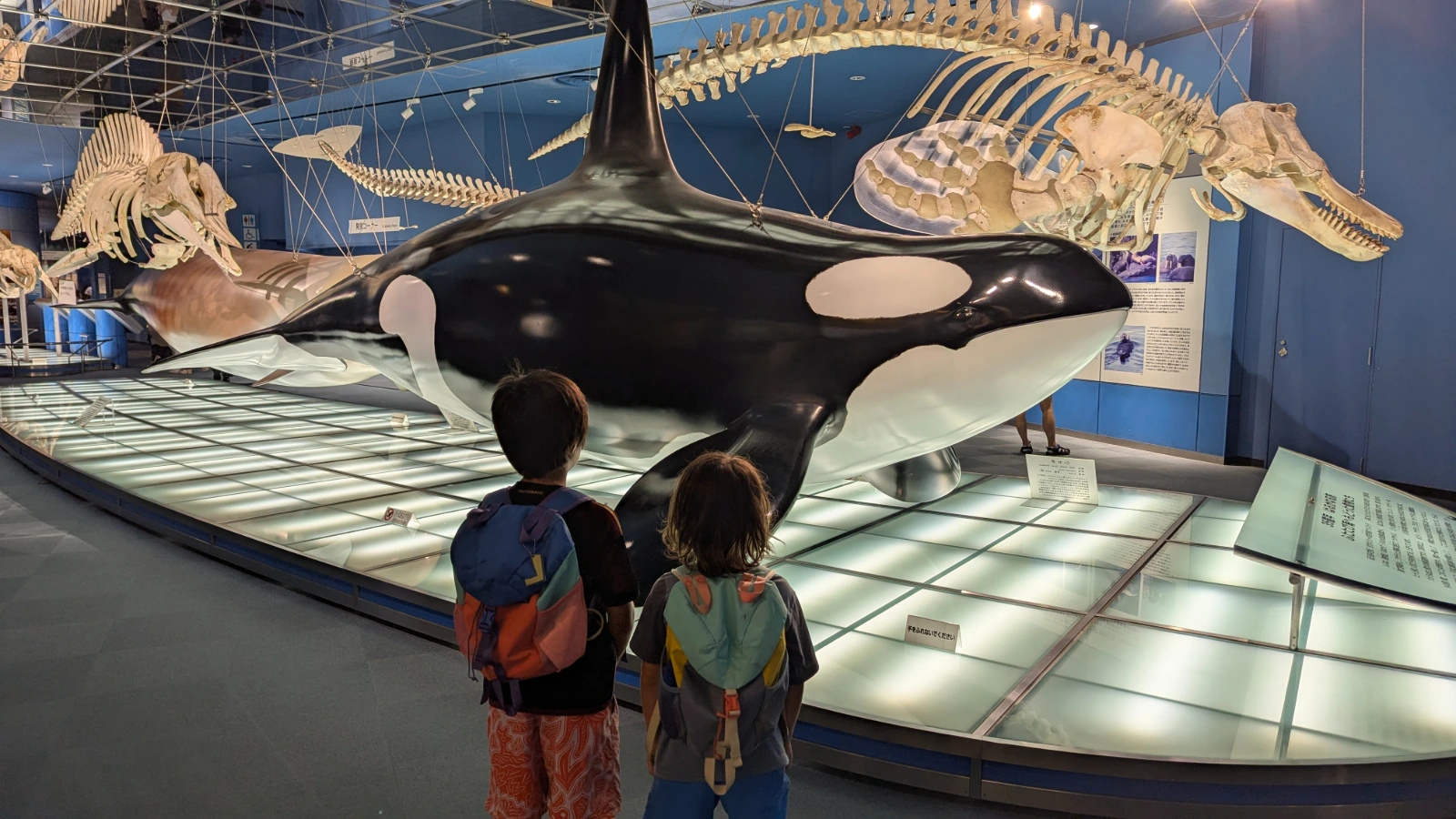
Two children visited this aquarium and both came away talking about the whales, which is the reason to choose this aquarium over another. One took it as a lesson, watching the orcas and dolphins and wanting to understand them. The other collected surprises: a fact about whales he had not known, a very young turtle, and the orcas themselves. For a family planning the day, the lesson is plain: the whales and dolphins are the heart of the visit, and everything else in the building is the route between them. Put the orca training and the dolphin performance in the plan first, let one child learn and the other simply look and wonder, and use the smaller tanks along the way as the pauses between the big moments of the day.
Luca found it interesting to watch the killer whales and the dolphins, and to learn about them while he watched. Here that is more than a glimpse through glass: the orcas train in public and the dolphins perform for about fifteen minutes, so a child who wants to understand an animal sees it work, respond and move. That is the kind of watching that turns into learning, and it was what he took away.
This is the Anchor pattern: his reserve depletes through unfamiliarity and unconfirmed structure, and it steadies when watching becomes understanding, and animals that train in public on a program give him something to follow from start to finish. Families with a similar child should read about orcas and dolphins before the visit and give him questions to answer at the pool, so the performance becomes a lesson he is solving rather than a show he is waiting through, and the long walk between pools has a purpose.
Nico came away with a fact he had not known: that whales, a long time ago, had feet. He enjoyed looking at a baby turtle only two months old, and he enjoyed getting to watch the killer whales. Three different things held him, a surprise fact, a very small animal and a very large one, which says something about how much this building puts in front of a child between one pool and the next.
This is the Dynamo pattern. Restricted movement drains this child’s reserve, and here what held him was surprise: a new fact, a very young animal, and the orcas. Families with a similar child should keep the route moving toward the next thing to discover, point out the unexpected rather than the famous, and put the orcas late in the visit, when a big moving animal does the most good for a child whose legs and patience are starting to go.
Standing beneath an orca, or watching a dolphin surface and breathe, gives a child a sense of how large and alive the ocean is. Animals this big and this intelligent invite a different kind of attention, the patient watching that notices a pattern in a swim or a glance between a trainer and a dolphin. That attention is the beginning of care. A child who has met the ocean’s giants up close understands a little more why the sea matters, and why the creatures in it deserve protecting.
The LUNI Rating for the Port of Nagoya Public Aquarium.
One fact sits under all four verdicts: this is a large aquarium built around its whales and dolphins, with a published program of events and a long building to walk. The child who needs structure gets food on site, picnic areas and fixed events; the child sensitive to input gets a program and a crowd forecast to plan by. The Dynamo and the Sprinter find it hardest, because the day is long and mostly watching. Among Japan’s aquariums and animal encounters this one is built around its whales and dolphins, and the levers below make its long day work for each child.
Break the glass with open air. The Dynamo depletes through restricted movement, and an aquarium is mostly watching through glass, tank after tank. That is the difficulty for this child. What helps is the program: the dolphin performance, the orca training, the penguin feeding and the sardine tornado each give the child a moment when something happens, and Shiokaze Plaza at the North Building is outdoors, where a family can stop and eat and a child can move. The building is long, which helps here more than it hurts, since walking is at least movement, and the outdoor plaza is a real break rather than a corridor.
Alternate watching with moving. Plan the route from one event to the next, go out to Shiokaze Plaza for lunch rather than a restaurant table, and let the child set the pace in the halls between events. For an older child on a weekend, the observation notebook for elementary and junior high children turns the halls into a task, and a task is what this child needs between the big moments. A younger child can carry the plan instead: which event is next, and how many pools until the orcas.
What this means for your Dynamo: the Port of Nagoya Public Aquarium holds restricted movement at the glass, and its events and outdoor plaza release it. A younger Dynamo needs the plaza at lunch; an older one can take the notebook.Choose the day by the forecast. The Sensor depletes through sensory input, and what settles it here is scheduling: the events start at set times rather than without warning. The aquarium also keeps a crowd forecast calendar for the year and shows the day’s crowding online, which lets a family choose a quieter date before booking the trip. The dolphin performance in the Stadium is the big set piece of the day, and it is one a child can see coming.
Start from that forecast. Pick a quieter day from the calendar, arrive near opening, and plan the events so the child knows what comes next. At the dolphin performance, sit near an aisle so leaving is easy, and describe it before the child sees it. Balloons are banned and whistles may not be used, for the animals’ sake, which also keeps two sudden noises out of the building. If the halls grow busy, the outdoor Shiokaze Plaza is the place to reset before the next event.
What this means for your Sensor: at the Port of Nagoya Public Aquarium sensory input follows a program and a crowd forecast. A younger Sensor needs a quiet date chosen for him; an older one can plan the events.Set lunch and the events at home. The Anchor depletes through unfamiliarity and unconfirmed structure, and this aquarium answers that with food and a program. There is a restaurant, a food terrace and kiosks, and a family may eat its own food at two places, outdoors at Shiokaze Plaza and in the roofed Stadium seats. Re-entry on the same day is allowed, so a family is never locked into the building. The events follow a program, which gives a structured child the schedule he wants.
Settle the plan before the child walks in. Choose the events together, decide where lunch will be and whether it is packed or bought, and tell him that the family can step out and come back in. Baby corners on two floors, one with hot water for formula, settle the same questions for a younger sibling. With those answers in place, the long building becomes a known route rather than a maze. For an older Anchor, the observation notebook on weekends adds one more fixed thing to hold.
What this means for your Anchor: the Port of Nagoya Public Aquarium gives unfamiliarity food, picnic space and a program. A younger Anchor needs lunch settled at home; an older one can hold the event plan.Plan where to sit. The Sprinter depletes through sustained travel-style walking and standing, and the building is long: a full visit with the dolphin performance runs two to three hours on foot, so comfortable shoes matter. The building is fully barrier-free, with elevators in each building, and the Stadium seats give a roofed place to sit for the performance and for a packed lunch. The stroller rental helps only a younger child, since it is limited to children from 7 to 24 months.
Build rest into the route. Sit for the dolphin performance, take lunch in the Stadium seats or at Shiokaze Plaza, and cut the halls a child does not care about. Bring a stroller for any child past the rental age who still rides one, and use the elevators rather than stairs. A family that sees the orcas and the dolphins and stops there has seen the aquarium at its best, and the same-day re-entry means a break outside never costs the visit.
What this means for your Sprinter: the long halls of the Port of Nagoya Public Aquarium add up to a long stand. A younger Sprinter needs his own stroller; an older one needs the Stadium seats as rest.The questions parents actually ask.
The Port of Nagoya Public Aquarium turns on the season and the day ticket. Hours run later in Golden Week and summer, and the Monday closing lifts from July to September, while the city’s subway and bus day ticket lowers the admission for every family member who holds one. For choosing a season with children, Japan season by season with children sets the calendar out. After that, the plan is simple: pick the events, pack or buy lunch, bring the stroller from home for a toddler, and allow two to three hours on foot through the building, with the Stadium seats as the place to rest.
Is the Port of Nagoya Public Aquarium worth visiting with kids?
Yes. A child can watch orcas and dolphins here, through the North Building’s large underwater windows, and the program of events, from the dolphin performance to penguin feeding and the sardine tornado, gives the day a clear shape. It is also a long building to walk, so plan for two to three hours, wear comfortable shoes, and bring a stroller for a toddler.
How much does the Port of Nagoya Public Aquarium cost?
Adults and high school students pay 2,030 yen, elementary and junior high students 1,010 yen, and children aged 4 and over who are not yet in school 500 yen. Show a same-day Nagoya city subway or bus day ticket and the prices drop to 1,830, 810 and 400 yen. Re-entry on the same day is allowed with the ticket, so a break outside costs nothing.
What are the opening hours?
Normally 9:30 to 17:30. In Golden Week and the summer vacation, from late July through August, the aquarium stays open until 20:00, and from December to mid-March it closes at 17:00. Entry ends an hour before closing. On late-opening days an evening ticket from 17:00 costs less, a good option in the summer heat of August.
Which days is the aquarium closed?
Mondays, or the next day when a Monday is a public holiday. The Monday closing does not apply in Golden Week, from July to September, over the New Year or in the spring school break, when the aquarium opens every day, apart from any maintenance day posted on its calendar. Summer visits can fall on any day; in autumn or winter, plan around Mondays.
How long does the dolphin performance last?
About 15 minutes. It is one of several events across the day, alongside the public training of the orcas, penguin feeding and the sardine tornado. Seeing the whole building with the dolphin performance takes about two to three hours, longer if the family stays for more events, so choose one or two events in advance, and plan the walking route between them.
Is the aquarium stroller friendly?
Yes. The building is fully barrier-free, with elevators in each building and free wheelchairs. Strollers can be borrowed for 100 yen a day, but only for children from 7 to 24 months and only inside the building, and the number is limited. A family with a toddler past that age should bring its own stroller from home for the long halls.
Can you bring food into the aquarium?
Yes, to two places. Food brought from outside can be eaten at Shiokaze Plaza, outdoors at the North Building, and in the Stadium seats, which are roofed but open. Drinks can be taken anywhere while standing still. For bought meals there is a restaurant, a food terrace and kiosks, and baby corners on two floors, one with hot water for formula.
What should you not bring to the aquarium?
Balloons and bouncy balls, because the whales and dolphins could swallow one that falls into a pool, and a whistle should not be blown inside, since it disturbs the animals’ training. Drinks may be taken anywhere, standing still. The aquarium is five minutes on foot from exit 3 of Nagoyako Station on the Meiko subway line.
Where the Port of Nagoya Public Aquarium fits your Japan trip.
Official site and opening information: Port of Nagoya Public Aquarium (in Japanese)