Shibuya With Kids:which stop is for which child.
- Shibuya With Kids
- Yes, on a plan of two to four hours
- Things to Do
- Yoyogi Park, Meiji Jingu, Shibuya Sky, Hikarie
- Free for the Family
- The crossing, Hachiko, Yoyogi and Miyashita
- Book Ahead
- Shibuya Sky, a timed slot booked ahead
- With a Stroller
- Partly; use the Hachiko Exit with a stroller
The activities that work with children by day and by night, and how a visit to the famous crossing can stay calm.
Some links on this page are affiliate links. LuNi may earn a commission at no extra cost to you.
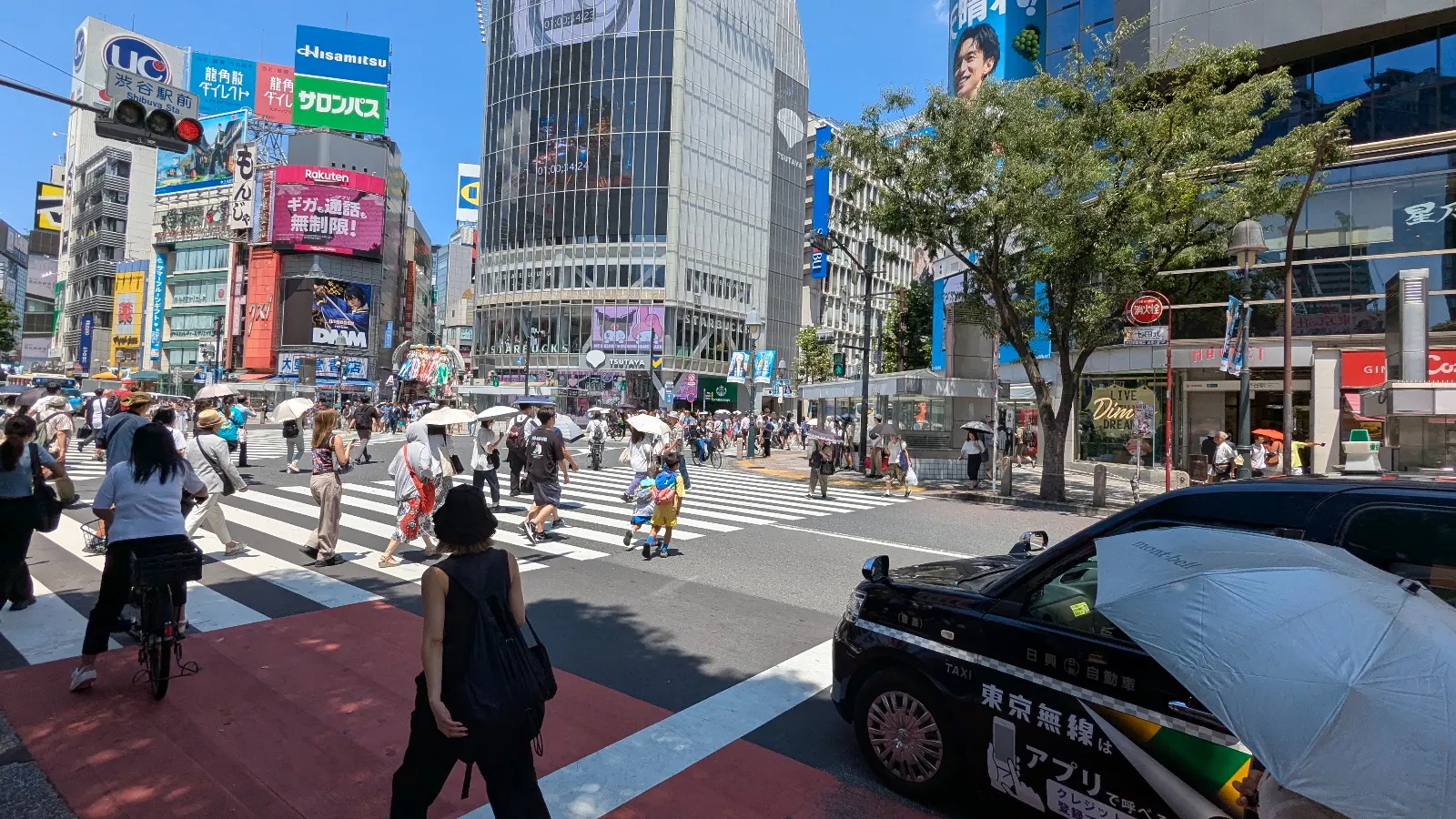
Shibuya is one of Tokyo’s most stimulating districts, and it works with children on a plan rather than on impulse. Open somewhere calm: the lawns of Yoyogi Park for a child with energy to burn, or the forest path to Meiji Jingu in the morning, before the district fills. Watch the Scramble Crossing from above, at Shibuya Sky or a cafe window, and cross it on foot off-peak. Book the Sky slot first, because it is the one timed stop of the day. Keep Hikarie as the reset between louder stops, and take Hachiko in passing on the way to the station.
Which stop is for which child.
These stops are not ordered best to worst. They are grouped by which child each one is for. The reason is simple: Shibuya is one of Tokyo’s most stimulating districts, and the stop that thrills one of your children is the stop that overwhelms another. So instead of a single list, you get four short ones, organized by how each child runs out of steam. The Dynamo runs short when they cannot move. The Sensor runs short on noise and crowds. The Anchor runs short when nothing is predictable. The Sprinter runs short on walking and standing. Find your child below, and start there.
For the Dynamo
Stops that relieve restricted-movement depletion.
For a child who depletes through restricted movement, the strongest stops are Yoyogi Park and the Scramble Crossing.
Open lawns give a movement-driven child the discharge the crossing and the shops deny them. It is the one nearby stop that returns Reserve rather than spending it, which is why it anchors the Dynamo’s day rather than ending it. Younger Dynamos get unbroken running room on the flat central lawns, and older ones can take a longer loop of the wooded paths without a single queue or rope line to hold them still.
Who it costs.The Sprinter. The size that frees the Dynamo is real walking distance for a low-stamina child, and the park has long stretches without seating.
How to make it work.For a smaller, contained rooftop with far less walking, Miyashita Park is a few minutes away and easier on tired legs while still serving the same movement need.
If this isn’t your child: still a calm green break from the neon, just not the reason you came to Shibuya.Crossing with the wave of people is sanctioned movement, the rare moment a high-energy child’s pace is the correct pace. The thrill is genuine and costs nothing, and for the Dynamo it discharges energy rather than draining it. A younger Dynamo holds a hand and rides the surge across; an older one can time the lights and lead the family over.
Who it costs.The Sensor and the Anchor, both at high risk. The peak-hour density is inescapable, and there is no contained interior to retreat to mid-crossing. The same high-risk pattern repeats one stop over on Takeshita Street.
How to make it work.With a Sensor or Anchor child, view it from above from a cafe window or the Shibuya Sky deck, and cross on foot only off-peak, never at the evening crush.
If this isn’t your child: a 90-second spectacle best watched from a window, not endured at street level.For the Sensor
Stops that let a sensory-loaded child recover.
For a child who depletes through sensory input, the strongest stops are Hikarie and Meiji Jingu.
Hikarie is the district’s reset button: a calm, climate-controlled complex with quiet floors, predictable sightlines, and easy seating, minutes from the crossing. For a child whose sensory threshold has been spent by the street, it is the indoor stop where input drops and the visit can continue. A younger Sensor recovers over a snack away from the noise; an older one can browse the upper floors at their own pace.
Who it costs.The Dynamo, mildly. The browse-and-sit format offers little discharge, so pair it with a movement stop rather than stacking two still ones.
How to make it work.Use Hikarie as the planned reset between two louder stops, not as a destination, so the Sensor refills before the next demand.
If this isn’t your child: a convenient, calm food and rest stop, useful to any family even without the sensory need.A forest path a few minutes from the crossing leads to one of Tokyo’s calmest spaces, an acoustic and visual opposite to Shibuya. For a Sensor child it is where the dial turns all the way down: dispersed sound, soft light, and a clear single-path circuit with no sudden shifts. Younger children walk the gravel approach slowly; older ones take in the shrine itself and the quiet around it.
Who it costs.The Sprinter. The gravel approach is a sustained flat walk with limited seating, and the shrine is morning-only at its calmest.
How to make it work.Go in the morning before the district fills, when the approach is quietest and the Sensor’s Reserve is highest.
If this isn’t your child: a genuinely beautiful shrine walk, though a Dynamo will want a discharge stop chained to it.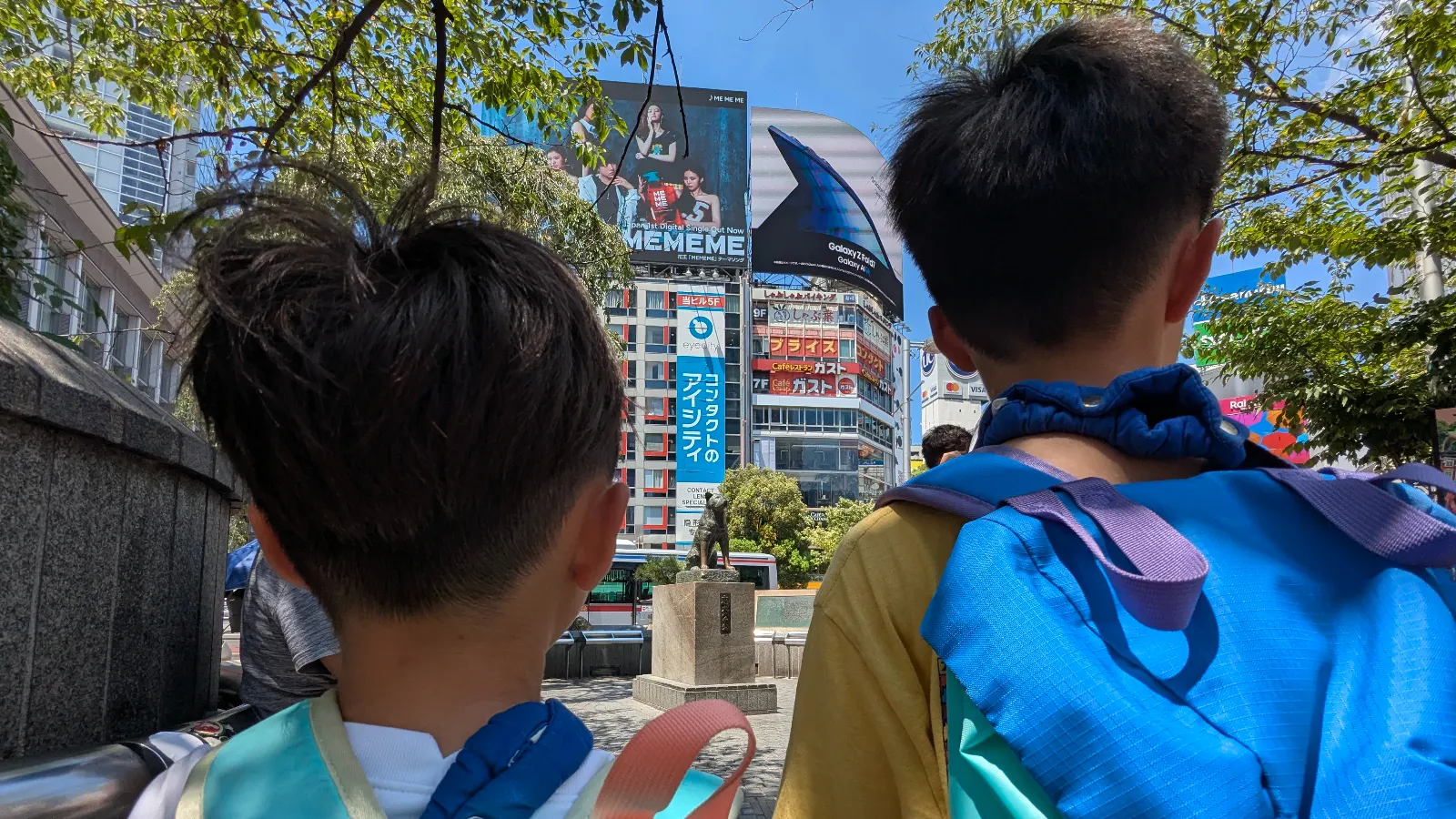
For the Anchor
Stops with confirmed, predictable structure.
For a child who depletes through unfamiliarity and unconfirmed structure, the strongest stops are Shibuya Sky and the character shops.
A timed ticket, a fixed elevator route, and a single defined platform make Shibuya Sky one of the most structurally predictable things to do in the district, which is exactly what an Anchor needs. The sequence can be confirmed in advance and nothing about it improvises. A younger Anchor is reassured by the clear up-and-down format; an older one anticipates the view they already know is coming.
Who it costs.The Sensor, at high risk at the open-air edge during peak slots, where wind, height, and crowd compress at once.
How to make it work.Book a specific timed slot in advance so the Anchor has a confirmed sequence, and choose an off-peak slot to keep the Sensor cost down.
If this isn’t your child: the best high view in Shibuya, worth booking for the sight alone.The flagship character stores in Shibuya PARCO are internationally familiar in a way little else in the district is: a child who knows Pokemon or Nintendo arrives already oriented, which is precisely the reference point an Anchor relies on. The format is contained and the brand is the structure. A younger Anchor recognizes the characters on sight; an older one navigates a store they have effectively visited before through the brand.
Who it costs.The Sensor, at high risk at peak. The floors run dense, bright, and merchandise-saturated, and at busy times the aisles are crowded enough that leaving is itself hard.
How to make it work.Go at opening on a weekday, before the floor fills, so the Anchor gets the familiarity without the Sensor paying the peak-density cost.
If this isn’t your child: a fun, brand-driven browse, though not a reason to plan the day around it.For the Sprinter
Short, low-stamina stops with little walking.
For a child who depletes through sustained walking and standing, the strongest stop is the Hachiko Statue.
The Hachiko statue is a fixed, low-walk landmark steps from the station exit: a quick, sit-nearby stop that asks almost nothing of a low-stamina child’s legs. For the Sprinter it is the cheap anchor point of a Shibuya visit, a real stop that costs no stamina. A younger Sprinter hears the dog’s story in two minutes; an older one gets the photo and moves on rested.
Who it costs.The Sensor, at high risk in the dense plaza crowd that gathers around the statue at peak.
How to make it work.Take it in passing on the way to or from the station rather than as a queue, so the Sprinter spends no standing time waiting for a clear shot.
If this isn’t your child: a 5-minute landmark and a good story, easy to fold into any route.Open with the child who runs short first.
The order of a Shibuya day is set by Reserve, not by the map. Each route opens with the stop that protects the named child, then chains to the nearest compatible one.
Settle these first. Shibuya Sky is timed entry: book the slot in advance, because a booking-gated stop controls the day’s shape more than the route does. The character shops are calmest at opening on a weekday. Everything else is walk-up fill-in arranged around those two.
When to go, and what costs nothing.
Late morning on a weekday is the widest window: lively enough to feel like Shibuya, calm enough to protect a sensory-sensitive child. Evenings are safe with kids and genuinely spectacular from above, with the lit crossing best seen from Shibuya Sky or a cafe window rather than crossed at the peak. The free stops carry real weight here: the crossing, the Hachiko statue, and the Miyashita and Yoyogi rooftop and park spaces all cost nothing, and they are also the stops that protect a child’s Reserve best, so the free route and the calm route are largely the same route.
Three bases that fit a family’s Reserve.
A shortlist chosen for location logic, not price tier. The full set is in the complete Shibuya hotel guide.
| Property | The LuNi Reason | Budget |
|---|---|---|
| LUNI Pick Trunk Hotel Tokyo Cat Street On the calmer Cat Street side | A boutique base set back from the crossing on Cat Street, the quieter spine between Shibuya and Harajuku. The lower-stimulation location protects a Sensor’s evening reserve while keeping both districts within a short flat walk. | ¥¥¥ |
| Hyatt House Tokyo Shibuya Walk to the station | Extended-stay suites with kitchenettes that hold an Anchor’s routine across a multi-night trip, and room to spread out at the end of a high-stimulation day. | ¥¥ |
| Dormy Inn Premium Shibuya Jingumae Near Harajuku | Public baths and family rooms close to the Meiji Jingu side of the district, a calmer base that pairs naturally with the Sensor’s quiet-first route. | ¥ |
Budget: ¥¥¥
Budget: ¥¥
Dormy Inn Premium Shibuya Jingumae
Budget: ¥
For every family-friendly option in the district, see the full Shibuya family hotel guide.