Tottori Sand Dunes with Kids: an open run, a draining climb.
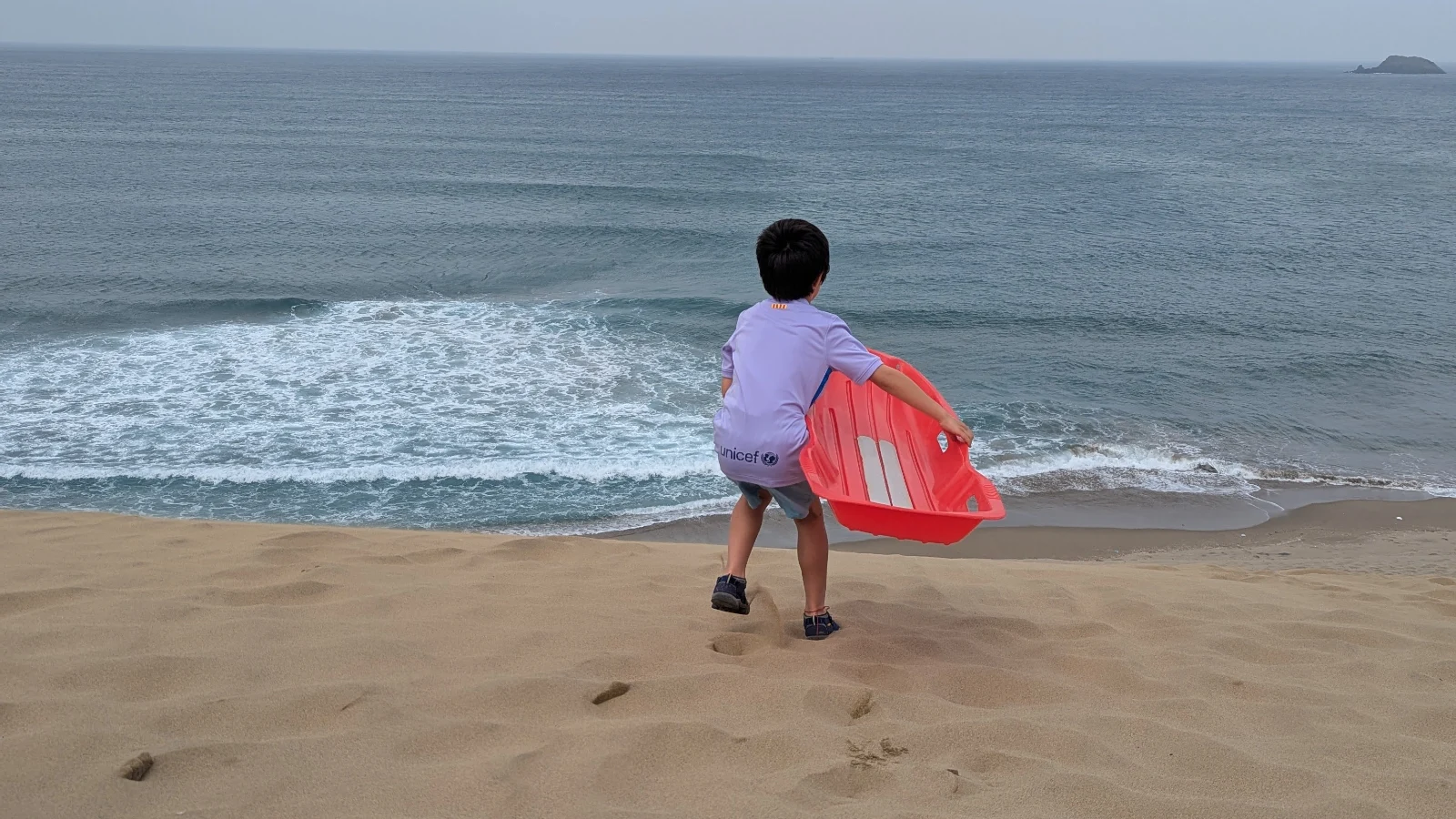
The dunes are free, gateless and wide open, and the chairlift runs between the Sakyu Center hill and the sand, which leaves the climbing to a family’s own legs.
Chairlift round trip ¥500 adults, ¥300 ages 4 to elementary; parking ¥500 per car. No booking needed.
Open land with no gate; the Visitor Center keeps 9:00 to 17:00 and the chairlift 9:30 to 16:00.
The Uma-no-se ridge and back, with time to play on the sand.
The chairlift charges from age 4; a child who can sit alone may sit on a camel for a photo.
Stairs at the dune entrance, then a steep sand slope to the Uma-no-se ridge.
Some links on this page are affiliate links. LuNi may earn a commission at no extra cost to you.
Is Tottori Sand Dunes worth it with kids?
The short version, before the costs, the timings and the case for each child.
Yes, and for a child who needs space it is a remarkable day out. The dunes are free, have no gate and need no booking, so a family simply walks onto the sand and decides for itself how far to go. The honest caveats are about legs and expectations. The chairlift carries a family between the Sakyu Center hill and the dunes, but the climbing on the sand is on foot, and soft sand is slow going for small feet. The chairlift and the Visitor Center frame the day, and the sand in between belongs to the child. Plan the Visitor Center’s roofed rest space for lunch, choose a turnaround point before setting out, and let the child run. A child who knows from the start that the walk back is part of the plan saves legs for it.
Planning Your Visit to Tottori Sand Dunes with Kids.
Three decisions shape the day on the dunes. The first is how to arrive, because there is no railway: buses run from Tottori Station in about 20 minutes, and a family driving uses the main parking lot, since the Visitor Center has no parking of its own. The second is the chairlift, which runs through the day between the Sakyu Center hill and the dunes, with a stop at each end, and saves the walk down to the sand, though not the climb on it, which is the part that tires a child most. The third is where to stop and eat, and the answer is the Visitor Center’s roofed rest space, which takes packed lunches. Pack one, and the middle of the day has a fixed place to rest. Closed shoes and sun cover belong at the top of a Japan packing list for this day.
Every LuNi attraction guide starts with a visit, with our own children
LuNi rates and writes about attractions only after visiting them with children. Luca and Nico were at Tottori Sand Dunes, and what they did there is recorded further down this page, including how each child actually met it.
Children arrive with different tolerances: for noise, for lines, for standing still, for being on their feet all day. A guide written for the average of them helps almost nobody. So every place on this site is read four ways, and each verdict says which children it already suits and what makes it work for the rest. Whoever you are bringing, the answer here is built for your family rather than for a general reader.
Restricted-movement depletion has nowhere to build on free, gateless sand with no set route, so let the child run and choose the turnaround.
Sensory-input depletion builds in an open landscape of sand, sun and wind, so plan the Visitor Center’s roofed rest space before anyone needs it.
Unfamiliarity and unconfirmed structure grow on a gateless landscape with camel and chairlift rules that change by day, so fix the plan before arriving.
Sustained walking and standing on soft sand, with a chairlift that stops at the dunes, make this a heavy day for tired legs.

Hotels we would book for this visit.
One family hotel here, a base in Tottori city three minutes on foot from Tottori Station, for a family arriving by train and taking the bus from the station, about 20 minutes, out to the dunes early the next morning. Early leaves the afternoon free.
| Property | The LuNi Reason |
|---|---|
| LUNI Pick Hotel New Otani Tottori About 15 minutes by car to the dunes | The New Otani, a full-service city base for one night by the dunes, three minutes on foot from the station at both ends of the day, with the bus doing the work of getting the family out to the sand in the morning and back again once small legs are done. After the sand, the evening asks nothing of legs. |
Nearby attractions, matched to your child.
Two pairings at the dunes’ own edge: the free Visitor Center, with a roofed rest space for a child who has walked further than planned, and the camels, whose rules for each kind of day can be told to a child well in advance.
| Pairing | Why This Solves the After-Visit | For Your |
|---|---|---|
| LUNI Pick Tottori Sand Dunes Visitor Center Free, 9:00 to 17:00 | Not a second sight but the dunes’ own building: free, with a roofed outdoor rest space where packed lunches are allowed, and drinks allowed on its first floor. Sustained walking and standing on sand need a planned seat, and this is the roofed place for lunch at the dunes’ edge. | Sprinter |
| Camel photos by the dunes Photos daily when running; rides on some weekdays | The camels belong to the dunes themselves rather than to a second sight, and their rules are fixed in advance for each kind of day, with photographs rather than rides at the busy times. Unfamiliarity and unconfirmed structure ease when a child hears the photo, not the ride, before arriving. | Anchor |
Tottori Sand Dunes Visitor Center
Free, 9:00 to 17:00 For YourSprinter
Camel photos by the dunes
Photos daily when running; rides on some weekdays For YourAnchor
How two children actually met this attraction.
Two children arrived at the same dunes and met them in opposite ways. One of them would not set foot on the sand until he understood it, and then climbed with a goal and a plan. The other needed nothing explained at all and was moving before the family had finished looking around. The dunes gave both of them a very good morning, which is their great strength: they suit the child who needs a reason and the child who needs space. What they do not do is look after a tired child, and that is the part of the plan a parent owns, from the choice of turnaround point to the lunch stop under a roof. Decide those two things before the family leaves the bus, and the dunes look after the rest.
Luca wanted the dunes explained before he was willing to climb them. He asked how a desert like this ends up on a coast in Japan, and only once he had an answer did he treat the ridge as a target worth reaching. He hung back at the base, watching how the sand moved. Once the climb had a stated objective, reaching the top for the view over the sea, he set off with a plan.
This is the Anchor pattern, with an analytical hook. A child whose Reserve depletes through unfamiliarity and unconfirmed structure meets a landscape with no gate, no route and no edges by looking for something to fix it in place. Families with a similar child should arrive with the fixing already done: a reason the dunes are there, a named goal to reach and a turnaround agreed on in advance, so the open sand has a shape before the child steps onto it.
Nico met the dunes with his whole body and no preamble. He ran down every slope he could find, dropped to roll, dug with both hands, filled his shoes without noticing, and stayed in near-constant motion from the moment he reached the sand. He needed no explanation and asked for none; the hill was simply the best thing anyone had handed him to move on. His strongest stretch was early, before the sand heated.
This is the Dynamo pattern. A child whose Reserve depletes through restricted movement treats open sand as one long channel for it, which is why running, rolling and digging here read as energy well spent rather than trouble. Families with a similar child should put the dunes early in the day and give the child the space without a route, then plan a seated stop afterward, because a Dynamo who has run on sand has spent more than it looks.
Sand dunes stretching toward the sea give a child something rare: a landscape with no path, no fence and no instructions. Running, jumping and climbing across open sand lets a child test their body against something vast and simple, and that freedom is a joy in itself. For a smaller child, even the effort of climbing a slope of soft sand is an adventure. A place this open teaches children that the natural world can be a playground and a teacher at the same time.
The LUNI Rating for Tottori Sand Dunes.
One fact runs under all four verdicts: the dunes are pure open space, free and gateless, and they give a family nothing it does not bring. The child who needs to move is given everything, sand and space alike. The child sensitive to input and the child who needs structure are given very little to hold, so both need a plan. The child who tires meets soft sand, a chairlift that leaves the climbing to him, and shelter only at the edges, and so pays the most. Plan the Visitor Center as the day’s middle, and even that child has a seat to aim for.
Let the child run, and choose the turnaround. The Dynamo depletes through restricted movement, and the dunes restrict nothing. There is no entry gate, no fee, no booking and no set route across the sand, so a child who needs to move can simply start moving the moment the family arrives. The chairlift from the Sakyu Center hill shortens the approach, and from there the sand is open ground in every direction. For this child it is space without conditions, and nothing needs to be explained first.
The only decision for the parent is where the running stops. Open sand gives no natural end, and a moving child will go further than the legs back can manage, so agree on a turnaround point before setting out and hold to it. Put the visit early, when a Dynamo’s energy runs highest. Swimming along the coast is banned under the dune ordinance, so make the sea the view rather than the goal, and plan the roofed rest space at the Visitor Center as the finish line.
What this means for your Dynamo: open sand discharges restricted movement completely. A younger Dynamo needs a turnaround agreed on in advance; an older one can set the goal and pace the return.Plan the shelter before the sand. The Sensor depletes through sensory input, and the dunes are a landscape with very little shelter in them. The sand is everywhere, underfoot, in the shoes and in the wind. The roofed place for a packed lunch is the Visitor Center’s outdoor rest space; inside, the first floor takes drinks only and the second no food or drink at all.
It stays manageable if the shelter is part of the plan rather than a rescue. Start at the Visitor Center, show the child where the roofed rest space is, and set a time to come back to it. Keep the time out on the sand to a length the child agrees to, and dress for the sun and the wind. The camels are optional, so a child who dislikes crowds or large animals can skip them without missing the point of the day.
What this means for your Sensor: sensory input comes from sand, sun and wind with little cover. A younger Sensor needs the roofed rest space shown first and a short time out; an older one can set their own time on the sand.Fix the plan before the dunes do not. The Anchor depletes through unfamiliarity and unconfirmed structure, and the dunes offer almost none of their own. There is no gate to pass, no ticket to show and no marked route, and two of the attractions change by the day: the camels are photographs only on weekends, holidays and school breaks, mostly photographs on weekdays, and can stop without notice, while the chairlift’s hours shift with the season, the weather and maintenance. Everything else is simply open sand.
So the family has to bring the structure. Before arriving, tell the child the order of the day: the bus from Tottori Station, about 20 minutes; the Visitor Center first, open 9:00 to 17:00; the chairlift if it is running; the walk out to a named goal and back; lunch under the roof. Promise camel photos, not a ride. With that frame in place, the open sand becomes a space inside a plan rather than a space with no plan at all.
What this means for your Anchor: a gateless landscape with changing extras leaves structure to the parent. A younger Anchor needs the order of the day told; an older one can hold the plan and the turnaround.Decide how far before the sand decides. The Sprinter depletes through sustained travel-style walking and standing, and the dunes stack every cost against this child. There is no railway, so the day starts with a bus of about 20 minutes or a drive to the main lot, since the Visitor Center has no parking. The chairlift carries a family between the Sakyu Center hill and the dunes, but the climbing on the sand is on foot, and soft sand is slow, heavy walking.
The honest reading is a hard one, and the answers are about limits. Ride the chairlift, 300 yen round trip for a child aged 4 through elementary school, to save the walk down to the sand. Decide before setting out how far the child walks, and turn back at half of what they feel they could do, because the return is the same sand. Keep one parent free to sit with a tired child, plan the Visitor Center’s roofed rest space for lunch, and leave the afternoon for something seated.
What this means for your Sprinter: soft sand and a chairlift that stops short of the climb make the walking heavy. A younger Sprinter needs a short, agreed distance; an older one can climb further if the way back is budgeted.The questions parents actually ask.
The Tottori dunes are simpler to plan than most places, because so much is free and open. There is no fee, no gate and no booking. The complications are all at the edges: the camels are usually a photograph, the chairlift links the hill with the dunes but does not do the climbing, swimming is banned, and a packed lunch goes to the Visitor Center, which is free and opens at 9:00, so it works as the start and the finish of the day. The dunes suit a family drawn to Japan’s places off the usual route, since the day is what the family brings.
Is Tottori Sand Dunes worth visiting with kids?
Yes, for a child who likes wide open ground, and the dunes cost nothing: there is no entry fee and no gate. What they ask for is walking. The chairlift links the Sakyu Center hill with the dunes, but every step on the sand itself is on foot, so plan for a tired younger child and bring something to sit on.
Can kids ride the camels at the Tottori Sand Dunes?
Usually only for a photograph. On weekends, national holidays, all school breaks, Golden Week and Silver Week the camels are photo sessions only, and on weekdays they are mostly photo sessions too; they can stop without notice. A child who can sit alone may sit on a camel for a 650-yen photo; on a weekday when rides run, a ride costs 1,600 yen.
Does the chairlift take you to the top of the Tottori dunes?
It takes a family between the Sakyu Center hill and the dunes, running 9:30 to 16:00, with hours that shift with the season, the weather and maintenance. The climbing on the sand is still on foot. A round trip costs 500 yen for adults and 300 for children aged 4 through elementary school; one way, 300 and 200.
Do you need tickets or a booking for the Tottori Sand Dunes?
No. The dunes are free, with no entry gate, and a free visit needs no booking, either for the dunes or for the Visitor Center. Only guided visits are arranged in advance. The Visitor Center is free as well, open 9:00 to 17:00, and it makes a sensible first stop for a family arriving by bus.
How do you get to the Tottori Sand Dunes?
There is no railway to the dunes. Buses run from Tottori Station to the Sakyu Kaikan or Sakyu Higashiguchi stops, about 20 minutes. By car, the Tottori Sand Dunes parking lot charges 500 yen per car for 24 hours and has about 300 spaces; the Visitor Center has no parking of its own.
Where can you eat a packed lunch at the Tottori Sand Dunes?
The Visitor Center has a roofed outdoor rest space where packed lunches are allowed. Inside, the first floor allows drinks only and the second floor no food or drink at all. It is the place for a packed lunch; the Sakyu Center at the top of the chairlift has a restaurant and a viewing terrace for a bought one.
Can children swim at the Tottori Sand Dunes?
No. Swimming along the dune coast is banned under the local dune ordinance, which also covers graffiti and littering. A family should also know that sledding needs no permission, but only on the east side of the Umanose ridge, with care around sandboarders, and the sled goes home with you.
Can you take photos at the Tottori Sand Dunes?
Yes, and a family’s own snapshots need nothing. Advance notice is needed for shoots with props or backdrops, TV coverage, group shoots and drones. When posting to social media, the Visitor Center asks visitors not to show third parties who could be identified, which is worth telling an older child with a phone before the dunes.
Where Tottori Sand Dunes fits your Japan trip.
Official site and opening information: Tottori Sand Dunes Visitor Center