Edo Wonderland Nikko Edomura with Kids: A village to play, not watch.
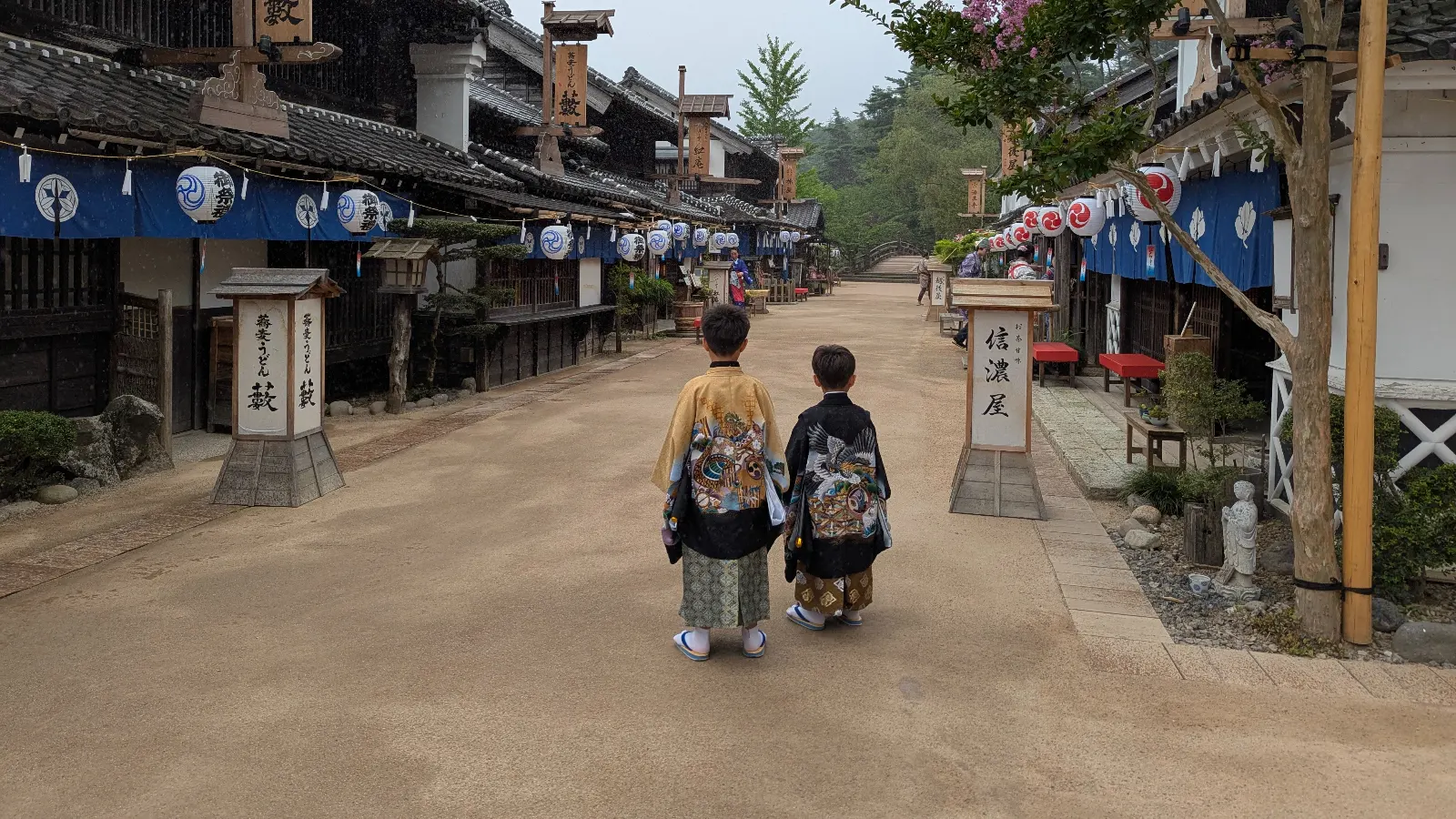
A day in a village of lanes and theaters is freedom to a child who needs to move and a long day on foot to a child whose legs tire first.
Preschoolers free; the afternoon ticket, from 14:00 (13:00 in winter), is ¥5,000 and ¥2,600. No booking needed.
9:30 to 16:00 in winter; closing days are irregular and set on the park’s calendar.
Same-day re-entry on showing the ticket, so a break outside fits.
The child samurai experience is for ages 5 to 12; children’s costumes fit from 80 cm to sixth grade.
At the office in front of the entrance gate, for children up to 4 years and 18 kg.
Some links on this page are affiliate links. LuNi may earn a commission at no extra cost to you.
Is Edo Wonderland Nikko Edomura worth it with kids?
The short version, before the costs, the timings and the case for each child.
Yes, for most children, and the real decision is how much of the day to buy. Edo Wonderland is an Edo-period village on the Kinugawa side of Nikko, crossed on paved lanes, with costumes to rent, experiences to try with the hands and shows staged in its theaters, on a ticket that runs for the whole day or from mid-afternoon. A child who needs to move gets a whole village to cover and plenty to do rather than watch. The child it asks most of is the one whose legs tire first, because the village is crossed on foot and the ticket runs until closing. Two choices change the outcome: whether to arrive at opening or buy the afternoon ticket, and whether a costume is the plan, because changing takes 30 to 45 minutes, depending on the costume, plus the wait.
Planning Your Visit to Edo Wonderland Nikko Edomura with Kids.
Three decisions shape the day, and all three are made before the gate. The first is the ticket. The full day starts at opening; the afternoon ticket starts mid-afternoon and costs less, and for a young family it is usually the better buy. The second is the costume. Rentals are first come on the day, changing takes 30 to 45 minutes, depending on the costume, plus the wait, and only the child wearing it goes into the changing room, so decide in the car whether it is the plan. The third is the way home. The park’s free shuttle to JR Nikko and its direct bus to Tokyo leave on fixed schedules but not on Wednesdays, and a route bus runs to Kinugawa Onsen Station, so pick the ride before the day, and with it where the park sits among Nikko’s other family stops.
Every LuNi attraction guide starts with a visit, with our own children
LuNi rates and writes about attractions only after visiting them with children. Luca and Nico were at Edo Wonderland Nikko Edomura, and what they did there is recorded further down this page, including how each child actually met it.
Children arrive with different tolerances: for noise, for lines, for standing still, for being on their feet all day. A guide written for the average of them helps almost nobody. So every place on this site is read four ways, and each verdict says which children it already suits and what makes it work for the rest. Whoever you are bringing, the answer here is built for your family rather than for a general reader.
Restricted-movement depletion stays low in a village covered on foot with experience areas to try, so let the child pick the lanes and ration the shows.
Sensory-input depletion concentrates in the theaters, where the show sets the volume and the pace, so choose shows ahead and sit where leaving is easy.
Unfamiliarity and unconfirmed structure ease when the day runs on fixed times, opening, the shuttle in and the ride home, so read them aloud before arriving.
Sustained walking and standing build over a day in a village covered on foot, so buy the afternoon ticket or rent a stroller to age 4.
- Cost
- ¥5,800 junior high and up / ¥3,000 elementaryPreschoolers free; the afternoon ticket, from 14:00 (13:00 in winter), is ¥5,000 and ¥2,600. No booking needed.
- Booking
- Walk up, or e-ticketNo reservation for parties of up to 20; an e-ticket skips the window line, and only the Oiran costume is booked ahead.

Hotels we would book for this visit.
Three bases chosen for the ride home rather than the room: two in Kinugawa Onsen, where the park’s route bus starts, and one in Nikko town, a short bus from the station the free shuttle leaves from.
| Property | The LuNi Reason |
|---|---|
| LUNI Pick Hoshino Resorts KAI Kinugawa About 15 minutes on foot from Kinugawa Onsen Station | The park’s route bus leaves from Kinugawa Onsen Station, and this is a walk from it, so a family reaches the gate without a car and is back before a tired child starts asking how much longer. It suits a family giving the village one whole day, with nothing to catch afterward but a short ride and a walk. |
| Asaya Hotel In Kinugawa Onsen | A second Kinugawa base, on the same logic: the park’s bus starts in this town, and Tobu World Square is a short ride from the same station, so a family can give the village one day and the miniature park the next without packing a bag in between. Two days, two different kinds of tired, one room. |
| Nikko Kanaya Hotel Near the Shinkyo bus stop, in Nikko town | For the family pairing the park with the shrine. On the days it runs, the free shuttle leaves from JR Nikko Station, a few minutes by bus from the hotel’s stop, and brings the family back to that station at a time you can know before you set out. The costume day and the shrine day share one base. |
Nearby attractions, matched to your child.
Three pairings for what a day in the village leaves over: legs that did all the walking, senses that did all the watching, and a child who wants tomorrow settled before it starts. Two are up the mountain, one back toward Kinugawa.
| Pairing | Why This Solves the After-Visit | For Your |
|---|---|---|
| LUNI Pick Kegon Waterfall Free shuttle to JR Nikko, then the Tobu bus up | A day on foot is the whole price of the village; Kegon Waterfall charges almost nothing in legs. An elevator makes the descent to the lower deck and brings the family back up, so a child whose walking and standing reserve went on the lanes still gets the big view. | Sprinter |
| Lake Chuzenji The Chuzenji Onsen stop, beside Kegon | After a day of theaters and costumes, Lake Chuzenji is the opposite: open air and a shore that runs for kilometers. Sensory input that built up indoors settles once the child sets their own distance from everything, and the lake gives them all the distance they could want. | Sensor |
| Tobu World Square About 5 minutes by bus from Kinugawa Onsen Station | The village hands a child a role and a whole town to read. Tobu World Square is simpler to hold in the head, with free guided tours that set off at fixed times, so unfamiliarity and unconfirmed structure ease when somebody else decides the route and the start. | Anchor |
Kegon Waterfall
Free shuttle to JR Nikko, then the Tobu bus up For YourSprinter
Lake Chuzenji
The Chuzenji Onsen stop, beside Kegon For YourSensor
Tobu World Square
About 5 minutes by bus from Kinugawa Onsen Station For YourAnchor
How two children actually met this attraction.
Two children put on costumes in the same village and came away with two different days. One treated the place as a system to check. Every greeting, every puzzle and every scene had to hold together before he would give himself to it, and for him it held. The other treated it as a place to act, where a costume was a license to be answered and a chase through the lanes beat any scene he was asked to sit and watch. Neither of them cared about the history. What they had in common is the reason the village works for so many children: it gives a child something to do with the role they are wearing, whether that means testing the role or using it.
Luca read the village as a world to be tested for consistency, and it passed. He wore the Lord costume and clocked the rule underneath it: the guards saluted and the townspeople bowed, every time, and no one broke character. He worked the trick mansion and the maze as puzzles rather than runs, and the ninja show held him completely. Asked afterward for a favorite, he named the ninja show, “because it seemed so real.”
This is the Anchor pattern. A child whose Reserve depletes through unfamiliarity and unconfirmed structure settles once a strange place behaves the same way twice, and Luca’s way of finding out was to watch whether the village kept its own rules. Families with a similar child should give that checking time rather than hurrying it: take the costume early if it is the plan, walk one lane slowly before the first show, and let the child confirm the place before asking them to enjoy it.
Nico latched onto everything he could act on. Being a Lord was fun mainly because people had to bow to him, a response he could trigger; the ninja activities were better still because he did them with his hands, and chasing the villain through the streets was the part he kept coming back to. Asked for a favorite, he could not pick one, because he had loved doing all of it.
This is the Dynamo pattern. A child whose Reserve depletes through restricted movement meets a place through what it lets them do, and every one of Nico’s favorites was an action: triggering a bow, working a ninja activity with his hands, running after a villain. Families with a similar child should build the day from things to do and treat each theater as a short pause between them, so the seated parts stay the exception the child agrees to rather than the shape of the day.
A village of old lanes, theaters and costumes invites a child to step into another time and play a part in it. Dressing up, watching performers and wandering streets built to feel like the past turns history into make-believe with real details, and children learn a great deal through play. For a hesitant child, the first minutes in costume are a small act of bravery. A day spent pretending to live in another era teaches that the past was full of ordinary people, not only famous names.
The LUNI Rating for Edo Wonderland Nikko Edomura.
One fact sits under all four verdicts: Edo Wonderland is a village sold by the day and crossed on foot, with its shows indoors in theaters and its experiences out along the lanes. That shape suits a child who needs to move, because there is always somewhere to go next, and a child who needs the day fixed, because the gate, the shuttle and the ride home all keep set times. It asks more of a child who takes in everything, because a theater sets its own volume, and of tired legs, because the ticket runs until closing and the lanes are walked the whole way.
Let the child pick the lanes. The Dynamo depletes through restricted movement, and Edo Wonderland is mostly movement. The village is crossed on paved lanes, the experience areas are there to be done rather than watched, and a costume turns walking around into playing a part. For a child whose Reserve drains whenever the body is held in place, a whole village to cross, with a reason to cross it, is close to ideal. The ninja costume even comes with a sword the child takes home, which tells a moving child exactly what kind of day this is.
The real restrictions are the theaters and the wait at the costume counter. A show is seated, and a child who needs to move is asked to hold still until the scene ends. Treat the shows as a ration rather than a checklist: choose one or two, place them between long stretches on foot, and let the child spend their energy before the curtain rather than during it. Same-day re-entry means even a walk back to the car can serve as a reset.
What this means for your Dynamo: restricted movement arrives in the theaters and the costume wait. A younger Dynamo needs one short show at most, placed between lanes; an older one can take the ninja costume and run the village as a mission.Choose the shows before the gate. The Sensor depletes through sensory input, and at Edo Wonderland the input is not spread evenly. Out on the lanes a child sets their own distance from everything, moves away from whatever is too much, and chooses what to look at. Inside a theater the show chooses for them: the volume, the pace and the moment it ends all belong to the performance, and a child seated in a row cannot step back from it. That concentration is the whole difficulty, and it is also why the difficulty is manageable. A parent who knows where the load sits can decide how much of it to take.
Give this child a choice and an exit. Pick one or two shows in advance rather than taking every show in turn, and sit where leaving is easy. Watch the weather, because some experiences move indoors when it rains and one theater’s show can be called off, so a wet day puts more of the visit inside. Same-day re-entry is the release valve: a child who has had enough can leave the village for a while and come back.
What this means for your Sensor: sensory input gathers in the theaters. A younger Sensor needs one show, taken early, from a seat where leaving is easy; an older one can choose the shows and decide when to step out.Read the day’s times aloud before you leave. The Anchor depletes through unfamiliarity and unconfirmed structure, and Edo Wonderland is an unfamiliar world run on a very fixed clock. The gate opens at a set hour, the free shuttle from JR Nikko arrives on a schedule except on Wednesdays, the afternoon ticket starts at a set time, and the ride home, the shuttle back on the days it runs or the route bus to Kinugawa Onsen Station, can be chosen before the day begins. The strangeness is all inside the village. The structure around it can be stated in full, and for this child it should be.
The one unknown worth preparing is the costume. Rentals are first come on the day, changing takes 30 to 45 minutes, depending on the costume, plus the wait, and only the child wearing it goes into the changing room. For a child who needs to know what happens next, that is the moment to rehearse: who goes in, how long it takes, where the parent will be. Once the costume is on, the role itself gives the child a part to play, and a part is its own kind of structure.
What this means for your Anchor: unfamiliarity sits inside a day whose times are fixed. A younger Anchor needs the changing room explained before arrival; an older one can plan the ride home and the order of the day.Buy less of the day. The Sprinter depletes through sustained travel-style walking and standing, and Edo Wonderland is sold by the day and walked on foot. The lanes are paved and the village can be toured by wheelchair, but it is still a village, and the experiences, the shows and the costume changing all add standing to the walking between them. What keeps it manageable is that the way home is easy: the route bus to Kinugawa Onsen Station leaves from the park itself, and so does the free shuttle to JR Nikko except on Wednesdays, so the end of the day is a seat rather than a search for a stop.
The right ticket does half the work. The afternoon ticket starts mid-afternoon and costs less, and for a child whose legs tire first it is the right amount of village. For a child up to age 4 or 18 kg, rent a stroller for the day at the office in front of the entrance gate, and leave bags in the lockers there. Then plan backward from the ride home, and stop before the legs do rather than after.
What this means for your Sprinter: walking and standing add up over a full ticket. A younger Sprinter needs the afternoon ticket and, to age 4, a rented stroller; an older one can manage a longer day if the ride home is fixed first.The questions parents actually ask.
Money and hours are tied together at Edo Wonderland more tightly than at most parks, and both decide the day. The ticket can be a whole day or an afternoon, each costume has its own price, and the shuttle and the direct bus decide when the day ends. Settle the ticket, the costume and the ride home before arriving, and the village becomes a day of choosing what to do next. A child who wants a shorter day with a clear start and finish has the Ashio Copper Mine Museum, a short trolley ride in and a walk back out.
Is Edo Wonderland Nikko Edomura worth visiting with kids?
Yes, for most children. It is an Edo-period village crossed on foot, with costumes to rent, experiences to try with the hands and shows staged in its theaters. A child who needs to move does well here. Plan around a child who finds seated shows too much, and around tired legs, and consider the cheaper afternoon ticket for both.
How much does Edo Wonderland cost for a family?
A one-day ticket is 5,800 yen for adults and junior high students and 3,000 yen for elementary children, and preschoolers enter free, so two adults and two elementary children pay 17,600 yen. The afternoon ticket costs 5,000 and 2,600 yen and starts at 14:00, or 13:00 in winter, which makes it the better buy for a short day. Parking is extra.
How much are costume rentals at Edo Wonderland?
On the price list valid to March 2027, children’s costumes start at 3,800 yen and adults’ at 4,500 yen. A child’s ninja costume comes with a sword to take home, and the Lord and Princess costumes are 12,000 yen. Only the Oiran costume is booked, a week ahead. Changing takes 30 to 45 minutes, depending on the costume, plus the wait, so do it first.
Do you need to book Edo Wonderland tickets in advance?
No. Individuals and groups of 20 or fewer buy tickets at the window on the day, and an official e-ticket bought in advance lets you skip the window line. Costume rentals take no reservations and are first come on the day, except the Oiran costume, which is booked a week ahead and limited to one a day.
What are Edo Wonderland’s opening hours?
9:00 to 17:00 from March 20 to November 30, and 9:30 to 16:00 from December 1 to March 19. The park closes on days set by its operating calendar, so check the calendar for your date. Re-entry on the same day is allowed on showing your ticket, and the free shuttle does not run on days the park is closed.
How do you get to Edo Wonderland from Nikko or Kinugawa Onsen?
From March 20 to November 30, except Wednesdays, a free shuttle runs to the park from the Toshogu Omotesando and JR Nikko Station, about half an hour from JR Nikko, and a winter schedule runs too. From Kinugawa Onsen Station, the route bus takes about 15 minutes, and a taxi is quicker. By car, it is about 15 minutes from Imaichi IC.
Can you visit Edo Wonderland and Nikko Toshogu Shrine in one day?
Yes, on the days the free shuttle runs. Do Nikko Toshogu Shrine first, because its stairways spend a Sprinter’s walking and standing reserve, then ride the shuttle from the Omotesando, or from JR Nikko on the congestion days the park’s calendar lists. The 13:15 departure reaches the park at 14:00, when the afternoon ticket starts, though a tour group can fill it.
How does Edo Wonderland compare with Tobu World Square for kids?
Both are reached by bus from Kinugawa Onsen Station, and they suit different days. Edo Wonderland is a village to take part in, with costumes, experiences and shows, and it asks more of a child who tires or who finds shows too much. Tobu World Square is a walk among miniature buildings outdoors, with free guided tours at fixed times.
Where Edo Wonderland Nikko Edomura fits your Japan trip.
Official site and opening information: Edo Wonderland Nikko Edomura