Tobu World Square with Kids: The world at 1/25, on foot.
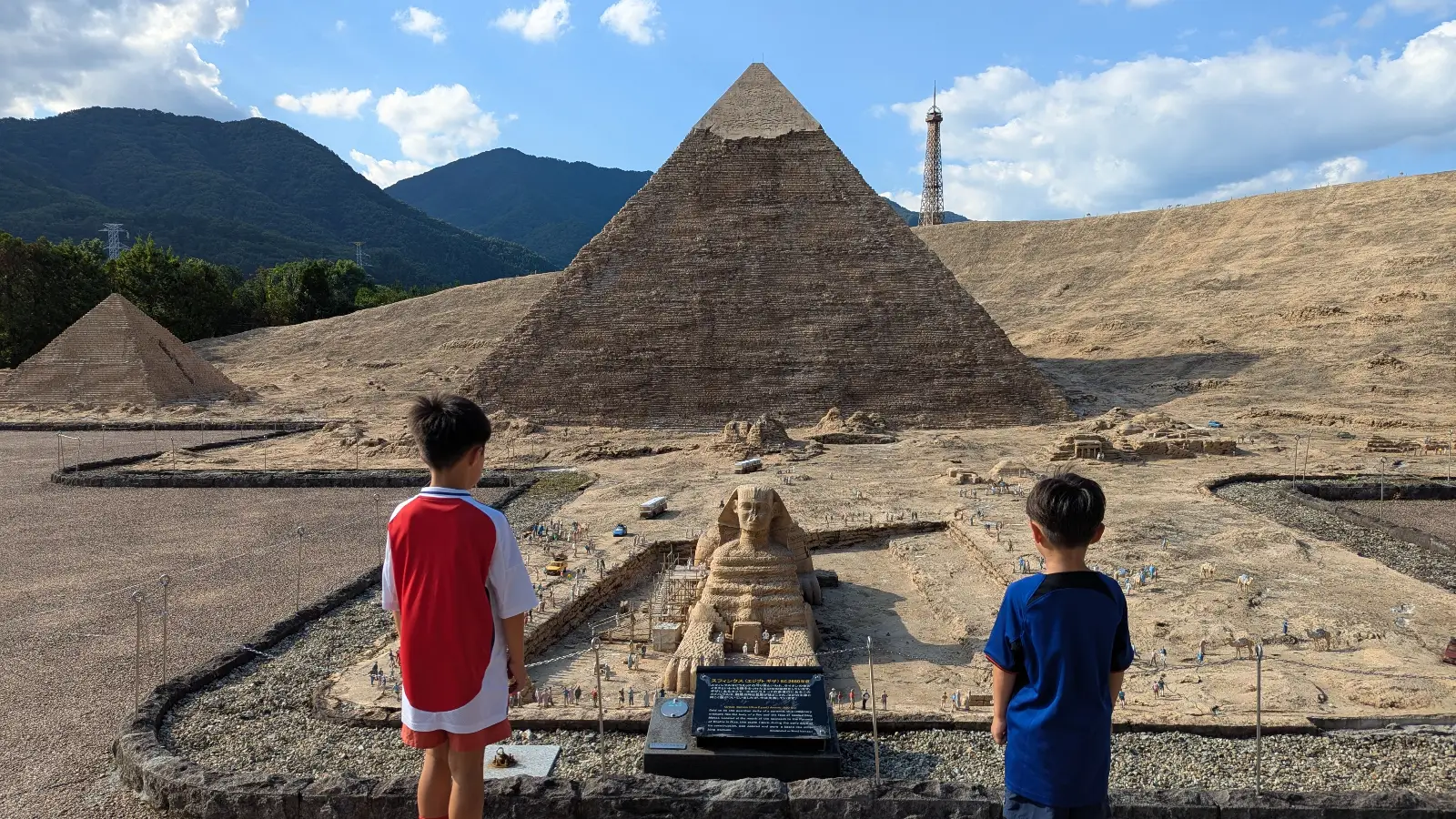
A park of the world’s famous buildings at one twenty-fifth scale is a treasure hunt for a child who needs to move and two hours of standing for one who tires.
Under 4 free; groups of 15 or more pay ¥2,500 and ¥1,300.
Check the park’s calendar before visiting; it also carries the closure days.
Every exhibit area is outdoors, with same-day re-entry through the gate.
Coin-operated models move for small hands; the free guided tours suit older children.
Rental strollers only through the Babycal service, with registration; wheelchairs are lent free.
Some links on this page are affiliate links. LuNi may earn a commission at no extra cost to you.
Is Tobu World Square worth it with kids?
The short version, before the costs, the timings and the case for each child.
Yes, for almost every child, with one plan made for tired legs. Tobu World Square is an outdoor park of model buildings from around the world, shrunk to a twenty-fifth of their size and set out in six zones on the Kinugawa side of Nikko, and a visit takes an hour and a half to two hours. A child who needs to move gets a walk with a target at every turn, and some of the models answer a coin by moving. A child who likes to know the plan can join a free guided tour at a fixed time. The hard part is the standing, because every exhibit is outdoors and there are no rides. Two decisions matter most: whether to arrange a stroller in advance, and where the family will eat, because packed lunches stay outside.
Planning Your Visit to Tobu World Square with Kids.
Three things are worth deciding at home, and the models are not one of them. The first is wheels. The park does its stroller rentals through an outside service that needs membership and a credit card, so a family counting on one should sign up before the trip; wheelchairs, by contrast, are lent free. The second is lunch. Packed lunches are not allowed in, so eat before the visit or step out for a meal and come back, since same-day re-entry only needs a word with the staff. The third is the clock. The free guided tours leave at fixed times, and arriving shortly before one gives the whole visit a spine and a start the children can be told about in the car. The park is one day among Nikko’s family days, and the easiest to hand to a child who likes to look closely.
Every LuNi attraction guide starts with a visit, with our own children
LuNi rates and writes about attractions only after visiting them with children. Luca and Nico were at Tobu World Square, and what they did there is recorded further down this page, including how each child actually met it.
Children arrive with different tolerances: for noise, for lines, for standing still, for being on their feet all day. A guide written for the average of them helps almost nobody. So every place on this site is read four ways, and each verdict says which children it already suits and what makes it work for the rest. Whoever you are bringing, the answer here is built for your family rather than for a general reader.
Restricted-movement depletion stays low on an outdoor walk where some models move for a coin, so let the child lead and carry the coins.
Sensory-input depletion stays low in open air with no public-address system in the zones, and recorded sounds sit at known models, so name them first.
Unfamiliarity and unconfirmed structure ease when a free guided tour leaves at a fixed time with somebody else leading, so arrive for one.
Sustained walking and standing fill up to two hours with no rides, so book a stroller service ahead and let a tour set the pace.
- Cost
- ¥2,800 junior high and up / ¥1,400 age 4 to elementaryUnder 4 free; groups of 15 or more pay ¥2,500 and ¥1,300.
- Booking
- Walk up, or digital ticketReservations only for groups of 15 or more; a digital ticket bought ahead makes entry smoother.
Hotels we would book for this visit.
Three bases for a park that has its own Tobu station and sits a short bus from Kinugawa Onsen Station: two in Kinugawa Onsen itself, and one in Nikko town for a family whose main event is the shrine.
| Property | The LuNi Reason |
|---|---|
| LUNI Pick Hoshino Resorts KAI Kinugawa About 15 minutes on foot from Kinugawa Onsen Station | The park is about five minutes by bus from the station this hotel walks to, which makes it the easiest morning of the three: no car, one short ride, and a family at the gate in time for the first guided tour. The ride back after two hours on their feet is just as short. |
| Asaya Hotel In Kinugawa Onsen | Also in Kinugawa Onsen, so the park stays a short bus away, and a second day can go to Edo Wonderland, whose route bus leaves from the same station. For a family planning two very different days, one of looking and one of doing, it saves moving hotels in between and keeps both mornings short. |
| Nikko Kanaya Hotel Near the Shinkyo bus stop, in Nikko town | For a family whose main event is the shrine, with the miniature park kept for a day of its own. The hotel is a few minutes by bus from the Nikko stations, and a child who spent a morning on stairways meets an outdoor walk among models the next day instead of more climbing. |
Nearby attractions, matched to your child.
Three pairings for what a walk among the models leaves over: a child who looked all morning and now needs to do something, legs that stood for two hours, and a child who wants the next day laid out in advance.
| Pairing | Why This Solves the After-Visit | For Your |
|---|---|---|
| LUNI Pick Edo Wonderland Route bus about 15 minutes from Kinugawa Onsen Station | After a morning of looking, Edo Wonderland is a day of doing: a village crossed on foot, experiences to try with the hands and a costume to wear. Restricted-movement depletion that built while a child stood at the models discharges in lanes they choose for themselves. | Dynamo |
| Kegon Waterfall The Lake Chuzenji side of Nikko | Two hours of standing at models is the bill a Sprinter pays slowly. At Kegon Waterfall an elevator makes the descent to the lower deck and the climb back, so the next big sight asks for a short walk from the bus and very little of the walking and standing reserve. | Sprinter |
| Ashio Copper Mine Museum Reached by city bus from the Nikko stations | The guided tour lends a child a route somebody else holds. The Ashio Copper Mine Museum offers the same certainty underground: a trolley ride in, one way only, then a short walk out past the displays. Said before boarding, that one direction is a plan a child can hold from start to finish. | Anchor |
Edo Wonderland
Route bus about 15 minutes from Kinugawa Onsen Station For YourDynamo
Kegon Waterfall
The Lake Chuzenji side of Nikko For YourSprinter
Ashio Copper Mine Museum
Reached by city bus from the Nikko stations For YourAnchor
How two children actually met this attraction.
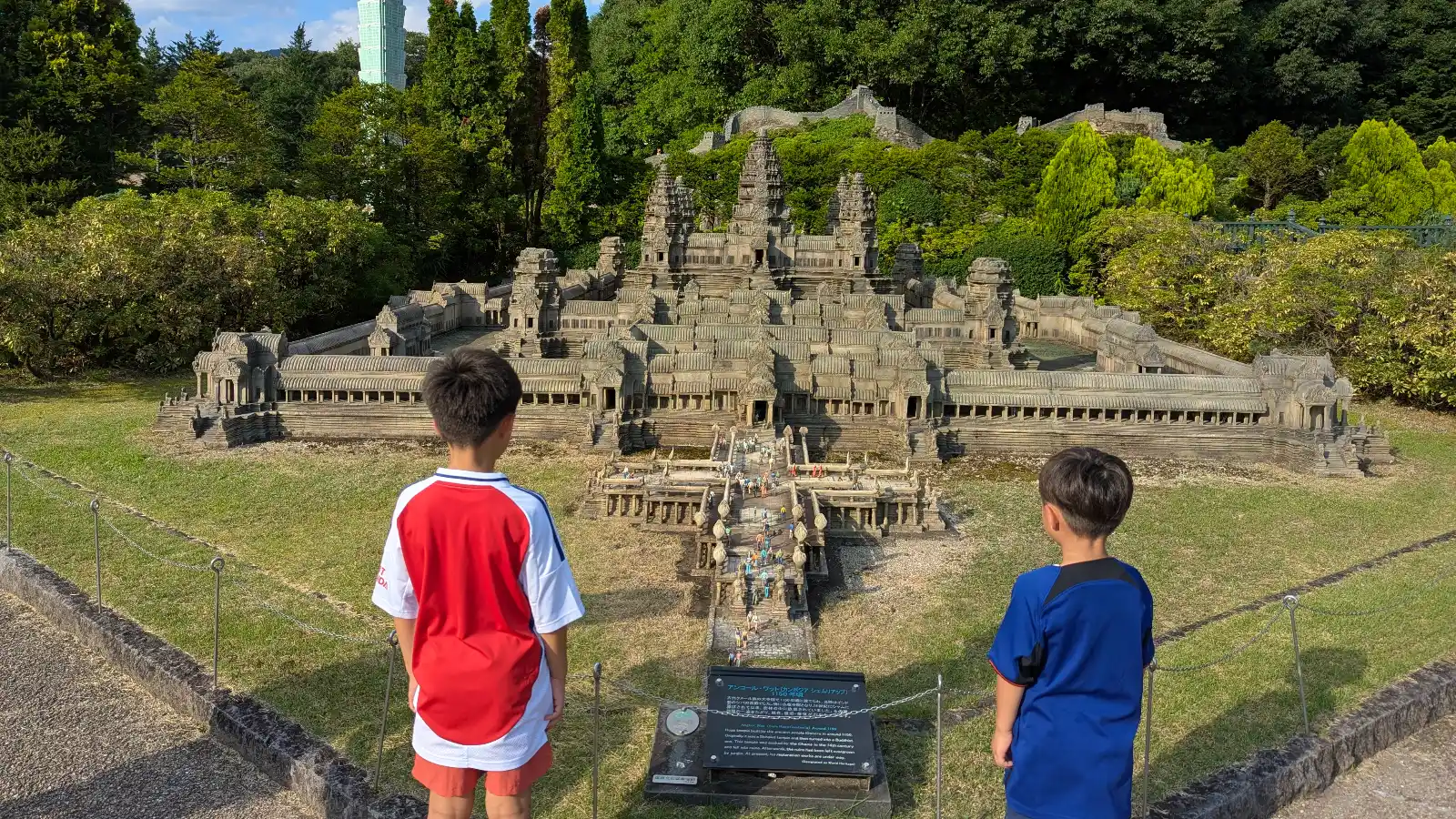
Two children walked the same miniature world and wanted opposite things from it. One came to check the world against what he already knew. He had met these buildings in books, and the park was his chance to find each one and confirm it in person, which he did methodically and with obvious satisfaction. The other came to make something happen. A model that only stood there held him for a moment; a model that did something when he fed it a coin held him far longer. Between them they show the park’s two uses, a map to be confirmed and a set of machines to be worked, and most children lean clearly toward one of them. Knowing which before the gate decides whether to bring a list or a pocket of coins.
Luca treated the park as a set of things he already knew, waiting to be confirmed in person. He worked methodically around it naming the famous landmarks as he found them, the ones he had read about and seen in books, and visibly settled once the layout made sense to him. He read the panels, lingered over the landmarks he could place, and was most at ease when each new model matched something he had already filed away.
This is the Anchor pattern. A child whose Reserve depletes through unfamiliarity and unconfirmed structure settles when the new matches the known, and Luca turned a strange park into a checklist of places he had already met in books. Families with a similar child should hand that over before the visit: a few of the buildings to look for, found together the night before, and a guided tour at a fixed time for the child who wants somebody else to set the order.
Nico latched onto the things he could act on. He lit up at the London Bridge model because it carried a name he already knew, dropped a 100-yen coin into the mechanism to make the bridge open, and sang the song as it lifted. He was less interested in looking at a model than in doing something to it and getting a response back, and the coin-operated pieces held him far longer than the static landmarks did.
This is the Dynamo pattern, working through the hands. A child whose Reserve depletes through restricted movement engages by making something happen, and a model that moves when paid is the kind of exhibit built for exactly that. Families with a similar child should carry a pocket of coins, let the child hunt for the models that answer them, and use each one as the next target, so the walk between models becomes the way to the next thing to do rather than a wait.
A park of the world’s famous buildings in miniature lets a child travel the globe in an afternoon, spotting towers, temples and palaces they may one day see for real. Small models invite close attention and endless questions about where each building stands and who built it. Children love the feeling of being giants among tiny cities. A walk through a world in miniature can spark a lifelong curiosity about faraway places, and plant the first ideas of journeys a child might dream of taking.
The LUNI Rating for Tobu World Square.
One fact sits under all four verdicts: Tobu World Square is a walk, outdoors, among models, with no rides. That suits a child who needs to move, because the walking is the visit, and a child who takes everything in, because the air is open and the sounds come from a few known places. A child who needs structure can borrow it from a free guided tour that leaves at a fixed time. What the park asks for is standing: up to two hours on foot, stopping at model after model, which is a bill that tired legs pay slowly and notice late.
Hand over the route and a few coins. The Dynamo depletes through restricted movement, and Tobu World Square is a park you cover on foot, zone by zone, outdoors, and with no rides, so every step of the movement is the child’s own. The models themselves stay put, which is the one risk: a child who needs to move can meet a hundred buildings to look at and nothing to do with them. The park answers that in places. Coin-operated play spots make figures, ships and bridges move, and the canal lock model by the Statue of Liberty works for a hundred yen.
Hand this child ownership of the day. Let the child lead the way through the six zones rather than following a map in order, give them the coins, and let the play spots set the rhythm: walk, find one, make it move, walk on. Save the guided tour for a sibling who wants it, because for this child being led is the part that restricts. A Dynamo who is steering the visit is not spending the day waiting for it to end.
What this means for your Dynamo: restricted movement stays low because the walking is the visit. A younger Dynamo needs coins and the play spots to aim at; an older one can navigate the six zones for the whole family.Name the loud models before you reach them. The Sensor depletes through sensory input, and most of Tobu World Square is open air, with no public-address system in the exhibit zones. What a child takes in is mostly visual, a great deal of detail at small scale, at their own speed and from as close or as far as they like. Some models add sound on purpose. The Tokyo Dome plays recorded crowd noise from a real baseball game, and at the Tokyo Station model the platform announcements can be heard.
Neither is a problem once it is named, and naming it is the whole lever. Say where the sounds are, let the child decide whether to walk past or stop, and bring a hat and water in summer, since every exhibit area is outdoors and the weather is the input that builds without anyone noticing. A Sensor who has been told what the park sounds like meets each noise as something chosen rather than something sprung on them.
What this means for your Sensor: sensory input stays low and the loud spots are known. A younger Sensor needs the stadium and the station named in advance; an older one can choose the route around or through them.Join a guided tour, and time the arrival to it. The Anchor depletes through unfamiliarity and unconfirmed structure, and a park of six zones and a hundred models gives this child a great deal of order to work out alone. Tobu World Square hands that job to a guide. The free guided tours leave at fixed times through the day, need no booking, and run about half an hour to forty minutes, so a family can plan its arrival around one and give the child a known start, a leader and a known finish.
Before that, preview the six zones: modern Japan, America, Egypt, Europe, Asia and Japan. A child who knows the park is a trip around the world in six stops can hold the whole visit in the head from the gate onward. A digital ticket bought in advance makes the entrance smoother, which takes the edge off the first unscripted moment of the day, and a child who has already chosen the first zone to find has started the visit before the gate.
What this means for your Anchor: unfamiliarity is answered by a guide and a fixed start. A younger Anchor needs the tour time said at breakfast; an older one can pick the tour and the zones to see after it.Sort out the wheels before the day. The Sprinter depletes through sustained travel-style walking and standing, and that is the entire shape of this visit: up to two hours on foot, outdoors, stopping at model after model, with no rides to carry anyone. Standing to look spends the Reserve as surely as walking does, and because nothing about looking at a model feels like effort, the bill arrives later than a parent expects, often on the way out. Tell an older child how long the walk is, so they can spend it deliberately.
Arrange rest and wheels in advance. Rental strollers come only through a paid service that needs membership and a credit card, so sign up before the trip, not at the gate; wheelchairs are lent free. Use a guided tour as the paced core of the visit, stop between zones rather than at every model, and step out through the gate for a break if the legs need it, because same-day re-entry needs only a word with the staff.
What this means for your Sprinter: standing and walking fill the whole visit. A younger Sprinter needs the stroller service arranged ahead; an older one needs the tour as a pacing plan and a break halfway through.The questions parents actually ask.
Tobu World Square is an outdoor park where time and comfort decide the day, and each is simpler than the park looks. The walk is two hours at most, strollers need arranging in advance, packed lunches stay outside, and a coin brings some models to life. Give each child a coin and one moving model to find, and two hours of walking become a hunt the child leads instead of a walk behind the adults. A child who has had enough of looking closely can have Lake Chuzenji the whole next day, open air and a wide view with no models at all.
Is Tobu World Square worth visiting with kids?
Yes, for almost every child. It is an outdoor park of model buildings from around the world at one twenty-fifth scale, and a visit takes about an hour and a half to two hours. A child who needs to move and a child who needs structure both do well here. Plan around tired legs, because the whole visit is walking and standing.
How much are Tobu World Square tickets?
Adults and junior high students pay 2,800 yen, and children from age 4 through elementary school pay 1,400 yen; under 4 enter free. Two adults and two children pay 8,400 yen. Groups of 15 or more pay less, and there is no senior discount. Parking is extra for a car, paid at the machine by the ticket booth before you leave.
How long do you need at Tobu World Square?
About an hour and a half to two hours. Every exhibit area is outdoors and there are no rides, so the time is spent walking and standing at the models. A free guided tour takes 30 to 40 minutes of it, and you can leave and come back the same day by telling the gate staff.
Is Tobu World Square stroller-friendly?
Rental strollers come only through a paid service that needs membership registration and a credit card, so arrange one before the day rather than at the gate. Self-propelled wheelchairs are lent free. The restrooms in Welcome Square, the Egypt, Asia and Japan zones and the parking lot are all wheelchair-usable, and the Mercado II shop has a baby room with a bed.
Can you bring food into Tobu World Square?
Individuals may not bring their own lunch into the park, so plan to eat before or after the visit. Same-day re-entry is allowed by telling the gate staff, which makes stepping out for a meal and coming back possible. Paid coin lockers, medium and large, take the bags, and suitcases fit the large ones.
Which models move or make sound at Tobu World Square?
Coin-operated play spots make figures, ships and bridges move, and the Panama Canal lock model by the Statue of Liberty costs 100 yen a go. Some models add sound: the Tokyo Dome plays recorded crowd noise from a real baseball game, and platform announcements can be heard at the Tokyo Station model. Warn a child who dislikes sudden noise.
Can you visit Tobu World Square and Nikko Toshogu Shrine in one day?
It makes a long day on foot. Nikko Toshogu Shrine is walked on stairways that spend a Sprinter’s walking and standing reserve, and the park asks for up to two more hours of it. Do the two on different days if a child tires first; if it must be one day, put the shrine first and keep the park short.
How does Tobu World Square compare with Edo Wonderland for kids?
Both are a short bus from Kinugawa Onsen Station, and they share little else. Tobu World Square is a calm walk among models, outdoors, with guided tours at fixed times. At Edo Wonderland a child joins in, in costume, at hands-on experiences and seated shows, which asks more of a child who finds shows too much. They make good consecutive days.
Where Tobu World Square fits your Japan trip.
Official site and opening information: Tobu World Square