Oya History Museum with Kids: An Underground Quarry, Rated.
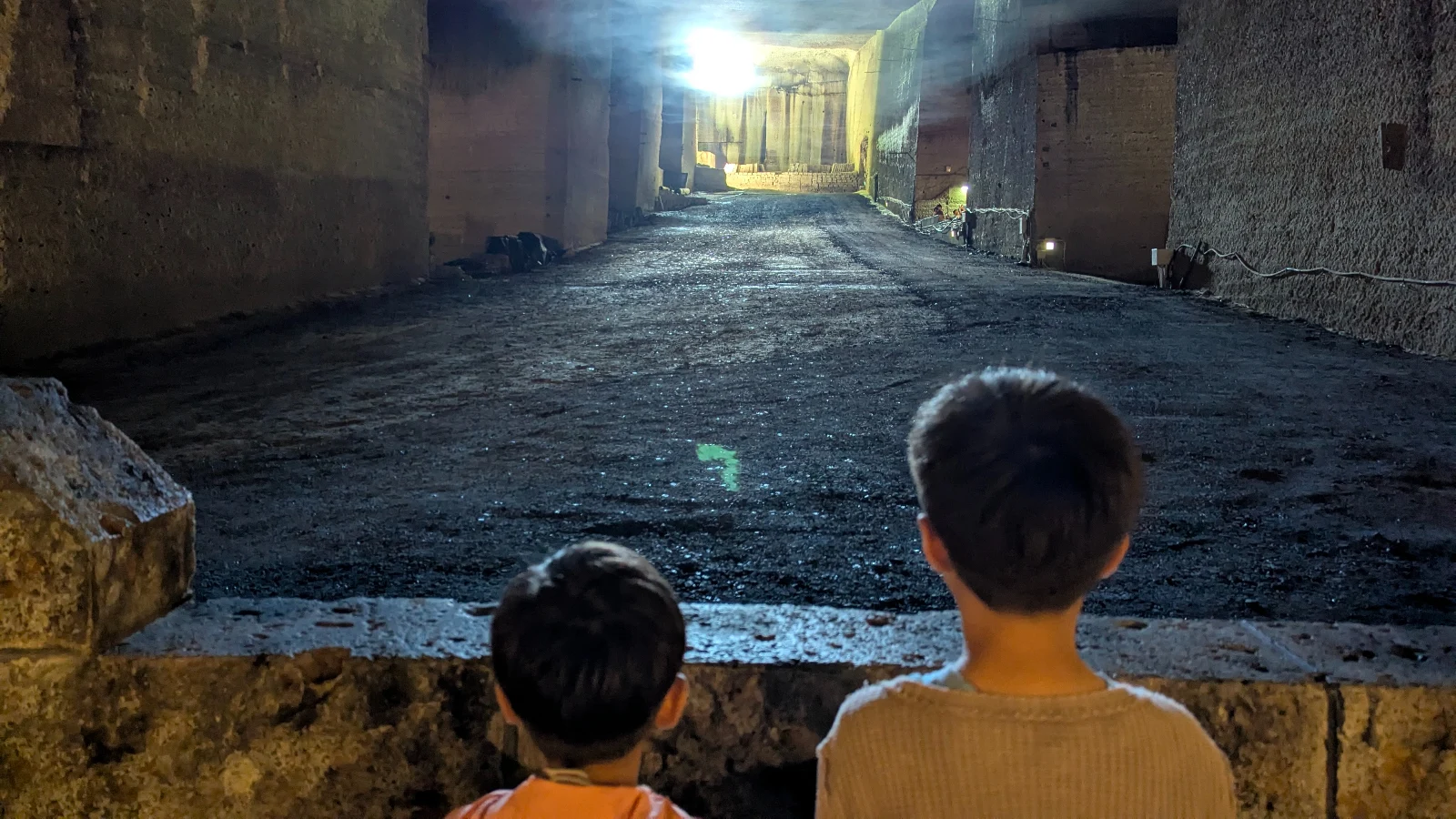
A quarry about thirty meters down is room to roam for a child who needs to move and a cold, closed-in space for a child who takes everything in.
Preschoolers free; cash only, and parking is free. Groups of 20 or more book by form.
9:30 to 16:30 in winter, closed Tuesdays then; closed December 26 to January 3; phone before going.
The quarry runs about 30 m deep, reached by stairs.
The quarry stays cold, so bring a jacket; no eating or drinking underground.
No entry with strollers or wheelchairs; a golf cart takes visitors who cannot walk, weekdays, booked ahead.
Some links on this page are affiliate links. LuNi may earn a commission at no extra cost to you.
Is Oya History Museum worth it with kids?
The short version, before the costs, the timings and the case for each child.
Yes for most children, with one real exception worth planning around. The Oya History Museum is a former underground stone quarry in Utsunomiya, about thirty meters deep, entered by stairs, and vast enough that the size is the whole experience. A child who needs to move gets a room big enough to walk and walk, as long as the walking stays quiet, because shouting is not allowed below. The child it is hardest for is the one who takes in everything: the quarry is cold, enclosed and far below ground, and for almost every family leaving is a climb of stairs from thirty meters down. Two decisions change the day: a jacket for every child, in any month, and a plan for the smallest, because strollers are not allowed in.
Planning Your Visit to Oya History Museum with Kids.
Three things decide this visit, and all three are settled before the car door opens. The first is a jacket for everyone, whatever the season: the quarry is cold, and the museum has stopped lending blankets. The second is how the smallest child gets around, because strollers, wheelchairs and push-carts are not allowed below. Bring a carrier, and for anyone who cannot manage stairs, reserve the golf cart that takes visitors down on weekdays, well ahead, since it cannot be booked on the day. The third is the drive. Search for the museum by name or phone number rather than its street address, which sends a GPS into the hills, and bring cash, because that is all the window takes. With those three settled, the quarry asks nothing more of the plan.
Every LuNi attraction guide starts with a visit, with our own children
LuNi rates and writes about attractions only after visiting them with children. Luca and Nico were at Oya History Museum, and what they did there is recorded further down this page, including how each child actually met it.
Children arrive with different tolerances: for noise, for lines, for standing still, for being on their feet all day. A guide written for the average of them helps almost nobody. So every place on this site is read four ways, and each verdict says which children it already suits and what makes it work for the rest. Whoever you are bringing, the answer here is built for your family rather than for a general reader.
Restricted-movement depletion stays low on a quarry floor big enough to roam, so let the child walk it freely and quietly, since shouting is banned.
Sensory-input depletion runs high in a cold, enclosed quarry thirty meters down, with the exit up a stair, so keep it short and leave early.
Unfamiliarity and unconfirmed structure build in a space unlike anything above ground, so describe the stairs, the cold and the size before going down.
Sustained walking and standing come with stairs down and back up and no wheels allowed below, so bring a carrier and spend the legs early.
Hotels we would book for this visit.
The hotel on the drive course ten minutes from the quarry has only double and twin rooms. These three are bases for a family pairing Oya with Nikko: one at the shrine end of the drive, two in Kinugawa Onsen.
| Property | The LuNi Reason |
|---|---|
| LUNI Pick Nikko Kanaya Hotel Near the Shinkyo bus stop, in Nikko town | By car the quarry is about forty minutes from Nikko Toshogu, by way of the Romantic Village, and this hotel sits at the shrine end of that drive. A family can do Oya on the way up and wake beside the shrine, so the next morning starts where Nikko’s family days begin rather than with another drive. |
| Hoshino Resorts KAI Kinugawa About 15 minutes on foot from Kinugawa Onsen Station | For a family whose Tochigi days center on Kinugawa rather than the shrine. After the quarry, a child who took in too much needs an evening with nothing new in it, and a hotel within walking distance of the station keeps the last stretch of the day short and familiar for a family traveling by train. |
| Asaya Hotel In Kinugawa Onsen | A second Kinugawa Onsen base, for a family that wants Edo Wonderland or Tobu World Square the next day. Both are reached by bus from Kinugawa Onsen Station, so a day below ground at Oya can be followed by a day in the open air without changing hotels or repacking a car. |
Nearby attractions, matched to your child.
Three pairings for what a stone room underground leaves over: a child who took in too much, a child who wants something familiar and named next, and legs that paid for the stairs twice. Two are ten minutes away.
| Pairing | Why This Solves the After-Visit | For Your |
|---|---|---|
| LUNI Pick Wakayama Farm About 10 minutes by car | After cold, enclosed time below ground, Wakayama Farm is open air and daylight, a bamboo forest a short drive away. Sensory input that built in the quarry settles outdoors, as long as the child hears first about the fog machine that mists one clearing. | Sensor |
| Oya Temple and Heiwa Kannon On the same road, south of the museum | The quarry is one huge unknown; Oya Temple and Heiwa Kannon is a short list of known things: stone Buddhas in a hall, a pond and a giant Kannon outdoors. Unfamiliarity and unconfirmed structure ease when every stop can be named in advance. It closes on Thursdays. | Anchor |
| Kegon Waterfall The Lake Chuzenji side of Nikko, a day of its own | The quarry charges a Sprinter in stairs, down and back up, with no wheels allowed. Kegon Waterfall charges almost nothing: an elevator does the whole descent and the ride back up, so the next big sight spares the walking and standing reserve. | Sprinter |
Wakayama Farm
About 10 minutes by car For YourSensor
Oya Temple and Heiwa Kannon
On the same road, south of the museum For YourAnchor
Kegon Waterfall
The Lake Chuzenji side of Nikko, a day of its own For YourSprinter
How two children actually met this attraction.
Two children went down the same stairs into the same cold, enormous room and came back up with different stories. One could not look at the walls without asking how they had come to be there, and until he had turned that question over he was not really in the room at all. The other asked nothing. He looked at the size of the place and wanted to cross it, and the quarry floor gave him exactly that. What the two share is that the size reached them first, one through his head and the other through his legs. For a parent that is most of the preparation: know which way the size will reach your child, and plan the stairs, the questions or the walking around it.
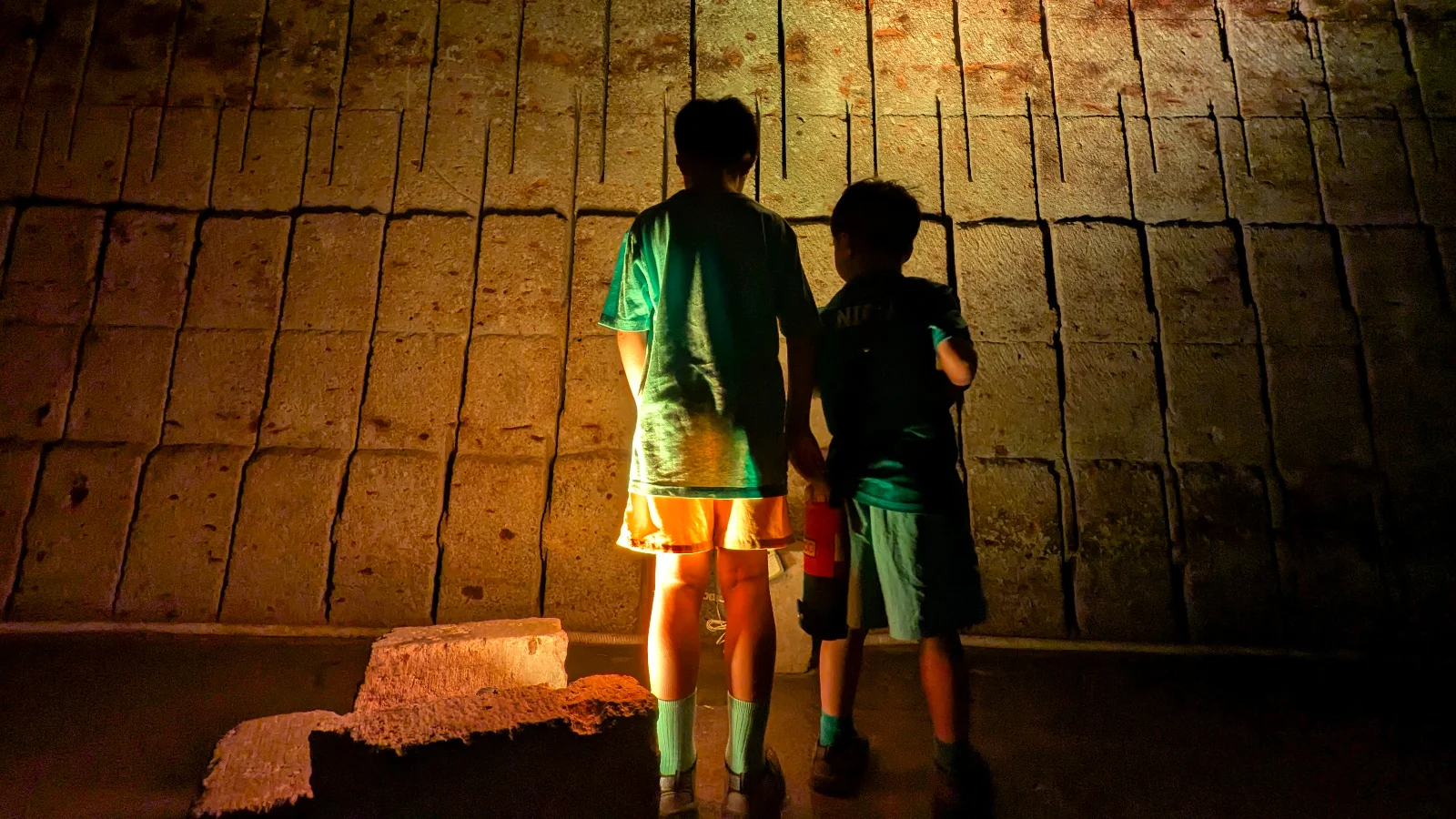
Luca fixed on the how of it. What he kept turning over was that people had dug a space this enormous without machines, and he wanted to understand it before he would move on, running the scale and the effort through his head as he looked at the walls. The question he could not let go of, how the quarry was made by hand, was the thing that held him.
This is the Anchor pattern. A child whose Reserve depletes through unfamiliarity and unconfirmed structure steadies by making sense of a strange place, and for Luca the sense had to come from how the place came to exist. Families with a similar child should give that question room rather than a quick answer: stop at a wall together, let the child keep asking, and let the question ride along with the visit. An Anchor working on a real question is spending attention rather than Reserve.
Nico’s verdict was shorter and entirely physical: it was fun, and it was huge. He was not studying the walls so much as using the room, moving out into the open floor to feel the size of it, drawn on by how much space there was to cover. What he took from the quarry was the plain pleasure of a place big enough to roam without anyone telling him to stop.
This is the Dynamo pattern. A child whose Reserve depletes through restricted movement reads a very large room as permission, and Nico met the quarry with his legs rather than his questions. Families with a similar child should let the walking happen and set one rule at the top of the stairs: the quarry is for moving, not for shouting, because shouting is not allowed below. A Dynamo who knows the rule in advance can use all the room there is without being stopped partway through it.
Descending into a vast underground quarry, cool and silent, gives a child a sense of wonder that is hard to find anywhere else. Standing in a space cut from the rock over many decades of work, a child begins to grasp how much effort built the world around them, stone by stone. For a sensitive child, the cold and the scale are a lesson in knowing when to climb back up. A place this unusual teaches children that the earth holds hidden rooms, and that human work can make something useful and beautiful.
The LUNI Rating for Oya History Museum.
One fact sits under all four verdicts: the Oya History Museum is a vast room of stone about thirty meters underground, reached and left by stairs. Its size is a gift to a child who needs to move. Its cold, its depth and its closed walls are the hardest combination here for a child who takes everything in, because the way out is a climb away. A child who needs the unfamiliar explained has to be told about it before going down, and tired legs pay for the stairs twice, once on the way down and once on the climb back up.
Let the room do the work, quietly. The Dynamo depletes through restricted movement, and the quarry is that rare thing, an indoor space a moving child does not have to fight. It runs to about twenty thousand square meters, a floor big enough to walk and walk, and the visit is simply moving through it. For a child whose Reserve drains whenever the body is held still, size is the best thing an attraction can offer, and here the size is the attraction. The stairs down and the climb out are the part a parent needs to shepherd.
The one rule to set is noise. Shouting, instruments and dancing are not allowed in the quarry, so this is room for legs, not voices. Say so at the top of the stairs, because a child who meets a huge stone room wants to test it with a shout, and being stopped halfway through is the kind of restriction that sours a visit. Then let the child lead, at their own speed, and save the snack for the surface, since eating and drinking are not allowed underground either.
What this means for your Dynamo: restricted movement is rarely a problem in a room this size. A younger Dynamo needs the no-shouting rule said before the stairs; an older one can lead the family through the space at their own pace.Keep it short, and decide when to leave before the stairs. The Sensor depletes through sensory input, and the quarry puts several strong inputs together at once. It is cold, cold enough for a jacket even in summer. It is enclosed, a room of stone about thirty meters underground. And leaving is a climb of stairs from thirty meters down. For a child whose Reserve drains through what the senses take in, that last fact matters most: once the input is too much, relief is still a climb away, and a climb is slow.
Set the length, and say the plan out loud. Decide before the first step how long the family stays below and when it heads for the exit, and tell the child the plan: down the stairs, a look, then the climb out. A younger Sensor can keep the whole visit short, and a short visit still counts. If the child reaches the limit, head for the exit without negotiating, because the surface is where the recovery happens and the quarry is not.
What this means for your Sensor: sensory input runs high below ground and the exit is a climb. A younger Sensor needs a short visit and a parent ready to leave early; an older one can stay longer with a leaving time agreed on first.Describe the place before the stairs. The Anchor depletes through unfamiliarity and unconfirmed structure, and the quarry is about as unfamiliar as a family visit gets: a vast room of stone, far underground, cold, and reached only by going down. It is unlike any museum most children have met. The structure of the visit is simple, stairs down, the room, a climb of stairs out, but a child cannot see that from the top, and an unconfirmed plan is exactly what this Reserve pays for.
A picture and a sequence settle this child. Show the child a photograph of the quarry the night before, name the order out loud, down, look, climb out, and tell them about the cold before they feel it. If the child asks how the place was made, let the question ride along with the visit rather than rushing to close it. Stay together at first, and let the child decide when the room is known enough to walk further into it.
What this means for your Anchor: unfamiliarity stays high until the place has been seen. A younger Anchor needs a photograph and the sequence the night before; an older one can read about the quarry and set the plan.Save legs for the climb back up. The Sprinter depletes through sustained travel-style walking and standing, and the quarry charges for both. Stairs lead down into it and back up out of it, the room itself is walked on foot, and wheels are not an option, because strollers, wheelchairs and push-carts are all kept out of the quarry. The stairs at the end are the part that catches families off guard: they come when the legs are already spent on the floor.
Plan the visit around that last climb. Carry the smallest child in a carrier, keep the time below short enough that there are legs left for the stairs up, and save the rest for the surface, where parking is free. For anyone who cannot manage the stairs, the museum takes visitors down by golf cart on weekdays, reserved well in advance for an extra fee, and it cannot be arranged on the day, so the decision belongs to the week before.
What this means for your Sprinter: stairs in, a climb out and no wheels below make the legs the budget. A younger Sprinter needs a carrier; an older one needs the climb back up counted before the family goes down.The questions parents actually ask.
The Oya History Museum is a cold quarry reached by stairs, so comfort and access decide the visit. It is cold enough for a jacket, strollers stay above, the golf cart has to be booked ahead for a weekday, and winter Tuesdays and the New Year week are closed. Settle those four at home, before anyone gets in the car for the drive, and the quarry becomes a remarkable stop for most children rather than a turned-back car at the gate. The drive on to Nikko takes about forty minutes, which makes Nikko’s family stops an easy pairing on a day with a car.
Is Oya History Museum worth visiting with kids?
Yes, for most children, with one real exception. It is a former underground stone quarry about thirty meters deep, entered by stairs and big enough to walk and walk. A child who needs to move does well here. A child easily overwhelmed by cold, enclosed places does not, so keep that child’s visit short, or leave it out.
How much does Oya History Museum cost?
Adults pay 1,000 yen, elementary and junior high students 400 yen, and preschoolers enter free, so two adults and two children pay 2,800 yen. Groups of 20 or more pay less, and disability handbook holders pay the group rate. Payment at the window is cash only. Parking is free for cars in the museum’s lots.
What are Oya History Museum’s opening hours?
April to November, 9:00 to 17:00 every day, last entry 16:30. December to March, 9:30 to 16:30, last entry 16:00, closed Tuesdays, or the Wednesday when Tuesday is a holiday. It is also closed December 26 to January 3, and it can close on short notice, so phone before going.
How cold is it inside Oya History Museum?
Cold enough for a jacket, even when it is warm outside. In late September 2026 the quarry read 13 degrees, and the museum no longer lends the blankets it once offered in summer, so every visitor should bring a layer. Put children’s jackets on at the top of the stairs, before the cold reaches them, rather than halfway down.
Can you take a stroller into Oya History Museum?
No. Wheelchairs, strollers and push-carts are not allowed into the quarry, so bring a carrier for a small child. Visitors who have difficulty walking can be taken down by golf cart on weekdays only, reserved in advance for an extra fee. It cannot be arranged on the day, and it may be refused at Golden Week, Obon or on busy days.
How do you get to Oya History Museum?
By bus from stand 6 at the west exit of JR Utsunomiya Station, toward Oya and Tateiwa, about 30 minutes to the Shiryokan-iriguchi stop, then about 5 minutes on foot; from Tobu Utsunomiya the bus takes about 20 minutes. By car it is about 12 minutes from Utsunomiya IC. Set the GPS by name or phone number, because the address leads into the hills.
Can you visit Oya and Nikko Toshogu Shrine in one day?
Yes, by car. The drive from the quarry to Nikko Toshogu Shrine takes about forty minutes, by way of the Romantic Village. Put Oya first and keep it short, because the quarry’s stairs and the shrine’s stairways both spend a Sprinter’s walking and standing reserve, and two stair-heavy visits make a long day for tired legs.
How does Oya History Museum compare with the Ashio Copper Mine Museum?
Both take children underground, in different ways. The Ashio Copper Mine Museum is a trolley ride into an old mine and a walk of a few hundred meters out, along one route. The Oya quarry is one huge, cold room entered by stairs. For a child who is easily overwhelmed, Ashio is the gentler of the two.
Where Oya History Museum fits your Japan trip.
Official site and opening information: Oya History Museum