Zuihoden with Kids: A climb to one still platform.
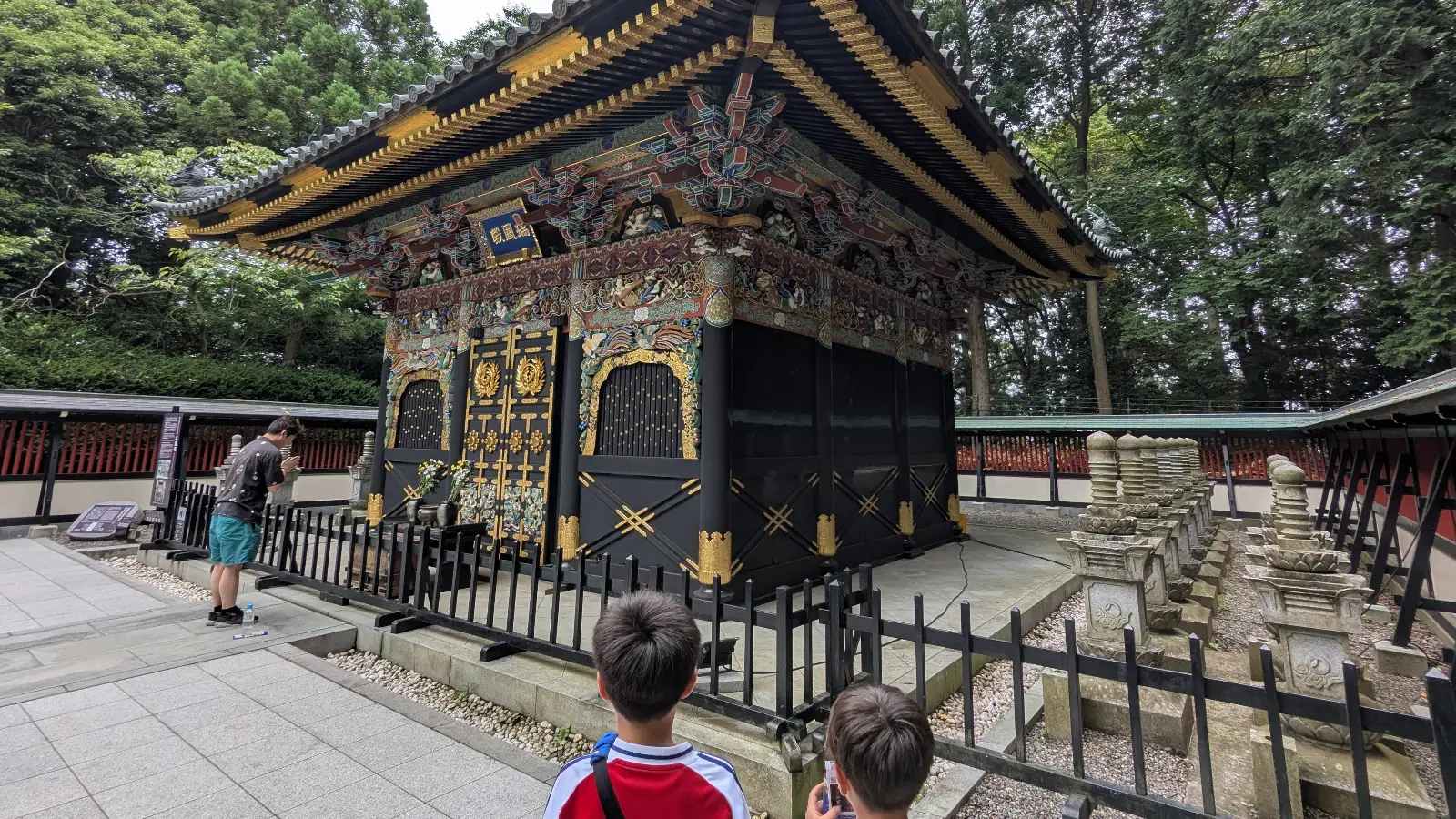
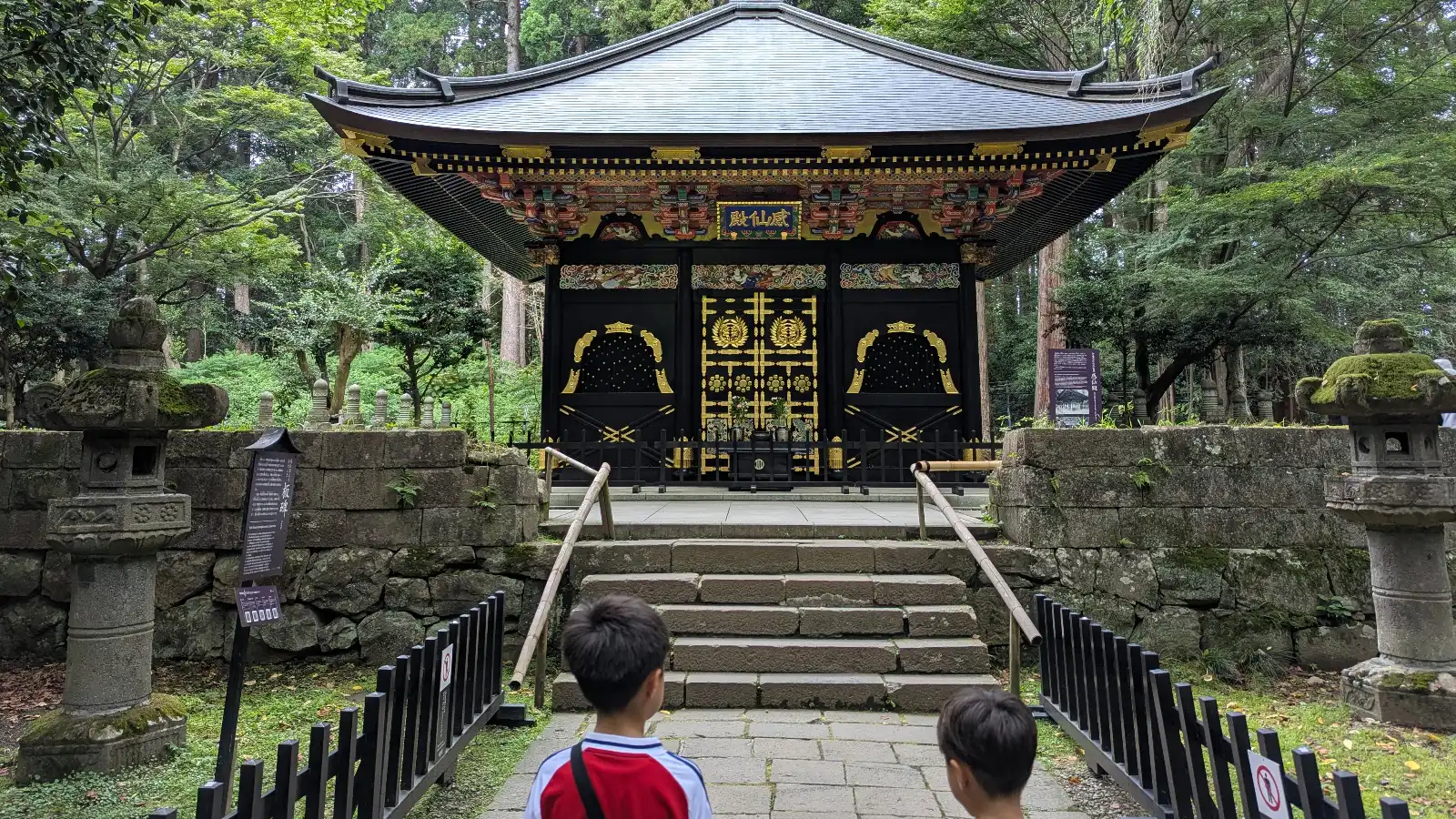
The same seven-minute climb delivers one child to a story they had been walking toward and another to a platform with the charge still in their legs.
High school ¥410. One ticket covers the whole precinct and the museum, sold at the window with nothing to book.
9:00 to 16:20 from December to January; last entry 20 minutes before closing. Closed December 31; on January 1 only Zuihoden opens.
Add the seven-minute walk up from the bus stop at each end.
Under five the carvings land and the history does not.
Steps on the approach and in the grounds; a wheelchair needs several helpers.
Some links on this page are affiliate links. LuNi may earn a commission at no extra cost to you.
Is Zuihoden worth it with kids?
The short version, before the costs, the timings and the case for each child.
Yes, if you bring the story. Zuihoden is the mausoleum of Date Masamune, lost to war damage in 1945 and rebuilt in 1979 to the scale and decoration of the original, and it does not explain itself to a child at the gate. It is a short uphill walk with stairs in it to one raised, densely carved platform, and it is worth allowing about an hour. A child who arrives already knowing whose grave this is reads the carvings as evidence and slows down in front of them. A child who arrives cold meets a handsome building and a climb that has already spent something. Two decisions change the outcome: tell the story before the steps, and settle before you leave the hotel how the family is getting back down.
Planning Your Visit to Zuihoden with Kids.
Three things are settled before you leave the hotel, and all three are cheap now and expensive at the bus stop. The first is the pass. Buy the Loople one-day pass before boarding, because showing it at the gate brings the admission down, so the bus ticket pays part of the visit back. The second is the return. The Loople runs one way only, so a family that rides up comes back on a regular route bus or rides most of the loop around again. The third is what the children carry, because the walk up from the stop has stairs in it. Leave the bags in the free coin lockers on site and let small hands climb empty, so the steps are all they have to manage.
Every LuNi attraction guide starts with a visit, with our own children
LuNi rates and writes about attractions only after visiting them with children. Luca and Nico were at Zuihoden, and what they did there is recorded further down this page, including how each child actually met it.
Children arrive with different tolerances: for noise, for lines, for standing still, for being on their feet all day. A guide written for the average of them helps almost nobody. So every place on this site is read four ways, and each verdict says which children it already suits and what makes it work for the rest. Whoever you are bringing, the answer here is built for your family rather than for a general reader.
Restricted-movement depletion builds on a stairway that allows one pace and one direction, so spend the six AR quiz points and the descent as the outlet.
Sensory-input depletion stays low across an outdoor approach and an open precinct where the whole visit is looking, so the museum is the one room to pace.
Unfamiliarity and unconfirmed structure are answered by one named man and one climb that ends where the story does, so tell it before the steps.
Sustained walking and standing are front-loaded by a seven-minute uphill approach with stairs, so buy the climb back with a taxi in and the bus out.
Hotels we would book for this visit.
Three family hotels chosen for what each does to this particular morning: how cleanly a family reaches a hillside with no station under it, with a child who will climb once it gets there.
| Property | The LuNi Reason |
|---|---|
| LUNI Pick Hotel Metropolitan Sendai East Connected to Sendai Station | It is connected to the station, and the station is where the Loople starts, which takes the transfer out of the front of the day. On a visit whose whole cost is an uphill approach, reaching the bus without crossing a city first is the Reserve a family is buying. |
| The Westin Sendai Sendai Trust Tower, 6 to 9 minutes’ walk from the station | The confirmed advantage here is the pass rather than the drive. A Loople one-day pass carries a discount at this property, and the same pass drops Zuihoden’s gate price to the group rate, so one ticket bought for the bus pays at two counters on the same morning. |
| Sendai Royal Park Hotel Izumi-ku, 30 minutes by car from Sendai Station | This is the one hotel on the list outside the center, and the transfer is the whole of what it costs: thirty minutes by car from the station, about forty by bus, and the mausoleum lies on the far side of the station again. Book it for a night that ends in northern Sendai. |
Hotel Metropolitan Sendai East
Nearby attractions, matched to your child.
Three pairings, each a separate run out from the center, chosen for what each one repairs after an hour of climbing and standing, from a building of things to press to a dome and an aquarium by the sea.
| Pairing | Why This Solves the After-Visit | For Your |
|---|---|---|
| LUNI Pick Hokushu Sendai City Science Museum Bus back to the center, then the subway north | Zuihoden hands a moving child a stairway that allows one pace and a precinct to be walked rather than worked. Hokushu Sendai City Science Museum answers it with two exhibition floors of hands-on science, where restricted-movement depletion discharges on exhibits a child works rather than views. | Dynamo |
| Sendai Umino-Mori Aquarium Route bus to the center, the Senseki Line, then a 15-minute walk | After an uphill approach and a spell of standing, a low-stamina child needs flat ground and a seat. Sendai Umino-Mori Aquarium is indoor, level and built around seated viewing, but it ends in a fifteen-minute walk from Nakanosakae, so put a taxi on that last leg. | Sprinter |
| Sendai Astronomical Observatory Bus west of the center | A child who settled at Zuihoden because the visit had one shape needs the next stop to have one too, and the planetarium at the Sendai Astronomical Observatory runs to a posted daily schedule, which answers unfamiliarity the same way. Weekday mornings outside the long school vacations are reserved for groups, so read the board before promising a show. | Anchor |
Hokushu Sendai City Science Museum
Bus back to the center, then the subway north For YourDynamo
Sendai Umino-Mori Aquarium
Route bus to the center, the Senseki Line, then a 15-minute walk For YourSprinter
Sendai Astronomical Observatory
Bus west of the center For YourAnchor
How two children actually met this attraction.
Two children climbed the same approach on the same morning and spent it on two different things. Neither arrived interested in a mausoleum. What was in front of them was a building carrying carved animals, lions worked into the pillars, a kirin above the doors, dragons on the roof tiles, reached by a walk up the hill. One child took that surface as the end of a question: whose grave is this, and why does it look like this. The other took it as one enormous object, read it in under a minute, and then had a climb’s worth of momentum and a platform’s worth of permitted movement. Both readings were accurate, and they produced two different second halves of the morning.
Luca stood under the mausoleum working out what it was actually for, and reached a conclusion he wanted to say out loud: Date Masamune was lucky, because he ended up with such a nice and big, gold and colorful place to be after he died. He was reasoning backward from the carvings to the man, weighing the grandeur against the life it marked. Once the story clicked into place he slowed right down and took it in.
This is the Anchor pattern. A child whose Reserve depletes through unfamiliarity and unconfirmed structure settles the moment a place can be explained, and here the explanation is a person: one named man, one grave, one reason the building looks the way it does. Families with an Anchor should hand over the story before the climb rather than at the top, because a child who can name who is buried here stops bracing against the site and starts reading it, and will often outlast everyone at the carvings.
Nico had one immediate, loud reaction to the mausoleum and it was about the surface, not the story: gold and black, and the design was super cool. He wanted to be right up at the panels, pointing and narrating the colors faster than anyone could answer, and within a minute of arriving he had taken in everything the exterior was going to give him. Then he was ready to move well before the adults were.
This is the Dynamo pattern. A child whose Reserve depletes through restricted movement can be lit instantly by a striking surface, but the charge is kinetic, and a stairway up and a place to stand at the top are the only movement on offer. Families with a Dynamo should let the first burst run hot and short and then move, treating the descent and the lower grounds as the discharge rather than as the end of the visit, because a child out of permitted outlet is not being difficult.
A mausoleum reached by a steep climb, with its bright carvings and a museum that shows the faces of the lords laid to rest there, lets a child meet history as real people rather than names. Seeing a reconstructed face turns a warlord from a story into someone who once lived. Children connect with the past most deeply through faces and personal details. A visit that ends with looking someone from four centuries ago in the eye teaches a child that history is made of lives, not only dates.
The LUNI Rating for Zuihoden.
One fact drives all four verdicts. Zuihoden is a hillside precinct that is climbed. The approach rises from the bus stop in about seven minutes and has stairs in it, and the grounds beyond carry stairs and level changes throughout. Eight numbered features sit inside them on a single ticket, the two later mausoleums and the museum among them, with six AR quiz points set around the same ground. That geometry is generous to a child who wants one place explained, and expensive for a child whose legs are the thing that needs somewhere to go.
Plan the descent as the outlet. The Dynamo depletes through restricted movement, and Zuihoden spends that currency in a way the map does not show. The approach is a seven-minute walk up from the bus stop with stairs in it, and a stairway is movement channeled rather than released: single file, one pace, nowhere to go but up. What waits at the top is a building to look at and carvings to look at longer, and the grounds beyond it carry stairs and level changes throughout. So the bill is not distance. It is permitted movement that never becomes free movement, ending exactly where the child is most wanted still.
The quiz, not the route, carries this child. A stamp waits at each of the six points, and a child who collects all six is given a card at the end of it, on any phone that reads a QR code. That turns eight numbered features on one ticket into a route with a reason to cross it, and it works best on the way down, where the climb is already paid for. Then remember what the return is: the Loople runs one way, so the journey back is a route bus or most of a loop.
What this means for your Dynamo: restricted movement, not the length of the walk, is what this hill charges. A younger Dynamo needs the descent treated as running time; an older one holds the climb if the carvings are given a job, counting the animals worked into them.The load is the museum, not the hill. The Sensor depletes through sensory input, and at Zuihoden almost all of it is under the family’s control. The visit happens outdoors, and what the site asks of a child is looking: at the buildings, at the carvings, at the ground they stand on. The carvings are visually dense, lions and a kirin and dragons worked into every surface, but visual richness a child can approach at their own pace and step back from is engagement rather than load.
The one room that changes the reading is the museum, which reopened in April 2026 after a rebuild. One wall of the storeroom is now glazed, so the grave goods sit close to the visitor, and a hundred-inch screen runs a film of the precinct through the seasons. That screen is the exception: it is large, lit and facing you, and stepping back does not make it smaller. The room also holds the findings of the survey of the three lords’ remains, including a reconstructed face for each. Photography and video are not permitted inside. For most children it is the best part of the ticket, and for a child who would rather not meet a face rebuilt from a skeleton, or sit under a screen that size, it is the one part that can simply be skipped.
What this means for your Sensor: sensory input stays inexpensive on this hillside. A younger Sensor can skip the museum entirely and lose nothing; an older one can use the same low load to work a single panel as long as they like.Tell the story before the steps. The Anchor depletes through unfamiliarity and unconfirmed structure, and this site answers both with a person rather than a plan. Zuihoden was built in 1637 on Date Masamune’s own dying instruction, the year after he died at seventy, and everything a child meets on the hill runs downstream of that. The two later mausoleums in the same grounds belong to his son and his grandson, so those three buildings are one family in generation order. The precinct is not: among the eight numbered features are a monk’s memorial and a monument to the war dead, so promise the three, not the ground they stand on. A visit with a named person at its center is one a child can confirm while it is happening.
The friction an Anchor meets here is anticipatory: a site not yet seen, and a building whose purpose is not obvious from the bus stop. Say what it is before the climb and the climb becomes the last part of a story instead of the first part of an unknown. Volunteer guides work the grounds in purple surcoats, mainly on Saturdays and Sundays, free and approached directly.
What this means for your Anchor: unfamiliarity is the whole bill on this hill, and a story told before the steps pays it. A younger Anchor settles once the grave has a name attached to it; an older one settles once the dates check out against what they were told.The approach is the whole bill. The Sprinter depletes through sustained travel-style walking and standing, and Zuihoden front-loads both before anything is seen. From the Zuihoden-mae stop it is about a seven-minute walk up, and there are stairs in it. Beyond the gate the level changes keep coming, enough that a wheelchair visit needs more than one helper. Then the visit itself is standing: in front of the mausoleum, in front of the carvings, in the museum. The cost is not the distance but the order: the climbing and the standing arrive back to back.
This is a sequencing problem, solvable at both ends. A taxi from Sendai Station takes about ten minutes and the free parking lot is at the main entrance, so the stairway up from the stop never happens on the way in. Walk down afterwards and ride the Loople onward, which is the only direction it runs. Free coin lockers matter more than they sound: a child carrying nothing climbs further.
What this means for your Sprinter: the standing and the stairs are the cost, not the distance. A younger Sprinter should be carried for the steepest stretch; an older one paces once the climb is named as the price of the carvings.The questions parents actually ask.
The bus that brings you up runs one way only, so the journey back is a separate decision taken in advance. The ticket bought at the window covers the whole precinct, so the two later mausoleums and the museum are already paid for and nothing waits behind a second gate. And the approach is short but climbs, with stairs in it, which is where this visit goes wrong far more often than the site itself does. A child who liked the carvings will find Chusonji Temple rewards the same attention, though a Sprinter’s walking and standing run long on its climb, so give it a morning.
Is Zuihoden worth visiting with kids?
Yes, if the story arrives before the steps do. It is the mausoleum of Date Masamune, reached by a short uphill walk from the bus stop, at 570 yen for an adult and 210 for elementary and junior high. A child who knows whose grave it is will read the carvings. A child who does not is looking at a beautiful building and a climb.
How long do you need at Zuihoden with kids?
Allow forty-five minutes to an hour for the mausoleum, the two later mausoleums and the museum, all of which sit inside the one ticket. A child who works the carvings will stretch it. Add about seven minutes of walking up from the bus stop and the same back down, and budget the descent as movement rather than as transit.
What age is Zuihoden best for?
Five to twelve, when a child can hold the Date Masamune story and read the carvings as more than decoration. Below five the walk up works and the history does not. Teens engage when the narrative is set up first, and some will read the carvings more closely than the adults.
Is the climb to Zuihoden too much for young children or strollers?
It is short but real. The walk up from the Zuihoden-mae stop is about seven minutes and has stairs in it, and the approach and grounds carry stairs and level changes throughout, enough that a wheelchair visit needs more than one helper. A baby carrier beats a stroller here, and a taxi to the main entrance skips the stairway on the way in.
How do you get to Zuihoden from Sendai Station, and can you get back the same way?
The Loople Sendai bus reaches the Zuihoden-mae stop in about fifteen minutes, then it is a seven-minute walk up. You cannot come back the same way, because the Loople runs one way only: the return is a regular route bus or the rest of the loop. A taxi takes about ten minutes. Drivers should navigate to Otamayashita 18-12 rather than to the name.
Does one ticket cover Kansenden and Zennoden?
Yes. Kansenden and Zennoden stand inside the same grounds as Zuihoden, two of eight numbered features on a single admission, along with the museum. There is no combination pass to buy and nothing to pay at a second gate. Holders of a Loople one-day pass or a Sendai Marugoto Pass pay the group rate instead, 460 yen for an adult.
What is on site at Zuihoden, and should we bring food?
There is a shop selling original goods, where the goshuin stamps are given out, and coin lockers that cost nothing to use. Parking beside the main entrance is free. Bring water and snacks for the climb rather than planning to buy them at the top, and leave the bags in a locker before you start up, or send them ahead on a moving day.
Can you visit Zuihoden in the evening?
Not in normal opening, which runs 9:00 to 16:50 with last admission at 16:30, and 16:20 and 16:00 from December 1 to January 31. The exception is the Sendai Tanabata festival in early August, when the site stays open to 20:30 for three nights, the approach and the main hall are lit from late afternoon, and a special Loople night service runs from Sendai Station every fifteen minutes rather than every twenty. Check the dates for the year you are traveling. The whole site closes on December 31, and on January 1 only Zuihoden itself opens.
Where Zuihoden fits your Japan trip.
Official site and opening information: Zuihoden