Sendai Dai Kannon with Kids: A statue you go inside.
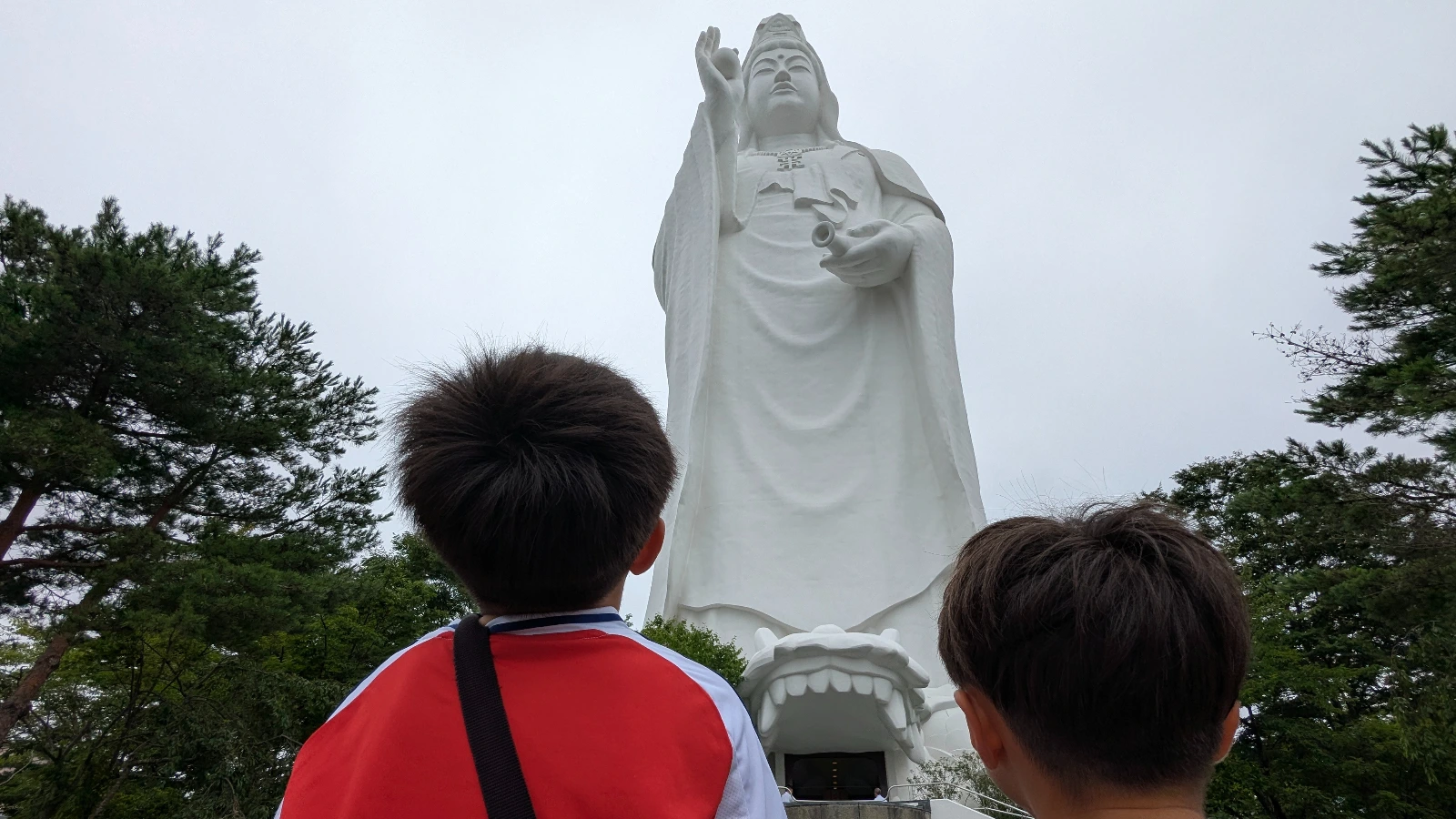
The ticket here buys the inside of a hundred-meter figure, which makes this a decision about what a child wants to be inside rather than what they want to look at.
The fee is for the statue’s interior, which cannot be booked ahead.
Last entry 15:30 on Saturdays, Sundays and national holidays. Open every day.
Add the run out from Sendai Station at each end.
Elementary and preschool children go in with a parent or guardian.
Some links on this page are affiliate links. LuNi may earn a commission at no extra cost to you.
Is Sendai Dai Kannon worth it with kids?
The short version, before the costs, the timings and the case for each child.
Yes, if the child is interested in being inside things rather than looking at them. Sendai Dai Kannon is a hundred-meter figure standing over Izumi Ward, and the ticket buys the inside of it: an elevator ride up, then level after level of Buddhas to look at, and four windows that open onto the city and the Pacific. Two things decide whether it is worth the distance. The window is short, and it closes to new visitors in the middle of the afternoon, so a late start loses most of it. And it sits a taxi ride out from the station, which makes it a morning of its own rather than something dropped into one. For a child who likes a building that turns into a list, it is one of the easier mornings in Sendai to get right.
Planning Your Visit to Sendai Dai Kannon with Kids.
Three things settle this visit before the family leaves the hotel, and each is cheap now and expensive at the stop. The first is the day: the interior stops taking visitors in the middle of the afternoon, earlier on a weekday than on the weekend, so an afternoon here has less room than it looks. The second is the fare tier, which changed at the start of 2026, so the full ticket now begins at junior high school rather than high school, and a family with a junior high student budgets for one more full fare. The third is the run out: a taxi from Sendai Station takes about twenty minutes, so on a day that begins with the ride up from Tokyo, this is the stop that will not fit.
Every LuNi attraction guide starts with a visit, with our own children
LuNi rates and writes about attractions only after visiting them with children. Luca and Nico were at Sendai Dai Kannon, and what they did there is recorded further down this page, including how each child actually met it.
Children arrive with different tolerances: for noise, for lines, for standing still, for being on their feet all day. A guide written for the average of them helps almost nobody. So every place on this site is read four ways, and each verdict says which children it already suits and what makes it work for the rest. Whoever you are bringing, the answer here is built for your family rather than for a general reader.
Restricted-movement depletion builds inside one building where the climb is an elevator ride, so hand a moving child the 108 Buddhas as a count to cover.
Sensory-input depletion stays low across an interior whose whole demand is looking at a pace you set, so the four windows are the way out.
Unfamiliarity and unconfirmed structure are answered by a numbered interior of twelve levels and one hall, so hand the count over before the gate.
Sustained walking and standing are spent on the journey out and then among the statues, so take the taxi in and arrive at the opening.
Hotels we would book for this visit.
Three properties judged on one question: what each does to a morning whose entire cost is a run out to the city’s northern edge and back, and, if the family is changing hotels that day, whether sending the bags ahead buys the hour back.
| Property | The LuNi Reason |
|---|---|
| LUNI Pick Hotel Metropolitan Sendai East Connected to Sendai Station | The whole cost of this visit is the journey out and back, so the property that removes the first transfer is the one that pays. Connected to the station, it puts a family into a taxi or onto the bus from stand 19 without crossing the city first, which matters most on a morning with a 15:00 clock. |
| The Westin Sendai Sendai Trust Tower, 6 to 9 minutes’ walk from the station | It carries most of the Metropolitan’s advantage, six to nine minutes on foot from Sendai Station, where the taxis and the bus from stand 19 leave. Book it when the rest of the trip wants the Westin more than this one morning wants a shorter walk. |
| Sendai Royal Park Hotel Izumi Ward, about 30 minutes by taxi from Sendai Station | The one hotel on the list already on the right side of the city, because the hotel and the statue share a ward. It shortens the run out on a visit that otherwise charges twenty minutes each way, and the rest of the trip pays that distance back. |
Hotel Metropolitan Sendai East
Nearby attractions, matched to your child.
Three pairings, all back toward the center from Izumi Ward, chosen for what each repairs after an hour spent standing inside a statue, and for how the week is shaped around them.
| Pairing | Why This Solves the After-Visit | For Your |
|---|---|---|
| LUNI Pick Zuihoden Back across the city, then a hillside approach | This statue settles an Anchor by being countable, twelve levels and one hall to work down. Zuihoden answers unfamiliarity the other way, with one named man and one grave, so a child who has just finished a sequence gets a story instead of a second list. | Anchor |
| Sendai Umino-Mori Aquarium Across the city, the Senseki Line, then a 15-minute walk | An hour of looking at still figures leaves a Sensor with reserve rather than without it, and Sendai Umino-Mori Aquarium is where it can be spent on purpose. The catch is the fifteen minutes on foot from Nakanosakae, and a taxi covers that last leg. | Sensor |
| Sendai Astronomical Observatory West of the center | The statue charges a Sprinter for the journey and then for standing, so the next stop has to be a seat. The planetarium at the Sendai Astronomical Observatory sits a family down on a posted schedule. Weekday mornings outside the long school vacations are group-only, so read the board before promising a show. | Sprinter |
Zuihoden
Back across the city, then a hillside approach For YourAnchor
Sendai Umino-Mori Aquarium
Across the city, the Senseki Line, then a 15-minute walk For YourSensor
Sendai Astronomical Observatory
West of the center For YourSprinter
How two children actually met this attraction.
Two children went up the same hundred-meter statue on the same morning and came out of it holding two different buildings. Neither arrived caring about Buddhist iconography, and neither needed to. What was in front of them was the statue itself, an entrance cut in the shape of a dragon’s mouth, and an interior divided into levels with statues on them. One child took the levels as a list and set about working through it in order. The other took the dragon first, then treated everything after it as ground to be covered. Both readings were accurate, and the gap between them is the gap between a child who needs a place to resolve into something knowable and a child who needs a place to allow movement.
Luca decided at the top that he would walk down every single step rather than skip a floor, because skipping a floor meant missing statues. He worked his way down methodically, stopping at each level to study the figures and compare them, noting that the shapes kept changing as he went and announcing that the ones lower down were better than the ones above. What held him was the sequence rather than the height.
This is the Anchor pattern. A child whose reserve depletes through unfamiliarity and unconfirmed structure settles the moment a space resolves into a known sequence, and Luca did it by turning a set of levels into an ordered list he could finish. Families with a similar child should hand the level count over before the entrance rather than at the top, because an Anchor holding a sequence to complete is spending reserve on the task instead of on the building.
Nico was captured before he was even inside, calling the dragon at the entrance the best part and wanting to stand in its mouth. Once in, his attention ran to scale and to doing: he kept remarking on how tall the Kannon was, and set himself the moving mission of photographing all of the statues, roving from figure to figure rather than settling in front of any one of them.
This is the Dynamo pattern. A child whose reserve depletes through restricted movement stays solvent by having something active to do while moving, and Nico kept his by turning the interior into a roving mission rather than a stand-and-look. Families with a similar child should give a Dynamo a task that travels rather than a thing to stand in front of: a figure to find on the next level, a number to reach. A Dynamo with no permitted outlet inside a building is not being difficult.
A statue a hundred meters tall that a child can walk inside turns scale into an experience rather than a number. Climbing through its levels past rows of small Buddhas, then looking out from windows high above the city, gives a child a sense of both size and devotion. Learning that the height itself carries a meaning adds a quiet lesson: people build things to say something. A child who has stood inside a figure this large carries home a new idea of what human hands and wishes can make together.
The LUNI Rating for Sendai Dai Kannon.
One fact drives all four verdicts. The ticket here buys the inside of a statue rather than a site. Twelve levels sit inside a hundred-meter figure, an elevator carries visitors up, and what fills them is statues, 108 Buddhas across the middle levels and a memorial hall near the bottom holding the thirty-three Kannon and the Twelve Divine Generals. Four windows in the Goshinden open onto the city and the Pacific behind it. That geometry is generous to a child who wants a building to resolve into a list, and expensive for a child whose legs are the thing needing somewhere to go.
The building is the whole of the constraint. The Dynamo depletes through restricted movement, and Sendai Dai Kannon spends that currency by putting the entire visit inside one figure. What the ticket contains is one building: twelve levels stacked inside a hundred-meter statue, reached by a twenty-minute run out from the center spent sitting. The only climb the price includes is an elevator ride. What waits at each level is statues to look at, the opposite of what this child’s legs arrived asking for.
Count, rather than route, is what moves this child. 108 Buddhas are set through levels three to eleven, which makes the building a target spread over nine floors rather than one object to stand under, and a child covering figures has a reason to keep going. Give the number before the entrance and let the pace be theirs. The other half is the shape of the day. Elementary and preschool children are asked to be accompanied by a parent or guardian, so a Dynamo cannot be sent ahead, and the movement this hour withholds has to be found elsewhere in the afternoon.
What this means for your Dynamo: restricted movement is the cost, and the building charges it rather than the distance. A younger Dynamo needs the outdoor half of the day booked before you leave; an older one holds the interior once the 108 are handed over as something to finish.The demand is looking, at a pace the family sets. The Sensor depletes through sensory input, and what this interior asks of a child is to look at still objects for as long as they want and then move on. A child who has taken enough of one level can be moved to the next without losing anything. The one arrival that is not gradual is the entrance, cut in the shape of a dragon’s mouth, striking to walk into and over in a step.
The four windows are the lever. Two at the front of the Goshinden and two at the rear open onto Sendai and the Pacific Ocean behind it, which gives a child who has had enough interior somewhere to look a long way off without leaving the building. The Goshinden also holds the densest object in the statue: a golden treasure pagoda on a lapis pedestal, with a Nyoi-Hoju and a Dainichi Nyorai kept as hidden Buddhas, and Osawari Hotei alongside. For a child who wants richness that is the room to slow in; for a child who does not, it is one room, and the windows are in it.
What this means for your Sensor: sensory input is the one currency this statue barely touches. A younger Sensor can be lifted to a window the moment the levels start to blur; an older one can use the low load to work a single hall as long as they like.Hand the count over before the gate. The Anchor depletes through unfamiliarity and unconfirmed structure, and this building answers both with numbers rather than with a plan. The interior is twelve levels. An elevator carries visitors up. Levels three to eleven hold 108 Buddhas. Level one holds the Mizuko memorial hall, with the thirty-three Kannon, the Twelve Divine Generals and Mizuko-Kannon in it. A child told those four things at the bus stop knows the shape of the building before entering it, which for this profile is the entire mechanism.
The landmarks then confirm themselves, which is the second half of it. The entrance is cut in the shape of a dragon’s mouth, so the first thing the child meets is the thing they were told to expect. The statue faces the front of Sendai Station, so a family can point from the city toward where they are going and, an hour later, point back. The Goshinden’s four windows are where that closes: the city they came from, and the Pacific behind it. The friction here is anticipatory rather than physical, and it is paid before the ticket.
What this means for your Anchor: unfamiliarity is what this building charges for, and it is settled outside the gate. A younger Anchor settles once the twelve levels are named as twelve; an older one settles once the numbers check out against what they were told on the way.The journey is charged before the visit starts. The Sprinter depletes through sustained travel-style walking and standing, and this trip front-loads the travel. The statue stands out in Izumi Ward, a taxi ride or a city bus from Sendai Station, and the bus adds a wait at the stop and a walk from it to a morning that has not properly started. Then the visit is standing, in front of level after level of figures and a hall at the bottom. The cost is not a climb but the order in which sitting still, waiting and standing arrive.
Buy the approach and open the day early. A taxi in removes the wait at the stand and the walk from the stop, and the elevator carries the height, so going up is the one thing this site does not charge for. What it charges for is arriving late: the last visitors go in by mid-afternoon, so a family through the door at the opening has the whole window and a family arriving after lunch does not. Drivers can come in from the Kunimi Station side in about ten minutes, and there is parking, large buses included.
What this means for your Sprinter: the standing and the journey are the cost, not the height. A younger Sprinter should have the taxi booked in both directions; an older one paces once the run out is named as the price of the view.The questions parents actually ask.
Three things account for most of what families ask here, and each is easy to miss until the bus is already moving. The fare tier changed at the start of 2026 and now begins at junior high school, so a junior high student now pays as an adult. The window is short, and shorter on a weekday, closing to new visitors in the middle of the afternoon. And the statue stands twenty minutes out of the center in Izumi Ward, which makes this a trip rather than a stop, and trips are the things that go wrong when they get planned as stops.
Is Sendai Dai Kannon worth visiting with kids?
Yes, if the child wants to be inside a thing rather than look at one. It is a hundred-meter statue in Izumi Ward with twelve levels inside it, at 500 yen for junior high school students and above. An elevator carries you up. What the visit asks after that is looking at statues, one level at a time.
How much does Sendai Dai Kannon cost, and who pays?
Admission is 500 yen, and since the start of 2026 it begins at junior high school rather than high school. That is one more full ticket than most families budget for a junior high student. The fee is specifically for entering the statue’s interior. Elementary and preschool children are asked to be accompanied by a parent or guardian.
How long do you need at Sendai Dai Kannon with kids?
Allow about an hour inside. A child who stops at every level will stretch it, and a child who rides up and comes straight back down will not use half of it. Add roughly twenty minutes each way from Sendai Station, and treat the run out as part of what the visit costs rather than as transit around it.
What time does Sendai Dai Kannon stop letting people in?
The interior takes its last visitors at 15:00 on a weekday and 15:30 on Saturdays, Sundays and national holidays, from a 10:00 opening. So a weekday gives about five hours and a weekend half an hour more. That is worth settling before a family builds the morning somewhere else and arrives here after two.
How do you get to Sendai Dai Kannon from Sendai Station?
A taxi takes about twenty minutes. By bus, the city routes leave from stand 19 at the West Exit bus pool for the Sendai Daikannon-mae stop, and the sign on the front names the end of the line, not the temple. Drivers can also come in from Kunimi Station on the Senzan Line, about ten minutes away.
What is actually inside the Sendai Dai Kannon statue?
Twelve levels, with an elevator carrying visitors up. Levels three to eleven hold 108 Buddha statues. Level one holds the Mizuko memorial hall, with the thirty-three Kannon, the Twelve Divine Generals and Mizuko-Kannon in it. The Goshinden holds a golden treasure pagoda on a lapis pedestal, with hidden Buddhas inside it, and four viewing windows.
What can you see from the windows at the top?
Sendai, and the Pacific Ocean behind it. There are four windows in the Goshinden, two at the front and two at the rear. The statue faces the front of Sendai Station, so a child can be shown from the city exactly where they will be looking back from, which turns the view into a confirmation rather than a surprise.
What age is Sendai Dai Kannon best for?
Five to twelve, when a child can hold a count and work through it. Below five the scale registers and the iconography does not. Teens engage when the numbers are handed over as a problem rather than a tour, and a family torn between this and a hands-on day should answer which kind of day to choose first.
Where Sendai Dai Kannon fits your Japan trip.
Official site and opening information: Sendai Dai Kannon