Sendai Umino-Mori Aquarium with Kids: 18 minutes by train, 15 on foot.
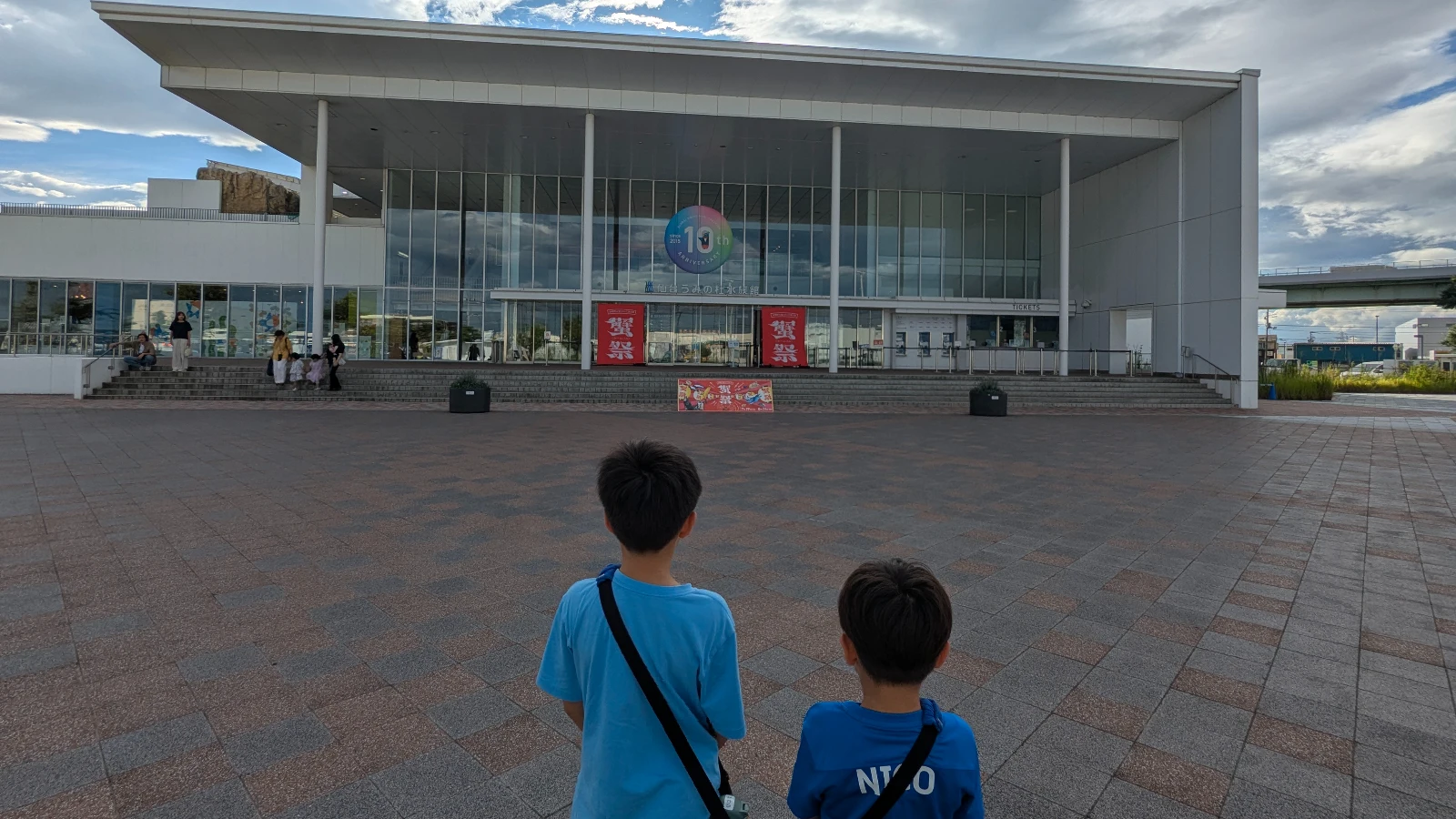
An easy indoor day on the coast is sold on a short train ride, and the half of the journey that decides how the day ends is the half nobody quotes.
Middle and high school ¥1,700; ¥700 from age 4, and under 4 free. An Asoview ticket bought ahead skips the ticket line.
9:00 to 17:30 from September 28 to November 3; last entry 30 minutes before closing. Open all year.
Same-day re-entry if you ask staff at the exit.
Older children take both floors without needing either one shortened.
Ramps and elevators on the main route; loaners are limited, first come, first served.
Some links on this page are affiliate links. LuNi may earn a commission at no extra cost to you.
Is Sendai Umino-Mori Aquarium worth it with kids?
The short version, before the costs, the timings and the case for each child.
Yes, provided the journey is planned as a journey rather than as a train ride. Inside, this is an easy building: two floors on the coast east of the city, a penguin beach, the world’s seas and a stadium show, on a main route a stroller can take. The part that is routinely understated is getting there. The train is short, but the aquarium sits a real walk beyond the station, and a family that budgets only the train arrives with a walk it has not allowed for at both ends of a long day. A cheap local bus covers that stretch, and riding it both ways is the single most useful decision of the day, because it keeps a tired child’s legs for the floors rather than the roadside.
Planning Your Visit to Sendai Umino-Mori Aquarium with Kids.
Two things settle this day and the first one is not the fare. It is the opening hour, which moves with the calendar: through the winter months the doors open an hour later than in summer, so a family that plans a nine o’clock start in December loses an hour it thought it had. The second is the walk. The train out to Nakanosakae is the easy part, and the aquarium is a fair way beyond the station on foot, past two main-road crossings that are nobody’s idea of a stroll with a stroller at the end of a long day. That walk is optional, because a local bus does the same stretch and takes a stroller aboard without folding it, so decide on the way out how the family will come back.
Every LuNi attraction guide starts with a visit, with our own children
LuNi rates and writes about attractions only after visiting them with children. Luca and Nico were at Sendai Umino-Mori Aquarium, and what they did there is recorded further down this page, including how each child actually met it.
Children arrive with different tolerances: for noise, for lines, for standing still, for being on their feet all day. A guide written for the average of them helps almost nobody. So every place on this site is read four ways, and each verdict says which children it already suits and what makes it work for the rest. Whoever you are bringing, the answer here is built for your family rather than for a general reader.
Restricted-movement depletion runs high across two floors of watching, and wheeled toys are refused at the door, so same-day re-entry is the lever.
Sensory-input depletion peaks in one stadium whose pool has no acrylic barrier, so take the edge of the stand and stay off the front rows.
Unfamiliarity is answered before arrival, because the floor map prints and the interior walks through online, so the route can be rehearsed at home.
Sustained walking is charged outside the building, not in it, so spend 200 yen on the non-step bus and keep the legs for the floors.
- Cost
- ¥2,400 adult / ¥1,200 elementaryMiddle and high school ¥1,700; ¥700 from age 4, and under 4 free. An Asoview ticket bought ahead skips the ticket line.
- Booking
- Walk up, or buy on AsoviewAn Asoview ticket skips the ticket line; one bought anywhere else is exchanged at the window.
Hotels we would book for this visit.
Three family hotels judged on one question, because the coast leg is fixed and the city leg is not: how cleanly a family reaches the Senseki Line platforms with a stroller.
| Property | The LuNi Reason |
|---|---|
| LUNI Pick Hotel Metropolitan Sendai East Connected to Sendai Station, beside the East Exit | Connected to Sendai Station beside the East Exit, so the day’s first leg starts inside the station the Senseki Line leaves from. That matters before a day that already has thirty minutes of sidewalk in it, and it is the one base where the city leg is almost nothing. |
| The Westin Sendai Sendai Trust Tower, 6 to 9 minutes’ walk from the station | It suits the family pushing a stroller, for whom six to nine minutes of street at each end of the day are an easy roll on top of the sidewalk at the coast, and the tower’s basement parking keeps a car close for a family that would rather drive to the aquarium’s own lot. |
| Sendai Royal Park Hotel Izumi Ward, about 30 minutes by taxi from Sendai Station | This is the driving answer, and here that is a real answer rather than a consolation, because the aquarium holds 800 free spaces and sits immediately off an expressway interchange. A family that has already decided on a car should stay north and drive across. |
Hotel Metropolitan Sendai East
Nearby attractions, matched to your child.
Three pairings chosen for what each adds to a day spent on the far side of the city, after the tanks, a stadium show and a long ride back to the center.
| Pairing | Why This Solves the After-Visit | For Your |
|---|---|---|
| LUNI Pick HOKUSHU Sendai City Science Museum North of the center, by subway from Sendai Station | A day here is spent on the correct side of the glass, watching. The science museum hands the day back to a child’s hands: numbered zones of stations built to be worked hard, and a forest park at the door when the indoor charge runs out. | Dynamo |
| Sendai Astronomical Observatory West of the center, by bus from Sendai Station | Stadium shows here run to posted times, which is the right shape for this child and only lasts as long as the show. The observatory extends it into a whole afternoon built on one named projection slot, picked off the board at the counter. | Anchor |
| Zuihoden Across the city, by the Loople bus or car | A building of tanks and a stadium is a day of things happening at a child rather than around one. Zuihoden reverses that completely: it is outdoors, it is unhurried, and the loudest thing it asks of a child is that they stand still and look at a carved wall. | Sensor |
HOKUSHU Sendai City Science Museum
North of the center, by subway from Sendai Station For YourDynamo
Sendai Astronomical Observatory
West of the center, by bus from Sendai Station For YourAnchor
Zuihoden
Across the city, by the Loople bus or car For YourSensor
How two children actually met this attraction.
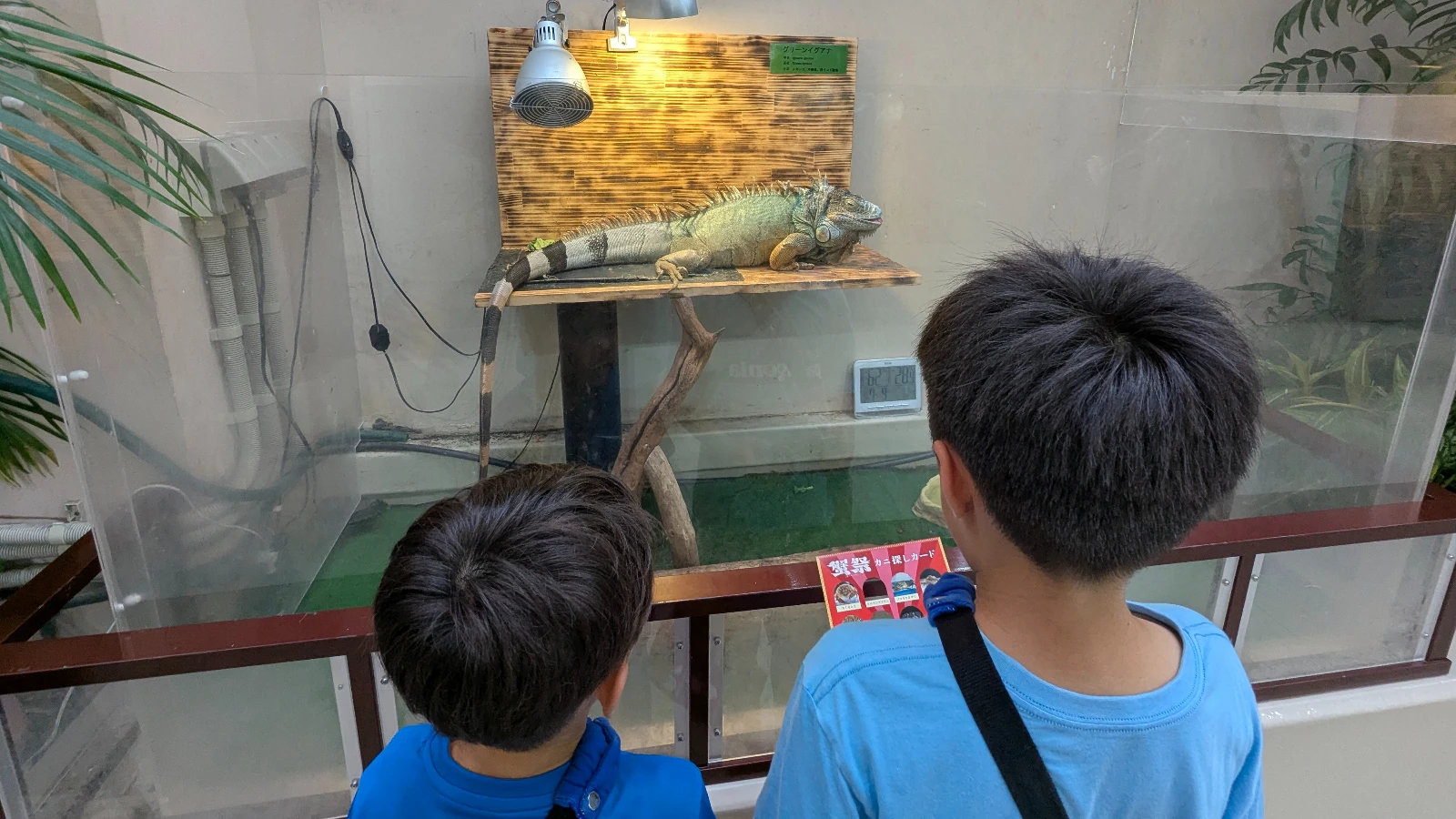
Two children walked the same two floors at completely different speeds and both of them stopped at the same animal, for opposite reasons. One treated the building as a set of problems to be closed off one at a time and would not be hurried through any of them. The other took the whole place at pace and gave his attention only to whatever was moving. What is worth knowing before you pay is that neither of them organized the visit around the big tanks or the stadium, which is what the building is sold on. They organized it around two of the smallest things in it, a paper activity and a lizard under a lamp, and a parent who plans the route around the headline exhibits is planning somebody else’s day.
Luca worked the crab bingo card as a rule set, tank by tank, and refused to move on until a square was confirmed rather than guessed. The one thing that unsettled him was a large iguana lying motionless under a lamp. He decided it was dead, said so, and would not let the matter go or move to the next tank until an adult had confirmed out loud that it was only basking under the heat.
This is the Anchor pattern. A child whose Reserve depletes through unfamiliarity and unconfirmed structure settles the instant a room turns out to contain a task with rules and a way of checking the answer. Families with a similar child should pick up whatever paper activity is running that season at the desk, and should expect a long stall at anything ambiguous, because the thing being sought is not the animal at all, it is the confirmation that comes after it.
Nico called the whole thing fun and covered it fast. What held him was anything in motion: fish sweeping the length of the big tank, the splash at the stadium. He read the same still iguana as not alive, said it plainly, turned the idea over once out loud, and then moved on without needing anybody to settle the question for him, because the answer was not what he was there for.
This is the Dynamo pattern. A child whose Reserve depletes through restricted movement will spend it on a fast circuit rather than a slow one, and a building of glass cases offers very little to spend it on. Families with a similar child should take the stadium early, plan the middle of the day outside the building rather than inside it, and treat the exit desk as a door that opens twice rather than as the end of the visit.
An aquarium on the coast shows a child the life of the ocean that lies just beyond the shore they traveled along to reach it. Penguins, a stadium of shows and long tanks of sea creatures connect the visit to the place in a way a distant aquarium cannot. Shows and tanks alike reward attention. A child who leaves knowing a little more about the sea on their doorstep begins to understand that every coastline holds its own world, and that it is worth looking after.
The LUNI Rating for Sendai Umino-Mori Aquarium.
One fact drives all four verdicts and it is a fact about the site rather than the tanks. Almost everything difficult about this visit happens outside the building, and almost everything easy happens inside it. Inside is two floors with slopes and elevators on the main route, free strollers and wheelchairs at the desk, nursing rooms and accessible restrooms on both floors, and a stadium with seats. Outside is a fifteen-minute walk from the station at each end of the day. Every verdict below is really a judgment about which of those two halves a particular child pays for, and on what can be bought to shift that cost.
The workaround most families bring is refused at the door. The Dynamo depletes through restricted movement, and two floors of glass is a long stretch of looking without doing. What makes it harder than it looks is that the usual parental answer is not available here: kick scooters, toddler push-carts, ride-on and pull-along toys, skateboards and pedal-strollers may not be used inside, whether or not they have wheels or pedals, if a child can propel themselves on them, and staff check at entry. A family that has been using a scooter all week to keep a moving child moving arrives without it.
The one tool that does exist is the exit. Same-day re-entry is allowed, processed by staff at the exit on the way out, which turns one long indoor stretch into two shorter ones with outside in the middle. There is no second tool inside. The penguin beach on the first floor is modeled on the Cape reserve at Boulders Beach, and it is worth the stop, but it is a zone on the route rather than somewhere a child discharges anything. Take the stadium early while the Reserve is still there, then use the door rather than arguing with a child on the second floor.
What this means for your Dynamo: restricted movement is charged steadily and cannot be offset with wheels. A younger Dynamo needs the re-entry door used once; an older one can be given the second floor as a route to lead rather than follow.The load is concentrated in one room and that room has a geometry. The Sensor depletes through sensory input, and most of this building is a self-paced walk past tanks that do not do anything to a child unless the child looks at them. The exception is the stadium on the second floor: about a thousand seats, the largest in the region, and a pool with no acrylic barrier between the audience and the water. That is the design that makes the show good and it is also exactly why a sound-sensitive or splash-averse child should sit toward the edge of the stand and well back from the front rows rather than being carried into the middle of it.
The retreats are real and they are mapped. Two nursing rooms with hot-water sinks sit on the first and second floors, four multipurpose restrooms are spread across both, and the jellyfish gallery upstairs is the natural place to decompress after the stadium. A family that knows where those are before the day starts has somewhere to go the moment the stadium turns out to be too much, which is the difference between leaving early and taking a break.
What this means for your Sensor: sensory input concentrates in one room you can sit at the edge of. A younger Sensor should watch from the back and go to the jellyfish gallery afterward; an older one can choose the front rows knowingly.This is the rare venue a child can walk through before leaving the hotel. The Anchor depletes through unfamiliarity and unconfirmed structure, and the answer here is unusually literal: there is a printable floor pamphlet meant to be printed before arrival, and a 360-degree walkthrough of the interior published online. A child who has already seen the rooms, in order, on a screen, arrives at a building they already recognize rather than one they are meeting. Nothing else here is worth as much to this profile as twenty minutes with that map the night before.
The shape itself is simple and says so. Two floors: Japan’s seas and the penguin beach below, the world’s seas, the marine mammal plaza and the stadium above, with the food court and shop on the first floor. The stadium show, about twenty minutes of dolphins, sea lions and birds, runs daily at times posted for each day, which gives the day one fixed appointment to build around. The one thing to check with this child is that the seasonal event content changes, so the map printed in March is not describing every activity that will be running.
What this means for your Anchor: unfamiliarity can be spent at home instead of at the door. A younger Anchor holds one floor at a time; an older one can take the printed map and run the family’s route from it.The building is easy and the approach is not. The Sprinter depletes through sustained travel-style walking and standing, and inside this one the main route is viewable with a stroller or a wheelchair using slopes and elevators, with B-type strollers and wheelchairs lent free at the first-floor information desk in limited numbers and with no reservations taken. None of that helps with the part that actually costs this child: about fifteen minutes on foot from Nakanosakae, across two main roads, at both ends of the day.
Two hundred yen removes it. The aquarium bus from Nakanosakae is low-floor, so a stroller or a wheelchair boards as it is rather than being folded, and a child rides for half fare. It stops running around four in the afternoon, so check the last one before settling in for the stadium. Ride it in both directions and the day is comfortable; walk it twice and it is not. Driving is the other clean answer, with a large free lot, though the entrance takes no right turns, so plan the approach.
What this means for your Sprinter: sustained walking here is a purchase, not a property of the place. A younger Sprinter takes the bus both ways and the loaned stroller inside; an older one can walk in and should still ride out.The questions parents actually ask.
The thirty minutes at either end decide a day at Umino-Mori more than anything inside. The train is the short, reliable part. The walk is the part that gets left out of the plan, and it is the part that decides whether the return leg is a stroll or a negotiation. The second is the clock, because the winter opening is an hour later than the summer one and a family working from a half-remembered figure loses the morning it was counting on. Among Japan’s aquariums for families, it is one of the easier buildings inside, which is why the journey decides the day.
Is Sendai Umino-Mori Aquarium worth visiting with kids?
Yes, with the journey planned properly. It is two floors on the coast east of the city, with a stadium seating about 1,000 and no acrylic barrier over the pool. Two adults and two elementary children pay 7,200 yen. The trip is 18 minutes by train and about 15 more on foot.
How do you get to Sendai Umino-Mori Aquarium from Sendai Station?
The JR Senseki Line runs to Nakanosakae in about 18 minutes, and it is roughly 15 minutes on foot from there. A Miyakou bus covers that last leg for 200 yen, half for children, and the buses are non-step, so a stroller or wheelchair boards as it is.
What does Sendai Umino-Mori Aquarium cost for a family?
Adults are 2,400 yen, middle and high school 1,700, elementary 1,200, infants of four and over 700, and under-fours free. Visitors of 65 and over pay 1,800. Two adults and two elementary children therefore come to 7,200 yen, and an annual passport costs the price of two admissions.
What time does Sendai Umino-Mori Aquarium open?
It depends on the date, and the winter opening is an hour later than most families assume. November 4 to March 19 is 10:00 to 17:00, last admission 16:30. September 28 to November 3 is 9:00 to 17:30. It is open every day of the year.
Is Sendai Umino-Mori Aquarium stroller friendly?
Inside, yes. The main internal route is viewable with a stroller or wheelchair, using slopes and elevators, and B-type strollers are lent free at the first-floor information desk in limited numbers with no reservations. The 15-minute walk from the station is the part to plan around.
Is there parking at Sendai Umino-Mori Aquarium?
Yes: 800 spaces, free. There is no right turn into the entrance, so approach from the correct side rather than doubling back at the gate. Satellite navigation may need the older address for Nakano Magata, and the site sits immediately off the Sendai-ko interchange on the Sendai Tobu Road.
Where should a sensitive child sit for the stadium show?
Toward the edge of the stand and well back from the front rows. The stadium seats about 1,000 and its pool carries no acrylic barrier, so the audience is genuinely close to the animals and to the water. The jellyfish gallery on the second floor is the quieter retreat afterward.
What age is Sendai Umino-Mori Aquarium best for?
Five to twelve, with the caveat that under-fours enter free and a four-year-old pays 700 yen, so the arithmetic favors going early. Older children hold both floors easily. Plan the visit around the stadium show for an older child and the penguin beach for a younger one.
Where Sendai Umino-Mori Aquarium fits your Japan trip.
Official site and opening information: Sendai Umino-Mori Aquarium