Shikisai-no-oka with Kids: Open Hills That Do the Pacing.
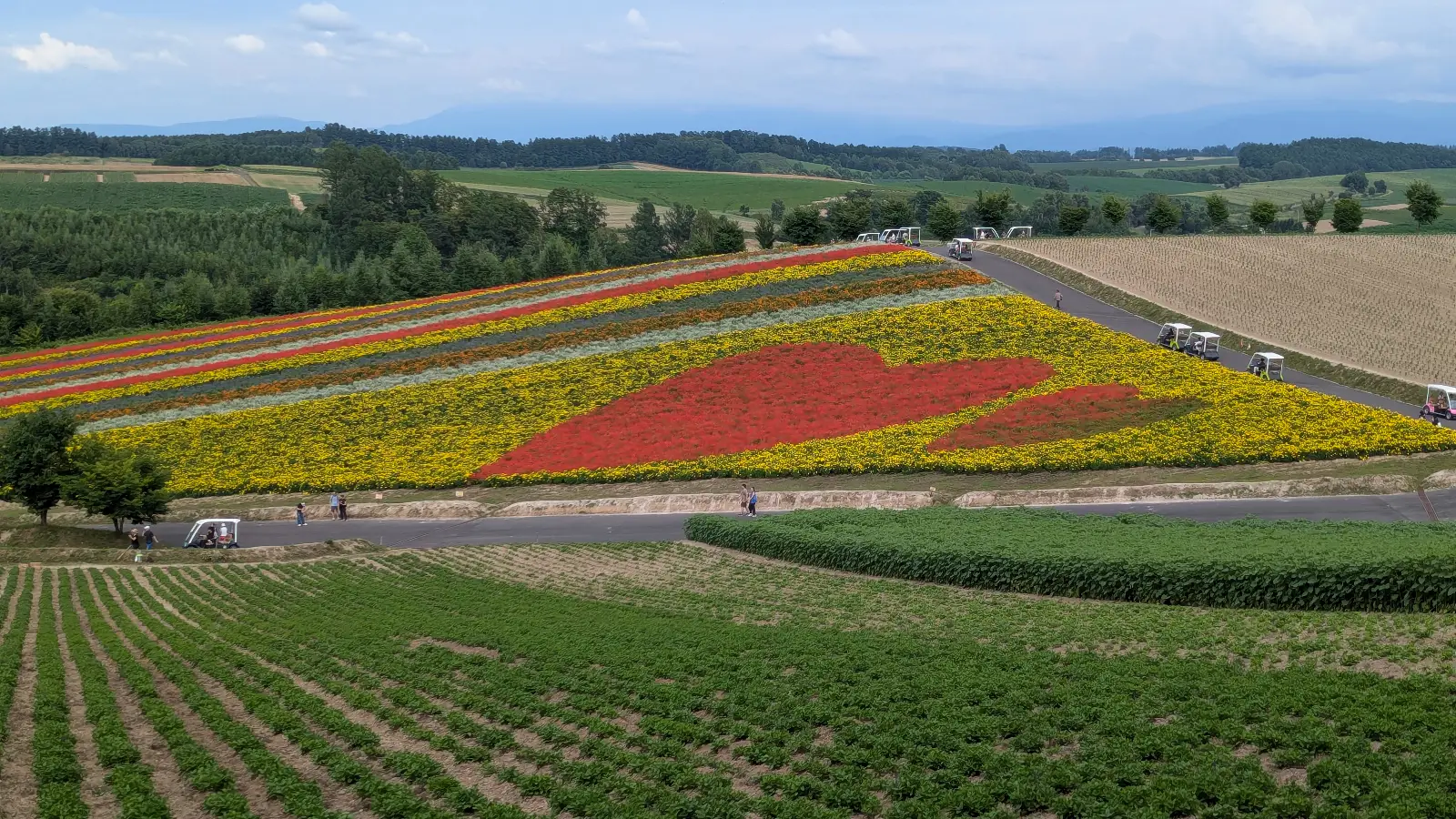
A flower park on the hills of Biei that is best seen from a seat, where the cart needs a licensed driver and the child’s job is to watch.
Under elementary free (the July to September rates); rides and the alpaca farm cost extra, cash only. No booking needed.
Shorter hours in other months; the alpaca farm closes 30 minutes earlier. Closed December 31 and January 1.
Built around two rides: the tractor bus circles the park in about 15 minutes, and the cart runs 15.
Buggy passengers from about 4 and over 102 cm; buggy drivers are 16 and over.
A barrier-free restroom.
Some links on this page are affiliate links. LuNi may earn a commission at no extra cost to you.
Is Shikisai-no-oka worth it with kids?
The short version, before the costs, the timings and the case for each child.
Yes, in the green season, and mostly from a seat. From late April to late October a tractor bus circles the park in about fifteen minutes and keeps running in rain, which is the easiest way for small children to take in the fields, and an alpaca farm, open all year, lets them feed the animals. The fields themselves are seen from the paths and the rides, never from inside them. Entry for children under elementary school age is free, and the rides and feed are paid in cash. In winter the park turns to snow, from sleds to snow rafting, with snowmobiles for drivers of 17 and over. Arriving by train means a 25-minute walk from an unstaffed station, so most families will want a car.
Planning Your Visit to Shikisai-no-oka with Kids.
Four decisions shape the day, and the season comes first. From late April to late October the park runs its rides; from early December to late March it runs snow activities; the weeks between have neither, so plan around the two seasons. Japan in winter with children is its own planning job, and Biei in snow is a different visit from Biei in flower. Next is the car, because the walk from the station is long for small legs and the park has plenty of parking. Then cash, since the window, the rides and the alpaca feed all take it and nothing else. Last, and worth saying out loud to the children, is the fields themselves: nobody walks into the flowers, even for a photograph, so say so before the camera comes out.
Every LuNi attraction guide starts with a visit, with our own children
LuNi rates and writes about attractions only after visiting them with children. Luca and Nico were at Shikisai-no-oka, and what they did there is recorded further down this page, including how each child actually met it.
Children arrive with different tolerances: for noise, for lines, for standing still, for being on their feet all day. A guide written for the average of them helps almost nobody. So every place on this site is read four ways, and each verdict says which children it already suits and what makes it work for the rest. Whoever you are bringing, the answer here is built for your family rather than for a general reader.
Restricted-movement depletion stays low with rides in motion, an alpaca farm to walk and feed, and sleds in winter, so keep the child riding or moving.
Sensory-input depletion builds in a park sized for crowds, with parking for 300 cars and fifteen tractor buses, so plan a short, early visit.
Unfamiliarity and unconfirmed structure ease on a tractor bus that runs one fifteen-minute circuit rain or shine, so describe the ride fully before boarding.
Sustained walking and standing add up from an unstaffed station 25 minutes away, so drive in and let the tractor bus carry the loop.
Hotels we would book for this visit.
Two Furano hotels for a family staying among the hills for a few days, and one in Asahikawa for a family basing the trip in the city and driving out for the flowers.
| Property | The LuNi Reason |
|---|---|
| LUNI Pick La Vista Furano Hills | La Vista Furano Hills is for a family making the flower hills one day of a longer stay in the area. A car does the rest of the work, since the park has parking for 300 and the walk from the unstaffed station is 25 minutes, long for small children. |
| Shin Furano Prince Hotel Nakagoryo, Furano | Shin Furano Prince Hotel is for a family that wants the flower park in the green season or snow in the winter from the same base, since Shikisai-no-oka runs sleds, snow rafting and snowmobiles from early December to late March. One base serves both halves of the year. |
| OMO7 Asahikawa by Hoshino Resorts | OMO7 Asahikawa, in the city rather than Furano, is for a family pairing the flower hills with the zoo or the science museum and basing the whole trip in the city. From there the flower park is a drive, or a train to Bibaushi and a 25-minute walk. |
OMO7 Asahikawa by Hoshino Resorts
Nearby attractions, matched to your child.
Three Asahikawa-area visits for what the flower hills leave undone: a mountainside of animals for a child who needs to walk, an indoor floor for a child tired of crowds, and a garden with its own path.
| Pairing | Why This Solves the After-Visit | For Your |
|---|---|---|
| LUNI Pick Asahiyama Zoo Asahikawa: bus from JR Asahikawa, about 40 minutes | Where the flower hills are mostly ridden, Asahiyama Zoo is walked: a mountain slope of animal houses a Dynamo can cover for three to four hours. Restricted movement finds its outlet there, but a Sprinter’s walking and standing run long, so plan the free East Gate shuttle. | Dynamo |
| Asahikawa Science Museum Asahikawa: bus from JR Asahikawa, about 5 minutes | Indoors and on one floor, the Asahikawa Science Museum is the change a Sensor needs after a crowded hillside. Sensory-input depletion eases where the intense stations, a dark touch passage and a quake experience, are ones to choose, and the rest corner is on the same level. | Sensor |
| Ueno Farm Asahikawa: seasonal bus, late April to mid-October | At Ueno Farm the garden season runs to October 18 with no closing day inside it, the hours are the same every day, and a named path joins the gnome garden to a small hill. Unfamiliarity and unconfirmed structure ease when the walk has a known end, the summit view. | Anchor |
Asahiyama Zoo
Asahikawa: bus from JR Asahikawa, about 40 minutes For YourDynamo
Asahikawa Science Museum
Asahikawa: bus from JR Asahikawa, about 5 minutes For YourSensor
Ueno Farm
Asahikawa: seasonal bus, late April to mid-October For YourAnchor
How two children actually met this attraction.
Both children chose the same thing here, the ride, and for opposite reasons, which is the most useful thing to know before a visit. One wanted to understand the whole place, how it was made and how it fitted together, and riding let him see all of it at once. The other simply found riding more fun than walking, and the motion held him in a way that no single view would have. That agreement makes the day easy to plan: put a ride near the start, let the careful child take in the layout from it and the restless child enjoy the movement, and keep the standing at viewpoints short. A family that arrives expecting a long walk among flowers will be working against both of them.
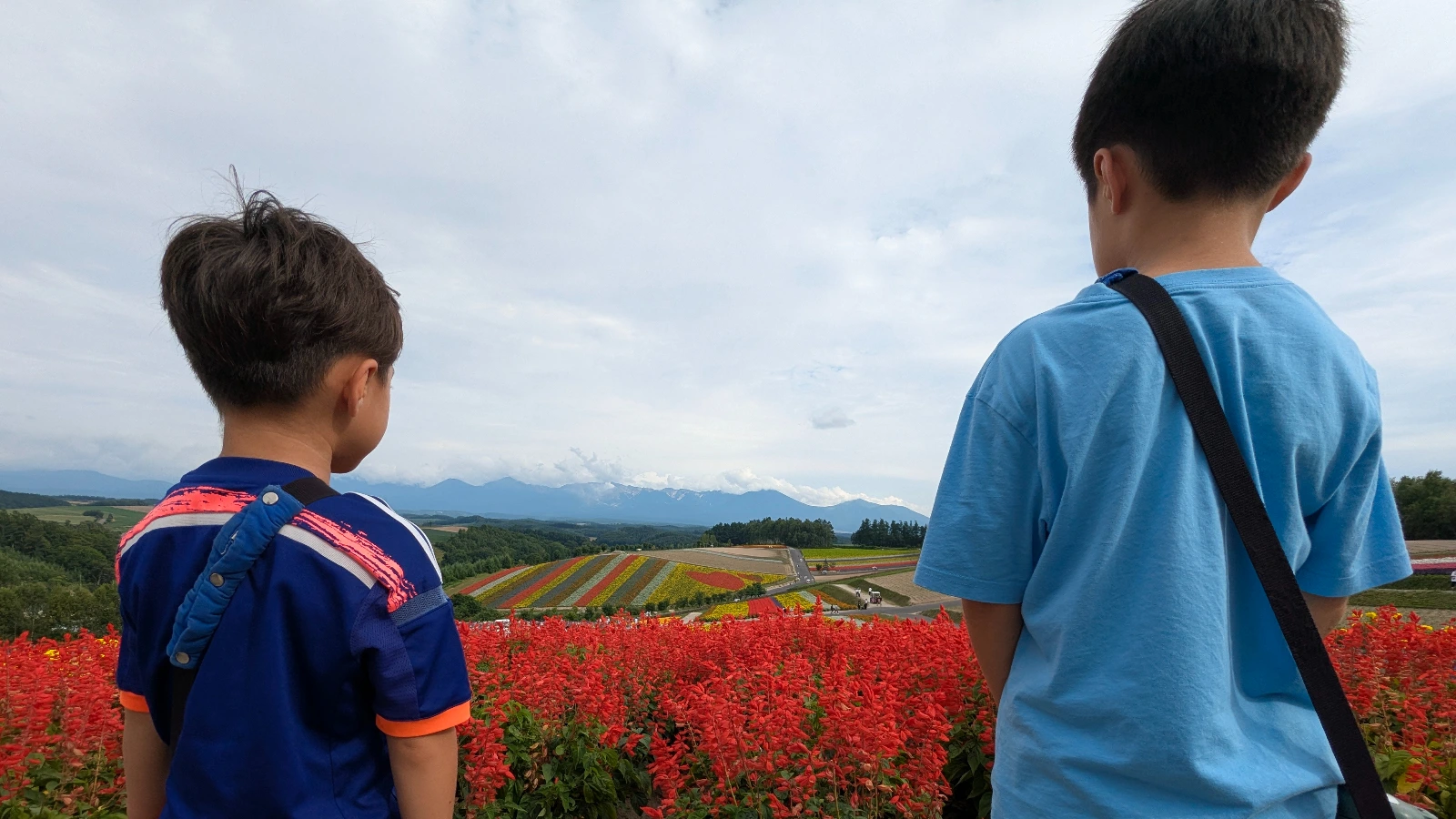
Luca stood at the edge of the fields and wanted to know how long it takes to plant all of these flowers, working out how many people and days a hillside this size would take. He was not counting colors; he was reverse-engineering the operation. Offered a choice between walking the rows and taking the golf cart, he chose the cart, because riding let him take in the whole layout at once.
This is the Anchor pattern, with an analytical pull. A child whose Reserve depletes through unfamiliarity and unconfirmed structure settles once a place can be understood as a system, and asking how long a hillside takes to plant is that child working out the system before relaxing into the view. Families with a similar child should let the question stand rather than hurry an answer, and choose the ride that shows the whole layout at once, because seeing the whole is what lets this child enjoy the parts.
Nico’s favorite thing was spotting the heart design worked into the flower planting, calling it out and tracking it as the cart moved. The cart itself was the point for him: riding around to look at all the flowers was far more fun than walking to see them, and the constant motion of the ride kept him engaged in a way that standing still at any single viewpoint never would have.
This is the Dynamo pattern. A child whose Reserve depletes through restricted movement stays regulated through motion, and for Nico the moving ride was the point, far more than any single view. Families with a similar child should treat the rides as the engine of the visit, with a parent driving, and fill the time between them with walking and the alpaca farm, because a Dynamo asked to stand still and admire a hillside is spending, while one riding past it is not.
Fields of flowers seen from a cart or a tractor bus give a child a different kind of beauty from anything in a city: wide, quiet and changing with the season. Being the navigator rather than the driver hands even a young child a role, calling out colors and choosing where to look. Landscapes like this teach children to notice gradual things, the way a hill changes color or a field moves in the wind. A child who learns to enjoy a view that asks nothing of them gains a lasting source of calm.
The LUNI Rating for Shikisai-no-oka.
One fact sits under all four verdicts: Shikisai-no-oka is a park of flower fields seen mostly from rides and from the ground around them, and the rides are seasonal, paid in cash and driven by adults. The Dynamo and the Anchor do well because the rides move and can be described in full before boarding. The Sensor needs care because a park built for this many visitors fills up, and the Sprinter does too because the approach and the ground between rides still add up. A family choosing between summer and winter here should read when to visit Japan with children first, because the two seasons are almost different parks.
Keep the child riding or moving, never waiting. The Dynamo depletes through restricted movement, and at Shikisai-no-oka the movement mostly comes on wheels. The tractor bus loop takes about fifteen minutes, the four-seat cart runs fifteen with a licensed adult at the wheel, and the buggy runs a lap of about 700 meters on its own course, with passengers from about four. A ride in motion suits this child far better than a long stand at a viewpoint. Beyond the rides, the alpaca farm is open all year with feed at 100 yen, and winter adds sleds and snow rafting.
Fill the gaps, because the gaps are where this child tires. Walk from the car to the first ride, send the child to the alpaca farm between rides, and keep the waiting at viewpoints short, because that is where this child starts spending rather than refilling. Save the cart for later in the visit, with a parent driving and the child calling the stops. In winter, put the sled first and the snow rafting second, and let the rides and the snow do the work that walking does elsewhere, since here the park is built to be ridden.
What this means for your Dynamo: restricted movement is spent in motion, riding or walking between rides. A younger Dynamo needs the alpacas and the sled; an older one can add a buggy lap as a passenger.Go early, and go short. The Sensor depletes through sensory input, and Shikisai-no-oka is built for numbers: parking for 300 cars, fifteen tractor buses of forty seats each, a restaurant and an alpaca farm on the same hill. A park sized like that fills, and the flower fields a family comes for are the same fields every other visitor comes for. The load for this child is people and motion on open ground rather than noise from any one attraction, and that is the whole difficulty.
Timing and length decide this visit. Arrive at opening, which is 08:40 from May to October, see the fields before the parking lot fills, ride the tractor bus once for the overview, and leave while the child is still enjoying it. The restaurant takes last orders at 15:00 and closes on Wednesdays, so plan food around it rather than improvising at the busiest hour. A shorter visit that ends well is the right visit here, and a second short visit on another day beats one long one.
What this means for your Sensor: sensory input builds with the crowds the park is built for. A younger Sensor needs an early, short visit; an older one can stay longer if the day starts at opening.Describe the ride, then take it. The Anchor depletes through unfamiliarity and unconfirmed structure, and the heart of a Shikisai-no-oka visit is a ride whose whole shape can be told in advance. The tractor bus runs one circuit of the park in about fifteen minutes, keeps running in rain, and costs the same every time: 500 yen for adults, 300 for elementary and junior high students, and nothing for younger children. The hours are set month by month, and the park opens every day except December 31 and January 1.
Say it all before the parking lot. Tell the child which ride comes first, how long it lasts and what they will see from it, and settle who drives the cart, because the answer is always an adult with a license. Bring cash, since the window, the rides and the feed are paid in cash, and a child who has watched the ticket bought already knows how the rest of the visit works. Name the finish too, the car or the restaurant, so the day has an end.
What this means for your Anchor: a ride told in full leaves unfamiliarity nothing to guess. A younger Anchor needs the tractor bus described twice; an older one can read the month’s hours and plan the order.Drive in, then ride. The Sprinter depletes through sustained travel-style walking and standing, and the first cost at Shikisai-no-oka comes before the gate. The nearest station, Bibaushi on the JR Furano Line, is unstaffed and 25 minutes away on foot, which is a real spend for small legs before a single flower. The park has parking for 300 cars, and the seated rides that save walking inside run only from late April to late October, and that season is the whole difference.
Two tools serve this child: the car and the tractor bus. Drive, park, and take the tractor bus early for the overview, so the legs see the whole park before they have walked any of it. The cart, driven by a parent, adds fifteen minutes seated. Keep the whole visit short enough that the walk back to the car is still easy, and outside the green season, when the rides stop, keep the stay shorter still, since every stretch between the car and the views is then on foot.
What this means for your Sprinter: walking and standing add up before the gate. A younger Sprinter needs the car and the tractor bus; an older one can manage the station walk if a ride covers the park.The questions parents actually ask.
Shikisai-no-oka splits by season, and the plan is clear once the season is chosen. In the green season it turns on the rides, who may drive them and what they cost; in winter it turns on the snow activities and their age and height rules. Two facts catch families out in both: the window, the rides and the feed are paid only in cash, and no child drives the cart. Plan around those two before leaving the hotel, and the rest is easy, and our itineraries for families show how a Biei and Furano day fits a longer Hokkaido week.
Is Shikisai-no-oka worth visiting with kids?
Yes, above all from late April to late October, when the tractor bus runs its fifteen-minute circuit of the park, rain or shine. Children under elementary school age enter free, the alpaca farm is open all year, and the rides and animal feed are cash only. A parent drives the cart; children ride along as passengers.
How much does Shikisai-no-oka cost?
Admission for July to September is 800 yen for high school students and adults and 500 yen for elementary and junior high students at the ticket machine, and children under elementary school age are free. The tractor bus is 500, 300 or free by the same bands, and so is the alpaca farm.
Can children drive the carts?
No. The four-seat cart must be driven by someone with a regular driving license, so a parent drives and the children ride. Buggies run their own course, away from the flower fields, with drivers aged 16 and over and passengers recommended from age 4. The cart costs 2,500 yen for 15 minutes, plus 500 yen for each extra 5, with the adult at the wheel.
What are the opening hours?
Hours change by month: 08:40 to 17:30 from June to September, 08:40 to 17:00 in May and October, 09:10 to 16:30 in November and December, 08:40 to 16:30 in January, and 09:10 to 17:00 from February to April. It opens every day but December 31 and January 1.
What is there to do in winter?
From early December to late March the park runs snow activities: snow rafting for 1,200 yen, sleds for 500 yen, and a snowmobile forest course from 15,000 yen. Snowmobile drivers must be 17 or over, and children 102 centimeters tall or shorter cannot ride at all. The touring routes need an advance reservation.
How do you get to Shikisai-no-oka?
By car is simplest, and there is parking for 300 cars. By train, the nearest station is Bibaushi on the JR Furano Line, which is unstaffed, and the walk from there takes about 25 minutes, a long way for small children. The park has no coin lockers, so plan to keep bags in the car.
Can you eat at Shikisai-no-oka?
Yes, at the restaurant, which takes its last orders at 15:00 and closes every Wednesday. Plan lunch before mid-afternoon, and on a Wednesday plan it somewhere else entirely. Pets are allowed in the park, except in the shop and the alpaca farm, and smoking is not allowed anywhere on the grounds.
Can you walk into the flower fields for photos?
No. Entering the flower fields to take photographs is not allowed, drones are banned during opening hours, and group photos are taken only at designated places. Enjoy the fields from where the park allows and from the tractor bus, which shows small children the whole layout without a long walk.
Where Shikisai-no-oka fits your Japan trip.
Official site and opening information: Shikisai-no-oka