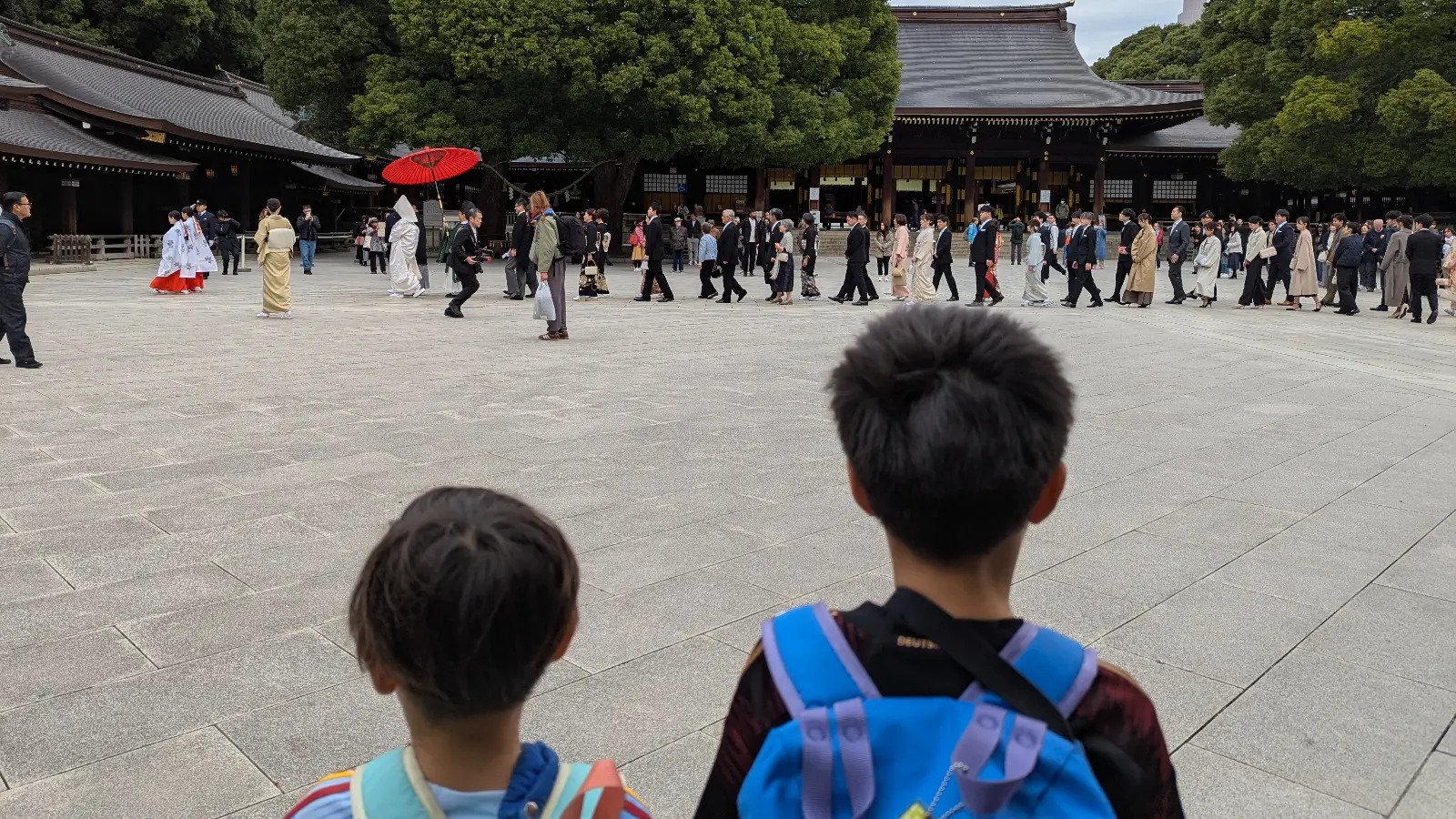
The thick gravel paths of Meiji Jingu Shrine create a specific parental hesitation that no other Tokyo shrine produces: a twenty-minute approach over unpaved terrain, with no seating and no intermediate reward, before a child reaches the main complex. For families carrying a low-stamina child or pushing a standard stroller, that walk is not a minor inconvenience, it is the deciding factor. At the same time, the towering wooden torii gates and the dense forest canopy offer something genuinely scarce in central Tokyo: a quiet, contained outdoor environment that actively reduces sensory load rather than adding to it.
Whether the shrine functions as a restorative break or a physical drain depends almost entirely on the child making the walk. The Family Fit™ framework makes that prediction reliable. For a broader view of how this fits into your Tokyo itinerary, our complete Tokyo family friendly travel hub maps the right balance of high-demand and low-demand days.
Is Meiji Jingu Shrine Worth Visiting with Kids? (Quick Answer)
Meiji Jingu Shrine is worth visiting with most families, provided the child making the walk has the physical reserves to sustain a continuous outdoor approach over unpaved terrain. The forested grounds reward Dynamos, Sensors, and Anchors through a combination of open walking space and predictable, low-stimulation environment, while Sprinters face a genuine physical challenge in the long gravel approach that has no seating and no shortcut. The profile breakdown below will tell you exactly which families should build this into their Tokyo itinerary and which should redirect their morning.
Pros of Visiting Meiji Jingu Shrine with Kids
- The wide outer approach paths are open, socially tolerant of a child moving at their own pace and volume, and free of the fragile-environment constraints that restrict behavior at most Tokyo cultural sites, making this a strong physical outlet for Dynamos before the more regulated inner complex requires a behavioral shift.
- The dense forest canopy absorbs city noise almost entirely, creating a predictable, low-input sensory environment that functions as a deliberate decompression tool for Sensors who have been absorbing the auditory load of busy transit stations and surrounding districts.
- The giant wooden torii gates at the entrance produce an immediate visual impression that children register without any contextual knowledge of Shinto tradition, making the opening moment high-impact for even the youngest visitors.
- The chozuya water pavilion provides a brief, tactile, sequenced ritual, one of the few genuinely participatory moments at a Tokyo shrine, that gives children a structured way to engage with the experience rather than observe it passively.
- The linear format of the grounds, a single clear path from the outer gate to the main hall, creates a fully predictable environmental sequence that allows Anchors to be briefed on every step before it happens, removing the uncertainty that makes new environments difficult for some children.
- The inner precincts operate at a social volume that is genuinely calm rather than performatively regulated, meaning families with well-prepared children can move through without the constant vigilance that more enclosed cultural spaces demand.
Cons of Visiting Meiji Jingu Shrine with Kids
- The main approach path is laid entirely in thick gravel, which creates significant rolling resistance for standard strollers and demands continuous active walking from children who cannot be carried or pushed through it comfortably, a physical requirement that catches many families off guard.
- The inner sanctuary requires hushed voices and limited movement, which creates a behavioral expectation that Dynamos will struggle to meet near the inner gate without advance preparation and clear parental guidance on the behavioral shift required before crossing it.
- The grounds offer almost no tactile or hands-on engagement beyond the water pavilion ritual, meaning a child who needs visual variety or interactive stimulation to stay present will exhaust the experience quickly and without warning.
- There are no seating areas along the main forest approach, which means the entire walk from the outer gate to the main hall must be completed in a single continuous effort, a structural fact that is particularly unforgiving for families traveling with Sprinters.
- The sake barrel display and other visual details along the path require an adult to actively point them out and contextualize them, as the grounds do not generate independent engagement for a child left to observe passively.
Why “Worth It” Depends on Your Child
Two parents can leave Meiji Jingu Shrine with completely opposite assessments of the same morning, and both can be correct, because the variable is not the shrine, it is the child who walked it. The Family Fit™ framework makes that distinction predictable before the visit rather than obvious only after.
The Dynamo – Go. The outer approach paths are wide, open, and socially tolerant of a child who moves at their own pace and volume, providing the physical discharge a high-energy traveler needs before the more regulated inner complex requires a shift in behavior. Prepare your Dynamo for the behavioral shift at the inner gate before you arrive, and schedule an active outdoor activity immediately after to avoid a post-visit energy backlog.
The Sensor – Go. The forest canopy creates a sensory environment that is rare in central Tokyo: quiet, shaded, predictable, and fully escapable at any point along the approach. Use this visit deliberately as a recovery window after a high-input transit day, and time arrival for early morning when crowd density is at its lowest.
The Anchor – Go. The linear, sequential structure of the grounds, outer gate, forest approach, water pavilion, main hall, maps onto a simple, rehearsable routine that a routine-reliant child can absorb entirely before stepping through the first gate. Brief the sequence in advance, name each step, and the visit unfolds exactly as described.
The Sprinter – Caution. The approximately twenty-minute gravel approach has no rest points and cannot be shortened, which means a child who arrives with any physical depletion will likely reach their limit before the main hall. Families who recognize this threshold in advance and plan accordingly, scheduling this visit as the first activity of the morning, before any energy has been spent elsewhere, convert this from a likely problem into a manageable one.
If you are not yet certain which profile best describes your child, the Family Fit™ Quiz will clarify the answer before you finalize your itinerary.
Who Will Enjoy Meiji Jingu Shrine with Kids (By Age Group)
Toddlers (under 3)
A toddler’s walking stamina is insufficient for the full gravel approach without a carrier or an appropriate stroller, and the grounds provide no sensory anchors designed to hold a very young child’s attention independently. Conditionally worth it if you have a carrier or a stroller with wheels suited to unpaved terrain; not worth attempting with a toddler who must walk the full route independently.
The LUNI Framework
Planning around Japan.
Or planning around your child?
Every child travels differently. The LUNI Profile Quiz identifies your child's specific profile in three minutes, and tells you exactly how to structure your itinerary around it.
Preschoolers (3 to 5)
Children at this developmental stage respond strongly to sequenced, participatory rituals and retain vivid sensory memories of visually striking environments. The water pavilion ritual and the scale of the wooden torii gates both land well with this age group, and the structured approach route gives parents a clear framework for keeping a preschooler engaged across the full walk. Worth it, provided the child is fresh and the visit is scheduled before midday fatigue sets in.
School-Age Kids (6 to 10)
This age group has the physical capacity to complete the walk and the cognitive range to begin appreciating the cultural context, but without active parental engagement the grounds can feel undifferentiated to a child who processes environments through activity rather than observation. Worth it when parents build in participatory prompts, counting the torii markers, locating the sake barrels, naming the sequence of approach rituals, rather than letting the walk speak for itself.
Older Kids and Teens (11+)
Teenagers with any interest in photography, architecture, or the particular atmosphere of ancient-seeming spaces surrounded by modern city will find Meiji Jingu genuinely compelling. The contrast between the forest interior and the fashion districts immediately outside the grounds provides a cultural juxtaposition that lands differently at this age than it does for younger children. Worth it as a deliberate counterpoint to high-stimulation urban activities.
Best Alternatives to Meiji Jingu Shrine for Families with Kids
Senso-ji Temple. Best for families with young children or children who need immediate engagement rather than a sustained approach walk. The Nakamise shopping street leading to the main hall provides continuous visual stimulation and frequent natural stopping points, eliminating the sustained physical output that the Meiji Jingu approach demands. Senso-ji Temple guide
Shinjuku Gyoen National Garden. Best for families whose primary goal is green-space decompression with a child who cannot manage uneven terrain. The garden delivers the same forested, low-crowd sensory relief as Meiji Jingu’s approach but across paved and well-maintained paths that place no additional physical demands on children who tire quickly. Shinjuku Gyoen guide
teamLab Borderless. Best for high-energy children who need active, movement-responsive engagement after a low-stimulation cultural morning. The fully interactive installation environment provides the hands-on, high-visual-return experience that Meiji Jingu’s quiet grounds deliberately exclude. teamLab Borderless guide
For a full map of how these options connect across Tokyo’s family-friendly neighborhoods, our Tokyo family friendly travel hub structures the routing decisions by district and profile.
Final Recommendation: Is Meiji Jingu Shrine Worth It with Kids?
Meiji Jingu Shrine is worth visiting with most families, specifically those whose child can sustain a continuous outdoor walk and benefits from a low-stimulation environment that functions as a genuine reset from Tokyo’s urban density. The visit works strongly for children who thrive in open, quiet, predictable outdoor spaces, and presents a meaningful challenge only for those whose physical stamina is the limiting factor of the day. For families in that second group, the visit succeeds when it is the first activity of the morning, before any energy has been spent; there is no mitigation available once the approach has begun and a child’s reserves are spent. Arriving at the outer gate early also secures the quietest conditions before the midday crowd changes the atmosphere.
The Meiji Jingu Shrine Briefing: Essential Intel
Parents planning a Meiji Jingu Shrine visit with kids return consistently to the same questions, from whether the long gravel approach is a genuine stamina problem for young children to how the regulated inner environment affects a child who struggles with behavioral constraints.
A: This is one of the strongest Tokyo options for an easily overwhelmed child. The forest approach absorbs ambient city noise almost completely, the crowd density is manageable outside peak hours, and the experience has no enclosed or inescapable elements; the family can exit the grounds at any point along the route without committing to the full walk. Sensors in particular benefit from the predictable, gentle sensory inputs that the forested approach delivers.
A: Worth it for babies who are in a carrier or a stroller designed for uneven terrain, because the dense forest canopy blocks direct sun and the ambient noise level is low enough to support a mid-morning nap for many infants. The caveat is equipment: a standard urban stroller with small wheels will struggle on the main gravel path, which means a carrier or an appropriately robust stroller is a prerequisite rather than an optional upgrade.
A: The shrine presents a genuine physical challenge for Sprinters because the main approach is approximately twenty minutes of continuous walking over unpaved gravel with no rest points, no shortcut, and no alternative surface. This is not a visit that rewards improvisation: families with low-stamina children who arrive without a carrier or terrain-appropriate stroller face a high probability of the visit ending before the main hall is reached.
A: Families whose primary criterion is hands-on engagement will find Meiji Jingu under-delivers. The water pavilion ritual is the only structured participatory moment, and the rest of the grounds are designed for quiet, observational walking rather than active exploration. A digital art space or interactive science museum will return more engagement per minute for a child who needs tactile or active stimulation.
A: The shrine is a strong choice for teenagers, particularly those drawn to photography or to the atmosphere of a densely forested environment that feels architecturally ancient despite sitting minutes from Harajuku’s fashion district. The visual scale of the approach and the cultural contrast between the inner precincts and the streets immediately outside the grounds provide a perspective that a teenage traveler is developmentally positioned to appreciate in a way younger children are not.
A: The shrine is an excellent fit for routine-reliant children because the experience follows a single, unchanging linear sequence with no optional branches, surprise elements, or crowd-driven unpredictability in its structure. Parents can fully brief the sequence, gate, forest path, water pavilion, main hall, return, before the visit begins, giving a routine-reliant child a complete mental map of everything that will happen. The Anchor functions particularly well here for this reason.
