Sumida River Fireworks Festival 2026
Dates, spots, and the crowd.
Nearly a million people gather on one riverbank for 90 minutes of light. The night is worth it. The plan is what decides whether it is spent well.
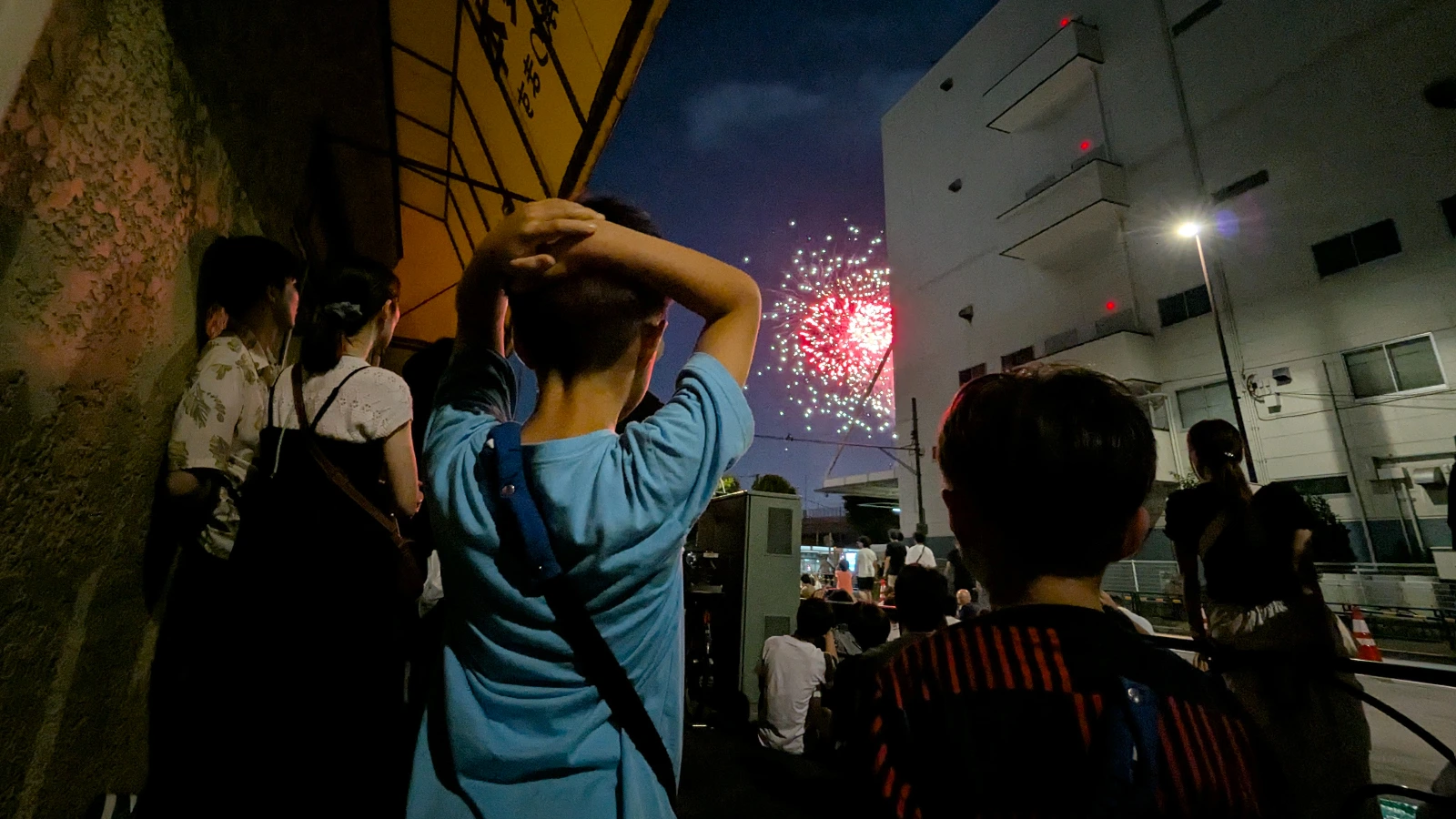
Held the last Saturday of July each year.
Riverbanks free to all. Paid reserved seats optional.
Show runs 7:00 PM to about 8:30 PM.
Two launch sites, more than 20,000 shells.
Some links on this page are affiliate links. LuNi may earn a commission at no extra cost to you.
Which costs your child more,
a museum or a playground?
You have the days. Now the nights.
Where to stay in Tokyo →Why the crowd is worth it.
The Sumida River Fireworks Festival, known locally as the Sumidagawa Hanabi Taikai, is one of Tokyo’s oldest and largest summer traditions. First, the facts a family needs.
The 2026 festival is set for Saturday, July 25, following the tradition of the last Saturday of July. More than 20,000 shells launch from two sites along the river across a roughly 90-minute program, and the show runs from about 7:00 PM to 8:30 PM. Heavy rain can push the event to the following day, so confirm the forecast before you travel. Watching from the public riverbanks and parks is free. Paid reserved seating is sold separately for families who want a guaranteed spot, and the Tokyo Skytree decks sell timed tickets that book out early.
That combination, free entry and a fixed evening window, is what makes the night deceptively simple to underestimate. Family travel runs on three currencies, not two. Money and time are the ones parents already track, and at a free festival both look cheap: no admission, one evening. The LUNI Framework names the third currency, the child’s reserve, their finite capacity to absorb what the day asks of them, and it is the currency this night actually spends. A claimed mat held for hours, concussive light and sound at peak density, then a slow release into a crowd of nearly a million that does not move quickly: the cost of the evening is paid in reserve, not yen, and the family that plans for that is the one still enjoying the finale rather than enduring it.
Viewing spots, free and paid.
The festival launches over two sites, and where you stand changes the night as much as when you arrive. These are the five areas families choose between, and what each one trades.
| Viewing Area | What to Expect | Access |
|---|---|---|
| Sumida Park, Asakusa side | Open green space with room for picnic mats and the most festive atmosphere. The family default, and the first area to fill. | Free |
| Sumida Park, Sumida side | A little less crowded than the Asakusa bank, with strong open river views. The better free choice for a child who needs lower density. | Free |
| Asakusa Station area | Lively streets thick with food stalls and easy transport, but the most congested approach and the tightest sightlines to the sky. | Free |
| Riverside bridges | Direct reflections on the water and a dramatic vantage, offset by dense, standing-only crowds with limited room for children. | Free |
| Tokyo Skytree area | Panoramic deck views with special illumination and a calmer, seated setting well above the crush. Tickets sell out well in advance. | Reserved |
Sumida Park, Asakusa side
Free. The family default.
Sumida Park, Sumida side
Free. Lower density.
Asakusa Station area
Free. Most festive, most congested.
Riverside bridges
Free. Dramatic, but standing-only.
Tokyo Skytree area
Reserved. Calmest, seated, above the crush.
The crowd, and your kids.
Crowd size and arrival timing are the two questions parents search most, and they are really one question: how do you spend a child’s reserve across a long, loud, stationary night. The answer depends on how that child depletes.
The framework reads a night like this through four travel profiles, and knowing which one you are pacing for is the decision that protects the evening. Each depletes differently, so each needs a different move built into the same plan.
The Dynamo depletes through restricted movement, and a mat claimed early is hours of enforced stillness with nowhere to put the energy. Let it out before the ground fills: a younger Dynamo runs the open stretches of Sumida Park in the late afternoon, while an older one takes on a job with motion in it, the snack run or scouting the exit route, so the wait carries movement rather than fighting it.
The Sensor depletes through sensory input, and this is the profile the night tests hardest, since a million people, shells breaking directly overhead, and food-stall noise all concentrate at the 7:00 PM peak. Plan around the ceiling rather than discovering it at the edge. Ear protection and the less-dense Sumida-side bank keep a younger Sensor under threshold, and an older one does better with a quieter fallback spot agreed in advance, a place to step back to that was chosen before the crowd arrived, not during it.
The Anchor depletes through unfamiliarity and unconfirmed structure, and a crowd this size erases the landmarks a child uses to stay oriented. Confirm the structure before dark. Walk a younger Anchor to the meeting point and the toilets while the space is still legible, and give an older one the actual sequence, show time, finale, and exactly when and how you leave, because a named plan is what holds an Anchor steady when the riverbank closes in.
The Sprinter depletes through sustained travel-style walking and standing, and the real tax is the exit, when stations back up and the walk out can run past an hour on spent legs. Do not join the first surge. A younger Sprinter stays seated on the mat until the crush thins, and an older one walks to a farther, quieter station, trading extra distance for a line that is at least moving.
A long wait in a huge crowd is one of the first places a child learns that anticipation and boredom feel almost the same in the body, and that the difference is whether they know what they are waiting for. Giving a child a real part in the night, a job, a choice, a share of the plan, hands them the thing that turns waiting into readiness. That is a skill that outlasts the fireworks, and outlasts the trip.
Transit, and where to sleep.
The approach and the exit are the hardest logistics of the night. A little planning on both, plus a bed within walking distance, removes most of the friction.
Getting there. Asakusa Station (Tokyo Metro Ginza Line, Toei Asakusa Line, Tobu Skytree Line) is the closest access point and by far the most crowded. Kuramae Station and Hikifune Station give slightly calmer approaches to the river. Local buses serve the area but face road closures and delays, so trains are the reliable choice. Arrive 3 to 4 hours before the 7:00 PM start to claim space, and expect the exit after the finale to take well over an hour. Pack a picnic mat, water, and snacks in case of long waits, and bring small LED toys or glow sticks: they keep children entertained and make them easy to spot in the evening crowd.
Family hotels within festival reach
A room within walking distance of Asakusa turns the punishing exit into a short walk home and gives a depleted child somewhere to reset. These three sit close to the launch site across three budgets.
| Hotel | Why It Fits | Tier |
|---|---|---|
| LUNI Pick The Gate Hotel Kaminarimon by Hulic Steps from Asakusa | Rooftop views and family comfort within walking distance of the launch site. The shortest, calmest route back once the finale crowd releases, which suits a child who needs to decompress the moment the night ends. | ¥¥¥ |
| Hotel Gracery Asakusa Quiet street near the park | Modern, well-priced rooms on a calmer side street near the festival area. A quieter base helps a sensory-sensitive or structure-seeking child recover between the day and the evening show. | ¥¥ |
| Asakusa Tobu Hotel By Asakusa Station | Triple rooms a few minutes from Asakusa Station, the shortest walk back once the crowd surges toward the trains. The lowest-friction budget base for families with tired legs after the finale. | ¥ |
The Gate Hotel Kaminarimon by Hulic
Budget: ¥¥¥
Budget: ¥¥
Budget: ¥
Sumida River Fireworks, answered.
When is the Sumida River Fireworks Festival 2026?
The 2026 festival is set for Saturday, July 25. The event is held annually on the last Saturday of July, with the fireworks beginning around 7:00 PM and running to about 8:30 PM across a roughly 90-minute program. Heavy rain can push the event to the following day, so confirm the forecast before you travel.
Is the Sumida River Fireworks Festival free, or do you need tickets?
The festival is free to attend from the public riverbanks and parks. No ticket is required to watch from Sumida Park or the surrounding streets. Paid reserved seating is sold separately for families who want a guaranteed spot with less crowd pressure, and the Tokyo Skytree observation decks sell timed tickets that book out well in advance.
What time should you arrive at the Sumida River Fireworks Festival with kids?
Plan to arrive 3 to 4 hours before the 7:00 PM start. The best family spots at Sumida Park fill by mid to late afternoon, and arriving early lets younger children move and settle before the ground fills. Families holding paid reserved seats have more flexibility but should still allow extra time for the crowded approach to the river.
How crowded is the Sumida River Fireworks Festival?
The festival draws close to a million spectators to the riverbanks around Asakusa and Sumida each year, which makes it one of Tokyo’s most crowded summer events. Trains, walkways, and the exit after the finale are all shoulder to shoulder. Keep children close, agree on a meeting point in advance, and expect the walk to the station to take well over an hour once the show ends.
Where is the best place to watch the Sumida River Fireworks Festival with kids?
Sumida Park on the Asakusa side is the most family-friendly free spot, with open green space for picnic mats. The Sumida side of the park is a little less crowded with strong river views. Paid reserved seating and the Tokyo Skytree decks trade the free, festive atmosphere for a calmer, guaranteed view, which suits families who find dense crowds hard with young children.
Is the Sumida River Fireworks Festival stroller-friendly?
Strollers are technically allowed, but the crowd density makes them very hard to maneuver, especially on the approach and the exit. A baby carrier is strongly recommended for infants and toddlers. If you do bring a stroller, treat it as a stationary base at your mat rather than something you move through the crowd during peak hours.
What should you bring to the Sumida River Fireworks Festival with kids?
Bring a picnic mat, water, and snacks in case of long waits, since stalls and convenience stores sell out and lines grow long near the start. Small LED toys or glow sticks help you keep track of children in the evening crowd. Ear protection is worth packing for a child sensitive to loud noise, and a printed meeting-point plan helps if phone signal drops in the dense crowd.