Shibuya Scramble Crossing with Kids: the view decides the visit.
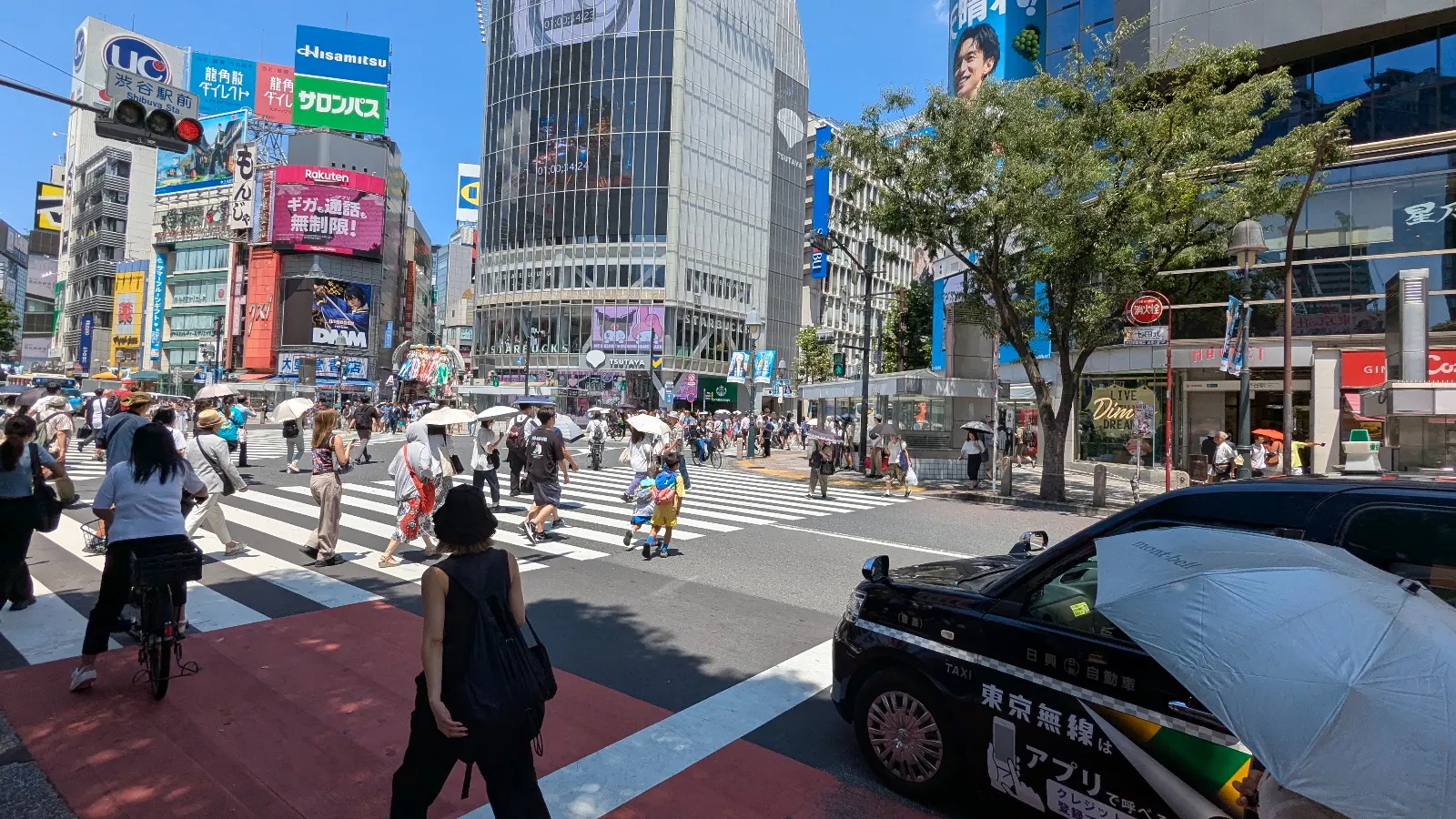
Shibuya Crossing costs nothing to walk and takes one signal, but the view from above is the part children remember, and it cannot be booked ahead for them.
Shibuya Sky above: adults from ¥2,700 on the web; a child ¥1,200 at the counter on the day.
A public street crossing; Shibuya Sky’s roof above closes without notice in bad weather.
One signal to cross; plan the view above as a second, separate stop.
At Shibuya Sky, children cannot be carried in arms or on shoulders; bring a carrier.
Only Shibuya Sky’s loan strollers go on the roof; the crossing itself is a public street.
Some links on this page are affiliate links. LuNi may earn a commission at no extra cost to you.
Is Shibuya Scramble Crossing worth it with kids?
The short version, before the costs, the timings and the case for each child.
Yes, but plan it as two short experiences, not one long one. The first is the crossing itself: free, a single signal, and for most children a genuinely thrilling minute in the middle of Tokyo. The second is the view down onto it, which is where the crossing makes sense, and that part needs planning. A child’s ticket for Shibuya Sky is sold only at the counter on the day, with the child there, and the roof can close without notice in bad weather, so the view can never be guaranteed in advance. For a child who finds crowds and noise hard, keep both parts brief and have a second plan ready. For a child who loves to move, the crossing is the easy win.
Planning Your Visit to Shibuya Scramble Crossing with Kids.
Three decisions shape a Shibuya visit, and the first is whether to go up at all. Shibuya Sky sells a child’s ticket only at the 14th-floor counter on the day, so an adult ticket bought online does not secure the child’s, and the child’s ticket is bought just before entry, with the child standing there. The second is the weather: the roof closes without notice for wind, rain, snow, thunder, smog or extreme heat, so have a second plan. The third is how to carry a small child, because carrying a child in your arms or on your shoulders is not allowed at Shibuya Sky; bring a baby carrier and leave the stroller at the hotel. The crossing and the view are a short part of a Shibuya morning, so let the weather decide which comes first.
Every LuNi attraction guide starts with a visit, with our own children
LuNi rates and writes about attractions only after visiting them with children. Luca and Nico were at Shibuya Scramble Crossing, and what they did there is recorded further down this page, including how each child actually met it.
Children arrive with different tolerances: for noise, for lines, for standing still, for being on their feet all day. A guide written for the average of them helps almost nobody. So every place on this site is read four ways, and each verdict says which children it already suits and what makes it work for the rest. Whoever you are bringing, the answer here is built for your family rather than for a general reader.
Restricted-movement depletion finds a real outlet in a crossing walked in one signal, so let a moving child set the direction, a hand always held.
Sensory-input depletion peaks at a public crossing the family cannot control, and a child’s view from above cannot be booked ahead, so keep it short.
Unfamiliarity stays high when the child’s Shibuya Sky ticket is sold only on the day and the roof can close, so have a second plan.
Walking and standing build on the stairs and escalators at Shibuya Sky, where children cannot be carried in arms, so bring a baby carrier.
- Cost
- Free at street levelShibuya Sky above: adults from ¥2,700 on the web; a child ¥1,200 at the counter on the day.
- Booking
- Adults online; children on the dayA child’s Shibuya Sky ticket is sold only at the 14th-floor counter, with the child present.
Hotels we would book for this visit.
Timing is the whole question for a room here: the crossing takes one signal and the view above depends on the weather, so a room in one of Shibuya’s family hotels lets a family choose the moment. Three rooms in the district, the pick first.
| Property | The LuNi Reason |
|---|---|
| LUNI Pick Shibuya Stream Hotel | Shibuya Stream Hotel is for a family that wants the crossing on the child’s clock rather than the day’s. Staying in the district means it can be crossed early, before other plans, or late, after dinner, and a child who found it too much the first time can try it again the next morning without a trip across the city. |
| Shibuya Excel Hotel Tokyu | Shibuya Excel Hotel Tokyu is for a family that pairs the crossing with the Hachiko statue and the roof lawn at Miyashita Park. The crossing is a single signal, so the day needs its other stops close together, and a base in the same district lets a child who has had enough go back and rest between them. |
| Hotel Indigo Tokyo Shibuya | Hotel Indigo Tokyo Shibuya is for a family giving Shibuya two short visits rather than one long one: the crossing and the view on one day, the rest of the district on another. A child the plaza wore thin can stop after a single signal, rest, and try again when the day allows it. |
Nearby attractions, matched to your child.
Three pairings for what the crossing leaves unmet: a rooftop lawn for a moving child, a short, free stop for tired legs, and a large, quiet park for a child the crowd has overwhelmed.
| Pairing | Why This Solves the After-Visit | For Your |
|---|---|---|
| LUNI Pick Miyashita Park Shibuya; a four-story park with a roof lawn | After a crossing spent holding a hand, a Dynamo’s restricted movement gets real ground to cover on Miyashita Park’s roof lawn, with skateboarding and bouldering beside it. The crossing asked a child to keep pace with strangers; the lawn lets them set their own. | Dynamo |
| Hachiko Statue Shibuya Station, Hachiko Exit; free | The Hachiko Statue stands at the station exit named after it, a free stop that asks a Sprinter for almost no walking. It is an open public plaza, though, and a Sensor’s sensory input meets the same uncontrolled space there, so keep it to a photograph. | Sprinter |
| Yoyogi Park Harajuku; wide lawns, no gate hours | After a crossing where strangers set the pace, Yoyogi Park gives a Sensor ground that belongs to nobody in particular: wide lawns, open at every hour, where loud or amplified music is not allowed. Sensory input falls away with room on every side, three minutes on foot from JR Harajuku. | Sensor |
Miyashita Park
Shibuya; a four-story park with a roof lawn For YourDynamo
Hachiko Statue
Shibuya Station, Hachiko Exit; free For YourSprinter
Yoyogi Park
Harajuku; wide lawns, no gate hours For YourSensor
How two children actually met this attraction.
Two children stood at the same crossing and made opposite things of it. One would not cross until he understood it, and then spent the rest of the visit watching it work from above; the other made it a game at street level and had no interest at all in looking down. That split is the real lesson of Shibuya with children. The crossing and the view are two different experiences, and most children want one of them far more than the other. Find out which before you arrive. A child who reads systems will want the view, so plan the counter line and a clear day. A child who needs to move will want the street, so give them the crossing, with a hand held and a rule set.
Luca did not want to cross first. He wanted to know how it worked. He stood at the curb through a full signal cycle without moving, watching the vehicle lights, the pedestrian signal, and the way the whole intersection emptied and then refilled, and only committed to walking once he had confirmed the pattern for himself. What held him longest afterward was the view down onto it.
This is the Anchor pattern. A child whose Reserve depletes through unfamiliarity and unconfirmed structure does not refuse a chaotic place; he stands outside it until he has worked out its rules. For a similar child, let him watch a full signal before crossing, and do not hurry him. Then give him the view from above if the day allows, where the same system plays out below him, and it becomes something he understands rather than something that happens to him.
Nico turned it into a race before anyone suggested one. He picked a landmark on the far side, announced it, and made the crossing a course against his brother, with the only rule being that you could not bump into anyone. He crossed it three times, twice on a diagonal, talking the whole way. The view he ignored entirely: looking down from above held him for well under a minute.
This is the Dynamo pattern. A child whose Reserve depletes through restricted movement meets a busy crossing as somewhere to go rather than something to avoid, and he will make a game of it if you do not. For a similar child, set the game yourself: choose a landmark on the far side, walk to it together on the signal, with his hand in yours. Skip the view, which does nothing for him, and spend that time at a roof lawn instead.
The crossing teaches a lesson that has little to do with sightseeing: how thousands of strangers manage to move together without colliding. For a child, walking it beside a parent is a first experience of trusting a system bigger than the family, and seeing it from above turns the same chaos into a pattern that can be read. Children who have felt a city work, from inside it and from over it, come home steadier about crowds. A busy place frightens less once a child understands how it keeps its order.
The LUNI Rating for Shibuya Scramble Crossing.
The verdicts split on what an uncontrolled public place asks of each child. For a child who needs to move, a crossing walked in one signal is a thrill, which is why the Dynamo is the easy case. For a child who takes in everything at once, or one who needs a plan, it is the hardest kind of stop, and the view that might have helped cannot be booked ahead for a child, which is why the Sensor and the Anchor pay the most. The Sprinter needs a plan for the stairs above. Those two need only one green light here; a calmer Tokyo neighborhood can have the day.
Give the crossing to the child who needs to move. The Dynamo depletes through restricted movement, and the crossing is one of the few famous sights in Tokyo that a moving child can actually do rather than watch. It takes one signal, it is free, and the whole intersection clears and fills again in front of you. For a child who needs somewhere to go, walking across it with everyone else is the point of the visit, and the whole of its value.
The adult’s job is to set the rules before the signal changes. Pick a landmark on the far side together, hold the child’s hand, and walk, never run, with the crowd. Cross twice if the first one went well. Then take a moving child somewhere with open ground, such as the roof lawn at Miyashita Park, rather than up to a viewing deck, which will hold them for a minute at most.
What this means for your Dynamo: a crossing walked in one signal gives restricted movement a clear outlet. A younger Dynamo needs a hand held and one crossing; an older one can choose the landmark and lead the way over.Keep it brief, and do not bank on the view. The Sensor depletes through sensory input, and a crossing in the middle of Shibuya is public space at its most intense: the family has no control over who else is there or how loud it is. The usual answer is to watch from above instead, and that is where this child meets the second problem. A child’s ticket for Shibuya Sky cannot be booked ahead; it is sold only at the counter on the day, and the open-air roof can close without notice.
The one thing that would help cannot be secured in advance. Keep the street-level visit very short, one crossing at most, or skip it and see it from above if the day allows. If you do try for the view, go on a clear day and have a quieter fallback ready, somewhere green and open. Do not promise this child the view; promise them the fallback.
What this means for your Sensor: input peaks at a public crossing, and the view above cannot be secured ahead for a child. A younger Sensor needs a single short crossing or none; an older one can choose the view on a clear day.Plan the fallback before you plan the view. The Anchor depletes through unfamiliarity and unconfirmed structure, and Shibuya offers almost nothing that can be confirmed in advance. The crossing is a public road with no schedule but its signals. The viewpoint above cannot be booked for a child, whose ticket is sold only at the 14th-floor counter on the day, and the roof can close without notice for wind, rain, snow, thunder, smog or heat.
So give this child a plan that does not depend on either. Tell them there are two possible versions of the day, the view if the weather and the counter allow, and a named second stop if they do not, and describe both. Inside Shibuya Sky, warn them about the stairs, the escalators, the dark floor areas and the bag check. A child who knows the fallback will cope with the change; a child promised only the view will not.
What this means for your Anchor: unfamiliarity stays high when neither the ticket nor the roof can be confirmed ahead. A younger Anchor needs two versions of the day described in advance; an older one can hold the plan and the fallback.Bring the carrier, not the stroller. The Sprinter depletes through sustained travel-style walking and standing, and the crossing itself asks very little: one signal, a short walk. The effort is in the view above. Shibuya Sky has stairs and escalators inside, with a priority elevator on request, and a family’s own stroller cannot go onto the roof, where only the venue’s loan strollers are allowed.
There is one more rule that matters for a tired child: carrying a child in your arms or on your shoulders is not allowed at Shibuya Sky, and a baby carrier is recommended instead. So bring the carrier, ask for the elevator if the stairs are too much, and keep the visit short. For this child the view costs more legs than the crossing, and both can be managed.
What this means for your Sprinter: the stairs and escalators above are where walking and standing build, and arms are not allowed. A younger Sprinter needs a carrier and the elevator; an older one can manage the stairs if the visit is short.The questions parents actually ask.
A child’s ticket to the view above the crossing exists only at a counter, on the day, and every other decision bends around that. The adults can book online, up to two weeks ahead; the child cannot. Children cannot be carried in arms or on shoulders up there, and the roof closes in bad weather, often without warning. None of that rules the view out; it means planning it, with a fallback named before the family arrives. Tell the child the fallback too, so a closed roof is just a change. The crossing itself asks nothing but a green light and a hand to hold across it.
Is Shibuya Scramble Crossing worth visiting with kids?
Yes, as a short experience rather than an outing. Crossing it is free and takes a single signal, and most children remember it. Seeing it from above is the other half, and it takes planning, because a child’s ticket for the main viewpoint cannot be bought ahead. For a child who struggles with crowds and noise, keep the visit brief.
Can you book Shibuya Sky tickets for children in advance?
No. Elementary-school tickets and tickets for children of 3 to 5 are sold only at the 14th-floor counter on the day, with the child present. They are still sold when adult tickets are sold out. Adults, which Shibuya Sky counts from 12, buy on the web up to two weeks ahead, and when the web sells out, the counter does too.
How much does Shibuya Sky cost?
An adult ticket, for visitors 12 and over, is 2,700 yen on the web for entry up to 14:59 and 3,400 yen from 15:00, or 3,000 yen and 3,700 yen at the counter. A child’s ticket is 1,200 yen, at the counter on the day only. Children of six who are not yet in school enter free.
Can you carry a child at Shibuya Sky?
Not in your arms or on your shoulders: the venue asks visitors not to carry children that way when entering, viewing or moving about, for safety. A baby carrier is recommended instead. Your own stroller cannot go onto the roof; only the venue’s loan strollers can, and not into the heliport area.
What happens at Shibuya Sky in bad weather?
The rooftop can close without notice for wind, rain, snow, thunder, photochemical smog or extreme heat. That is the main reason a family should never make the view the only purpose of a Shibuya day. Have a second plan ready, such as the crossing itself at street level or a covered stop nearby, before you line up at the counter.
What can you take onto the Shibuya Sky roof?
Very little. Bags, tripods, selfie sticks, earphones, hats and food are not allowed on the roof, and there are bag checks on the way in. Food and drink should not be brought into Shibuya Sky at all. The route inside includes stairs, escalators and dark floor areas, with a priority elevator on request.
Is there another way to see the crossing from above?
Yes. MAG8, the crossing-view rooftop lounge at MAGNET by SHIBUYA109, charges 1,800 yen per person, including one drink, and opens from 10:00 to 22:00 with last entry at 21:30. Alcohol is served there. It can close early or shut in bad weather, and a 150-second photo service costs 1,500 yen.
Where should families stay near Shibuya Crossing?
Staying in Shibuya lets a family see the crossing early or late, when it suits the children, rather than fitting it into a day spent elsewhere. Shibuya Stream Hotel suits a stay built around the crossing and the view above it; Shibuya Excel Hotel Tokyu in Dogenzaka suits a day of short stops, with the statue and Miyashita Park among them.
Where Shibuya Scramble Crossing fits your Japan trip.
Official site and opening information: Shibuya Sky