Megane Bridge with Kids: A Short Stop, Best at Low Water.
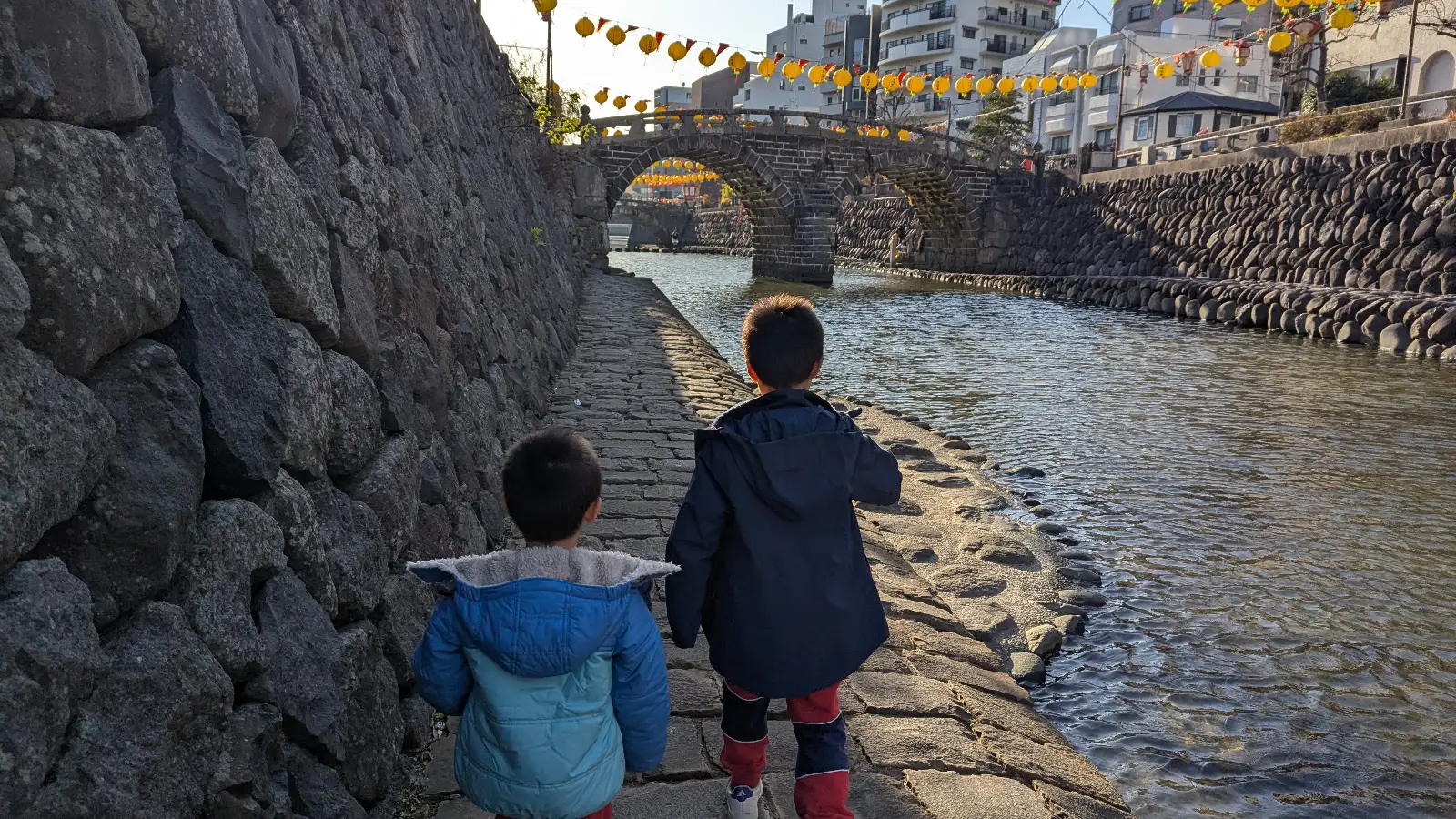
A stone bridge in a city center is a few minutes of looking for a parent and, when the river runs low, a riverbank for a child who needs to move.
A public bridge carrying a street, with no gate and nothing to book.
No hours and no closing day; the bridge area is decorated and much busier during the Lantern Festival.
A short stop, longer when the river holds a child’s attention.
Old enough to hunt for heart stones in the river wall and to stay back from the water’s edge.
No rules of its own: the bridge carries a street, and the river wall is seen from the banks.
Some links on this page are affiliate links. LuNi may earn a commission at no extra cost to you.
Is Megane Bridge worth it with kids?
The short version, before the costs, the timings and the case for each child.
Yes, as a stop on the way somewhere, not as the day. Megane Bridge is a free stone arch bridge over the Nakashima River in central Nagasaki, one of the oldest of its kind in Japan, and it takes no ticket, no line and no plan. What turns it from a photo into something a child enjoys is the river. Heart-shaped stones are set in the river wall for a child to hunt, the water holds carp, herons and turtles, and the wall and the water together can hold a child far longer than the arch above them. The one decision worth making is when to pass by: in daylight, with the hunt already promised, and for as long as the child wants and no longer.
Planning Your Visit to Megane Bridge with Kids.
There is almost nothing to plan here, and that is the appeal. The bridge is free and always there, so the only decisions are when to pass it and what to hand the child. Pass it in daylight, when the stones in the river wall can be seen, and have a heart-stone hunt ready before you arrive, because the stones give a child a job from the first minute and cost nothing to promise, whatever the water is doing. Avoid the Lantern Festival days if the child is young or easily flooded by crowds, since the bridge is a festival venue and much busier then. Reach it by the tram to City Hall and a short walk, and let it be a few minutes in a Nagasaki day with children rather than the day itself.
Every LuNi attraction guide starts with a visit, with our own children
LuNi rates and writes about attractions only after visiting them with children. Luca and Nico were at Megane Bridge, and what they did there is recorded further down this page, including how each child actually met it.
Children arrive with different tolerances: for noise, for lines, for standing still, for being on their feet all day. A guide written for the average of them helps almost nobody. So every place on this site is read four ways, and each verdict says which children it already suits and what makes it work for the rest. Whoever you are bringing, the answer here is built for your family rather than for a general reader.
Restricted-movement depletion stays low at a free bridge on an open street, so let the child cross, hunt the heart stones and move on.
Sensory-input depletion stays low at a short outdoor stop with nothing to line up for, so keep it brief and avoid the festival evenings.
Unfamiliarity and unconfirmed structure barely arise at one bridge with nothing to decide, so give the child a single thing to find before arriving.
Sustained walking and standing stay short at a bridge a few minutes from the tram, so treat it as a stop between rides, not a walk.
Hotels we would book for this visit.
Three Nagasaki family hotels at or near Nagasaki Station, all a short tram ride from City Hall, the stop for the bridge. None is chosen for the bridge alone; they are chosen for the day it sits in.
| Property | The LuNi Reason |
|---|---|
| LUNI Pick Nagasaki Marriott Hotel At Nagasaki Station, on the tram stop side | The tram toward Hotarujaya reaches City Hall, the stop for the bridge, in about four minutes, and the Marriott sits on the side of the station where the trams run. That makes the bridge an easy detour on the way to anything else. Connecting rooms are available, which helps when two children need separate beds and separate quiet. |
| Hilton Nagasaki At Nagasaki Station’s west exit | The station’s west exit leads straight onto a pedestrian deck and into this hotel, which keeps the first and last minutes of every day simple. It also has a nursing space and a changing table, a practical advantage with a baby. Cross the concourse to the tram side for City Hall and the short walk to the river. |
| Stadium City Hotel Nagasaki About 10 minutes’ walk from Nagasaki Station | About ten minutes’ walk north of the station, near a tram stop, with an indoor pool and hot-spring baths inside. For the bridge it is a longer ride, Line 3 through the station to City Hall, so it suits a family whose days are spent mostly north of the center. |
Nearby attractions, matched to your child.
Megane Bridge fills a quarter of an hour, so these pairings are what the rest of the morning becomes: more of the hunt for a child who moves, a place to settle for a child who reads, and a seat for tired legs.
| Pairing | Why This Solves the After-Visit | For Your |
|---|---|---|
| LUNI Pick Glover Garden Route 5 tram, no change | Route 5 runs from the Meganebashi stop to Glover Garden without a change. Heart-shaped stones are set in the garden’s paving as well, and entered at the top by the free Sky Road, the hillside is a long walk down, so restricted movement never builds up and the search simply continues. | Dynamo |
| Dejima About 1 km on foot along the tram line | A walk of about a kilometer brings the family from the river to Dejima, a reconstructed island of historic buildings with a free staff-led walk. Where the bridge is gone in minutes, this is a place to settle into, and an unfamiliar site eases for an Anchor when someone else leads the way through it. | Anchor |
| Nagasaki Science Museum Line 3 from City Hall to Ohashi, then 10 minutes’ walk | Line 3 runs from City Hall to Ohashi without a change, and Nagasaki Science Museum is a short walk on. Its planetarium shows run about 40 minutes in a seat, so a child whose walking and standing reserve is running low gets an indoor afternoon with a long sit built in. | Sprinter |
Glover Garden
Route 5 tram, no change For YourDynamo
Dejima
About 1 km on foot along the tram line For YourAnchor
Nagasaki Science Museum
Line 3 from City Hall to Ohashi, then 10 minutes’ walk For YourSprinter
How two children actually met this attraction.
Two children stood at the same bridge and got completely different things out of it. One needed to know why it was called what it was called before he would give it any attention, and he did not stop until he had seen the answer for himself. The other did not care what it was called. He was down at the water before the family had finished arriving, searching the wall and touching the river, and ready to leave the moment he had done it all. A bridge is a small place with very little to it, and that is exactly why it shows the difference between them so clearly: one child came to understand it, the other came to use it, and each was finished at his own speed.
Luca wanted to know why it was called the spectacles bridge before he was willing to like it. He asked when it was built and treated the answers as claims to be checked. Then he tested it himself, moving along the bank until the two arches lined up with their reflection and the pair of glasses actually appeared. Once the mechanism resolved, he was satisfied in a way a photo would never have made him.
This is the Sensor pattern, with an analytical hook. A child whose Reserve depletes through sensory input is often the child who takes in detail most completely, and at a small outdoor stop that same close attention turns a bridge into a puzzle to solve rather than noise to endure. Families with a similar child should hand over the question as the way in, why it has its name and where to stand, so the noticing has somewhere to go.
Nico was down on the riverside steps within a minute, before anyone had finished reading the sign. He went straight for the embankment wall to hunt the heart-shaped stone, touched the water, and kept moving the whole time, narrating what he was doing to no one in particular. For him the bridge was a place to get into, not a thing to look at. He enjoyed it at full speed and then wanted to leave.
This is the Dynamo pattern. A child whose Reserve depletes through restricted movement does not meet a riverbank as scenery. He meets it as somewhere that moving is the whole point, so the wall and the water become the visit. Families with a similar child should let the stop be short and physical rather than fighting for a posed photo on the bridge, and plan it as a quick outlet between longer visits, so that its brevity works for the child.
A small stone bridge in the middle of a city shows a child how an ordinary thing can become beloved over centuries. Standing on the bank and searching for the heart stones set into the river wall, a child discovers that a famous sight can also be a personal treasure hunt. Children often connect more with the details a place hides than with the view it is known for. A short visit that ends with a heart found teaches a child that looking closely is how ordinary places become special.
The LUNI Rating for Megane Bridge.
One fact sits under all four verdicts: Megane Bridge is a free stone bridge on an open city street, with nothing to book, nothing to line up for and a river beneath it. It works for a child who needs to move, since there is a wall to search and, at low water, steps down to the river. It suits a child who takes in everything, because the stop is short and outdoors, and a child who needs things settled, because there is nothing to decide. And it asks little of tired legs, because it is a few minutes from the tram.
Give the child the wall, and the water if it is low. The Dynamo depletes through restricted movement, and Megane Bridge asks for none. It is a public bridge on an open street, free and ungated, so a child can cross it, cross back and look down at the river without being held anywhere. Heart-shaped stones are set in the river wall around the bridge, which gives a moving child a hunt, and the water holds carp, herons, ducks and turtles to spot and chase along the bank.
The water’s edge is the part to handle carefully. Steps lead down to it only when the river is low, so a family arriving on a high-water day gets the bridge from above and the hunt along the wall, and nothing more. Check before you promise. On a low-water day, stay close on the steps and let the child set the pace along the edge. On any day, treat the stop as a burst of movement between longer visits, not as the morning’s main event.
What this means for your Dynamo: restricted movement never builds on an open street and riverbank. A younger Dynamo needs the heart-stone hunt with a parent on the steps; an older one can search the whole wall and count.Keep it short and outdoors. The Sensor depletes through sensory input, and on most days a stone bridge on a city river asks for very little of it. The visit is outdoors, short and entirely at the child’s pace: there is no entrance to pass, no room to share and no set time to be anywhere. A child who wants to watch the water or search the wall can do it for as long as it holds them, and step back to the street whenever they want.
The exception is the Lantern Festival. The bridge area is one of the festival’s decorated venues and is much busier than usual then, which turns a quiet stop into a crowded one. For a young or easily overwhelmed child, pass by on another day and in daylight. The ice-cream cart beside the bridge, out except in rain, is a small reward that also marks a natural end to the visit.
What this means for your Sensor: sensory input stays low except in festival crowds. A younger Sensor needs a daylight visit on an ordinary day; an older one can choose how long to watch the water and when to go.Hand the child one thing to find. The Anchor depletes through unfamiliarity and unconfirmed structure, and a single bridge on a city street offers almost nothing unknown to prepare for. There is no ticket, no gate and no route to follow, and nothing on the visit happens at a set time. What an Anchor needs here is not reassurance but a purpose, because a stop with nothing to do can feel shapeless to a child who likes to know what happens next.
So give the visit a shape before arriving: one question to answer and one thing to find. Why is it called the Spectacles Bridge, and where do you stand to see the glasses in the water? How many heart-shaped stones are in the wall? A child who arrives with a task has a beginning, a middle and an end, and the stop feels finished rather than cut short when the family moves on to the next place.
What this means for your Anchor: unconfirmed structure hardly arises at a single bridge. A younger Anchor needs one task named before arriving; an older one can hold the question and test the answer for themselves.A stop between rides, not a walk. The Sprinter depletes through sustained travel-style walking and standing, and Megane Bridge costs very little of either. The City Hall tram stop is about four minutes on foot, the bus stop about three, and the bridge itself is crossed in moments. There is no line to stand in and no exhibit to stand in front of. For a child whose legs tire first, it is one of the cheapest sights in the city.
Keep it that way. The walk that tires children here is the one families add on, following the river to the next bridge or walking on to the next district without a plan. Arrive by tram or bus, see the bridge, go down the steps only if the water is low and the child wants to, and ride on to the next place. If the day needs a walk, choose one that goes somewhere, like the kilometer to Dejima.
What this means for your Sprinter: walking and standing stay minimal at a stop minutes from the tram. A younger Sprinter needs the ride both ways; an older one can manage the walk on to Dejima if it is the day’s plan.The questions parents actually ask.
Megane Bridge is a detour, not a destination, and that is the first thing to settle. The river and its stones decide the rest: when the steps down are usable, where to look for the hearts, and what the name means. Settle the day by the water level rather than the calendar, and pair the stop with something longer and more demanding. A family that treats it as a pause between two bigger stops gets the best of it. The one time of year to think twice is the Lantern Festival, when the bridge is decorated and far busier than on any ordinary day of the year.
Is Megane Bridge worth visiting with kids?
Yes, as a short stop rather than an outing. It is a free stone arch bridge in the middle of the city, with heart-shaped stones set in the river wall to hunt for and fish and birds in the water. When the river is low, steps lead down to the water’s edge, which is the part most children remember.
How much does Megane Bridge cost, and when can you visit?
Nothing. Megane Bridge is a public bridge carrying a street between two neighborhoods, so there is no ticket, no gate and nothing to book. What changes the visit is the river, not the clock: the steps down to the water’s edge are only usable when the water is low, so look before promising them.
How do you get to Megane Bridge from Nagasaki Station?
Take the tram bound for Hotarujaya about 4 minutes to the City Hall stop and walk about 4 minutes, or take bus 26 or 60 from the Nagasaki Ekimae East stop about 6 minutes to the Meganebashi stop and walk 3. The Meganebashi tram stop is on route 5 only, which does not call at the station.
Can children go down to the river at Megane Bridge?
Only when the water is low. Then steps lead from the bank to the water’s edge, and the river holds carp, herons, ducks, softshell turtles and sweetfish for a child to spot. When the river is high, the bridge is a view from above, so treat the water’s edge as a bonus and check it on arrival.
Where are the heart stones at Megane Bridge?
Several heart-shaped stones are set in the river wall around the bridge, and the spot is known as a place to wish for luck in love. For a child it is simply a hunt: give them the job before you arrive, let them search the river wall around the bridge, and count what they find.
How old is Megane Bridge?
By tradition it was built in 1634 by Mokusu Nyojo, a monk of Kofukuji, though the records were lost in a fire in 1663 and the date is disputed. It is one of the oldest surviving stone arch bridges in Japan, a National Important Cultural Property, and it was partly destroyed in the 1982 flood and restored the next year.
Why is it called the Spectacles Bridge?
Megane means glasses. When the water is still, the arches and their reflection in the river make the shape of a pair of spectacles, which is the whole trick of the name. It is also counted among Japan’s three famous bridges, with Nihonbashi in Tokyo and Kintaikyo in Yamaguchi. Look from the bank to see the glasses appear.
Is Megane Bridge busy during the Lantern Festival?
Yes. During the Nagasaki Lantern Festival the bridge area is decorated and much busier than usual. A Sensor spends sensory input fast in that crowd, and an Anchor’s unfamiliarity and unconfirmed structure rise when a quiet bridge becomes a festival venue, so visit in daylight on another day and save the festival for a planned, short evening.
Where Megane Bridge fits your Japan trip.
Official site and opening information: Megane Bridge