Free Things to Do in Tokyo With Kids:
the stops that ask least.
A free Tokyo list is usually a list of things that happen to cost nothing. What a parent needs is what each one asks of them before they walk in.
One closes its booking five days out. The other is a lottery about a month ahead.
Nishi-Gotanda now, not Kyobashi. Any guide with the old address is wrong.
Paddling at the water’s edge is provided for. Going in is prohibited.
The step-free way up is a free monorail that stops in strong wind.
Ten stops, and the child each one is for.
Ten Tokyo stops with nothing to pay, sorted by who they suit rather than by fame.
These ten are not ordered best to worst. They are grouped by which child each one is for, across the four profiles. Family travel runs on three currencies: money and time, plus the child’s Reserve, their finite capacity to absorb what travel asks of them. Free usually reads as a budget compromise. Here it reads as the opposite, because a stop with no ticket has nothing to lose by leaving early, and no sunk cost pushing a tired child through one more room. On this page the cheapest choice and the kindest one are the same choice. The Dynamo runs short when they cannot move, the Sensor on unfiltered input, the Anchor when nothing is confirmed, the Sprinter on standing.
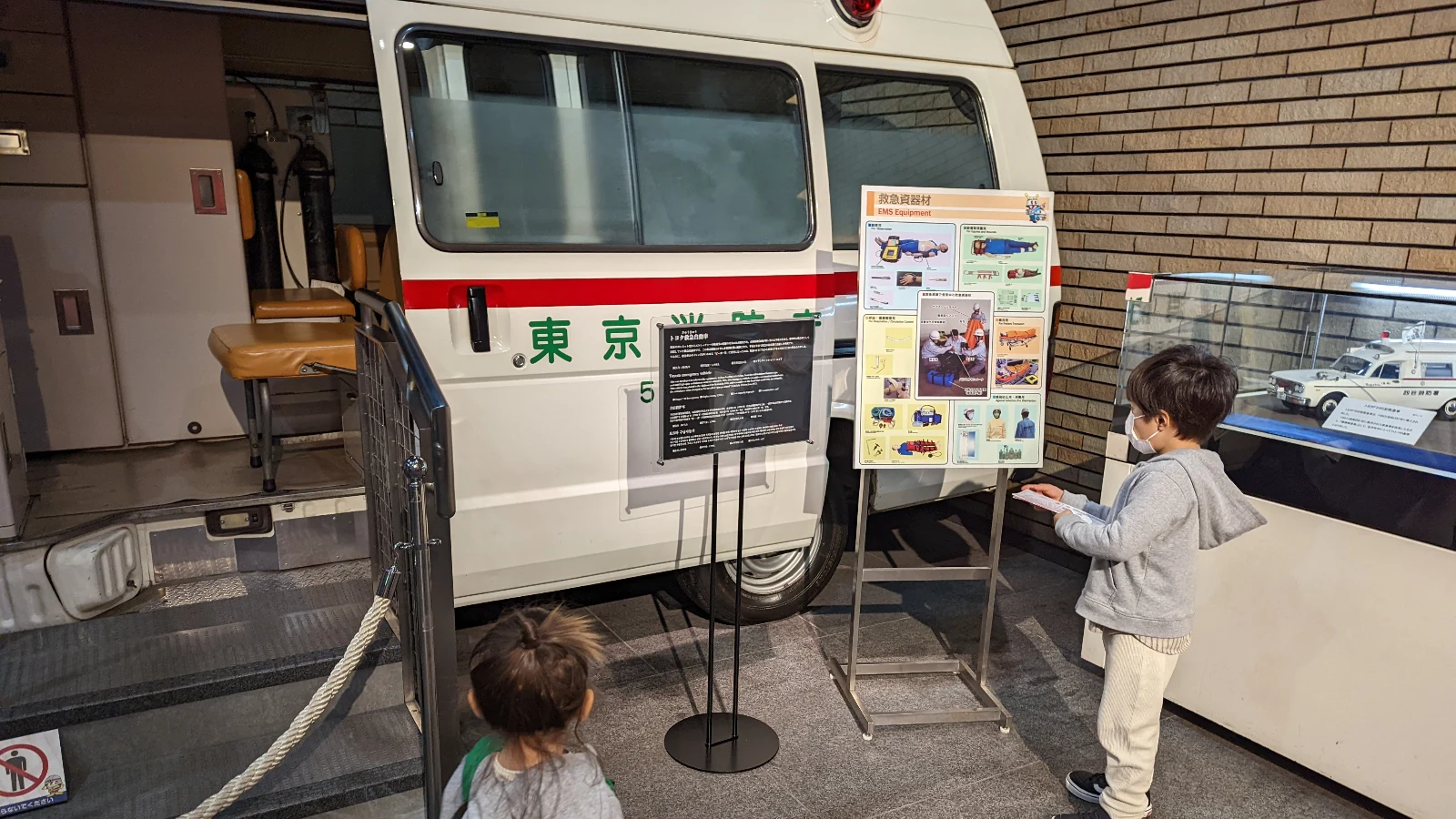
Honjo Life Safety Learning Center.
Not because it is best for any one child, but because it holds the widest range of them and asks least in return. Four exhibition floors, entirely indoor, walk in and walk out, with a booked tour beside them for a family that wants a fixed hour.
Find the profile that fits your child, then read down.
| The Stop | What It Settles | Best For |
|---|---|---|
| Komazawa Olympic ParkSetagaya | Named places for ball play, skateboarding, cycling and running. | Dynamo |
| Asukayama ParkOji | A free push-button monorail that removes a 17.4 m climb. | Dynamo |
| Odaiba Seaside ParkOdaiba | An artificial shoreline for paddling, with swimming prohibited. | Dynamo |
| Imperial Palace East GardensOtemachi | Grounds where making noise is against the rules, not just frowned on. | Sensor |
| Suginami Animation MuseumOgikubo | Three enclosed levels, and a bus leg that keeps the crowd off. | Sensor |
| Honjo Life Safety Learning CenterKinshicho | A booked hour and forty-five minutes, or four walk-in floors. | Anchor |
| Toyosu Market Visitor AreasShijo-mae | Walkways anyone can use, and one deck decided by lottery. | Anchor |
| Police MuseumNishi-Gotanda | One floor, reached by lift, with nothing above or below it. | Sprinter |
| Haneda Airport Observation DecksHaneda | Five deck spaces, every one of them reached by machinery. | Sprinter |
| Meiji JinguHarajuku | A second walk of about ten minutes each way, stated in advance. | Sprinter |
Komazawa Olympic Park
Dynamo
Asukayama Park
Dynamo
Odaiba Seaside Park
Dynamo
Imperial Palace East Gardens
Sensor
Suginami Animation Museum
Sensor
Honjo Life Safety Learning Center
Anchor
Toyosu Market Visitor Areas
Anchor
Police Museum
Sprinter
Haneda Airport Observation Decks
Sprinter
Meiji Jingu
Sprinter
For the Dynamo
Ground that gives a child somewhere to put the energy, and says so.
For a child who empties out when they cannot move.
Komazawa is the only park in this city that says out loud where a child may do each thing. Ball play has a named home in the Free Square. Skateboarding has a dedicated SS Square and is not permitted outside it. Cycling runs on a one-way course of about 2,080 meters. Running has a marked course of about 2.1 kilometers, near flat, with distance markers every hundred meters. A movement-led child spends most of a Tokyo day being told what they may not do. Here the answer comes back as a place instead of a no. A five-year-old takes the Squirrel playground; a fourteen-year-old takes the skate square.
Who it costs.The Sensor, whose Reserve empties on unfiltered input. The Central Plaza is a two-hectare paved space built for large events and film shoots, so amplified sound arrives where the rest of the park is quiet.
How to make it work.Both circuits are loops, so a fast child is never more than half a lap from a parent standing still. Ride with the flow, because the cycling course runs one way. The playgrounds, courses and dog run cost nothing; the sports facilities are the paid part. Nothing is under a roof, so rain ends the visit.
If this isn’t your child: the clearest set of movement permissions in Tokyo, on a site with nowhere to go when the weather turns.The climb into this park is done for the family by a two-minute monorail the child calls themselves. The Asuka Park Rail runs on a push-button system, so nobody queues for a departure. It takes wheelchairs and strollers, costs nothing, and climbs 17.4 meters from the entrance beside Oji Station’s central exit to the top of the hill. Waiting there is the children’s area: a large castle play structure, a sandpit, swings, slides, and animal and ship equipment, with a preserved tram and a steam locomotive beside it. A four-year-old rides twice before touching the playground; a thirteen-year-old goes straight for the tram.
Who it costs.The Sprinter, whose Reserve empties on sustained walking and standing. The monorail stops in strong wind and bad weather, and it is the only step-free route up that rise, so on the wrong day the ascent becomes a hill.
How to make it work.Check the wind before you promise the ride, and give the button to whichever child needs a job. Three museums inside the park are not covered by the free entry, and the Kyu-Shibusawa Garden now closes on the same days as the memorial museum beside it.
If this isn’t your child: a proper playground on a hill with a free lift to the top, and a lift the weather can take away.This beach is for paddling and not for swimming, and the difference is a posted rule rather than a hint. Going into the water is prohibited. Water play at the edge is deliberately provided for, with showers and lockers in the Marine House to support it, which is the paid part of an otherwise free park. That suits a movement-led child better than it sounds: the shoreline is long, open and walkable, and the boundary is ankle deep and obvious. A five-year-old works the shallow edge; a twelve-year-old walks the breakwater causeway out to Daiba Park.
Who it costs.The Anchor, whose Reserve empties when nothing is confirmed. The causeway is an out-and-back with no second way off it, and Daiba Park carries dated closures, so the island end can be shut while the beach is open.
How to make it work.Read the scale properly. The headline 510,809 square meters is mostly sea: about 435,000 of it is water, leaving roughly a seventh as ground a child can walk on. Pack a change of clothes rather than swimwear, and expect no shelter outside the Marine House.
If this isn’t your child: the most walkable free shoreline in central Tokyo, and a beach that looks swimmable and is not.For the Sensor
Places with a published rule about what is allowed to happen inside them.
For a child who empties out on noise, crowding and unfiltered input.
Making noise inside these gardens is not discouraged, it is prohibited by the rules that govern them. So is public performance, and so is any demonstration or rally. No concert and no amplified event is permitted on this ground, which makes it the one large central green space in Tokyo where a family can know in advance that nothing loud is scheduled. That certainty is worth more to a child who empties out on input than any impression of quiet, because it holds on a Saturday as well as a Tuesday. A four-year-old walks the Ninomaru grove; a thirteen-year-old reads the castle keep foundations.
Who it costs.The Dynamo, whose Reserve empties through restricted movement. Athletic games are prohibited, so there is no sanctioned ball play, and vehicles may not be brought in, which rules out a bicycle.
How to make it work.Use the three gates as three gates. Otemon is five minutes from Otemachi, and Hirakawamon and Kitahanebashimon are five from Takebashi, so a family enters at one and leaves at another without walking the same ground twice. A free tag is handed over on the way in and back on the way out.
If this isn’t your child: the quietest free ground in central Tokyo by rule rather than by luck, and a place where a child cannot kick a ball.This museum is awkward to reach, and that is exactly what it is good for. It is not a station-adjacent room that absorbs whoever walks past. From Ogikubo Station’s north exit it is a five-minute bus ride and two minutes on foot, or a twenty-minute walk. What the bus leg buys is three enclosed levels on the upper floors of a public hall, holding the exhibition space and a theater. Eating is prohibited throughout and there is no eating space, so no food traffic passes through. A five-year-old works the hands-on exhibits; a fifteen-year-old sits the theater.
Who it costs.The Sprinter, whose Reserve empties on sustained walking and standing. The approach is a bus leg each way, and because nothing may be eaten inside, a break for food means leaving the building.
How to make it work.Everything is free, screenings included, and the only charge is a materials fee on some workshops. Diaper changing happens at the third-floor women’s toilet or in the fourth-floor nursing room, and that room is the only option for a father. Strollers are not loaned.
If this isn’t your child: the calmest free indoor hour in west Tokyo, and a bus ride out and back to reach it.For the Anchor
Stops whose shape can be said out loud before the family leaves the hotel.
For a child who empties out when nothing is confirmed and everything is new.
One free building runs two opposite contracts at once, and knowing which one you walked into is most of the visit. The guided tour is reserved in advance and runs as a fixed one-way sequence of an hour and forty-five minutes, so the length, the order and the ending can be told to a child the night before. The four exhibition floors are the other contract: no reservation, walk in, walk out, leave a floor half done. Neither costs anything. A six-year-old does the smoke route; a fourteen-year-old takes the earthquake platform seriously.
Who it costs.The Sensor, whose Reserve empties on unfiltered input. The corners are, by design, a simulated earthquake, a smoke-filled maze, a rainstorm with wind and water, and urban flooding, taken in order.
How to make it work.Read the gates first, because they exclude specific children from specific corners rather than from the building. The earthquake corner takes age three and over. The rainstorm corner takes elementary school year one and over. Firefighting takes year three and over. Virtual reality takes year two and over and at least 100 centimeters. Smoke and urban flooding carry no restriction, which makes them the right start for a mixed-age family.
If this isn’t your child: the most useful free indoor hour in east Tokyo, with age gates that will separate your children if you have not read them.The famous half of this market costs nothing and is still the hardest thing in Tokyo to walk into. The tuna auction viewing deck is free and allocated by advance application and a lottery, explicitly not on a first-come basis. The slot runs 05:45 to 06:25, the party assembles at 05:30 on the third floor of the Block 7 management building, and identification is checked for every person in it, a newborn included. Applications open about a month ahead, one per group, up to five people.
Everything else here is walked into, and that is the part worth planning around. Block 7 has a ground-level corridor over the tuna auction floor. Block 6 holds two real turret trucks. Block 5 has a second-floor corridor over the produce wholesale floor. A rooftop green space with grass sits above Block 6, reached by lift. Three buildings, linked by pedestrian decks, each leaveable at any point.
Who it costs.The Sensor, whose Reserve empties on unfiltered input. Auction calling carries into the viewing corridor on a live feed, and the tuna floor is at its most active between roughly 5:30 and 6:30.
How to make it work.Treat the lottery as a separate trip, because losing it changes nothing about the walkways, and later in the morning the same corridors are calm. The approach from Shijo-mae runs along a pedestrian deck into the third floor of Block 7 rather than at street level, and market vehicles work the whole site.
If this isn’t your child: a working market a family can walk through for nothing, and one deck inside it that a month of planning may still not win.For the Sprinter
Stops where the machinery does the climbing, or the distance is stated up front.
For a child who empties out on sustained walking and standing.
This museum is not where the guidebooks put it. Since 24 April 2026 it has been on the third floor of the TOC Building in Nishi-Gotanda, Shinagawa, a temporary home while the Kyobashi site is redeveloped, and it goes back there when the work finishes. Any Kyobashi address is now the wrong station and the wrong walk. What the move handed a child who runs out of legs is a single floor: free roam on one level, reached by lift and left the same way, with nothing above or below it. Osaki-Hirokoji is five minutes on foot, Fudomae six, Gotanda eight.
Who it costs.The Anchor, whose Reserve empties when nothing is confirmed. A venue that has moved once and will move again, and that can cap entry when busy, cannot be promised to a child from last year’s guide.
How to make it work.The children’s uniform dress-up is the rationed thing, not the entry. From 1 October 2026 it runs on Saturdays, Sundays and public holidays only, the uniforms come in three sizes, 100, 120 and 140 centimeters, and places go by numbered ticket, so a late family can find it gone while the door is still open and still free.
If this isn’t your child: one flat floor of police vehicles and uniforms for nothing, in a building that is not the one most guides will send you to.Five separate deck spaces across three terminals, and not one of them is climbed to. Terminal 1 carries a south deck and a north deck on the sixth floor plus a rooftop deck above them. Terminal 2 has a fifth-floor deck and FLIGHT DECK TOKYO, an indoor viewing area on the same floor. Terminal 3’s deck is also on the fifth floor. Each is a lift ride from inside the building and is left the same way, so a child spends their standing at the rail rather than on the approach. A four-year-old counts departures; a fifteen-year-old reads the tails.
Who it costs.The Sensor, whose Reserve empties on unfiltered input. Aircraft operations are the sound source and they arrive loud, intermittent and on no schedule a visitor can read in advance.
How to make it work.Know which deck is which before you commit a wet afternoon. The open-air decks close for weather or security without notice, so on a bad day the indoor FLIGHT DECK TOKYO in Terminal 2 is the version that holds. Terminal 3’s deck uses rope-type fencing rather than a solid barrier, which gives clear sightlines and a reason to hold a small hand.
If this isn’t your child: the best free spectacle in Tokyo for an aircraft-minded child, on decks the weather can shut without warning.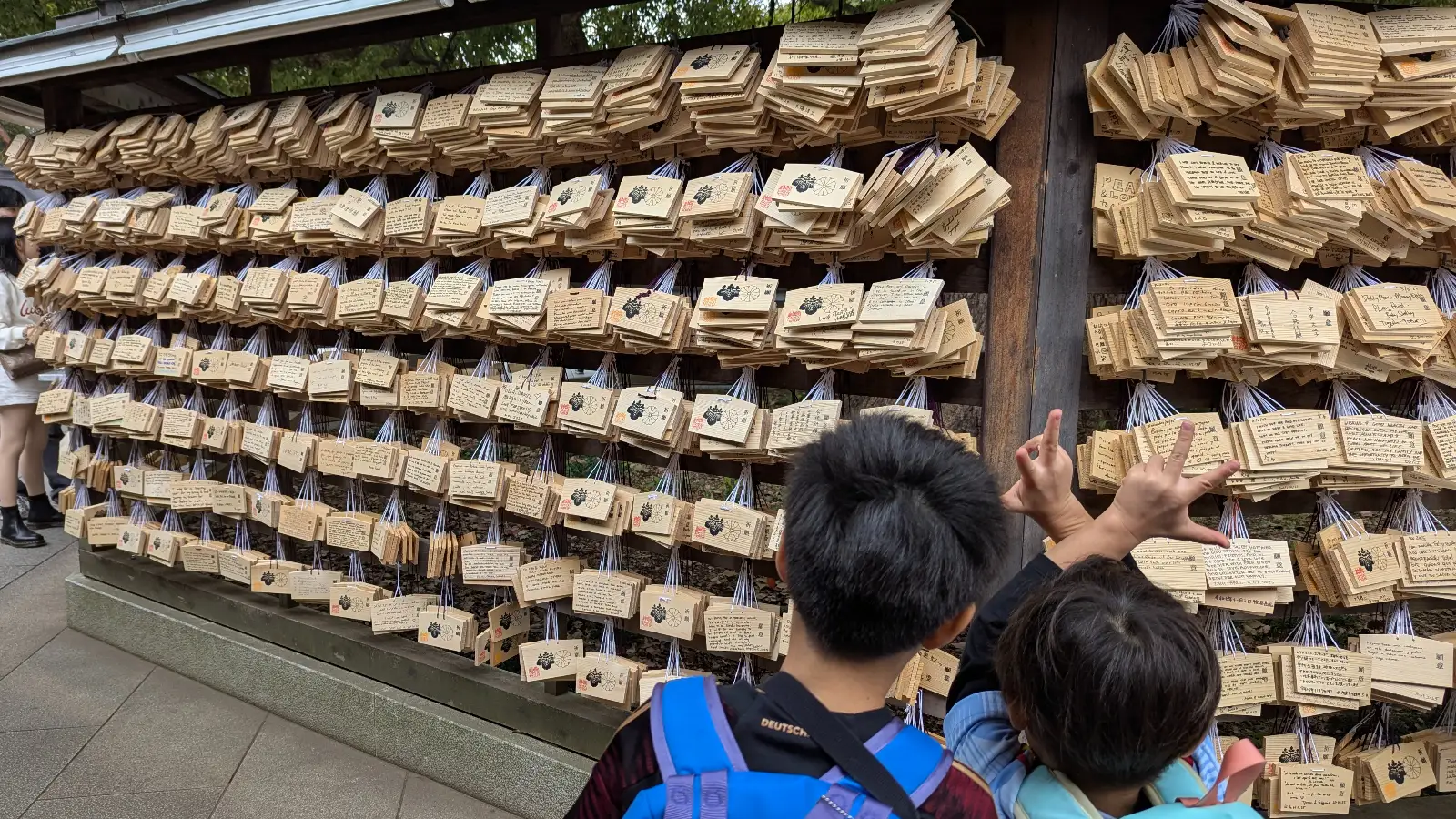
The walk most guides quote for Meiji Jingu is only the first half of it. From any of the three entrances it is about another ten minutes on foot to the main shrine buildings, and that leg is additional to whatever the walk from the station costs. The minimum here is therefore roughly twenty minutes of forest path there and back before a family has done anything. Stated in advance, that is a gift rather than a warning, because the real distance can be budgeted before anyone sets off. A five-year-old is carried for the second half; a fourteen-year-old walks it.
Who it costs.The Dynamo, whose Reserve empties through restricted movement. Bicycles must be left in the parking areas at each entrance, so the whole visit is a walk at somebody else’s pace with no sanctioned release.
How to make it work.Use the three entrances as a through route. Walk in at Harajuku and out at Sangubashi or Yoyogi and the return leg becomes new ground rather than the same path twice, which is the biggest saving available to a child who runs short on standing. Build the rest before the approach, not after it.
If this isn’t your child: the largest free forest walk inside Tokyo, and twenty minutes of it spent before you arrive anywhere.Build the day around the two that are gated.
Eight of the ten are walked into, so the two with a gate decide the shape. Open with whichever child runs short first: the Dynamo on restricted movement, the Sensor on input, the Anchor on unconfirmed structure, the Sprinter on standing.
Which kind of free each one is.
Free with nothing to arrange, which is most of this page: Komazawa, Asukayama, Odaiba, the East Gardens, Suginami, Honjo’s exhibition floors, the Police Museum, the Haneda decks and Toyosu’s walkways. Turn up, leave when the child is done.
Free to walk in with something charged inside: at Komazawa the sports facilities, at Asukayama the three museums, at Odaiba the Marine House showers, at Meiji Jingu the Inner Garden and treasure house, at Toyosu the restaurants. In every case the thing a child came for sits on the free side of the line.
Free and still booked, the category most lists never mention. Honjo’s tour takes reservations up to five months ahead and closes them five days out, with telephone booking inside four days. The Toyosu tuna deck runs on a lottery about a month ahead, with identification checked for every person and a 05:30 assembly. A free thing you have to reserve is not frictionless, and it should be planned like a ticket.
What puts a free stop on this list.
Free-Tokyo lists sort on price, the one thing every entry on them already has in common.
The axis here is friction: what a stop asks of a family before, during and after the visit. Four questions decide it. Is there anything to reserve, and how far out? Can the family leave in the middle without losing something? Is there sanctioned space to move, or a published rule keeping the place calm? And how much walking happens first? Sorted that way, a park with posted skateboarding rules outranks a famous view.
The questions parents actually ask.
What are the best free things to do in Tokyo with kids?
It depends on the child rather than on the list. Komazawa Olympic Park, Asukayama Park and Odaiba Seaside Park hold a child who empties out when they cannot move; the Imperial Palace East Gardens and the Suginami Animation Museum a child short on noise and input; Honjo and the Toyosu Market walkways a child who needs the hour settled in advance; the Police Museum, the Haneda decks and Meiji Jingu a child who runs out of legs.
Are there free things to do in Tokyo that still need booking?
Two, and they are the trap in every free-Tokyo list. The guided tour at the Honjo Life Safety Learning Center is free and reserved, bookable up to five months ahead and closing five days before the visit, though its four exhibition floors are walk-in. The Toyosu tuna auction deck is also free and runs on a lottery about a month out, not first come, with identification checked for every person in the party.
Where is the Police Museum in Tokyo now?
On the third floor of the TOC Building in Nishi-Gotanda, Shinagawa, where it reopened on 24 April 2026. It is a temporary home while the Kyobashi site is redeveloped, so any guide printing a Kyobashi address is sending a family to the wrong station. Osaki-Hirokoji is five minutes on foot, Fudomae six, Gotanda eight. Entry is still free and still needs no reservation.
Can children swim at Odaiba beach?
No. Swimming is prohibited at Odaiba Seaside Park, and that is the thing most likely to catch a family out, because the shoreline looks entirely swimmable. What is provided for is water play at the edge, with showers and lockers in the Marine House, which are the paid part of an otherwise free park. Plan for wet feet.
Is Meiji Jingu free, and how long is the walk with kids?
The forest approach and the main precinct are free with no ticket, and the walk is longer than the figure most guides quote. From any of the three entrances it is about another ten minutes on foot to the main shrine buildings, on top of the walk from the station, so the minimum is roughly twenty minutes there and back.
What free things are there to do in Tokyo with kids when it rains?
Three, and only three on this page. The Honjo Life Safety Learning Center is entirely indoor and its four exhibition floors are walk-in, so a wet morning turns into it without notice. The Suginami Animation Museum is three enclosed levels inside a public hall, though the bus leg to reach it is not covered. FLIGHT DECK TOKYO in Terminal 2 at Haneda is the one indoor viewing area among the airport decks.
What is free at Toyosu Market?
More than most families realize. The visitor walkways in all three blocks are free and need no reservation, including the corridor over the tuna auction floor in Block 7 and the two real turret trucks in Block 6. So is the rooftop green space above Block 6, reached by lift. The restaurants and shops are the paid part, and the tuna auction deck is free but lotteried.