Senso-ji Temple with Kids:
How Long to Spend in Asakusa.
The open grounds let a restless child move freely, but the same Nakamise crowd, incense, and constant foot traffic that make Senso-ji vivid are exactly what push a sensory-loaded child toward their threshold.
Open grounds discharge restricted-movement energy on foot.
Incense, crowd noise, and density load sensory input fast.
A legible, repeatable route confirms structure rather than threatening it.
The Nakamise approach plus seatless standing accumulates walking depletion.
Yes, Senso-ji is worth visiting with kids, and it rewards the Dynamo and the Anchor without condition: the open, walkable grounds discharge a movement-driven child’s energy, and the legible gate-to-hall route confirms structure for a child who needs to know what comes next. The Sensor and the Sprinter are the profiles that gate the verdict, and one decision clears both: arrive before 10:00 a.m. and build in a single seated reset, which keeps the layered sensory load and the standing time below threshold.
Some links on this page are affiliate links. LuNi may earn a commission at no extra cost to you.
Which costs your child more,
a museum or a playground?
You have the days. Now the nights.
Where to stay in Tokyo →The LUNI Rating for Senso-ji Temple.
LuNi’s opinions are framework-derived, not opinion-derived. Each verdict below is the result of applying The LUNI Framework to a single attraction, measuring it against the third currency every family spends but few track: the child’s reserve. The reasoning that follows is the case.
Senso-ji is one of the few major Tokyo cultural sites that lets a movement-driven child walk the whole visit. The Dynamo’s reserve depletes through restriction of movement, and the structure here works against that depletion rather than with it: the approach from Kaminarimon down Nakamise Street, the open courtyard around the main hall, and the adjacent Sumida Park are all walkable, so the energy that queues and sit-down attractions would trap has a continuous channel to discharge. There is no ticketed sequence forcing stillness, which is the single feature that most often sends a Dynamo into restlessness at indoor attractions.
Younger Dynamos do best given the run of the open courtyard between rituals rather than being held in line on Nakamise. Older Dynamos benefit from being handed the navigation: let them lead the route from the gate to the main hall and locate the omikuji stand, which converts movement into purpose. The mechanism is identical at four and at fourteen; only the form of the discharge changes.
What this means for your Dynamo: the open, walkable layout serves restricted-movement depletion well, so the only real risk is letting the child stall in the Nakamise crush rather than keeping them moving through it.Senso-ji is manageable for a Sensor, but only with the arrival timing decided in advance. The Sensor’s sensory-load threshold is the visit’s real risk: the incense smoke at the main hall, the dense crowd noise funneled down the narrow Nakamise corridor, and the constant press of foot traffic concentrate quickly and from several directions at once. Generic guides treat Senso-ji as simply “busy” and miss that the load here is layered (scent plus sound plus proximity), which reaches threshold faster than any single input would.
Whether the visit stays manageable is almost entirely a question of the clock. Arriving before 10:00 a.m., or after about 4:00 p.m., keeps the corridor walkable and the hall calm; arriving midday does not. Younger Sensors do best with an early arrival and a single chosen ritual rather than the full circuit. Older Sensors, who tend to mask discomfort rather than report it, need an agreed exit signal and a quiet recovery stop (Asakusa Shrine behind the main hall, or Sumida Park) built into the plan before you arrive, not improvised once they are already over threshold.
What this means for your Sensor: the layered sensory load is real but timing-dependent, so an off-peak arrival and a pre-planned quiet exit keep the visit below threshold at any age.You have the days. Now the nights.
Where to stay in Tokyo →Senso-ji suits the Anchor because its route is legible and repeatable rather than improvised. The Anchor’s reserve depletes through unfamiliarity and unconfirmed structure, and the temple offers an unusually clear spine: gate, then street, then hall, then one ritual. The sequence reads the same way to a child as it does to an adult, so the structure is confirmed by simply walking it, and there is no hidden logic or unpredictable queue order to decode. For a child who needs to know what comes next, a site with a single obvious throughline is reassuring rather than depleting.
The only friction is the crowd, which can obscure the sense of order. Naming the four steps before arrival neutralizes it. Younger Anchors do best with a quick verbal preview of the sequence on the train in; older Anchors do best handed the plan outright, so the structure becomes theirs to hold rather than something done to them.
What this means for your Anchor: the predictable gate-to-hall route confirms structure rather than threatening it, so a brief preview of the sequence removes the only unfamiliarity risk the crowds create.Senso-ji is short enough to work for a Sprinter, but the standing is the part to plan for. The Sprinter’s reserve depletes through sustained travel-style walking and standing, and the load here is less about distance than about the slow, stop-start shuffle down Nakamise followed by open standing at the main hall, where seating is scarce. The visit is genuinely brief (most families need only one to one and a half hours), which keeps the load contained, but the time is spent almost entirely upright and in motion.
Younger low-stamina children do best with wheels to the temple grounds and a carrier once Nakamise gets too dense for a stroller. Older low-stamina children do best with a deliberate rest before arriving and an agreed seated pause partway through, at the quieter Asakusa Shrine or a Sumida Park bench, before fatigue turns into resistance. Supportive footwear matters at every age, since the standing, not the walking distance, is what accumulates.
What this means for your Sprinter: the short visit length protects against walking-and-standing depletion, provided you build in one seated reset rather than treating the hour as continuous standing time.Senso-ji rewards depth over coverage. A temple this dense with ritual gives a child more than any itinerary can absorb, and the families who leave with something meaningful are usually the ones who picked a single thread (one fortune drawn, one wave of incense, one tall red gate looked up at) and let the rest go. The site does not need to be completed to be understood.
How two children actually met this attraction.
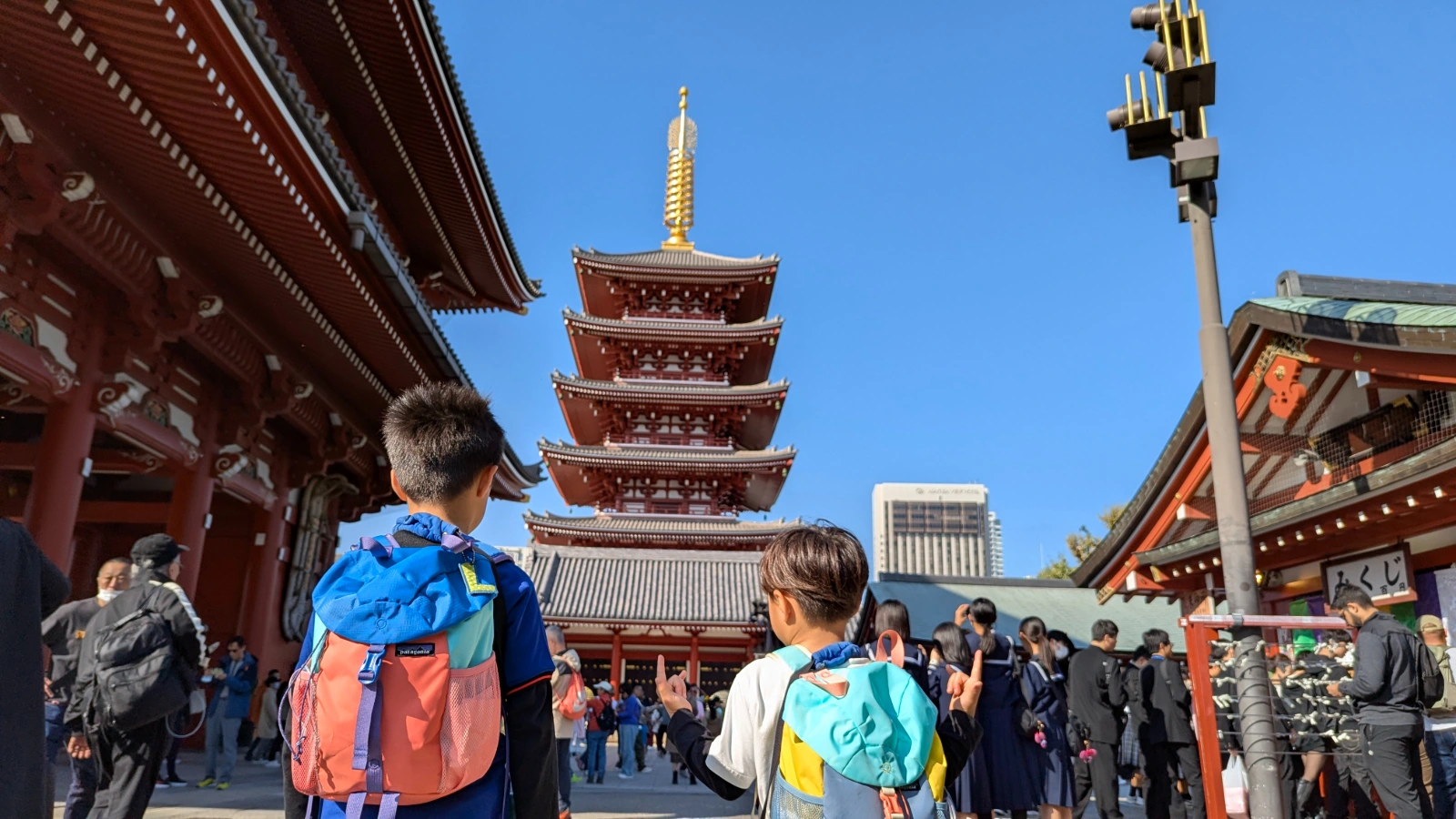
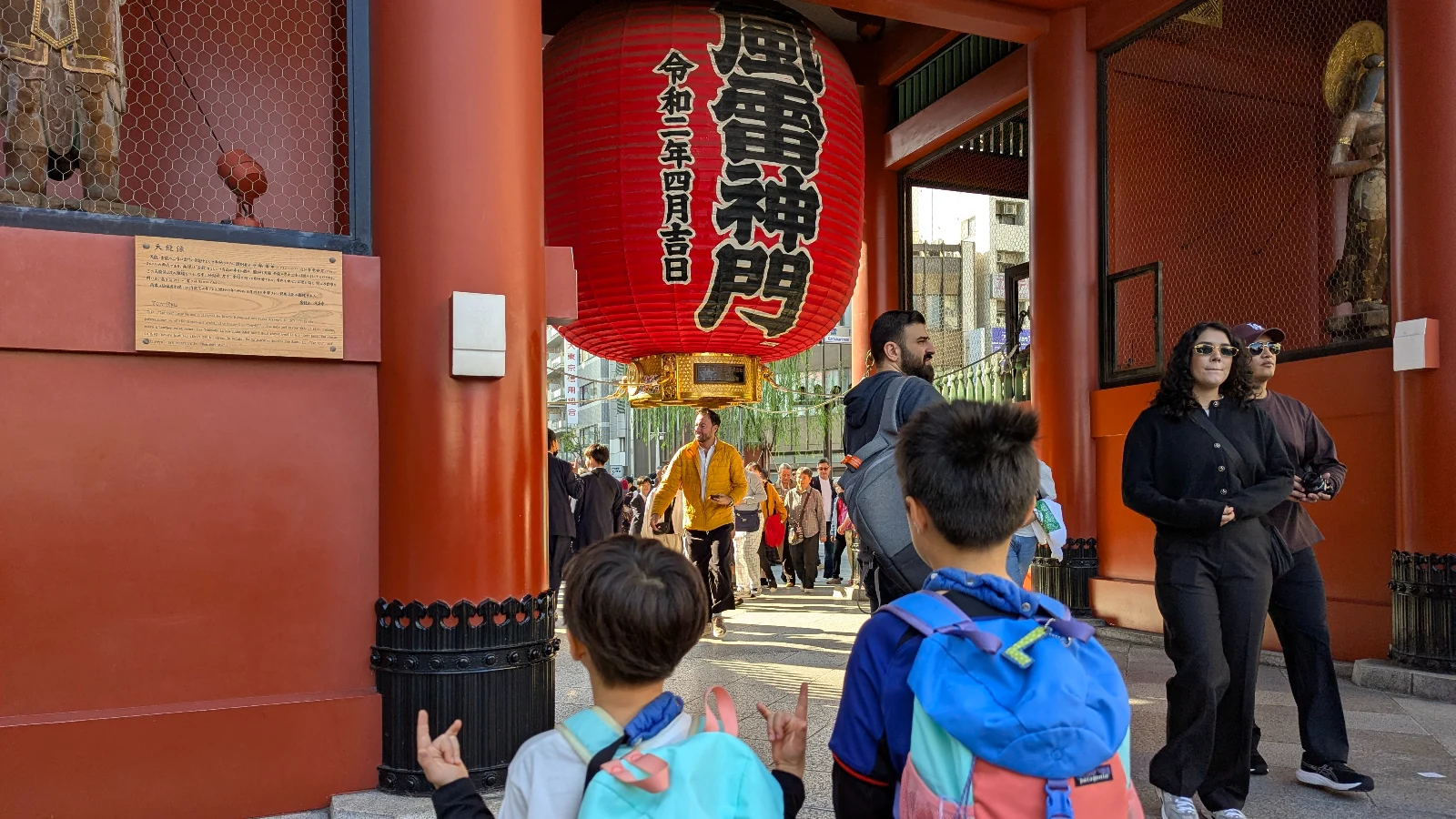
Here is what Senso-ji looked like through the eyes of two children whose priorities had nothing to do with its spiritual history and everything to do with the scale of a red gate and the crowd around it.
Luca fixed on the pagoda first, because it was tall and red, and red is a color he likes. What held him longest was not the temple’s purpose but a question of engineering: how do they make such a big lantern? He watched the people ahead of him reaching up to touch the bottom of the Kaminarimon lantern, registered that everyone was doing it, and wanted to do the same, his attention drawn less to the ritual than to working out the object itself.
This is the Anchor finding the hook that makes an unfamiliar place legible. The Anchor’s reserve depletes through unfamiliarity and unconfirmed structure, and a crowded, sensory-rich temple is exactly the kind of place that can feel illegible on arrival. An Anchor who fixes on a system to understand, here the question of how the lantern is built, converts unfamiliarity into something with a structure to decode, and the site stops costing reserve the moment it gives the child a problem to solve. For these families, arriving with one “how does this work” question ready is the difference between a child who braces against the site and one who engages with it.
Nico’s attention went straight to the lantern’s size, the tall lantern was huge, and he stayed locked on the crowd’s behavior around it: people kept trying to touch the bottom of it. He was less interested in standing still to look than in the movement happening underneath it, tracking hands reaching up, narrating what he saw, kept in motion by the activity around the gate.
This is the Dynamo holding attention through motion rather than stillness. The Dynamo’s reserve depletes through restricted movement, so what draws the child is rarely the static object and almost always the activity around it, here, the crowd’s hands reaching up under the gate. A Dynamo tracks and narrates movement because watching motion is itself a way of staying in motion. For these families, the implication is to give the child something to move toward (the next gate, the fortune stand) rather than asking them to stand and contemplate, which is what keeps a movement-driven child energized through the visit instead of fraying.
Planning Your Visit to Senso-ji Temple with Kids.
The verdict tells you whether to go. What follows is the operational intel a family needs to act on it: the visit at a glance, the profile-matched pairings worth knowing about nearby, the hotels we would book for this visit, and the questions parents most consistently ask.
Nearby attractions, matched to your child.
Three pairings selected for what each one solves after Senso-ji, profile by profile. The reason matters more than the recommendation.
| Pairing | Why This Solves the After-Visit | For Your |
|---|---|---|
| LUNI Pick Sumida Aquarium One stop by train, inside Tokyo Skytree Town | After the open, crowd-heavy temple, the aquarium offers a calm, dim, seated, indoor environment that lowers sensory input and removes the standing load in one move. It is the rare nearby option that resets every profile at once: cool and quiet for the Sensor, walkable tanks for the Dynamo, a clear loop for the Anchor, and benches for the Sprinter. | Sensor |
| Hanayashiki Amusement Park 3-minute walk, behind the temple | For a child still carrying unspent energy after a contemplative temple, Hanayashiki’s gentle rides give the Dynamo an active outlet steps away, no transit required. Small and nostalgic, it suits younger children especially without the overwhelm of a large park. | Dynamo |
| Sumida Park 5-minute walk, along the river | The simplest reset of the three: shaded benches and open riverside space with no ticket, no crowd, and no standing line. It is the decompression stop to reach the moment a low-stamina child needs to sit, before fatigue becomes resistance. | Sprinter |
Sumida Aquarium
One stop by train For YourSensor
Hanayashiki Amusement Park
3-minute walk For YourDynamo
Sumida Park
5-minute walk For YourSprinter
Hotels we would book for this visit.
Three properties chosen for the specific logistical advantage each delivers for Senso-ji, not for general Tokyo stays.
Senso-ji sits in Asakusa, a historic, walkable district northeast of central Tokyo and away from the Shinjuku and Shibuya hotel clusters: staying within a few minutes’ walk is what makes a before-10:00 a.m. arrival realistic, which is the single timing decision that keeps the visit below the Sensor’s threshold and shortens the Sprinter’s standing time.
| Property | The LuNi Reason | Budget |
|---|---|---|
| LUNI Pick The Gate Hotel Kaminarimon by Hulic A few steps from Kaminarimon Gate | Steps from the gate, it puts the temple within reach the moment it opens, which is the whole game for beating the crowd and protecting a Sensor. Rooftop views of Asakusa and family suites make it a base rather than a one-night stop. | ¥¥¥ |
| OMO3 Asakusa by Hoshino Resorts 1-minute walk to the temple | One minute from Senso-ji, it offers the shortest reset loop of the three: families can return midday for a full rest and redeploy in the afternoon without managing transit with tired children. Play areas and grab-and-go snacks ease the daily logistics. | ¥¥¥ |
| Asakusa Tobu Hotel 3-minute walk to the temple | Three minutes out, with triple rooms that fit a family without an adjoining-room scramble. Comfortable and clean, it holds the walking-distance advantage at a mid-range rate, so the early-arrival strategy stays affordable. | ¥¥ |
The Gate Hotel Kaminarimon by Hulic
A few steps from Kaminarimon GateBudget: ¥¥¥
OMO3 Asakusa by Hoshino Resorts
1-minute walk to the templeBudget: ¥¥¥
Budget: ¥¥
The questions parents actually ask.
Is Senso-ji Temple worth visiting with kids?
Yes. Senso-ji is worth visiting with kids, and it rewards a Dynamo and an Anchor without conditions: the open, walkable grounds discharge a movement-driven child’s energy, and the legible gate-to-hall route confirms structure for a child who needs to know what comes next. The Sensor and the Sprinter are a qualified yes, gated by one decision: arrive before 10:00 a.m. and build in a single seated reset, which keeps the layered sensory load and the standing time below threshold. The visit is short by design, so the pacing decision matters more than the total time.
How long do you need at Senso-ji Temple with kids?
Most families need about 1 to 1.5 hours, enough to pass under the Kaminarimon Gate, walk Nakamise Street for snacks, see the main hall, and try one ritual. Sensors and Sprinters do best at the shorter end with a planned pause, while a Dynamo or an older child curious about the grounds can comfortably stretch it toward two hours. The visit length is short by design, so the pacing decision matters more than the total time.
What time does Senso-ji Temple open and close?
The main hall opens daily at 6:00 a.m. and closes at 5:00 p.m. The temple grounds and Nakamise shopping street are open 24 hours, so families can walk the area before the hall opens or after it closes. Arriving at opening is the most reliable way to see the hall before the crowds build.
What age is Senso-ji Temple best for?
Senso-ji works well from around age 4 and up, when children can engage with the gates, draw a fortune, and enjoy the snack stands. Below 4, the crowd density tends to outweigh what a toddler absorbs, and a carrier becomes essential. There is no upper age limit: older children and teens often stay longer for the shopping and the nearby Asakusa streets.
What is the best time to visit Senso-ji to avoid the crowds?
The calmest window is before 10:00 a.m., when the corridor is walkable and the hall is quiet, with a second option after about 4:00 p.m. Midday brings tour groups and the densest crowds, which is exactly when a sensory-sensitive child reaches their limit. For families with a Sensor or a younger child, an early arrival is the single decision that most changes the visit.
Is Senso-ji Temple stroller-friendly?
Partially. The temple grounds are flat and paved, but Nakamise Street gets crowded enough that a stroller becomes hard to maneuver during busy periods, so a baby carrier is easier at peak times. Wheelchair users can reach the main areas, though some smaller side paths are harder to navigate. Arriving early keeps the stroller viable for longer before the crowd thickens.
How does Senso-ji compare to Meiji Jingu Shrine for kids?
The two answer different needs. Senso-ji is vivid, busy, and snack-filled, which energizes a Dynamo but loads a Sensor through crowd and incense. Meiji Jingu is calmer, set in forested grounds, which suits a Sensor or a child who needs lower input, but offers less of the lively activity a Dynamo feeds on. For a sensory-sensitive child, Meiji Jingu is the gentler first temple; for a movement-driven one, Senso-ji holds attention better.
How do you get to Senso-ji Temple in Tokyo?
The easiest route is by train: Senso-ji is about a 5-minute walk from Asakusa Station on the Tokyo Metro Ginza Line, Toei Asakusa Line, and Tobu Skytree Line. Families can also arrive by city bus or by Sumida River cruise boat, both of which stop nearby. The station is close enough that the walk itself is manageable even with younger children.
Where Senso-ji fits your Japan trip.
Senso-ji rewards the Dynamo and the Anchor without conditions, and the Sensor and the Sprinter only with one decision: an arrival before 10:00 a.m. and a single seated reset built into the hour.