Hachiko Statue with Kids: a quick stop, not an activity.
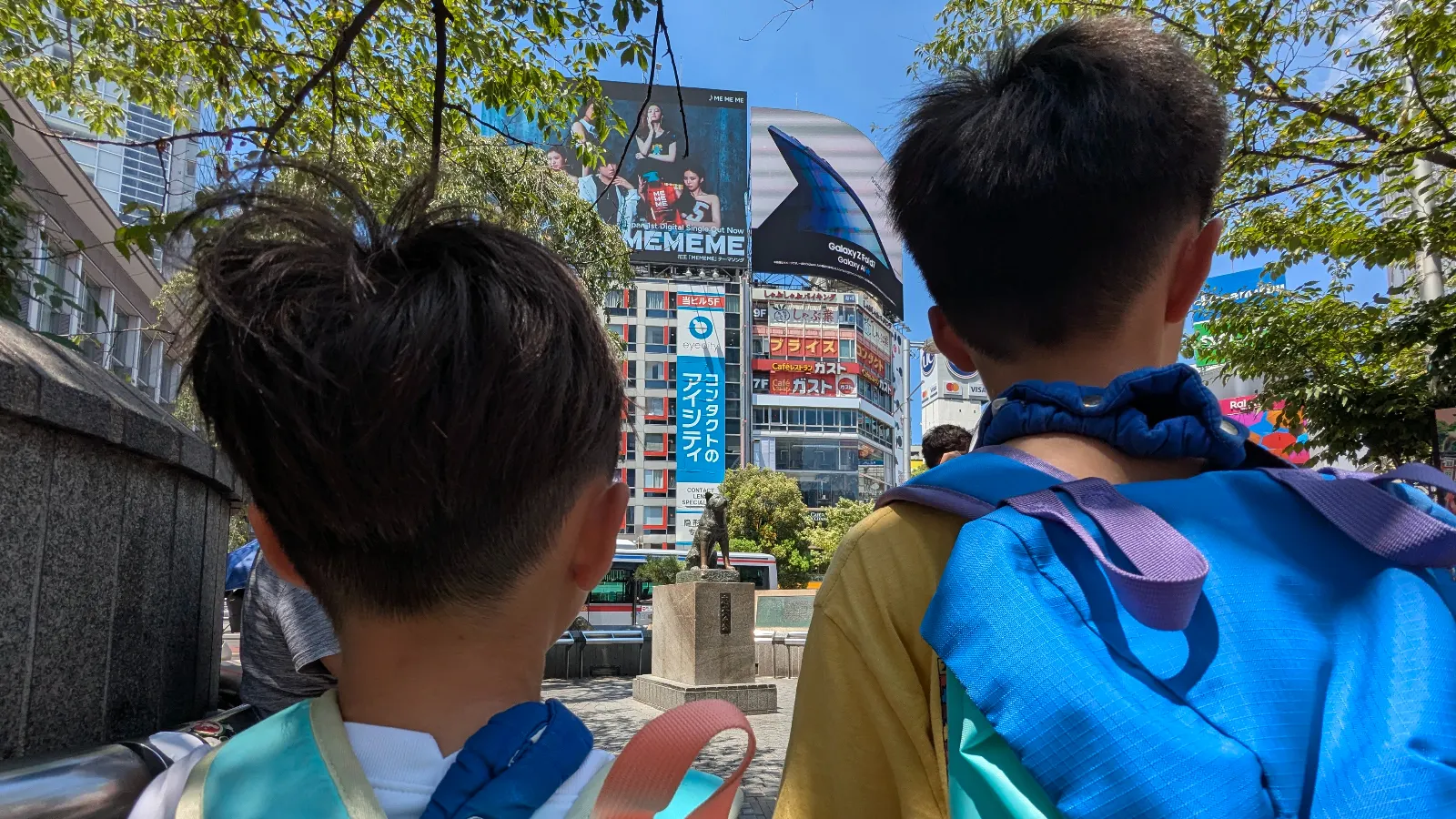
Hachiko is a free bronze dog at a Shibuya Station exit with one of the best stories in Tokyo, and a child can finish with it in the time a photograph takes.
A public statue at the Hachiko Exit of Shibuya Station: no ticket and nothing to book.
The city fences it off at Halloween, and has on past New Year’s Eves.
The statue is the whole stop, so choose the next place first.
The story is what lands, so a child old enough to follow it gets the most.
No operator sets stroller rules in the station square.
Some links on this page are affiliate links. LuNi may earn a commission at no extra cost to you.
Is the Hachiko Statue worth it with kids?
The short version, before the costs, the timings and the case for each child.
Yes, as long as you treat it as what it is: a short stop with a wonderful story, not an outing. The statue is free, it stands right at the exit named after it, and the story of the dog who waited there is the kind children remember long after the trip. What it cannot do is hold a child for long. It is a bronze figure to look at and photograph, and it sits in a public plaza where you cannot choose who else is standing beside you. So tell the story on the way in, take the photograph, and have the next place already chosen. For a child who finds busy places hard, keep the stop very short and avoid the few event nights when the city fences it off.
Planning Your Visit to the Hachiko Statue with Kids.
Three small decisions make this stop work, and all of them come before you reach the station. The first is the story: tell it on the train, so the statue arrives as the end of something rather than a lump of bronze in a crowd. A child who knows why the dog waited will look at the statue differently. Have the child tell the ending back before the exit, and the statue arrives as theirs. The second is the date. Shibuya City fences the statue off at Halloween and has done so on past New Year’s Eves, so a family arriving in late October or at the turn of the year should check first. The third is what comes next, because the statue will not fill more than a few minutes of a Shibuya day.
Every LuNi attraction guide starts with a visit, with our own children
LuNi rates and writes about attractions only after visiting them with children. Luca and Nico were at Hachiko Statue, and what they did there is recorded further down this page, including how each child actually met it.
Children arrive with different tolerances: for noise, for lines, for standing still, for being on their feet all day. A guide written for the average of them helps almost nobody. So every place on this site is read four ways, and each verdict says which children it already suits and what makes it work for the rest. Whoever you are bringing, the answer here is built for your family rather than for a general reader.
Restricted-movement depletion barely starts at a single bronze figure, but nothing here discharges it either, so route a moving child straight on to open space.
Sensory-input depletion is the risk in a public plaza at a station exit, where the family cannot choose the crowd, so keep the stop brief.
Unfamiliarity is settled only by the story, with no ticket, time or route to confirm, so tell it in full before the plaza.
Walking and standing stay low when the statue waits at the station exit named after it, so a tired child can see it without a detour.
Hotels we would book for this visit.
Three of Shibuya’s family hotels, because the statue takes minutes and the stay is about the district around it: two for a week centered on Shibuya itself, and Trunk Hotel Cat Street for one leaning toward Harajuku and the shrine.
| Property | The LuNi Reason |
|---|---|
| LUNI Pick Hotel Indigo Tokyo Shibuya | Hotel Indigo suits a family giving the district more than the statue’s few minutes. The stop itself asks almost nothing, so the room’s job is the rest of the day. A base in the same ward lets a child who has stood in a public plaza go back and rest before the afternoon without crossing the city. |
| Trunk Hotel Cat Street | Trunk Hotel Cat Street sits five minutes from Shibuya Station and seven from Harajuku, for a trip that pairs the statue with the shrine. A child the plaza wore down can go on to the car-free approaches at Meiji Jingu, and a room on that side of the ward keeps the calmer half of the day close. |
| Shibuya Excel Hotel Tokyu | Shibuya Excel Hotel Tokyu is for a family whose days start and end in Shibuya itself. A stop this short fits into the first or last minutes of any day, and a base in the same district lets the statue wait for whichever moment the child can spare it, before or after the rest of the plan. |
Nearby attractions, matched to your child.
Three pairings for what the statue cannot give: somewhere a moving child can finally spend energy, somewhere calmer for a child the crowd has worn down, and open lawns with written rules for a family with a morning to spare.
| Pairing | Why This Solves the After-Visit | For Your |
|---|---|---|
| LUNI Pick Miyashita Park Shibuya; a four-story park with a roof lawn | After standing still in a crowded plaza, a Dynamo needs somewhere its restricted movement can finally go. Miyashita Park answers on its roof: a lawn to cross, with a skate park and a bouldering wall beside it, so a statue that asked for stillness is followed by ground that asks for none. | Dynamo |
| Meiji Jingu Shrine Harajuku; free wooded approaches | The approaches to Meiji Jingu Shrine are closed to cars, and the shrine asks visitors to stay out of the woods and not to run. After a station plaza, that is a gentler kind of input for a Sensor: wide, wooded paths with rules everyone keeps. | Sensor |
| Yoyogi Park JR Harajuku, 3 min on foot; always open | For an Anchor, Yoyogi Park is open ground with its rules written down: no ball games, no skateboards, no amplified music, and no gate hours to watch. After a plaza where anything can happen, unfamiliarity eases on lawns whose limits a child can learn before arriving, three minutes from JR Harajuku. | Anchor |
Miyashita Park
Shibuya; a four-story park with a roof lawn For YourDynamo
Meiji Jingu Shrine
Harajuku; free wooded approaches For YourSensor
Yoyogi Park
JR Harajuku, 3 min on foot; always open For YourAnchor
How two children actually met this attraction.
Two children met the same statue and finished with it at very different speeds, and both of them were right. Neither needed more time than the statue could give them. One needed the story before he would look, and once he had it he stayed, though what held him in the end was the crowd rather than the dog. The other looked, touched, posed and was done almost at once. That is the honest shape of Hachiko with children. It is a story stop, and it lands with the child who wants the story, so tell it properly on the way. For the child who wants to act, it is a photograph and a minute, and the kindest plan is to have somewhere to go next before the camera comes out.
Luca wanted the whole story before he would look at the statue properly. He asked how many years the dog had waited, why it came back to this exact station every day, and what a dog had done to earn a bronze in the first place. Only once the story was settled did the statue hold him, and not for long. What kept him longest was the crowd: he watched how people approached, posed and moved off.
This is the Anchor pattern. A child whose Reserve depletes through unfamiliarity and unconfirmed structure will not engage with an object until the frame around it is settled, so the story has to come first. For a similar child, tell it in full on the train and name the steps: the exit, the statue, the photograph, the next stop. His crowd-watching is the same instinct at work, since reading how a place behaves is how this child makes an open plaza feel known.
Nico was delighted for about ninety seconds. He spotted the dog, patted it, announced something about its ears, and posed for exactly one photo, and then he was done, already turning to see what happened next. There was nothing here for him to build, run through or take apart. He was not upset; he had simply finished, and the finish came long before the adults were ready to move on.
This is the Dynamo pattern. A child whose Reserve depletes through restricted movement meets a statue as a photograph and a story, not as an activity, so the interest is real but brief. For a similar child, do not try to stretch the stop. Treat the statue as a pass-through, take the photograph promptly, and walk straight on to somewhere movement is the whole point, such as a roof lawn, before the waiting starts to cost the rest of the day.
Hachiko is a reminder that a place can matter to a child without being an activity. What children carry home from this stop is not the bronze but the story: a dog who kept coming back, day after day, for someone who never returned. Told well, it is often a child’s first meeting with loyalty and loss in a form they can hold, and it gives a busy station square a meaning they can feel. A monument earns its minute when a child understands why people still stop in front of it.
The LUNI Rating for the Hachiko Statue.
The verdicts split on what a public plaza asks of a child. A statue at a station exit asks almost no walking, which is why the Sprinter has so little to fear. It also offers nothing to do and no way to choose the crowd, which is why the Sensor pays most and the Dynamo and the Anchor need a plan. None of that makes the stop a mistake. It makes it a stop that should be short and planned. Ten well-used minutes will do more for a family than an hour. Tell the story first, take the photograph, and move on before the crowd sets the pace.
Take the photograph, then keep walking. The Dynamo depletes through restricted movement, and a statue offers a moving child nothing to do but look. The first minute is a pleasure: the dog, the story, a photograph. After that, a child who needs to act has only the plaza, a public space at a station exit where the family is standing among strangers, and that is where the minutes start to cost something.
The answer, then, is the next stop rather than a longer one. Take the photograph promptly, then walk on to somewhere built for movement. Miyashita Park, with its roof lawn, suits this child exactly. Save the lingering for the adults, another day, without the children. A child allowed to move straight after the photograph will give the next hour back.
What this means for your Dynamo: a single bronze figure offers restricted movement no outlet at all. A younger Dynamo needs the photograph taken fast and a lawn straight after; an older one can carry the camera and set the pace out.Keep it brief, and stand at the edge. The Sensor depletes through sensory input, and the statue stands in a public plaza at the Hachiko Exit of Shibuya Station. The family cannot choose the crowd, the noise or the timing of anyone else there, and the city itself fences the statue off at Halloween and has on past New Year’s Eves, advising visitors to come before or after. For a child who takes in everything at once, that is a lot to stand inside.
None of that can be planned away, only shortened. Tell the story before you arrive, so the child is not standing in the plaza waiting for it. Stand at the side rather than in the middle, take one photograph, and leave. Then plan somewhere quieter, such as the car-free approaches at Meiji Jingu, before asking anything more of the day.
What this means for your Sensor: input in a public plaza comes on the crowd’s terms, never the family’s. A younger Sensor needs a stop of minutes and a quiet place next; an older one can choose the moment and signal when to leave.Tell the story first, and name what happens next. The Anchor depletes through unfamiliarity and unconfirmed structure, and Hachiko has almost none to offer. There is no ticket, no time slot, no route and no staff: it is a statue in a public space, and whatever happens around it happens without warning. For a child who settles by knowing the shape of things, the only frame on offer is the one the family brings.
So bring it. Tell the story of the dog who waited, in full, before you reach the station, then name the sequence: the exit, the statue, one photograph, the next place. A child who knows all four steps will stand in the plaza calmly, and a child who does not will spend the stop asking. That is the cost, and also the reason it can be managed.
What this means for your Anchor: unfamiliarity eases only when the family supplies the frame. A younger Anchor needs the story told and the steps named in advance; an older one can lead the way from the exit to the statue.The easiest stop of the day for tired legs. The Sprinter depletes through sustained travel-style walking and standing, and Hachiko asks very little of either. The statue stands at the Hachiko Exit of Shibuya Station, the exit named after it, so a family arriving by train reaches it without a detour, and the stop itself is a few minutes of standing.
For a child who tires quickly, that makes it one of the kinder sights in Tokyo: a real piece of the city’s story that costs almost nothing in legs. Keep it that way. Do not wait for the perfect photograph; take the one you can get, and save the energy for the next place, where a Sprinter will want somewhere to sit. The statue is a gift to this child, so spend the saved energy on the parts of the day that cost more.
What this means for your Sprinter: with the statue at the station exit, walking and standing stay low. A younger Sprinter can see it from a carrier in a few minutes; an older one can manage the stop and walk on to the next.The questions parents actually ask.
The statue stands in a public square at the station exit named after it, which is why a visit is so easy to fit in. It is one of Tokyo’s free stops for families, it needs no booking, and it is fenced off on a few event nights. The larger question is what to pair it with, and that depends on the child: a lawn suits one, a quiet path the other. Decide which one before leaving the station, while the child still has patience to spare. The statue itself takes a few minutes, and it has a story worth telling before the family arrives.
Is the Hachiko Statue worth visiting with kids?
As a short stop with a story attached, yes; as an outing in its own right, no. The statue is free and stands at the Hachiko Exit of Shibuya Station, so it costs a family almost nothing to see. For a child who struggles with busy public places, keep it very brief, and plan somewhere calmer straight after.
Where is the Hachiko statue in Shibuya?
It stands at the Hachiko Exit of Shibuya Station, which is named after it, so the easiest way to find it is to follow the signs for that exit from inside the station. Outside the exit, the bronze dog stands in the station square, and that is where the photograph is taken, with the story told on the way in.
Does it cost anything to see the Hachiko statue?
No. The statue is free to visit, with no ticket and no booking, because it stands in a public space outside the station rather than inside a venue. That makes it one of the cheapest stops in Tokyo for a family, and an easy one to fit between two paid attractions on a Shibuya day.
Is the Hachiko statue ever closed?
On a few nights, yes. Shibuya City fences the statue off at Halloween, and it has done the same on past New Year’s Eves, advising visitors to come before or after. If your dates fall in late October or at the turn of the year, check the city’s notice before planning a photograph there.
How long should you spend at the Hachiko statue with kids?
Plan it as a quick stop, not an activity. The statue is a single bronze figure to look at, and most children finish with it long before the adults do. The better plan is to tell the story on the way, take the photograph, and move on to somewhere the day can breathe.
Is Hachiko a good stop for a child who dislikes crowds?
It is the hardest kind of stop for that child, because it is a public plaza at a station exit and the family cannot choose who else is there. Keep the visit very short, stand to the side rather than in the middle, and avoid the event nights when the city fences the statue off. Then go somewhere calmer.
What can kids do near the Hachiko statue?
Miyashita Park is a four-story park with a lawn on its roof, alongside a skate park, a bouldering wall and a sports facility, over a street of shops. For a view, Shibuya Sky sells children’s tickets only at its counter on the day, with the child present, and its roof closes in bad weather.
Where should families stay near Hachiko?
Hotel Indigo Tokyo Shibuya in Dogenzaka and Trunk Hotel Cat Street in Jingumae are both in Shibuya Ward, so the statue is a short part of a day that starts and ends nearby. Choose Dogenzaka for a stay built around Shibuya itself, and Cat Street for one that leans toward the shrine and the Harajuku side, where the calmer paths are.
Where the Hachiko Statue fits your Japan trip.
Official site and opening information: Shibuya City: the sights around Shibuya Station