Saga With Kids:which stop is for which child.
- Near the Ninja Village
- Stay in Ureshino
- Family Hotels
- Takeo and Ureshino onsen inns
- Room to Move
- Yoshinogari and Forest Adventure
- Quieter Stops
- Mifuneyama Rakuen and the camphor tree
- Rainy Day
- Space and Science Museum, Balloon Museum
The places to plan around in a quiet prefecture, from castle grounds to pottery towns, with indoor stops for wet days.
Some links on this page are affiliate links. LuNi may earn a commission at no extra cost to you.
For Saga Ninja Village, the nearest family base is Ureshino, and Saga’s family hotels are mostly onsen inns in Takeo and Ureshino. Twelve stops are grouped by child rather than ranked. Yoshinogari Historical Park, Forest Adventure Yoshinogari and the Ninja Village itself are for the child who cannot sit still; Mifuneyama Rakuen, the Great Camphor Tree of Takeo and the pottery towns of Arita and Imari are the quieter stops. On a rainy day, the Space and Science Museum, the Balloon Museum and a family onsen run fully indoors, and the Balloon Fiesta runs from October into November.
Which stop is for which child.
These stops are not ordered best to worst. They are grouped by which child each one is for. Saga is a calm, spread-out prefecture, so the stop that suits one of your children rarely overwhelms another, but the day still runs on Reserve. Instead of one long list, you get four short ones, organized by how each child runs out of steam. The Dynamo runs short when they cannot move. The Sensor runs short on sensory load. The Anchor runs short when nothing is predictable. The Sprinter runs short on walking and standing. Find your child below, and start there.
For the Dynamo
Stops that relieve restricted-movement depletion.
For a child who depletes through restricted movement, the strongest stops are Yoshinogari Historical Park, Forest Adventure Yoshinogari, and Saga Ninja Village.
Reconstructed watchtowers, pit dwellings, and wide Yayoi-era parkland give a movement-driven child room to run that an indoor museum never could. The open ground discharges restricted-movement depletion rather than storing it up, which is why it anchors a Dynamo’s day rather than ending it. Younger Dynamos get unbroken space on the central lawns, and older ones can climb the towers and cover the full moated circuit while dressing up in period costume along the way.
Who it costs.The Sprinter. The site is genuinely large, and the distance that frees the Dynamo is real walking for a low-stamina child, with long stretches between shaded benches.
How to make it work.Start at the northern settlement and let the Dynamo set the pace across the open middle, so the running comes early and the Sprinter still has legs for the walk back.
If this isn’t your child: still a hands-on history stop where kids climb, explore, and dress in Yayoi costume, just not the reason a calmer child comes to Saga.Tucked in the forest beside Yoshinogari Park, this ropes-and-zipline course turns a Dynamo’s need to move into the entire activity: climbing, balancing, and flying between trees under harness. Sustained physical challenge is the rare setting where a high-energy child’s pace is exactly the right pace, and it discharges energy rather than draining it. Older children and teens take the full high course, while the age and height limits mean the youngest Dynamos are better served next door in the open park.
Who it costs.The Sprinter, and it carries a genuine access floor. Harnesses, height, and age minimums apply, so a smaller or lower-stamina child is spectator rather than climber here.
How to make it work.Book ahead, confirm each child clears the height requirement before you travel, and pair it with Yoshinogari Park so a younger sibling has their own ground to run.
If this isn’t your child: a thrilling hour for a confident older kid, and a stop to skip entirely for families with only small children.Shuriken throwing, obstacle courses, and stealth paths in the hills near Ureshino turn a Dynamo’s restlessness into the whole point of the visit. Sanctioned physical challenge and dress-up let a high-energy child move at full speed with a goal attached, which is exactly the discharge the depletion needs. Younger ninjas run the beginner course in costume; older ones time themselves through the full stealth circuit.
Who it costs.The Anchor, where the improvised, unstructured play offers little to confirm in advance. Parents searching for hotels near Saga Ninja Village will find no on-site cluster; the nearest family base is Ureshino Onsen, a short drive away.
How to make it work.Pair it with an Ureshino Onsen overnight so the movement comes first and the evening soak resets everyone after.
If this isn’t your child: a fun couple of hours of dress-up and courses, though not a stop to build the whole day around.For the Sensor
Stops that let a sensory-loaded child recover.
For a child who depletes through sensory input, the strongest stops are Mifuneyama Rakuen, the Great Camphor Tree of Takeo, and the Arita and Imari pottery towns.
A vast garden of ponds, waterfalls, and ancient trees at the foot of Mount Mifune, Mifuneyama Rakuen moves at a pace a sensory-loaded child can absorb: soft light, dispersed sound, and space to slow down. Wide gravel paths let the Sensor’s load drain back down while there is still plenty to notice, from koi to stone statues. Younger children hunt for reflections in the ponds; older ones take the longer upper loop through the azalea valley. After sunset the teamLab light walk is open to anyone holding its own ticket, whether staying at the on-site hotels or visiting for the day.
Who it costs.The Sprinter, mildly, on the hillier upper trails, where the climb adds sustained walking a low-stamina child will feel.
How to make it work.Keep to the flat lower gardens for a short visit, and add the upper valley only if your Sprinter still has Reserve to spend.
If this isn’t your child: one of Kyushu’s most beautiful gardens and a calm break for any family, even without the sensory need.A short bamboo path within the grounds of Takeo Shrine leads to a 3,000-year-old camphor tree, hollow at the base and quietly astonishing. The shaded, low-noise setting is the dial turned all the way down for a Sensor child: soft sound, filtered light, and a single clear path with no sudden shifts. Younger children peer into the hollow trunk; older ones take in the scale and the calm of the surrounding grounds.
Who it costs.The Dynamo, mildly. It is a short, contemplative stop with little to physically do, so a movement-led child will want it chained to something more active.
How to make it work.Fold it in on the way to or from Mifuneyama Rakuen, which sits nearby, so the two calm Takeo stops share one trip.
If this isn’t your child: a genuinely memorable ancient tree and a quick, easy walk that suits almost any family in passing.The quiet porcelain towns of western Saga move at a pace a sensory-loaded child can absorb, and sitting down to paint a piece of Arita ware is exactly the kind of contained, repetitive task that lets the Sensor’s load drain back down. This one stop covers the whole cluster. In the hills above Imari, Okawachiyama Village, the old “village of secret kilns,” strings kiln chimneys and porcelain bridges along a quiet stream. In Arita itself, Tozan Shrine (Sueyama Shrine) is worth the short climb for its porcelain torii gate and porcelain guardian dogs, a genuinely rare sight. For a contained half-day with room to wander, Arita Porcelain Park pairs a Zwinger Palace replica and free Baroque gardens with hands-on painting and pottery-wheel workshops. Younger children decorate a pre-made cup; older ones try the wheel.
Who it costs.The Dynamo, who finds little room to move across an afternoon of shops and studios and can run short before the painting is done.
How to make it work.Book one workshop slot rather than browsing open-endedly, and time a visit to the Arita Ceramic Fair over Golden Week only if your family tolerates crowds.
If this isn’t your child: a beautiful, slow browse and a plate to take home, though a restless child will want it kept short.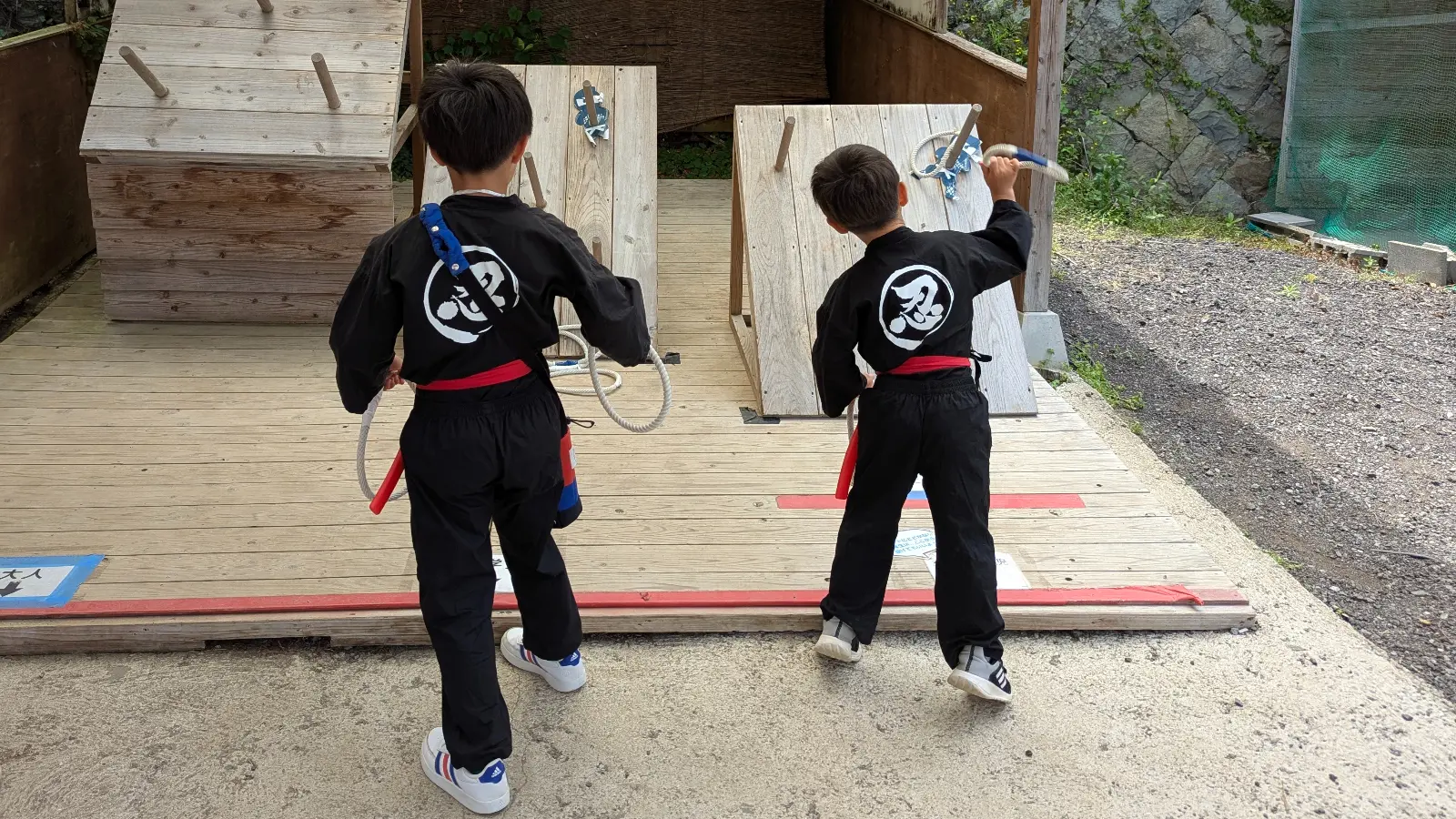
For the Anchor
Stops with confirmed, predictable structure.
For a child who depletes through unfamiliarity and unconfirmed structure, the strongest stops are the Space and Science Museum, the Balloon Museum, and the Nagoya Castle Museum.
Fixed exhibits, scheduled planetarium shows, and a clear indoor route make this one of the most structurally predictable stops in the prefecture, which is exactly what an Anchor needs. The sequence can be confirmed in advance and nothing about it improvises, so a child who depletes through unconfirmed structure can settle into it. Younger children work the hands-on rocket and meteorite displays; older ones follow the show schedule through the day.
Who it costs.The Sensor, in the planetarium and busier weekend workshops, where dark, loud, immersive shows push sensory load up.
How to make it work.Check the show timetable on arrival and build the visit around one confirmed slot, so the Anchor gets the structure without the Sensor sitting through every show.
If this isn’t your child: a strong rainy-day museum for any family, with enough hands-on exhibits to fill a couple of hours.The indoor Balloon Museum in central Saga runs on fixed, self-paced exhibits: virtual balloon flights, simple mechanics displays, and flight pods, all in a contained space that stays the same whatever the weather. That predictability is what serves the Anchor, who can preview the whole visit before walking in. Younger children pilot the virtual balloons; older ones dig into how the flights actually work. When the Saga International Balloon Fiesta fills the sky over the Kase River from late October into November, the same interest pays off outdoors, though the crowded riverbank is a very different, higher-load experience.
Who it costs.Few profiles, in museum form. The festival version, by contrast, taxes the Sensor heavily with crowds, noise, and uneven ground.
How to make it work.Use the museum year-round as the low-stress option, and treat the Fiesta as a separate, early-morning outing planned with a clear meeting point.
If this isn’t your child: a genuinely fun indoor hour for any family, and a fine rainy-day fallback.Built on a 16th-century castle site, this museum uses a familiar castle-and-samurai format an Anchor can orient to at a glance: try-on armor, battle-camp dioramas, and a clear indoor route through a known kind of story. The recognizable frame is the structure a child who depletes through unfamiliarity relies on. Younger children head straight for the armor; older ones follow the history of Saga’s role as a gateway to Korea.
Who it costs.The Dynamo, mildly, since it is an indoor, read-and-look museum with limited room to move.
How to make it work.Keep the visit to an hour or so and chain it to an open-air stop, so a movement-led sibling gets discharge before or after.
If this isn’t your child: a solid hands-on history stop, and an easy pairing with the castle grounds for a picnic.For the Sprinter
Short, low-stamina stops with little walking.
For a child who depletes through sustained walking and standing, the strongest stops are the Floating Torii Gate of Ouo Shrine, Yutoku Inari Shrine, and Takeo Onsen.
Three red gates standing in the shallows of the Ariake Sea make a short, photogenic stop that asks almost nothing of a low-stamina child’s legs. For the Sprinter it is the cheap anchor point of a coastal detour: a real destination reached in a few minutes from the approach path. Younger children watch the tide creep in around the gates; older ones time the walk out across the sand at low tide.
Who it costs.The Dynamo. It is a look-and-photograph stop with almost nothing to physically do, so a movement-driven child spends the visit restless rather than discharging.
How to make it work.Keep it short and chain it to an open, active stop the same day, so the Dynamo gets real movement before or after the few still minutes at the gates.
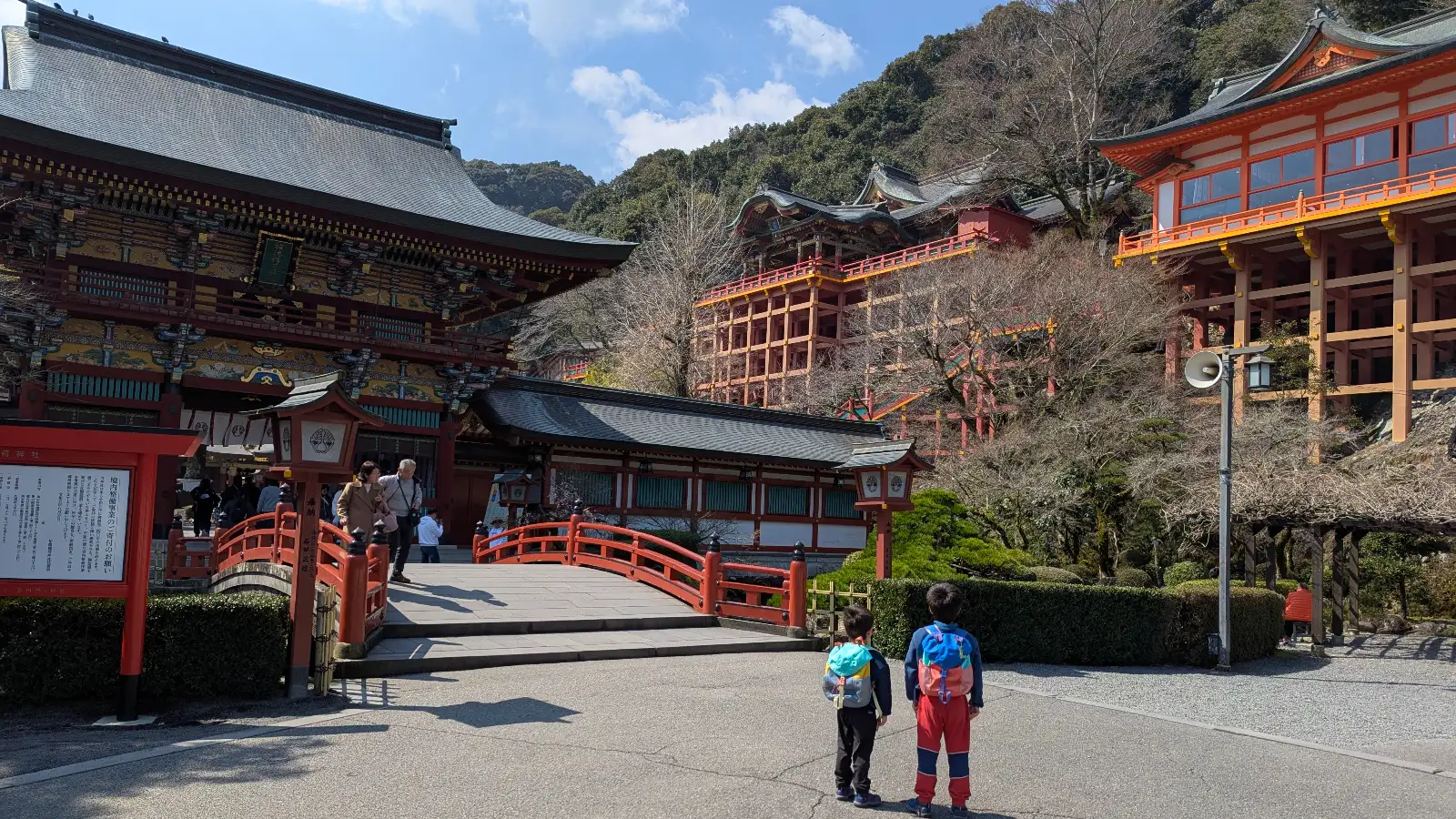
If this isn’t your child: a quick, scenic stop and a good family photo, easy to fold into a coastal drive.One of Japan’s three great Inari shrines, Yutoku Inari’s vermilion main hall stands on stilts against the hillside, with fox statues and bright torii throughout. The lower grounds deliver the whole spectacle in a short, flat visit, which is what makes it a strong Sprinter stop: maximum payoff for minimal walking. Younger children count the fox statues near the entrance; older ones take in the main hall from the approach without needing to climb.
Who it costs.The Sprinter too, if you go up. The upper shrine paths are a sustained stair climb, so the cost lands the moment the family leaves the flat lower grounds.
How to make it work.Treat the lower grounds as the visit and make the upper climb optional, so a low-stamina child gets the color and the foxes without the stairs.
If this isn’t your child: a stunning shrine that rewards even a short stop at the base.An old hot-spring town marked by its red-lacquered Romon gate, Takeo Onsen is a sit-and-soak stop that asks almost nothing of tired legs, which is precisely what a Sprinter needs at the end of a day. Several modern facilities offer private family rooms, so the whole family can rest together rather than stand and wait. For a flat, low-walk pairing nearby, the preserved Edo-period street of Hizen Hamashuku lets everyone stroll old sake storehouses at an easy pace. Younger children sample non-alcoholic amazake along the way; older ones spot the zodiac carvings on the Romon gate.
Who it costs.The public bathhouses are not stroller-friendly, so the cost is logistical rather than a profile’s Reserve, and it lands on parents of the youngest children.
How to make it work.Book a private family bath in advance so a stroller-age child is easy to manage and the soak stays the reset it is meant to be.
If this isn’t your child: a relaxing end to any Saga day, and the natural place to unwind after the castles and gardens.Open with the child who runs short first.
Saga’s stops are spread across the prefecture, so each route opens with the stop that protects the named child, then pairs to the nearest compatible one in the same area.
Settle these first. A few stops control the shape of a day more than the route does. Forest Adventure Yoshinogari is cheaper booked online by the day before, with height and age minimums confirmed before you travel. The Saga International Balloon Fiesta is a fixed, dated event from late October into early November. Mifuneyama Rakuen’s teamLab walk opens at sunset on its own ticket. Everything else is walk-up fill-in arranged around those three.
When to go, and what costs nothing.
Spring and autumn are the widest windows, mild enough for the open sites at Yoshinogari and Mifuneyama and comfortable for the shrine climbs. Mornings hold the most Reserve, so the low-stamina stops belong early, before the heat and the crowds build. The free stops carry real weight here: Yutoku Inari, the Floating Torii Gate of Ouo Shrine, the Great Camphor Tree at Takeo Shrine, and Hizen Hamashuku’s old street all cost nothing, and several of them are also the gentlest on a child’s Reserve, so for those the low-cost route and the calm route are the same route. When the weather turns, the Space and Science Museum, the Balloon Museum, and a private family onsen in Takeo or Ureshino are the three indoor stops that hold a wet day together.
Three bases that fit a family’s Reserve.
A short list chosen for location logic, not price tier: an onsen base that buys back Reserve, and two park-gate stays that keep a high-stimulation day close to a quiet room.
| Property | The LuNi Reason | Budget |
|---|---|---|
| LUNI Pick Wataya Besso Ureshino Onsen ryokan | A riverside ryokan with private onsen baths and family service, set in Ureshino, the same base that resets a Dynamo after Ninja Village and a Sprinter after Yoshinogari. The evening soak is the Reserve buy-back the day is built around. | ¥¥¥ |
| Hotel Okura JR Huis Ten Bosch At the park gates | Large rooms connected to the Huis Ten Bosch gates, an Anchor-friendly base where tomorrow’s plan is visible from the window and the routine holds across a multi-night stay. | ¥¥¥ |
| Hotel Europe Canal-side, inside the park | Spacious family rooms with direct access to the Huis Ten Bosch attractions, so a high-stimulation day ends steps from a quiet room rather than a long transfer. | ¥¥¥ |
Budget: ¥¥¥
Budget: ¥¥¥
Budget: ¥¥¥