Kagoshima With Kids:which stop is for which child.
- Start Here
- The Sakurajima ferry, from the city center
- Room to Move
- Ishibashi Memorial Park and Hirakawa Zoo
- Quieter Rooms
- City Aquarium and the Prefectural Museum
- Tickets
- Sengan-en and the aquarium sell on the day
- How Long
- Two to three days
Some links on this page are affiliate links. LuNi may earn a commission at no extra cost to you.
Kagoshima with kids starts with the Sakurajima ferry, which leaves from the center of the city, and the volcano side, the parks and the views make its calm route. Ten stops, grouped by child, fill two to three days. The ferry itself, Ishibashi Memorial Park and Hirakawa Zoo let an active child move; the Kagoshima City Aquarium and the Prefectural Museum are the quieter rooms. Sengan-en and the aquarium both sell tickets on the day, and a web ticket bought ahead skips the line at Sengan-en. The Amuran Ferris Wheel and the Shiroyama Observatory rest tired legs.
Which stop is for which child.
These stops are not ordered best to worst. They are grouped by which child each one is for. The reason is simple: Kagoshima pairs a high-energy volcano side with a run of quiet indoor museums, and the stop that thrills one of your children is the stop that flattens another. So instead of a single list, you get four short ones, organized by how each child runs out of steam. This is the third currency The LUNI Framework tracks alongside money and time: the child’s Reserve. The Dynamo runs short when they cannot move. The Sensor runs short on noise and crowds. The Anchor runs short when nothing is predictable. The Sprinter runs short on walking and standing. Find your child below, and start there.
For the Dynamo
Stops that relieve restricted-movement depletion.
For a child who depletes through restricted movement, the strongest stops are the Sakurajima ferry, Ishibashi Memorial Park, and Hirakawa Zoo.
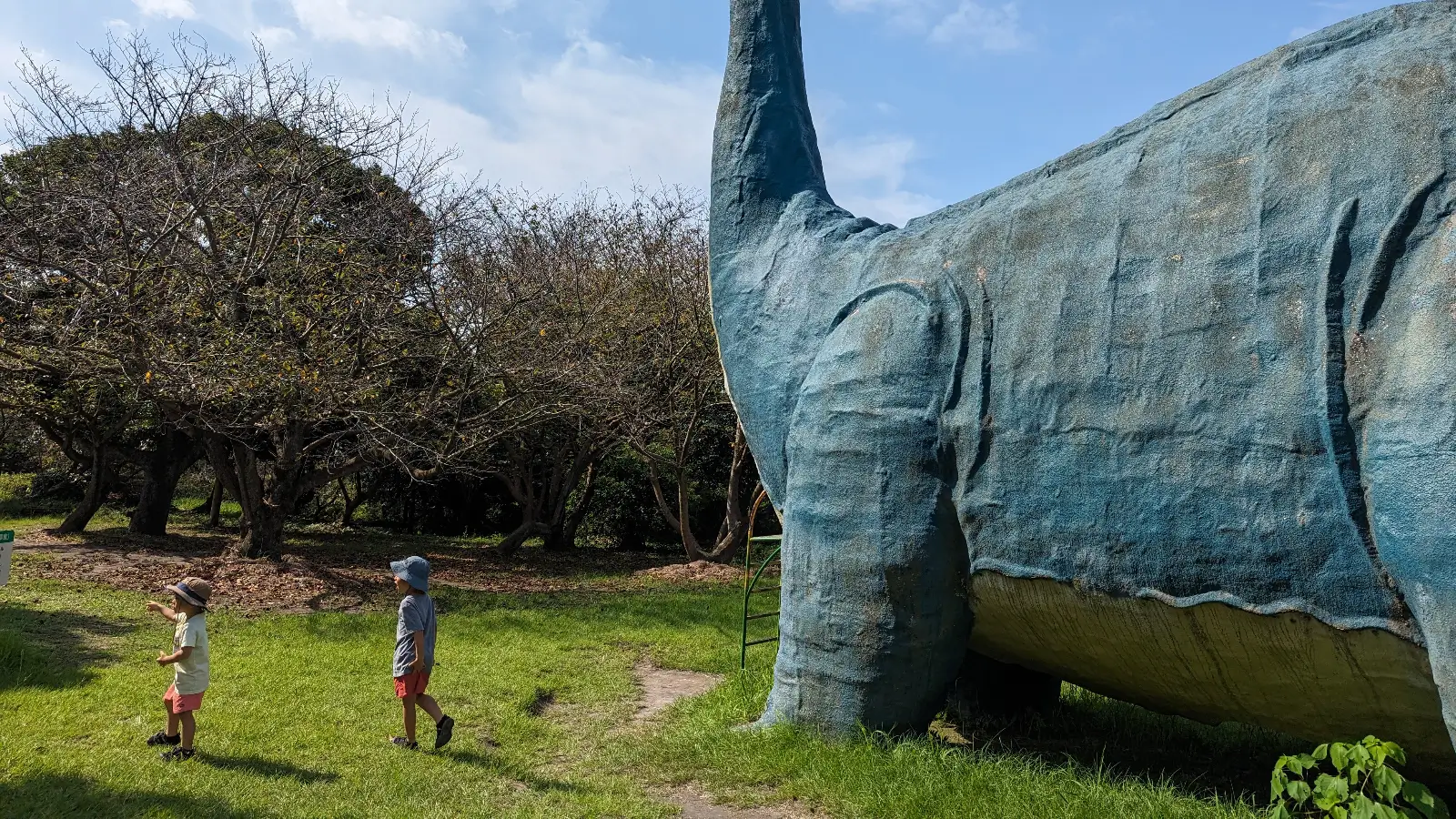
The 15-minute crossing and the volcano side beyond it give a movement-driven child what a museum cannot: room to move and a reason to. The overlooked discharge zone is the dinosaur park near the ferry terminal, with covered tunnel structures and open lawns that work as a genuine run zone. A younger Dynamo burns energy on the dinosaur-park lawns before the return boat; an older one walks a longer stretch of the visitor-side paths. Scheduling the park before the return ferry means the Dynamo boards in a lower-activation state, not a higher one.
Who it costs.The Sensor. Volcanic ash on paths and surfaces changes how the ground feels underfoot and can be disorienting on first encounter, so check the eruption status before you go.
How to make it work.Cross before mid-morning when the terminal is quietest, and use the enclosed ferry viewing decks as a controlled position for a sensory-sensitive child during the crossing itself.
If this isn’t your child: still the single most memorable thing you will do in Kagoshima, and worth the crossing for the volcano alone.Three relocated stone arch bridges anchor a free river-fed park whose bridge circuit gives a Dynamo a defined physical route with a start and an end, which channels restricted-movement energy far better than an open field with no objective. The bridges vary in height and span enough to hold a physically active child across a full loop. A younger Dynamo runs the wide riverside lawns beside the circuit; an older one walks the complete bridge loop at pace, then the family stays on with no time limit or entry gate.
Who it costs.The Sprinter. The full circuit is real walking distance, and a low-stamina child will feel the complete loop.
How to make it work.Name the three bridges as a sequence before you enter, which gives a Sprinter a short structured version to complete rather than an open-ended walk.
If this isn’t your child: a calm, free green space with a picnic lawn, pleasant for any family even without the movement need.Hirakawa’s primary family value is physical scale: the grounds are large enough that a high-energy child can move continuously between enclosures without crowding, which is exactly the discharge a Dynamo needs. A single main path with branching loops covers lions, giraffes, and a primate section in a sequence long enough to sustain 90 minutes without doubling back. A younger Dynamo runs the open path between enclosures; an older one paces the full loop, and the morning petting zone runs on a fixed schedule worth arriving early for.
Who it costs.The Sprinter. The scale that frees the Dynamo is sustained walking for a low-stamina child, with long stretches between rest points.
How to make it work.Walk the single main loop in one direction rather than backtracking, and arrive before the petting-zone start time so an Anchor also gets a confirmed first destination.
If this isn’t your child: a full-scale regional zoo that holds any young family for a morning, just longer on the legs than the map suggests.For the Sensor
Stops that let a sensory-loaded child recover.
For a child who depletes through sensory input, the strongest stops are the Kagoshima City Aquarium, the Prefectural Museum, and the Prefectural Library children’s area.
Io World’s vertical layout prevents the bottlenecking that makes smaller regional aquariums hard on mixed-age families, and its overlooked feature for a Sensor is the jellyfish gallery: timed lighting cycles shift color every few minutes, giving an overstimulated child something slow and predictable to track without having to respond. The free outdoor dolphin waterway beside the building extends the visit at no sensory cost. A younger Sensor resets in the jellyfish room; an older one takes the deep-sea tunnel, where a 60 to 90 second pause at the entrance lets the shift from bright lobby to low light land gently.
Who it costs.The Sprinter. The reef and freshwater sections reward patience a low-stamina child does not allocate to a static display, so they tire before the high-return rooms.
How to make it work.Lead a Sprinter straight to the jellyfish gallery and deep-sea tunnel and treat the rest as optional.
If this isn’t your child: the strongest all-weather stop in the city, and the safest single choice for a mixed-age group.This marine and geological science museum runs at below-average visitor volume for its content quality, which keeps ambient noise inside the range a Sensor can hold, and its geology section distributes touchable specimens without protective cases, giving a child who processes through touch the tactile access most Japanese public museums prevent. For a second calm indoor option nearby, the Kagoshima City Museum of Art pairs naturally: quiet galleries, low volume, and the same low-stimulation profile. A younger Sensor handles the mineral specimens directly; an older one works the geology and marine halls at an unhurried pace.
Who it costs.The Dynamo. The museum rewards focused attention and slow movement, offering none of the physical throughput a restricted-movement child needs to stay regulated.
How to make it work.Treat it as a contained half-hour stop for a Dynamo family and pair it with an outdoor movement stop immediately after.
If this isn’t your child: the most crowd-free substantive indoor stop in central Kagoshima on any day of the week.The children’s section of the prefectural library is a low-stimulation indoor room with fantasy murals on all four walls, soft reading corners, and library-standard quiet throughout, which produces exactly the sensory conditions most Sensor children need after a high-stimulation half-day, without a return to the hotel. It takes any entry age and charges only a small fee, making it the one guaranteed quiet family space in the center. A younger Sensor settles into a reading corner; an older one decompresses with a book while the murals hold the eye.
Who it costs.The Dynamo. Library-standard quiet and the absence of movement options are incompatible with a restricted-movement child’s needs, particularly after a morning outdoors.
How to make it work.Use it as a late-afternoon reset when a Sensor’s Reserve is nearly spent, not as a stop a Dynamo sibling is asked to sit through.
If this isn’t your child: a free, calm rainy-day room for younger children, and little more than that for a family without the sensory need.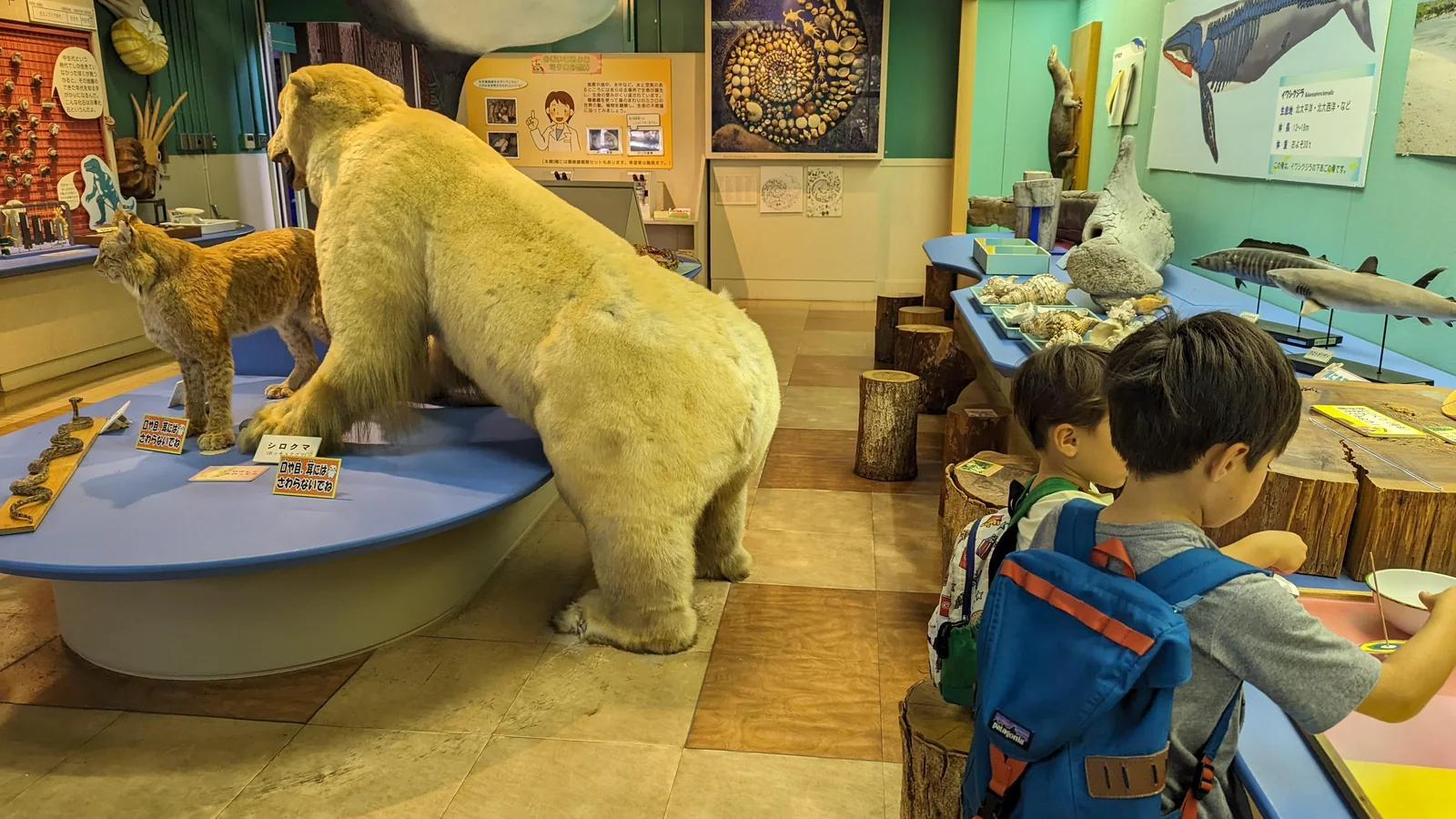
For the Anchor
Stops with confirmed, predictable structure.
For a child who depletes through unfamiliarity and unconfirmed structure, the strongest stops are the Museum of the Meiji Restoration and Sengan-en Garden.
The museum’s floor-by-floor thematic sequence is predictable in exactly the way an Anchor relies on: a clear order, English exhibit cards sufficient for a parent to narrate without a guide, and no improvised segments. Nearby Reimeikan, inside the Kagoshima Castle stone base, extends the same Satsuma-history theme with full-scale samurai armor at child eye level and a self-serve costume zone that runs without a queue on weekday mornings, removing the wait pressure that unsettles a routine-reliant child. A younger Anchor follows the confirmed floor order; an older one works the armor galleries and dress-up zone as the primary content.
Who it costs.The Sensor, mildly, when the exhibit halls concentrate school groups, though both buildings sit beside free outdoor castle-ground space that works as a decompression buffer.
How to make it work.Walk the floor sequence in order and confirm it to the child the night before, and use the costume zone at weekday opening before any group arrives.
If this isn’t your child: one of the more profile-compatible museum formats in regional Japan, and a strong wet-weather stop for any family.Sengan-en is a historic daimyo estate whose circuit follows a clear, engineered sequence of viewpoints with Sakurajima composed deliberately into the design, giving an Anchor a garden that reads as a confirmed route rather than an open wander. Kagoshima Shrine pairs with it as a second predictable-structure stop nearby: a fixed ritual sequence a routine-reliant child can anticipate. A younger Anchor follows three or four named viewpoints as a set sequence; an older one takes the full circuit knowing what comes next, with the quieter eastern bamboo path built in as a deliberate interval.
Who it costs.The Dynamo. The garden is designed for slow, observational movement and offers no discharge zones or open run space within the grounds.
How to make it work.Pair Sengan-en with an outdoor movement stop immediately after, not before, so a Dynamo does not enter carrying energy the garden cannot absorb.
If this isn’t your child: a genuinely beautiful estate with the best framed volcano views in the city, worth the visit for the setting alone.For the Sprinter
Short, low-stamina stops with little walking.
For a child who depletes through sustained walking and standing, the strongest stops are the Amuran Ferris Wheel and the Shiroyama Observatory.
The Amuran wheel sits on the roof of the complex directly above Kagoshima-Chuo Station, so it asks a low-stamina child for no trail, no exhibit to pace, and no walk from the platform, which is precisely why it suits a Sprinter. The city tram is the low-effort way to reach the station in the first place, a fixed short ride that spends no stamina. The enclosed gondolas remove weather as a variable. A younger Sprinter rides the short rotation without tiring; an older one gets the most from an evening slot, when the volcano silhouette against a low sun gives the ride a concrete focus.
Who it costs.The Sensor, mildly, when the rooftop and shopping complex below run busy at peak.
How to make it work.Fold it into a departure-day or schedule-gap slot that would otherwise be waiting time, and aim for golden hour for the volcano view.
If this isn’t your child: a quick, weatherproof 30-minute add-on that fills a gap between activities for any family.Shiroyama is one of the only free, unobstructed views that places the volcano within direct eyeline of the city, and the entire route from the parking lot to the viewpoint is flat and paved, which removes the physical entry cost that makes most elevated viewpoints conditional for a Sprinter. One short Satsuma-history stop folds in for older children who want more than a photo: the Cave of Saigo Takamori, the final refuge of the 1877 Satsuma Rebellion, sits at the foot of the hill. Kumaso Cave, tied to older Kumaso legend, is a longer drive out and worth it only for a family already deep in the history. A younger Sprinter reaches the view without a climb; an older one adds the cave at the base as a short, low-stamina detour.
Who it costs.The Sensor, at midday, when sun exposure and tourist concentration on the platform peak together.
How to make it work.Visit in late afternoon, when the cooling temperature reduces the heat that accelerates a Sprinter’s restlessness and the platform runs quieter.
If this isn’t your child: the best free volcano view in Kagoshima, worth the short trip up for the sight alone.Open with the child who runs short first.
The order of a Kagoshima day is set by Reserve, not by the map. Each route opens with the stop that protects the named child, then chains to the nearest compatible one.
Settle these first. Io World sells its tickets at the window on the day, so it can sit wherever the day needs an indoor stop. Sengan-en sells tickets on the day too, and a web ticket bought ahead skips the ticket-machine line. The Sakurajima ferry needs no reservation, only an eruption-advisory check. Everything else is walk-up fill-in.
When to go, and what costs nothing.
Ages 4 to 12 get the most complete experience across this guide, though the ferry, Io World, and Hirakawa Zoo serve toddlers well too. The free stops carry real weight here: the Sakurajima visitor areas and dinosaur park, the Shiroyama Observatory, and Ishibashi Memorial Park all cost nothing, and several are also the stops that protect a child’s Reserve best, so the free route and the calm route are largely the same route. Families with an extra day can add a side trip south to Ibusuki for the steam sand baths and Cape Nagasakibana, which sit outside the city and need a full day of their own.
Three bases that fit a family’s Reserve.
A shortlist chosen for location logic, not price tier. Where a base sits decides how much Reserve the day’s transit spends before the first stop.
| Property | The LuNi Reason | Budget |
|---|---|---|
| LUNI Pick Sheraton Kagoshima Above Kagoshima-Chuo Station | Sits directly on top of Kagoshima-Chuo, so the tram, airport bus, and Amuran wheel are reached with no street crossing or outdoor walk. For the Sprinter, whose Reserve drains through sustained walking, that vertical shortcut protects more than any amenity, and it gives an Anchor one fixed base. | ¥¥¥ |
| Solaria Nishitetsu Hotel Kagoshima Steps from Kagoshima-Chuo | A station-adjacent base at Kagoshima-Chuo, above the tram lines and under the Amuran wheel. The fixed, walk-everywhere position holds an Anchor’s routine across a multi-night trip and cuts transit reserve on a departure day. | ¥¥ |
| Shiroyama Hotel Kagoshima On the Shiroyama hillside | Set above the city on the Shiroyama hillside, not beside its transit. The elevated, self-contained setting keeps evening stimulation low for the Sensor, whose Reserve drains through sensory load, and the outdoor bath faces Sakurajima. It suits a family that recovers in the evening over one running on transit reserve. | ¥¥¥ |
Budget: ¥¥¥
Solaria Nishitetsu Hotel Kagoshima
Budget: ¥¥
Budget: ¥¥¥