Oita & Beppu With Kids:which stop is for which child.
- Best for Toddlers
- Umitamago, Funai Park, the Hells
- Getting There
- JR Sonic, about two hours from Hakata
- Oita or Beppu?
- Beppu is one stop before Oita
- Room to Move
- The Hell Tour and the African Safari
- In Oita City
- Oita Prefectural Art Museum
Some links on this page are affiliate links. LuNi may earn a commission at no extra cost to you.
Beppu with kids works best for toddlers at single-route stops with no reading or waiting in line: Umitamago aquarium, Oita Funai Park and the Hells. Beppu sits one stop before Oita on the JR Sonic, about two hours from Hakata. The Beppu Hell Tour circuit, the African Safari and the Yufuin stroll let an active child move; Umitamago and Inazumi Underwater Cave are the quieter visits. Neither the Safari nor Harmonyland has timed entry, and the Safari’s Jungle Bus is first come at the gate. Eleven stops in all, each mapped to the child it suits.
Which stop is for which child.
These stops are not ordered best to worst. They are grouped by which child each one is for. The reason is structural: Oita spreads its attractions across Beppu’s steaming hills, the inland valleys around Yufuin, and the calm of Oita City, and the stop that energizes one of your children is the stop that drains another. So instead of one list, you get four short ones, organized by how each child runs out of steam. The Dynamo runs short when they cannot move. The Sensor runs short on noise and unpredictable input. The Anchor runs short when nothing is confirmed. The Sprinter runs short on walking and standing. Find your child below, and start there.
For the Dynamo
Stops that relieve restricted-movement depletion.
For a child who depletes through restricted movement, the strongest stops are the Beppu Hell Tour circuit, the African Safari, and the Yufuin stroll.
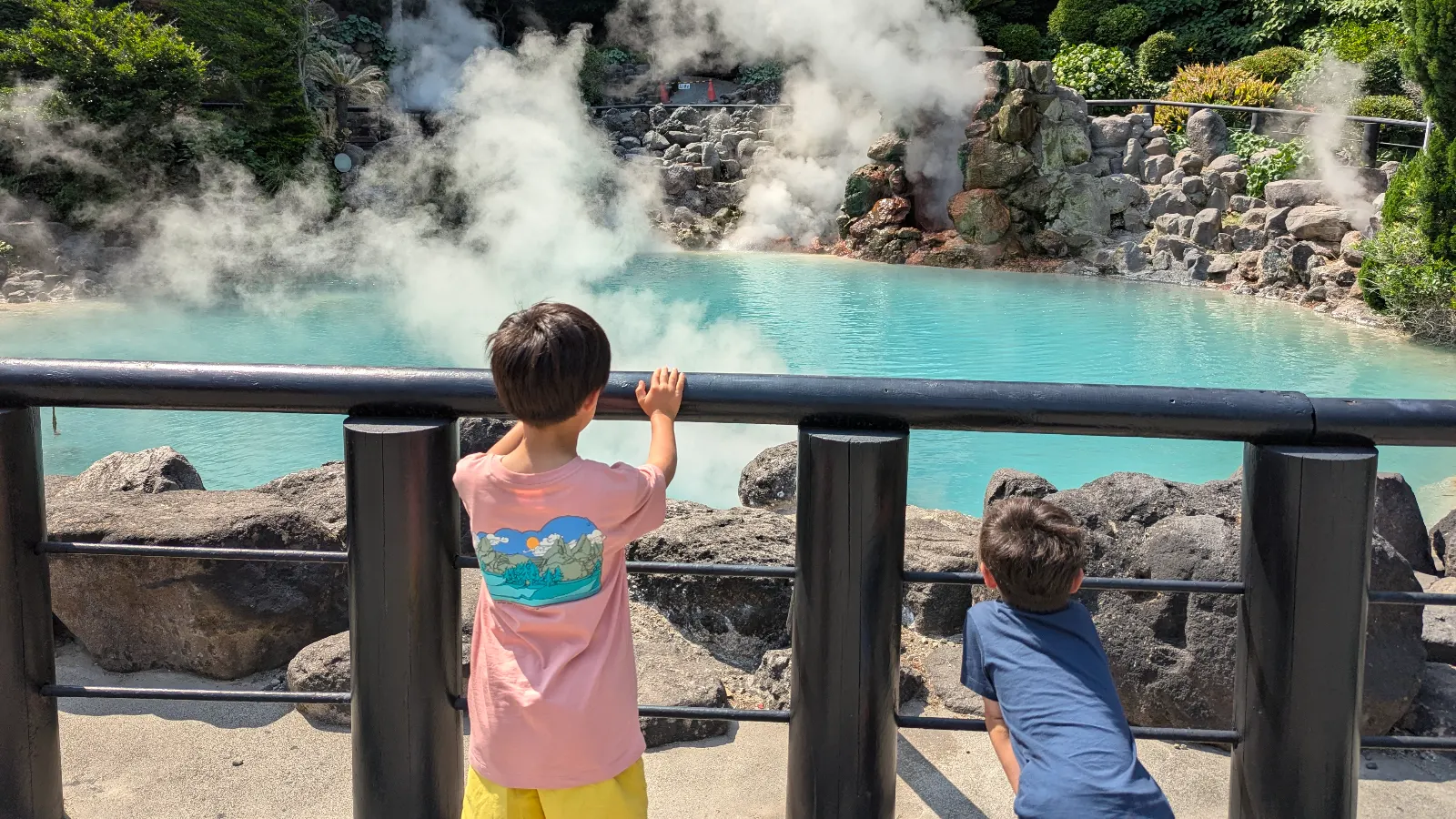
The Hells are walked, not toured, and for a movement-driven child that is the whole point: the circuit links seven steaming, vividly colored hot-spring pools across Kannawa on foot, so forward motion is the activity and restricted-movement depletion discharges instead of building behind a rope line. A cobalt pond, a blood-red one, a geyser on a timer, and the crocodile pool give a Dynamo a sequence of targets to move between. A younger Dynamo leads the family from gate to gate; an older one tracks down all seven and times the geyser.
Who it costs.The Sensor and the Anchor. The popular Hells are the densest, steamiest, most crowded stops in the area, with heat, sulfur smell, and no contained interior to retreat into between pools.
How to make it work.Walk the circuit on a cooler morning before the tour buses arrive, and treat the two or three best Hells as the goal rather than completing all seven, so the Dynamo gets the movement without the Sensor paying the full heat-and-crowd cost.
If this isn’t your child: still Beppu’s signature sight and worth one pass for the colors, just not a place to linger with a heat- or crowd-sensitive child. Beppu Park, a short distance away, offers open green space to discharge nearby.The Safari pairs a drive-through animal range with a hands-on petting zone and a feeding circuit, and it is that active, on-foot half that serves the Dynamo, not the drive. A movement-driven child depletes when held in place, so the value here is the walking petting area and the feeding task: a child who would unravel sitting still in a queue stays regulated when there is an animal to reach toward and a route to work through on their own legs. A younger Dynamo moves between the smaller animals and the feeding rail; an older one covers the full petting circuit and tracks which species appear in each range from the bus.
Who it costs.The Sprinter and the Sensor. The drive-through and the walking sections together make a long half-day, with sustained time on foot in the petting zone that a low-stamina Sprinter cannot bank, and the moving bus offers a sensory-sensitive child no quiet retreat once it sets off. It is also one of the more expensive stops in this guide.
How to make it work.Buy the Jungle Bus feeding slot at the entrance gate on arrival, since slots are first come, and go in the late morning when the Dynamo’s energy is highest, then put the seated drive-through first and save the walking petting zone for when a restless child most needs to be back on their feet.
If this isn’t your child: a genuine highlight for most families, but the cost and the half-day length make it a real commitment for a low-stamina child.Yufuin is a walkable hot-spring town strung along a single main lane that ends at Lake Kinrin, a small misty lake fed by warm springs. The whole stop is a stroll, which is exactly what a movement-driven child needs after a structured morning: open, self-paced walking with craft shops, snack stalls, and the Floral Village’s storybook lanes as moving targets along the way. A younger Dynamo runs the lakeside path; an older one navigates the lane and leads the family to the lake at the end.
Who it costs.The Anchor, mildly. The appeal is unstructured wandering rather than a confirmed route or a clear endpoint, which a child who needs a plan can find aimless.
How to make it work.Walk the lane in one direction toward Lake Kinrin as the named destination, so even the Anchor has a clear finish line, and fold in the Floral Village only if your child still has energy.
If this isn’t your child: a pretty, low-stakes half-day for any family, with the lake and the snacks carrying the visit even without a movement-led child.For the Sensor
Stops that let a sensory-loaded child recover.
For a child who depletes through sensory input, the strongest stops are Umitamago aquarium, Inazumi Underwater Cave, and Oita Funai Park.
Umitamago is built around dim, low-noise tank halls and a single continuous route, the conditions a sensory-loaded child needs to stay under threshold. The light is controlled, the ambient sound is low outside the dolphin show, and the touch pools let a child engage on their own terms rather than absorbing input they cannot turn down. A younger Sensor settles at the touch pool and the jellyfish tanks; an older one follows the route at their own pace and chooses when to take the open-air dolphin show, the one loud moment, on or off.
Who it costs.The Dynamo, mildly. The route rewards slow looking rather than large-motor movement, so a high-energy sibling needs the outdoor terrace as a discharge break.
How to make it work.Arrive at opening or in the last hour for the thinnest crowds, and chain Takasakiyama monkey park directly across the road, where wild macaques roam a hillside, as the Dynamo’s discharge half of the same trip.
If this isn’t your child: one of the easiest full visits in Oita for any family, fully stroller-accessible with ramps and nursing rooms, and a realistic two-to-three-hour stop.Inazumi is a cool, dim limestone cave with a slow boardwalk loop over still emerald water, one of the quietest, most controlled environments in the region. For a child who depletes through sensory input, the low light, the hush, and the absence of crowd compression make it a true recovery stop rather than another thing to absorb. A younger Sensor is held by the glowing water and the echo; an older one reads the cave’s geology and the rare fish that live in it.
Who it costs.The Anchor and the Dynamo. The footing is wet, uneven, and enclosed, which unsettles a child who needs confirmed, predictable structure underfoot, and the no-running, slow pace gives a movement-led child little to discharge.
How to make it work.Hold a young child’s hand on the wet walkways throughout and frame the visit as a short, contained reset of forty-five minutes, then move on before a restless sibling runs short.
If this isn’t your child: a genuinely unusual stop worth the inland drive from Oita City for the novelty, even for a family without a sensory-sensitive child.Funai Park is the quiet green grounds of Oita’s historic castle, with a small moat, old stone walls, and open lawns. Its value for the Sensor is the absence of input: no crowds, no noise, no demand, just space to sit and decompress between louder stops. A younger Sensor runs the lawns and looks for the stone walls; an older one walks the moat and pieces together how the castle once stood.
Who it costs.No profile heavily, which makes it a recovery stop rather than a destination. Its only real cost is opportunity: it does not fill a long block, so it works as a reset, not a half-day.
How to make it work.Slot it for thirty to forty-five minutes between two high-load stops, or in cherry-blossom or autumn-foliage season when the grounds are at their best.
If this isn’t your child: a free, central, calm green break for any family, and the most time-efficient reset in Oita City.For the Anchor
Stops that reward confirmed, predictable structure.
For a child who depletes through unfamiliarity and unconfirmed structure, the strongest stops are the Oita Prefectural Art Museum, Harmonyland, and Showa-no-Machi.
OPAM runs on exactly the kind of confirmed structure an Anchor needs: a clear gallery sequence, posted rules, and a dedicated hands-on kids’ space where the activity is defined rather than open-ended. A child who depletes when nothing is predictable can see the shape of the visit from the start, which keeps unfamiliarity from becoming a cost. A younger Anchor works the tactile kids’ zone; an older one follows the gallery route and the rotating exhibits with the visit’s order already settled.
Who it costs.The Dynamo. The museum rewards slow, contained looking rather than large-motor movement, so a movement-led sibling reaches their ceiling well before an Anchor does.
How to make it work.Tell the Anchor the plan before arrival, gallery first, kids’ space second, rooftop view to finish, and pair it with the open Funai Park afterward so a Dynamo sibling can discharge.
If this isn’t your child: a sleek, free-to-enter building with a rooftop city view that gives any family a calm ninety minutes, fully stroller-accessible.Harmonyland is a Sanrio theme park where the day runs on a posted schedule of parades, character meet-and-greets, and shows. For the Anchor that timetable is the appeal: a child who needs confirmed structure can anchor the visit to known showtimes rather than face an open, unpredictable park. A younger Anchor builds the day around the Hello Kitty parade and gentle rides; an older one tracks the show schedule and the seasonal events, with the structure doing the reassurance.
Who it costs.The Sensor and the budget. Parades concentrate music, crowds, and color into fixed windows that push a sensory-sensitive child toward threshold, and admission makes it one of the pricier stops here.
How to make it work.Go on a weekday or in an off-season month, print the show schedule in advance for the Anchor, and let a Sensor sibling skip the front row of the parade for the quieter perimeter.
If this isn’t your child: strongest for ages three to ten; most children above ten reach the ceiling of the gentle rides quickly, though the parades still land.Showa-no-Machi in Bungo-Takada is a preserved mid-century shopping street where the whole environment is fixed and legible: a single retro lane of old shopfronts, a small museum, and period displays. For an Anchor, the contained, unchanging setting is reassuring in a way a sprawling attraction is not, and the visit has a clear start and end. A younger Anchor is drawn to the old toys and candy shops; an older one reads the street as a window into a specific past.
Who it costs.The Dynamo and, on a hot day, the Sensor. There is little to physically discharge along the lane, and a movement-led child can exhaust it quickly.
How to make it work.Keep it to a focused hour built around the museum and one or two shops, and pair it with Usa Shrine nearby if an Anchor is enjoying the slower, structured pace of the day.
If this isn’t your child: a charming but niche stop; worth it on a route already heading north, less so as a dedicated trip with a restless child.For the Sprinter
Stops that limit sustained walking and standing.
For a child who depletes through sustained travel-style walking and standing, the strongest stops are the Beppu Ropeway and the Sand Bath at Hyotan Onsen.
The Beppu Ropeway carries families up Mount Tsurumi by cable car, which is precisely why it suits the Sprinter: the climb that would otherwise drain a low-stamina child is replaced by a seated ride to a panoramic summit. The reward, sweeping views over Beppu Bay and seasonal flowers, arrives without the sustained walking cost that defines this profile. A younger Sprinter counts the cities from the top; an older one takes the short, optional summit trails only as far as their Reserve allows.
Who it costs.The Sensor, mildly, on a crowded or windy day at altitude, and the Anchor if cloud cover makes the view (the whole point) uncertain.
How to make it work.Go on a clear day for the view, keep the visit to the summit deck and one short level path, and skip the steeper mountaintop trails, which have the uneven footing the cable car was meant to spare.
If this isn’t your child: a quick, high-reward stop for any family on a clear day, and one of the few summit views in Japan reachable without a climb.The sand bath is fully stationary: a child lies still while attendants bury them to the neck in naturally heated volcanic sand. For a Sprinter, that is the rarest thing on an active Beppu day, a genuine highlight that asks for no walking or standing at all, banking Reserve rather than spending it. An older child leans into the novelty of the warmth and the weight; the experience suits roughly age seven and up, where lying still for ten to fifteen minutes is realistic.
Who it costs.The Dynamo and younger children. A movement-led child cannot stay still long enough to feel the sand warm through, and under-sevens generally find the stillness and the heat too much.
How to make it work.Schedule it as a late-afternoon reset after a high-movement morning, and pair an older Sprinter’s bath with a younger sibling’s separate onsen time rather than expecting both in the sand.
If this isn’t your child: a memorable, unmistakably Beppu experience for an older child, but not a stop for toddlers or a child who cannot hold still.Open with the child who runs short first.
Oita’s stops are spread across Beppu, the inland valleys, and Oita City, so the order of a day is set by Reserve and by transit, not by the map alone. Each route opens with the stop that protects the named child, then chains to the nearest compatible one.
Settle these first. Two stops control the shape of the trip and should be settled before anything else. The African Safari sells its Jungle Bus slots at the gate, first come, and runs as a half-day inland, so it claims a whole day. Harmonyland runs on timed parades and shows, so it is best pinned to a confirmed weekday. Everything else, the Hells, the Ropeway, Umitamago, Funai Park, the sand bath, is walk-up fill-in arranged around those two. Getting in is straightforward: the JR Sonic Limited Express reaches Oita Station from Hakata in about two hours, with Beppu one stop before, while a rental car is the practical choice for the inland stops (the Safari, Yufuin, and Inazumi Underwater Cave).
Scenic add-ons for older kids who travel by car.
Three stops sit outside the Beppu, Oita City, and Yufuin core but reward a family willing to drive, and they suit older children who want a big view rather than an activity. The Kokonoe Yume Otsuribashi is one of Japan’s highest pedestrian suspension bridges, a short, dramatic crossing high above a wooded gorge. The Aso Sagiridai Overlook, in the wider Aso-Kuju area west toward Kumamoto, opens onto a broad volcanic panorama. Both are viewpoints rather than reserve-managed stops, so they fall outside the four-profile structure above: there is little to discharge and little to recover, only the view. Chain them with the Yufuin scenic stretch into a single driving day, and weigh them against a younger child’s tolerance for a long car journey before committing.
Three bases that fit a family’s Reserve.
A shortlist chosen for fit and location logic, not price tier. Each suits a different way a family runs short: one to discharge in, one to decompress in, one to settle into.
| Property | The LuNi Reason | Budget |
|---|---|---|
|
LUNI Pick
Suginoi Hotel
Resort base, discharge on site
|
A self-contained hilltop resort with a water park, arcade, bowling, and a nightly fountain show, so a Dynamo discharges on site without a second outing, while a free station shuttle spares the Sprinter the climb and the in-room calm lets a Sensor decompress after the Hells. | ¥¥¥ |
| ANA InterContinental Beppu Resort & Spa The quiet counterpart | The calm alternative to a busy resort: spacious modern rooms and a contained, low-stimulation feel make it the base for a Sensor or an Anchor whose Reserve runs short on noise, with full decompression away from the city and a short shuttle to Beppu Station. | ¥¥¥ |
| Amane Resort Gahama Beachfront, private baths | A beachfront ryokan-style stay with large suites and private-bath options, the Anchor’s base: beachfront calm, room to hold a routine across several nights, and the option of a private bath so a younger child never has to navigate a crowded communal onsen. | ¥¥¥ |
Budget: ¥¥¥
ANA InterContinental Beppu Resort & Spa
Budget: ¥¥¥
Budget: ¥¥¥