Sapporo With Kids:which stop is for which child.
- Indoors and in Winter
- Science Center, Shiroi Koibito
- Low-Cost Route
- Odori, the Snow Festival, Moerenuma
- Room to Move
- Odori Park and Es Con Field
- Snow Festival
- February only
- At Es Con Field
- A game or a booked tour slot
The activities and things to do through the year, from summer parks to the winter months, and how a family paces each one.
Some links on this page are affiliate links. LuNi may earn a commission at no extra cost to you.
Sapporo with kids has a stop for every season. The Sapporo Science Center and Shiroi Koibito Park hold up in the snow, and the Snow Festival runs in February only. Odori Park, Es Con Field and Shiroi Koibito Park let an active child move; the Science Center, the Sapporo TV Tower and the Ainu Culture Promotion Center are the quieter rooms; the Olympic Museum, the Hill of the Buddha and the Historical Village of Hokkaido give a child who wants the order settled a clear shape. Es Con needs a game or a booked tour slot, and Odori and Moerenuma make the low-cost route.
Which stop is for which child.
These stops are not ordered best to worst. They are grouped by which child each one is for. The reason is simple: Sapporo is a spread-out city of long winters and big distances, and the stop that energizes one of your children is the stop that empties another. So instead of one ranked list, you get four short ones, organized by how each child runs out of steam. The Dynamo runs short when they cannot move. The Sensor runs short on noise and crowds. The Anchor runs short when nothing is predictable. The Sprinter runs short on walking and standing. Find your child below, and start there. The framework that underpins this map, The LUNI Framework, treats that Reserve as the third currency of a trip, alongside money and time.
For the Dynamo
Stops that relieve restricted-movement depletion.
For a child who depletes through restricted movement, the strongest stops are Odori Park, Es Con Field, and Shiroi Koibito Park.
Odori is the green spine running through the center of the city, and for a movement-driven child it is the one central stop that returns Reserve rather than spending it. Open lawns, fountains, and long sightlines give a Dynamo sanctioned room to run between the indoor stops that hem them in. A younger Dynamo gets unbroken space on the flat central blocks, and an older one can walk the full length end to end without a single rope line or queue. In early February the park becomes the main site of the Sapporo Snow Festival, when the same blocks fill with carved snow sculptures and slides (free, and best early before the crowds), and in summer it carries flower beds and food stalls. For a Dynamo who needs even more room, the far larger Moerenuma Park on the city’s edge is the bigger version of this same discharge.
Who it costs.The Sprinter, mildly off-festival and more so during the Snow Festival, when the crowd density turns the open blocks into slow, shuffling walking with little seating.
How to make it work.Use Odori as the discharge stop between two indoor ones, and during the Snow Festival arrive early in the day before the central blocks fill.
If this isn’t your child: still the easiest free stroll in central Sapporo, and in February the single most spectacular thing in the city.Japan’s newest ballpark sits inside F Village, an open complex built to be wandered, and for a Dynamo that is the point. The outdoor PLAY FIELD lets a high-energy child run the bases and discharge before anyone sits down for a game, and the wider village (a rooftop park, playgrounds, an open-air foot bath) keeps movement available all day, game or no game. A younger Dynamo burns energy on the play structures; an older one can lap the village and the stadium concourses. It is a full-day stop on the city’s outskirts rather than a quick one.
Who it costs.The Sensor and the Sprinter. On a game day the stadium is loud and bright and the crowd is dense, and the village involves real walking distance with the stadium a trek from the gate, so a low-stamina child tires before the day is done.
How to make it work.For a movement-led visit, come on a non-game day when the PLAY FIELD and village are open but the sensory and walking load drops sharply, and book a stadium tour slot if you want inside.
If this isn’t your child: a genuinely impressive modern ballpark, worth a half-day even without a game on.The chocolate-themed park pairs a factory tour and cookie decorating with outdoor grounds, a fairy-tale courtyard, and seasonal winter illuminations, and a Dynamo gets to move between all of it rather than sit through one fixed exhibit. The grounds give a younger Dynamo room to roam between activities, and the hands-on cookie workshop gives an older one something to do with their hands rather than a queue to stand in.
Who it costs.The Sensor and the Sprinter, both at Caution. On peak days the indoor sections crowd and the aromas and displays concentrate, and the full grounds-plus-factory circuit is more walking than it first looks.
How to make it work.Go on a weekday and start outdoors in the grounds before the indoor factory floor fills, so the Dynamo moves first and the Sensor meets the crowd later or not at all.
If this isn’t your child: a charming, sweet-toothed half-day, just busier and more walking-heavy than it appears from the gate.For the Sensor
Stops that let a sensory-loaded child recover.
For a child who depletes through sensory input, the strongest stops are the Sapporo Science Center, the Sapporo TV Tower, and the Ainu Culture Promotion Center.
The Science Center is hands-on without being overwhelming: spaced exhibits, predictable indoor light, and a planetarium whose dimmed, slow-paced show works as an outright sensory reset in the middle of a busy day. For a child whose threshold is spent by crowds and cold-weather layering, it is the indoor stop where input drops and the visit can continue. A younger Sensor settles at the interactive stations at their own pace; an older one follows the space and robotics exhibits without a soundtrack of competing noise. The quieter, lesser-known Sapporo Sewage Science Museum is an even calmer alternative for the same need, and the Chi-Ka-Ho underground walkway lets a sensory-sensitive family reach the center from Sapporo Station without facing the winter street at all.
Who it costs.The Dynamo, mildly. The browse-and-observe format offers little discharge, so pair it with a movement stop rather than stacking two still ones.
How to make it work.Use the planetarium show as the planned reset between two louder stops, so the Sensor refills before the next demand on their Reserve.
If this isn’t your child: a strong rainy-or-snowy-day indoor stop for any family, with the planetarium worth the visit on its own.The observation deck above Odori Park is a contained, glassed-in space with a single clear payoff: the whole city, the snowy mountains beyond, and in February the Snow Festival sculptures laid out in a ribbon below. For a Sensor, the enclosed deck is a controlled high view, with the spectacle on the far side of the glass rather than pressing in around them. A younger Sensor takes in the view from a fixed spot; an older one picks out landmarks at their own pace. It is a short, low-demand stop that pairs naturally with the park below.
Who it costs.The Dynamo, at Caution. The deck is a stand-and-look stop with no room to move, so a movement-driven child empties quickly if it runs long.
How to make it work.Keep it short and time it for sunset or after dark, when the city lights make the single fixed view worth the still minutes it asks for.
If this isn’t your child: the best quick overview of the city’s layout, and a genuinely good view after dark.Also known as Sapporo Pirka Kotan, this center introduces families to the traditions of the Ainu, Hokkaido’s Indigenous people, through a calm, well-spaced indoor circuit of crafts, clothing, and music. For a Sensor it reads as a low-stimulation environment with predictable sightlines and quiet rooms, the opposite of a loud attraction. A younger Sensor looks closely at the textiles and tools; an older one engages with the history and, when offered, the hands-on carving or embroidery sessions.
Who it costs.The Dynamo, at Caution. The format is observe-and-listen with little to no room to move, so a high-energy child needs a discharge stop chained to it.
How to make it work.Check ahead for weekend demonstration or workshop times, so an older child gets the hands-on element that turns a quiet visit into an active one.
If this isn’t your child: a meaningful, quiet cultural stop that rewards a slower pace, though it asks for patience from a restless child.
For the Anchor
Stops with confirmed, predictable structure.
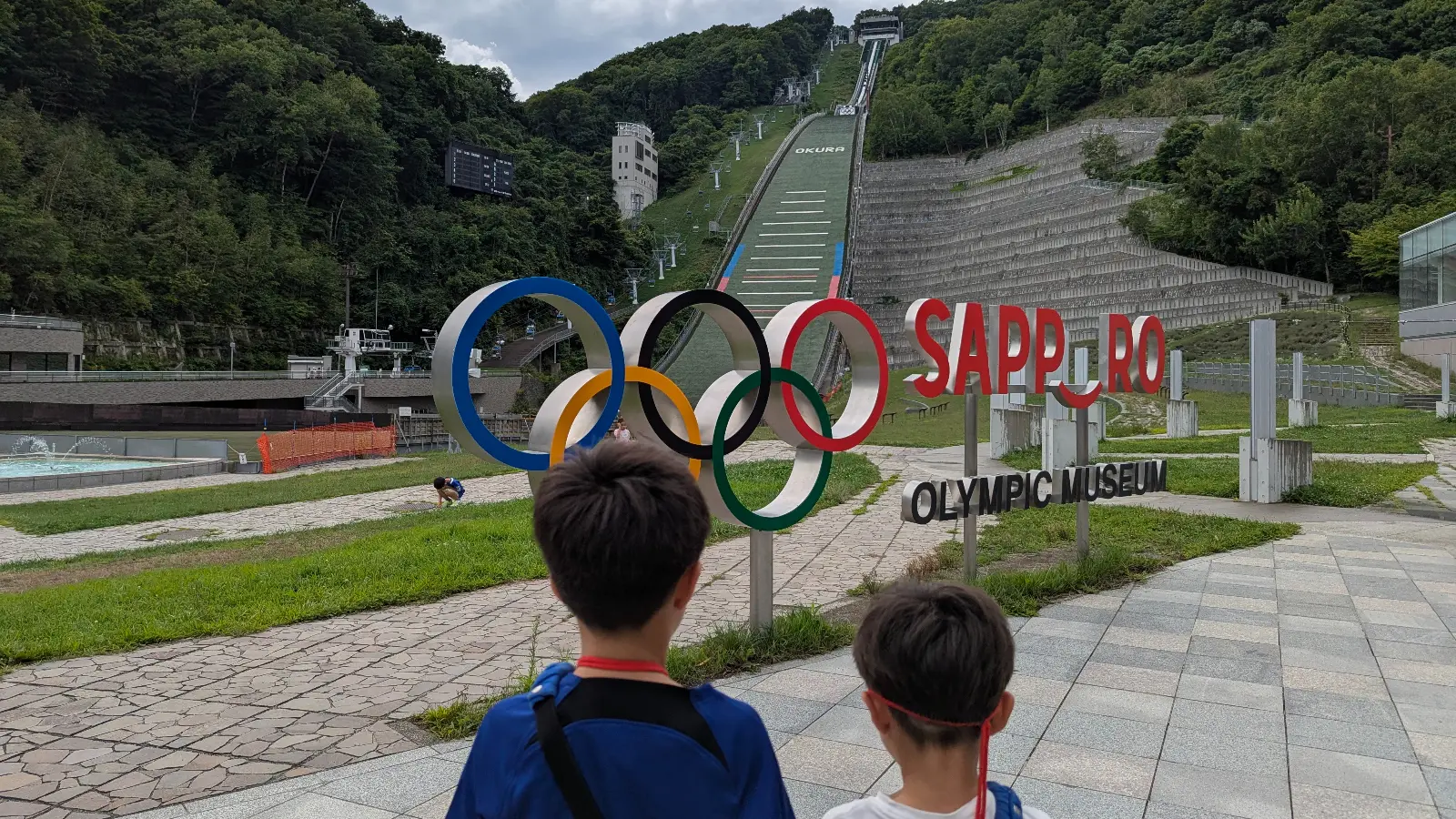
For a child who depletes through unfamiliarity and unconfirmed structure, the strongest stops are the Sapporo Olympic Museum, the Hill of the Buddha, and the Historical Village of Hokkaido.
Beside the Okurayama Ski Jump, this museum runs on a fixed, signposted circuit of simulators: virtual ski jumping, bobsled, and biathlon, each a clearly defined turn with a clear start and finish. For an Anchor, that confirmable sequence is exactly the structure they need, with nothing about the visit improvising. A younger Anchor is reassured by the one-after-another order of the activities; an older one knows what each simulator asks before they step up to it. The Okurayama lift to the jump platform adds a second fixed up-and-down with a major view.
Who it costs.Little, in Reserve terms. The cost here is practical: it sits outside the center, so it draws down time and travel rather than any one profile’s Reserve.
How to make it work.Come in the morning before the simulators draw a queue, and combine it with the Okurayama lift so the trip out of the center earns a full stop.
If this isn’t your child: a hands-on, genuinely fun stop for any family, with the ski-jump view a payoff on its own.Tadao Ando’s design leads visitors along a single set path, through a long tunnel, to the gradual reveal of a great stone Buddha ringed by lavender in summer and snow in winter. For an Anchor, the confirmed one-way sequence (you know the walk, the tunnel, and the reveal are coming in that order) is its own reassurance, a calm, structured build to a clear payoff. A younger Anchor follows the obvious single route without choices to weigh; an older one anticipates the reveal they have been told is at the end.
Who it costs.The Sprinter, at Caution. The approach is a sustained flat walk with limited seating, and the site sits well outside the center, so a low-stamina child arrives already spent.
How to make it work.Plan it as a half-day given the distance from the center, and pace the approach walk with a rest before the tunnel so the reveal lands rather than exhausts.
If this isn’t your child: a quietly powerful piece of architecture, worth the trip out for the reveal alone.This open-air museum recreates Hokkaido’s pioneer era across more than sixty relocated historic buildings, laid out as walkable old-town streets you move through in order: schools, shops, farmhouses, each one enterable and explained. For an Anchor, the museum’s clear map and self-contained buildings give a predictable, confirmable structure to a large site. A younger Anchor moves building to building with a visible next stop always in view; an older one reads the history at each one. The adjacent Hokkaido Museum pairs naturally as the indoor, climate-controlled companion to the open-air village.
Who it costs.The Sprinter, at High Risk. This is a large, spread-out, full-day site with long distances between buildings and real walking throughout, the single hardest stop in the city for a low-stamina child.
How to make it work.Take the in-park horse-drawn streetcar or sleigh to cut the walking distance, and treat it as a half-to-full-day stop rather than one squeezed between others.
If this isn’t your child: a vivid, immersive history stop, as long as the walking distances are planned for rather than discovered on arrival.For the Sprinter
Short, low-stamina stops with little walking.
For a child who depletes through sustained walking and standing, the strongest stops are the Mt. Moiwa Ropeway, Nijo Market, and Maruyama Zoo with a short route.
Mt. Moiwa delivers one of Japan’s best night views with almost no walking: a cable car and a short mini-cable lift carry the family from base to summit, where the observatory deck is a few level steps from the top station. For a Sprinter, the ride is the stop, a major payoff that costs their legs almost nothing. A younger Sprinter watches the city drop away from a seat; an older one picks out landmarks and the glowing TV Tower far below from the deck. It is the cleanest low-stamina stop in the city.
Who it costs.Little, in walking terms. The practical cost is timing and weather: it is an evening trip, it gets cold and breezy at the summit, and clear nights matter for the view.
How to make it work.Go near sunset to catch both the daylight panorama and the lights, and pack a warm layer even in summer for the exposed summit deck.
If this isn’t your child: the best night view in Sapporo, worth the ride up for the panorama alone.This compact central market is a short, contained food stop a Sprinter can take in without a long walk: a single covered run of stalls selling Hokkaido seafood, grilled snacks, and fresh produce, all reachable in a few minutes on foot. For a low-stamina child it is a quick, sensory-rich stop that asks almost nothing of their legs and rewards them with something to eat. A younger Sprinter samples a snack and moves on; an older one browses the stalls. The Sapporo Beer Museum, in its restored red-brick hall with a mostly seated tasting and garden, is the other low-stamina, low-walk option nearby.
Who it costs.The Sensor, mildly. A busy market run is close-packed and full of competing smells and noise at peak, so a sensory-sensitive child does better in a quieter window.
How to make it work.Go in the morning when the market is freshest and least crowded, and keep it to a single short pass rather than a long browse.
If this isn’t your child: a quick, tasty central stop that folds easily into any route through the center.Maruyama Zoo is one of Japan’s more walkable family zoos, with polar bears, penguins, and red pandas in a tree-lined setting and frequent indoor habitats and rest areas along the way. For a Sprinter, the trick is to treat it as a short defined loop rather than the whole grounds: chosen well, a route past the cold-weather animals and the indoor houses keeps the walking modest with seating and warm-up stops built in. A younger Sprinter does a compact circuit of the headline animals; an older one can extend it only as far as their stamina holds, with rest points always close.
Who it costs.The Sprinter themselves, if the visit sprawls. A full circuit of the entire hillside grounds is a real walk, so the cost is in over-ambition rather than the stop itself.
How to make it work.Pick a short loop in advance (the polar bears and the indoor houses), and plan to leave when it is done rather than completing the whole map.
If this isn’t your child: a pleasant, well-kept zoo for any family, as long as a low-stamina child is given a route rather than the whole hill.Open with the child who runs short first.
The order of a Sapporo day is set by Reserve, not by the map. Each route opens with the stop that protects the named child, then chains to the nearest compatible one.
Settle these first. The full-day outliers control the shape of a Sapporo trip more than the central stops do: Es Con Field, the Historical Village, and the Hill of the Buddha each sit outside the center and want a half-day or more, so anchor one to its own day rather than chaining it to others. Everything central (Odori, the TV Tower, the Science Center, Nijo Market) arranges easily around those.
When to go, and what costs nothing.
Season decides more in Sapporo than in most Japanese cities. Winter, December to February, is the city at its most magical, with snow play and the early-February Snow Festival, but it is also when walking is slowest and the Sprinter’s Reserve drains fastest underfoot. Summer opens the parks, lavender, and the easiest walking conditions of the year. Whatever the season, the indoor anchors hold: the Sapporo Science Center, the quieter Sapporo Sewage Science Museum, and Shiroi Koibito Park stay good in any weather, and the Chi-Ka-Ho underground walkway crosses the center without going outside. The free stops carry real weight here too: Odori Park, the Snow Festival, and Moerenuma Park all cost nothing, and they are also among the stops that protect a child’s Reserve best, so the low-cost route and the calm route are largely the same route.
Three bases that fit a family’s Reserve.
A shortlist chosen for location logic, not price tier. Each one protects a different currency of the trip.
| Property | The LuNi Reason | Budget |
|---|---|---|
| LUNI Pick JR Tower Hotel Nikko Sapporo On top of Sapporo Station | The reason to book this is the vertical connection: it sits directly above Sapporo Station. For the Sprinter, whose Reserve drains through the sustained walking and standing a spread-out snow city demands, going from room to platform without stepping onto ice is worth more than any amenity in the building. A top-floor onsen adds same-building recovery at the end of a long day. | ¥¥¥ |
| La’gent Stay Sapporo Odori At Odori Park | Bases the family at Odori, the central spine and home of the Snow Festival and the winter illuminations. For the Dynamo, whose Reserve drains through restricted movement, the discharge stop is downstairs rather than a subway ride away, so a movement-driven child starts and ends the day with room to run. | ¥¥ |
| Keio Plaza Hotel Sapporo Near the station | Large family rooms and several in-house restaurants near the station. For the Anchor, whose Reserve drains through unfamiliarity and unconfirmed structure, the room to spread out plus reliable on-site meals confirm the day’s base without sending a settling family back out into an unfamiliar city for dinner. | ¥¥¥ |
Budget: ¥¥¥
Budget: ¥¥
Budget: ¥¥¥
The questions parents actually ask.
Is Sapporo good for families with kids?
Yes. Sapporo is one of Japan’s most family-workable cities, with a clean subway, wide sidewalks, and a compact central core around Odori Park. What sets it apart is variety across the four profiles: open parks for a movement-driven child, navigable indoor museums for a sensory-sensitive one, and predictable, structured venues for a child who needs to know what comes next. The one currency it spends hard is the Sprinter’s, because the strongest stops are spread across the city and winter adds snow underfoot.
What are the best indoor activities in Sapporo for kids?
The Sapporo Science Center is the standout: hands-on, navigable, with a planetarium that doubles as a calm reset. The Sapporo Sewage Science Museum is a quieter, under-the-radar alternative that reads well across all four profiles. Shiroi Koibito Park puts a chocolate-factory tour and cookie decorating under one roof, though it crowds on peak days. The Chi-Ka-Ho underground walkway between Sapporo and Odori stations lets a family cross the center in winter without stepping outside.
When is the best time to visit Sapporo with kids?
It depends on what your family wants. Winter (December to February) is Sapporo at its most magical, with snow play and the Sapporo Snow Festival in early February, but it is also when the city is coldest and walking is slowest. Summer (June to August) opens the parks, lavender, and outdoor festivals with the easiest walking conditions. Spring and autumn are mild and quieter. The indoor stops hold their value in every season.
Is Sapporo stroller-friendly for families?
In the warmer months, yes. Odori Park, Maruyama Zoo, and the area around Sapporo Station have wide, level paths, and most public buildings have elevators or ramps. Winter changes the math: packed snow and ice make a stroller hard work, and a lightweight carrier is often easier for a younger child. The Chi-Ka-Ho underground walkway is a flat, weather-protected option for crossing the center.
How do you get from New Chitose Airport to Sapporo with kids?
The JR Rapid Airport train runs from New Chitose Airport to Sapporo Station in about 37 to 45 minutes and is the easiest option for most families. Airport buses serve major hotels directly and suit families with a lot of luggage. A child who depletes through sustained sitting or unfamiliarity does better on the train, where the route is fixed, frequent, and short.
What should kids wear in Sapporo in winter?
Sapporo winters sit below freezing for long stretches, so waterproof boots with grip, thermal base layers, a thick insulated jacket, and gloves or mittens are the baseline. Add a hat and a scarf or neck warmer for outdoor stops. For the Snow Festival or any extended snow play, snow pants keep a child comfortable enough to actually enjoy it rather than cut the stop short.
What are the best day trips from Sapporo with children?
Otaru, with its canal and glass workshops, is the easiest and most popular. Asahikawa pairs Asahiyama Zoo with the wider Furano and Biei flower country in summer. Noboribetsu offers hot springs and a bear park. Each is its own destination with its own pacing, so we cover them in dedicated guides rather than fold them into a Sapporo city day.