
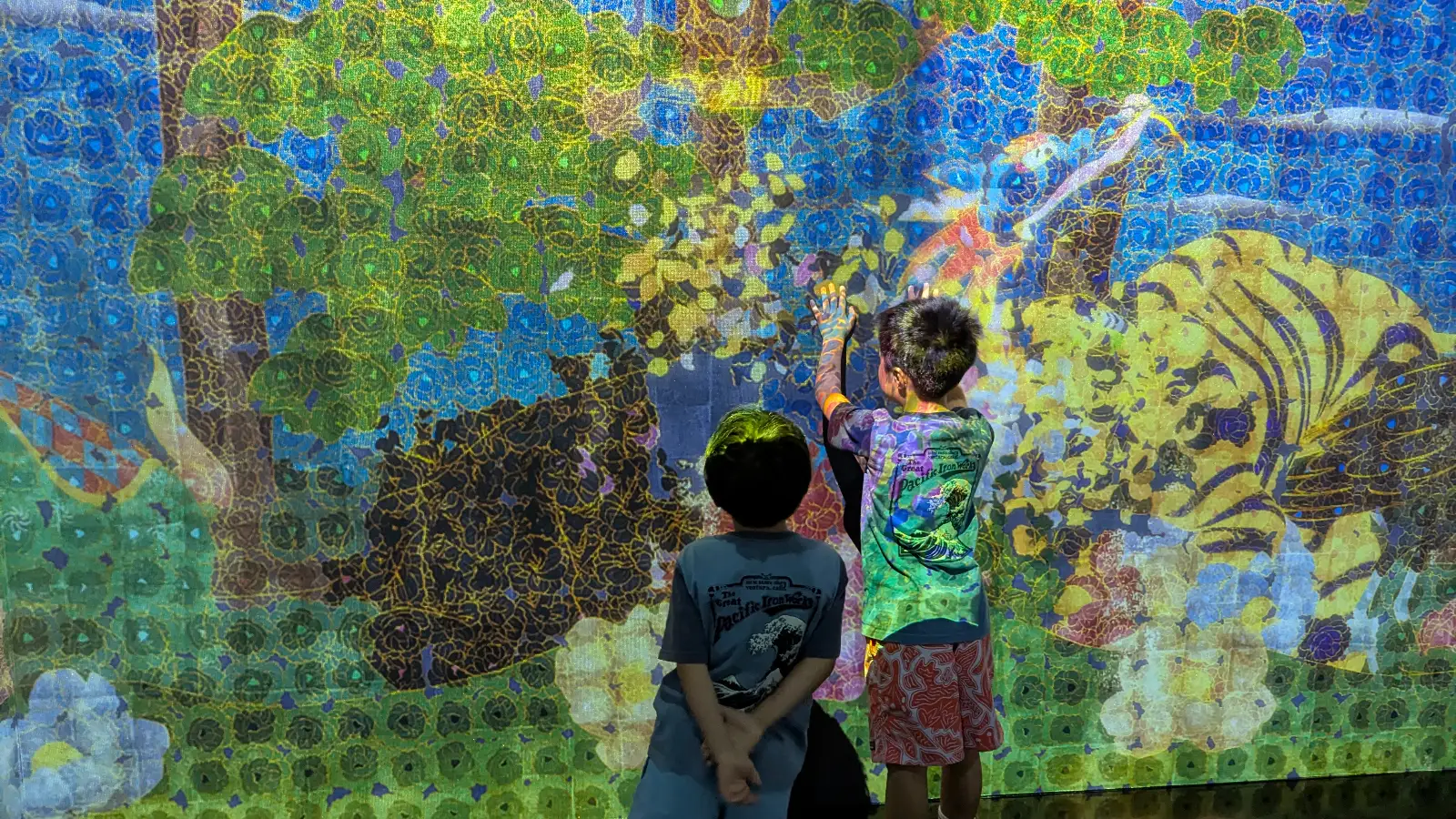
Parents researching Tokyo often wonder whether teamLab Borderless is worth visiting with kids, especially given its reputation as one of Japan’s most immersive digital art museums. While families frequently hear that the museum is family-friendly and “worth it,” parents still rightly question how their own children will react to the dark, glowing, and constantly shifting spaces.
Because every child experiences sensory environments differently, it is natural to ask whether teamLab Borderless is truly suitable for babies, toddlers, or teens before adding it to your itinerary. This family-focused breakdown shares the honest pros, cons, age-specific guidance, and better alternatives so you can decide if teamLab Borderless is truly worth it for your kids.
Wondering, “Is Tokyo worth visiting with kids?” Start there to see if the city is the right fit for your family!
Once you’re ready to plan, begin with our Tokyo Family Travel Guide for the essentials on where to stay, how to get around, and what to eat. Then visit the Tokyo with Kids Hub to explore all our Tokyo guides, attractions, and age-specific tips in one place.
For even more ideas, browse our Ultimate Guide to Family Attractions in Japan with Kids for the top castles, shrines, museums, aquariums, and theme parks.
Is teamLab Borderless Worth Visiting with Kids? (Quick Answer)
Yes, teamLab Borderless is worth visiting with kids if your family has school-age children or teens who enjoy sensory, artistic, and highly interactive experiences. The open-ended galleries and responsive digital art can feel magical for kids who are comfortable navigating dim, immersive environments filled with light, sound, and motion.
However, teamLab Borderless is not a good fit for babies, toddlers, or sensory-sensitive children, as the dark pathways and unpredictable visuals can quickly become overwhelming. When matched with the right age group and temperament, it can be unforgettable, but it’s not an experience that works equally well for every family.
Planning a visit? Explore our full guide to teamLab Borderless for tips on the best time to go, stroller access, what to expect with kids, and nearby family-friendly stops.
Why Families Consider Visiting teamLab Borderless with Kids
Families are drawn to teamLab Borderless because it’s one of Tokyo’s most iconic modern attractions, a fully immersive world of shifting lights, interactive digital art, mirrored pathways, and sensory surprises around every corner. Parents often imagine how magical it might feel for kids to step into rooms where flowers bloom across the walls or galaxies swirl at their feet, making it a uniquely captivating stop during a Japan trip. The combination of visual wonder, movement-based interactivity, and creative storytelling naturally sparks curiosity about how children of different ages might respond.
The Family Fit Reality
Researching the endless details of a Japan family trip, from figuring out what to pack to managing your daily yen budget, is a massive undertaking that requires careful logistical preparation.
But here is the hidden trap most parents miss: all the practical preparation in the world won’t save your trip if your entire vacation hinges on the hope that “everyone will just cooperate”. If your plan collapses the moment someone gets overstimulated, it is built on hope, not capacity.
Removing the stress from this trip requires understanding exactly how your child processes a foreign environment. An Anchor needs you to pack specific familiarity tools to feel safe, and a Sensor needs you to plan for sensory overload before it happens. A Sprinter requires a strict physical energy budget to prevent exhaustion, while a Dynamo needs you to rewrite the standard rules of travel so they aren’t constantly being shushed in a culture that rewards stillness.
Stop guessing and discover exactly how your child’s energy is wired to travel. Before you finish your general planning, take the free, 60-second Family Fit Check to identify your family’s exact profile and unlock the personalized strategies that prevent daily meltdowns.
Pros of Visiting teamLab Borderless with Kids
- Immersive digital rooms that react to movement, making kids feel like part of the artwork.
- High “wow factor” visuals, glowing tunnels, floating lanterns, and blooming flowers that amaze school-age kids and teens.
- Interactive spaces encourage exploration, curiosity, and playful movement.
- Memorable family photos thanks to vibrant colors and dramatic lighting.
- A rare fusion of art and play, offering older kids a creative experience they won’t find anywhere else.
Cons of Visiting teamLab Borderless with Kids (Important for Parents)
- Dark, maze-like rooms can overwhelm babies, toddlers, or kids who dislike unfamiliar environments.
- Strong sensory elements (sound, light, reflections) may overstimulate sensitive children.
- Consistent crowds make movement slower and reduce personal space, especially on weekends.
- No strollers allowed, which makes visiting challenging for families with infants.
- Navigation is intentionally disorienting, which may increase anxiety for younger children.
- Some rooms have uneven or mirrored floors, requiring very close supervision.
Why “Is It Worth It?” is a Tricky Question
One parent calls teamLab Borderless “a magical world of discovery,” while another calls it “a dark, crowded maze of anxiety.” Both are right: the difference isn’t the art, it’s the child. Using our Family Fit framework, these very different reactions become easier to predict:
- The Dark Mazes: A Dynamo thrills at the freedom to explore the “borderless” map and the permission to interact physically with the art, while an Anchor may feel deeply unsettled by the disorienting lack of signage, the darkness, and the absence of a clear, predictable path back to safety.
- The Sensory Intensity: A Sensor is at high risk of rapid overwhelm due to the intense combination of loud soundscapes, flashing LEDs, and mirrored floors, whereas a Sprinter may struggle physically with the uneven terrain and the inability to use strollers or find seating in the crowded corridors.
Knowing your child’s travel profile helps you predict which review you will write.
60-second Quiz to Discover Your Child’s Travel Profile
Who Will Enjoy teamLab Borderless with Kids (By Age Group)
- Toddlers: Often overwhelmed by darkness, crowds, and unpredictable visuals. A short, carefully guided visit might work for confident toddlers, but many may feel uneasy.
- Preschoolers (3–5): Some enjoy the colors and movement, but others may cling tightly due to the dim spaces and loud soundscapes. Works best for children who adapt well to sensory environments.
- School-Age Kids (6–10): Typically the ideal age group, curious, brave, and excited by interactivity. They can explore rooms more independently and appreciate the playful aspects of the art.
- Older Kids & Teens: A perfect match. Teens especially love the immersive visuals, creative storytelling, and highly photogenic rooms that make the experience memorable.
Who Should Skip teamLab Borderless with Kids (Honest Considerations)
- Families with babies, toddlers, or children who are sensitive to darkness, noise, or visual intensity.
- Kids who need open play spaces rather than navigational, maze-style environments.
- Families who dislike crowds or find tightly packed indoor attractions stressful.
- Anyone visiting during peak travel seasons who prefers calmer, predictable experiences.
- Families with limited mobility needs, since the dark, uneven, and reflective floors require constant careful movement.
Best Alternatives to teamLab Borderless for Families with Kids
- teamLab Planets Tokyo — A more tactile, movement-based digital art experience where families wade through water, making it especially fun and manageable for school-age kids and curious preschoolers.
- Sumida Aquarium — A calm, stroller-friendly indoor attraction inside Tokyo Skytree that works beautifully for babies, toddlers, and sensory-sensitive kids who may find Borderless overwhelming.
- Miraikan (National Museum of Emerging Science) — A hands-on, interactive science center that keeps kids engaged through robotics, space exhibits, and immersive tech, ideal for school-age children and teens.
- Tokyo Toy Museum — A wonderful choice for families with toddlers or young children who thrive with open-ended, wooden, tactile play rather than dark, sensory-heavy environments.
- Ueno Zoo — A spacious, movement-friendly alternative offering animals, outdoor play, and fresh air, great for families who prefer a slower, more predictable day outside digital stimulation.
Parent Insight: Experiences like digital art museums remind us that children process the world through emotion, movement, and curiosity long before they understand the meaning behind what they see. When parents follow their child’s cues, stepping back when they feel overwhelmed or letting them linger when wonder takes over, travel becomes less about checking boxes and more about nurturing confidence, resilience, and self-discovery.
Final Recommendation – Is teamLab Borderless Worth It with Kids?
TeamLab Borderless is worth it for families with school-age kids and teens who enjoy sensory experiences, artistic environments, and interactive digital play. It may be less worth visiting with babies or toddlers, who often struggle with the darkness, crowds, and intensity. Families get the best experience when visiting with children who feel comfortable exploring immersive spaces at their own pace. If your kids enjoy creative, visually rich environments, Borderless can be a memorable highlight of your Tokyo trip.
What to Do Next: Planning a Tokyo Trip That Actually Fits Your Family
Start with the Big Picture
• Tokyo Family Travel Hub
• Tokyo Family Travel Detailed Guide
• Tokyo Neighborhoods for Families
Design the Right Pace
• 3-Day Tokyo Family Itinerary
• Best Things to Do in Tokyo with Kids
• Attractions Worth Visiting with Kids Hub
Choose Your Base Camp
• Best Family Hotels in Tokyo
• Ueno, Asakusa, Shibuya & Odaiba hotel guides
• Best Family Hotels in Japan
Compare Cities Across Japan
• Plan Your Japan Family Trip
• Japan Family Travel Hub
• Destinations Worth Visiting with Kids Hub
FAQs: Is teamLab Borderless Worth Visiting with Kids?
Parents searching for whether teamLab Borderless is worth visiting with kids often want clear guidance on age suitability, sensory comfort levels, and whether the experience is truly family friendly before deciding to go.
A: TeamLab Borderless can feel overwhelming for some kids because of its dark rooms, shifting lights, and immersive soundscapes. Children who are sensitive to sensory input may find teamLab Borderless intense, while bolder school-age kids often adapt quickly. For families unsure about overstimulation, it’s helpful to prepare kids for what the environment will feel like.
A: TeamLab Borderless is not always ideal for toddlers, who may struggle with the darkness, mirrors, and unpredictable visuals. While some toddlers enjoy the colors and motion, many find teamLab Borderless confusing or scary, making it less consistently enjoyable for this age group. Parents who prefer calmer, predictable spaces may want a more toddler-friendly alternative.
A: For most families, teamLab Borderless is not worth visiting with babies, since infants cannot fully engage with the artwork and may react negatively to the loud and shifting environment. Babies often find teamLab Borderless too intense, and the sensory load can be uncomfortable. Families with infants typically have a better experience choosing a quieter, gentler attraction.
A: Yes, teamLab Borderless is great for school-age kids who enjoy exploring new environments and reacting to interactive art. Children in this age group often find teamLab Borderless exciting rather than intimidating, making it a strong fit for curious and adventurous learners. The immersive rooms provide just the right blend of creativity and discovery.
A: TeamLab Borderless is absolutely worth it for teens, who usually enjoy the visual drama, interactivity, and photo opportunities. Teens often engage deeply with the more artistic elements, making teamLab Borderless one of Tokyo’s most memorable stops for older kids. It’s especially appealing for creative or tech-interested teens.
A: TeamLab Borderless can be family friendly, but sensitive kids may find certain rooms overwhelming due to the intense lights and unfamiliar darkness. For children who prefer calm or predictable environments, teamLab Borderless may feel challenging rather than enjoyable. Families with sensitive kids often do better when they prepare them ahead of time or choose a gentler alternative.
A: Some younger kids may find teamLab Borderless scary because of its dark pathways, mirrored floors, and sudden visual changes. While many children enjoy the excitement, others feel uncertain in unfamiliar sensory environments, making teamLab Borderless a mixed experience for this age group. Parents who know their child prefers bright, open spaces should keep this in mind.
A: Yes, teamLab Borderless is very engaging for older kids, who tend to appreciate the interactive artwork, complex visuals, and freedom to explore. Many older children feel energized by the sensory-rich environment, making teamLab Borderless one of the most memorable attractions for this age group. It especially resonates with creative or tech-curious kids.
A: teamLab Borderless can feel dark, bright, or overstimulating for some kids, especially in rooms with intense LEDs, mirrored floors, or atmospheric haze. Sensitive children may do best with morning time slots, which are quieter and easier to navigate at a slower pace.
Stay curious, stay adventurous, and keep dreaming!
~ The LuNi Travels Family ~